My favorite moment from the entire URKL Robot Fight!
One brutal kick sent the robot's head hanging loose. and it somehow kept fighting like nothing happened!
I completely lost it. Had to lower down the volume of my laugh 😂😂
Zambians to celebrate 🙌🏾🇿🇲
Monica Musonda, founder and CEO of Java Foods, is one of Zambia’s most respected business leaders. Her journey from corporate law to food manufacturing is often described as bold—but when you listen to her speak, what stands out most is honesty. She does not romanticise entrepreneurship. She tells it as it is.
This article brings together a few of her most impactful quotes from her many interviews woven into the story of how she thinks about business, leadership and failure.
1. Leaving Comfort to Build Purpose:
Monica Musonda has often explained that entrepreneurship was not an escape, but a calling. “I did not leave law because I hated it; I left because I felt called to build something bigger.”
2. She has also been clear that passion alone is not enough.
“Entrepreneurship is not glamorous. It is hard, lonely, and full of setbacks.”
For her, purpose must be matched with endurance.
“You must be prepared to stay the course long after the excitement has worn off.”
3. On Failure, Fear, and Resilience.
Java Foods’ success today hides the reality of how close the company came to collapse.
“There were many moments when Java Foods could have failed, and we came very close.”
Instead of denying fear, she acknowledges it.
“Courage is not the absence of fear; it is continuing despite it.” Failure, she insists, is not the enemy.
“Failure is part of the journey. What matters is how quickly you learn and adapt.” And resilience is not dramatic—it is repetitive.
“Resilience is waking up every day and choosing not to quit.”
Monica Musonda’s words reflect a leader who understands both vision and sacrifice. Her story is not just about Java Foods—it is about what is possible when discipline, courage, and long-term thinking come together.
“Building something meaningful takes time, patience, and an unshakable belief in the mission.”
Photo and Write up credit: UZA Daily Facebook.
Zambia’s 5.2B Dollar Reserves Milestone:
A Win Worth Celebrating, While We Stay Honest About The Road Ahead 🇿🇲 💪🏾
This started as a simple conversion with a friend (@OwenSichilima) on whether the headline reserves story is as strong as it sounds. Let me share where that conversation went.
First, the win. Zambia’s gross international reserves now stand at about $5.2 billion as at end September 2025, the highest level ever recorded and roughly 5.2 months of import cover. BoZ shows this is up from about $4.7 billion at end June.
At the same time, preliminary data show the current account moved from a deficit of about $0.5 billion dollars in Q2 to a small surplus of about $0.03 billion in Q3, around 0.4% of GDP. Exports grew faster than imports, helped by higher copper earnings and non-traditional exports like maize, electrical cables, cement and gemstones.
On the rating side, the story is just as clear. On 21 November, S&P moved Zambia from Selective Default to CCC+ with a stable outlook. On 28 November, Fitch moved us from Restricted Default to B- with a stable outlook. After almost 5 years in default territory, we are back in the B family. Around $12.7 billion of the roughly $13.5 billion external debt in scope has now been treated or agreed in principle, close to 94% coverage.
So yes, there is something real to celebrate here. Debt restructuring, fiscal adjustment and tighter monetary policy have rebuilt buffers and restored credibility. That lowers the fear premium, improves access for syndications in mining, energy and infrastructure, and gives the private sector a better starting point. Positivity matters because it feeds into spreads and behaviour.
Now for the part where people say, “Here comes Dean the party pooper.” 😅
The point is not to pour cold water. It is to explain what sits behind the $5.2 billion so that we keep our optimism honest.
Gross International Reserves (GIR) are the full stock of qualifying foreign assets on the BoZ balance sheet. They support the currency, help pay external obligations and provide a buffer against shocks. On that measure, $5.2 billion is historic and good for sentiment.
Net International Reserves (NIR) are tougher. NIR takes that same pool, then subtracts short-term foreign currency liabilities, IMF credits and other restricted balances, including required foreign currency reserves that commercial banks must hold. In plain language, NIR is the part of reserves you can use in a crisis without immediately creating another problem.
Why does that distinction matter?
Because gross reserves can grow in 2 very different ways:
1. Through foreign exchange earned surpluses. Exports and services outpacing imports and income payments, giving you a positive current account and a healthier overall balance of payments.
2. Through programme disbursements, project loans, changes in statutory reserve requirements and other liability-linked flows that lift the headline stock today but carry obligations tomorrow.
Both routes show up in the gross number. Only the first really deepens resilience.
If you read the BoZ November presentation closely, they are very clear on what drove the jump from about 4.7 billion to about 5.2 billion dollars in quarter 3. The build up mainly came from:
a) IMF ECF disbursement of about $191 million
b) Project related receipts
c) Net increases in foreign currency statutory reserve deposits
d) BoZ purchases of foreign exchange (mining-tax-related)
e) Interest earnings on reserves
f) Gold purchases of about 186.6 kilograms (worth $21.5 million), taking total holdings to just over 3,051.3 kilograms
None of that is a problem. In fact, this is exactly how an IMF supported programme is designed. You take pain on the fiscal and monetary side, and in return official flows and projects help rebuild buffers while you repair the plumbing of the economy.
The nuance is simple. We are not yet looking at a story that is fully driven by clean export surpluses. Fitch itself still expects a current account deficit of around 2% of GDP in 2025, only moving to small surpluses from 2026 onward as reforms deepen. At the same time, the IMF Fifth Review shows that by end March 2025 Zambia had already missed the NIR indicative target by around $65 million, together with indicative targets on non-mining revenue and arrears clearance, largely because BoZ had to sell more foreign exchange for energy imports and to avoid disorderly currency moves.
So the picture today looks like this.
Gross reserves are at a record high and now backed by an improving current account after a difficult first half. Part of the Q3 build up reflects real strength in exports and reduced profit outflows. Another part is mechanical and liability-linked, coming from programme money, project flows and higher foreign currency reserve requirements (FCY deposits increased to $4.23 billion at the end of Q3 from $4.04bn at the end of Q2, increasing GIR by around $48.5 million).
That does not cancel the progress. It simply tells you what kind of progress it is.
Liability-linked reserves are not free. You can use them to defend the currency or pay import bills, but then you have to think hard about what happens when:
a) The loans that boosted reserves fall due
b) The statutory reserve framework changes
c) Project owners start to draw down their balances
d) Programme disbursements slow or stop
If you have already spent those balances, you meet the next shock with thinner buffers. That is why NIR is monitored separately, and why central banks (internally) and the IMF place weight on it.
So where do I land.
First truth. Zambia has earned this celebration. The exit from default, the rating upgrades and the record gross reserves are not public relations theatre. They reflect real work by technocrats and policy makers who have taken difficult decisions under pressure. People are right to feel encouraged. Confidence changes behaviour and, over time, lowers our risk premium.
Second truth. The window is still fragile. A meaningful share of the reserves story remains liability-driven. Net usable reserves and the deeper external position need to catch up with the headline. Dedollarisation, and deeper export diversification are still projects in front of us, not achievements behind us.
Some will still call that party pooping. I see it differently.
I want the party. I want people to feel that Zambia is rising, because belief does shape outcomes. I also want everyone to get home. Vibes are allowed. Structure is non-negotiable.
So we celebrate the $5.2 billion as a genuine milestone.
Then we get back to work and make sure that the next time we cheer a record reserves level, it is driven much more by organic surpluses in goods, services and income, and much less by programme flows, projects and statutory mechanics.
That is the road from borrowed buffers to earned buffers.
Structure before sentiment.
RESERVES HIT HISTORIC HIGH...Zambia Reclaims Its Economic Future as Reforms Lift the Country from Default to Stability...
The Government has announced that gross international reserves have risen to a historic high of US$5.2 billion, the strongest external buffer ever recorded. The disclosure was made by Finance Minister Dr. Situmbeko Musokotwane during QA Session on the National Assembly floor following a Ministerial Statement on recen credit rating upgrades.
The Minister stated that the strengthened reserve position reflects rising export earnings, improving investor confidence & the cumulative impact of sustained fiscal, monetary & structural reforms. He noted that the record reserve levels now provide Zambia with a powerful buffer against external shocks, reinforce exchange rate stability & strengthen the country’s external position.
The reserves milestone comes alongside decisive international validation of Zambia’s economic recovery through recent sovereign credit rating upgrades by S&P Global Ratings & Fitch Ratings, confirming the country’s transition from default to renewed stability & sustained growth momentum.
On 21.11.2025, S&P upgraded Zambia’s long-term sovereign rating from Selective Default (SD) to CCC+ with a Stable Outlook, confirming the country’s exit from default under S&P’s assessment. This was followed on 28.11.2025 by a further upgrade from Fitch, which lifted Zambia’s Long-Term Foreign-Currency Issuer Default Rating from Restricted Default (RD) to B– with a Stable Outlook, returning the country to the B-category for the first time since 2019.
Presenting his Statement to the House, the Minister noted that the upgrades reflect successful progress in debt restructuring, strengthened fiscal consolidation, stabilising macroeconomic conditions & clearer medium-term growth prospects. He stated that Zambia’s journey from its debut B+ ratings in 2011, through the 2020 default, to renewed B-category status in 2025, reflects both the depth of the crisis & the scale of the reforms that have restored national credibility.
As at June 2024, Zambia successfully concluded the restructuring of US$3.8 billion in Eurobonds & has now restructured US$12.7 billion out of the eligible US$13.5 billion external debt stock, representing 94 percent coverage. These milestones have normalised relations with commercial creditors & restored the foundations of debt sustainability.
The rating upgrades & the historic reserve build-up carry far-reaching implications for the economy. They reinforce Zambia’s restored international credibility, strengthen investor confidence & gradually improve access to financing on more affordable terms. Government has emphasised that while Zambia does not intend to return to unsustainable commercial borrowing, the improved credit profile will reduce risk premiums, support private sector access to capital & strengthen Zambia’s engagement with development partners.
The Minister further noted that the renewed confidence created by the debt restructuring programme and rating upgrades is already supporting rising foreign direct investment inflows across key sectors including mining, agriculture, energy, manufacturing & tourism, reinforcing foreign exchange inflows & strengthening macroeconomic stability.
Government has reaffirmed its unwavering commitment to prudent fiscal management, responsible debt practices, social sector protection, domestic revenue mobilisation & the completion of negotiations with remaining creditors. The recent upgrades & reserve accumulation, while historic, are regarded as a foundation for continued economic recovery rather than a final destination.
“The international community has taken notice. Investor confidence is returning. And the fundamentals for long-term prosperity are being rebuilt,” the Minister stated, adding that sustained discipline and reform will ensure Zambia’s credit standing & economic resilience continue to strengthen.
(c) @mofnpzambia
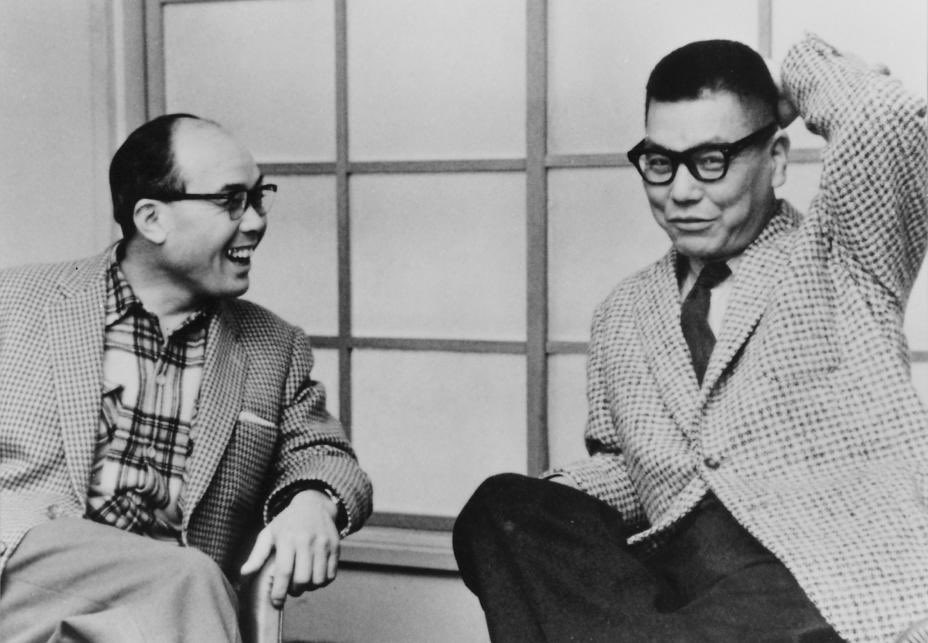
I’ve been reading a number of histories of Japanese companies recently, and one of my current favorite long-running, unusually productive collaborations is Honda’s Soichiro Honda and Takeo Fujisawa.
When he started his company in 1948, Honda was 43 years old, had already built and lost one company, and was more or less attaching surplus engines to bicycles. He met Fujisawa via a mutual friend in 1949. It was by all accounts a very successful meeting, and they began working together immediately.
Their partnership was a pretty extreme example of complementarity: Honda oversaw everything technical engineering, manufacturing, production. Fujisawa ran everything else, so finance, sales, and marketing. And they basically never interfered in the other’s domain.
The most consequential thing about this setup is that it enabled Honda to pursue technical development as his primary, and really, only, concern. Honda entered the Isle of Man TT race in 1959 as the first(!) Japanese manufacturer to compete in the world’s most prestigious motorcycle race, first without much success. But just two years later team won the manufacturer’s prize (racing, for Honda, was also advanced R&D).
At the same time, Fujisawa built an extremely sophisticated global distribution network. He established American Honda Motor Company in Los Angeles in 1959, creating their own distribution network (rather than working through existing dealers), and also set up European operations in Hamburg.
IMO the creation of the Super Cub is probably the best demonstration of their partnership, which was Honda’s answer to what at the time seemed like an impossible technical problem: creating a small motorcycle which was (relatively) cheap, reliable, and quiet. The Super Cub was quiet enough to ride through residential neighborhoods *and* extremely fuel efficient.
The advertising campaign for the Super Cub was also iconic. Fujisawa deliberately wanted to appeal to people who didn’t think of themselves as motorcycle riders, so their ads often featured students and/or housewives. To demonstrate the Super Cub’s simplicity at dealerships, he instituted a policy that sales staff would offer to teach anyone to ride in minutes, again packaging the Super Cub as a vehicle which provided liberation from both the complexity of cars and the intimidation of traditional motorcycles.
And of course today, the Super Cub is the bestselling motor vehicle of all time, having sold more than 100 million units.
There’s a lot more to say, but I think the other really special thing about these two is that they understood when to leave. They retired together in 1973 while they were still in their 60s, which was much earlier than they could have, especially given Japanese company norms. I love that they didn’t see themselves as irreplaceable geniuses and succession-planned for quite some time. Honda was clearly better for this.
I think unusually productive friendships and deep, long-lasting creative partnerships are under-theorized. I’d really like to better understand the alchemy that produces a Warren/Charlie, Jobs/Wozniak, Caro/Gottlieb, Will/Ariel Durant, and so on.
Notes on Charlie Munger’s commencement address:
1. What do you want to avoid in life: Sloth and unreliability.
2. Envy, resentment, revenge, and self-pity are disastrous modes of thoughts. It is a ridiculous way to behave. When you avoid it you get a great advantage over everyone else.
3. If you wish to persuade appeal to interest, not to reason. Human self-service bias is so extreme.
4. Cicero is famous for saying: “A man who doesn’t know what happened before he was born goes through life like a child.”
The sacrifice and the wisdom and the value transfer that comes from one generation to the next can never be underrated.
All of my life I have admired Confucius. I like the idea that there are values and duties that are learned.
All of that should be passed onto the next generation.
5. The safest way to try to get what you want is to try and deserve what you want. You want to deliver to the world what you would buy if you were on the other end.
6. Think about the type of funeral you want. There is a story about a person who died. The minister said it is now time to say something nice about the deceased. Nobody came forward. After long time a person came up and said, “His brother was worse.” That is not the kind of funeral you want.
7. Wisdom acquisition is a moral duty.
It is not just something you do to advance in life. This means you are hooked for lifetime learning. Without lifetime learning you people are not going to do very well. You will not get very far in life based on what you already know.
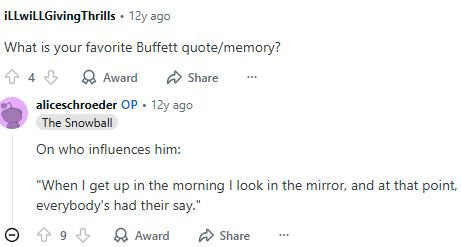
8. Berkshire Hathaway may have the best long term investment record in the history of civilization. The skill that got Berkshire through one decade would not get it through another decade without Warren Buffet being a continuous learning machine.
9. If you watched Warren Buffett half of all the time he spends is sitting on his ass and reading. The other half of the time he is talking one on one with highly gifted people.
10. I always obeyed the drift of my nature. If other people didn’t like it well I don’t need to be adored by everybody.
11. The way complex adaptive systems work is that problems are usually easier to solve if you turn them around and reverse them.
Invert, always invert.
12. Avoid extremely intense ideology. It turns your brain into cabbage.
13. Avoid working with someone you don’t admire and don’t want to be like.
14. Intense interest in a subject is indispensable if you want to excel in it.
15. Life will have terrible blows in it. Horrible, unfair blows. It doesn’t matter. Some people recover and others don’t.
The attitude of Epictetus is the best.
He thought every mischance in life is an opportunity to behave well and learn something. He thought you should utilize the terrible blow in a constructive fashion.
That is a very good idea.
Introverts don't get bored. They love their company. Just chilling around the house. Looking out the window. Browsing old photos. Cringing about something they said 3 years ago. Feeling ten different emotions in 4 seconds. 2 hours of self-talk. Walk. Eat. Nap. But never bored.
I once worshipped at a Jehovah's Witness church. Services were nice because it was always more of a discussion than preaching. After a month I asked my friend, "Since I've been coming here there has never been an offertory session during the service. How does one contribute?" ...