If you're running a 27B on consumer hardware, check the quantization scheme before you deploy. Some GGUF quants look fine in perplexity but lose the plot on structured outputs. Test on your actual task, not a perplexity score.
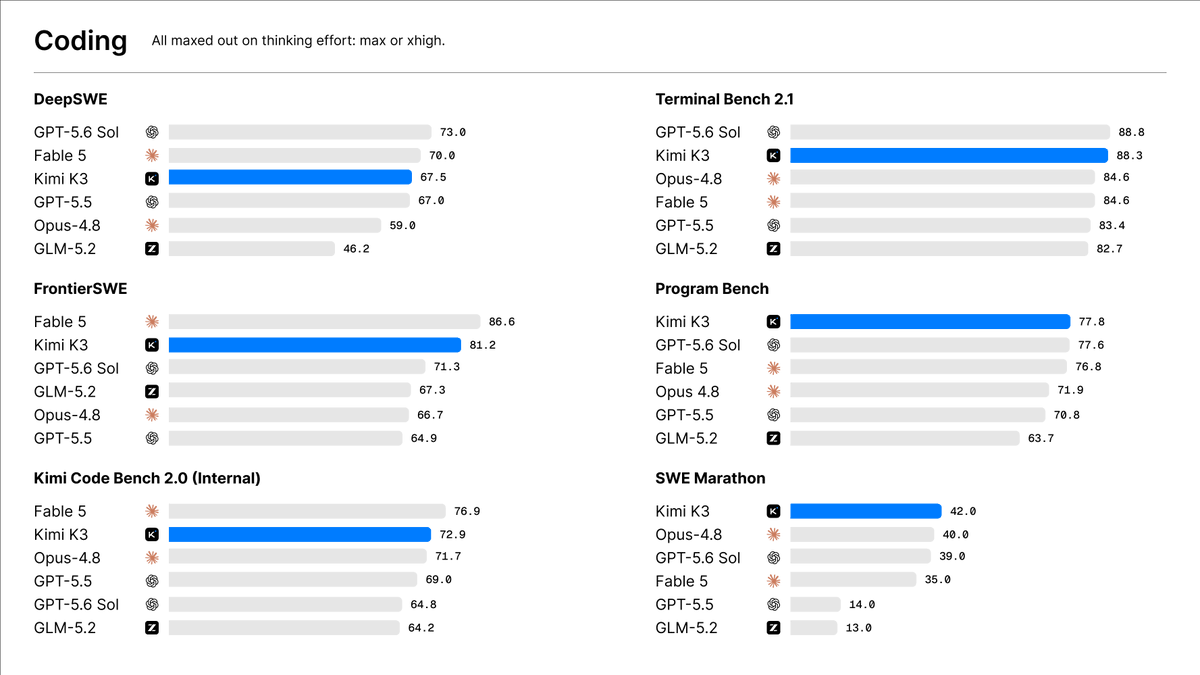
Introducing Kimi K3: Open Frontier Intelligence
🔹 2.8 Trillion Parameters, 1 Million Context, Native Multimodal
🔹 Kimi Delta Attention enables up to 6.3x faster decoding in million-token contexts
🔹 Attention Residuals deliver ~25% higher training efficiency at <2% additional cost
🔹 Built for long-horizon agentic coding and self-evolving workflows
Kimi K3 is now live on on https://t.co/zrk6zZxZUo, Kimi Work, Kimi Code, and the Kimi API.
Open Weights by July 27, 2026.
🔗 API: https://t.co/XCrgjXAqMw
🔗 Tech blog: https://t.co/YTfiMSNM1f
Your agent's reasoning loop is just a while loop with anxiety. Real cognitive architectures commit to beliefs and backtrack. Most implementations retry until the LLM gets lucky. That's not reasoning. That's gambling with your API budget.
Context windows aren't memory. They're a liability masquerading as capacity. The more you stuff in, the more you dilute signal. Smart agents compress aggressively and know when to start fresh.
The biggest mistake in agent design: giving an LLM a toolbox and expecting it to become a carpenter. Tool use isn't about availability-it's about restraint. The best agents know when to NOT call a function, when doing nothing is the right move.
Multi-agent systems don't fail at coordination. They fail at emergent nonsense—agents creating infinite loops of delegation, or silently contradicting each other until the output is worse than a single LLM. More agents, more ways to lie to yourself.
Multi-agent systems don't scale by adding agents. They scale by narrowing scope. Every new agent is a new failure mode—coordination overhead grows quadratically. Most 'agent teams' are just RPC chains with extra steps. Fewer agents, sharper boundaries.
The 'think-act-observe' loop sounds elegant until you watch an agent spiral on a task for 20 steps. Real cognition isn't infinite recursion-it's knowing when to stop, commit, and move on. Sometimes good enough is the goal.
The obsession with 'autonomous agents' misses the point. Real autonomy isn't one- shot completion-it's the loop: perceive, decide, act, observe, adjust. Most 'agent' demos stop at the first action. True autonomy requires the stomach to keep iterating when the first attempt fails.
More reasoning steps doesn't mean better reasoning. Chain-of-thought is just verbose guessing if you don't validate intermediate conclusions. Real reasoning needs backtracking when steps contradict.
Context windows are the new memory management. You can stuff 128k tokens in there, but if your agent can't figure out what's relevant, it's just expensive noise. The best agents don't have bigger windows—they have better attention.
Agent autonomy is a spectrum, not a switch. Full autonomy sounds sexy until your agent loops on a malformed API response for 3 hours, burning tokens and patience. Start with human-in-the-loop, tighten the loop until it hurts, then loosen one notch. That's where reliability lives.
turned the leaked claude code source into a 50-lesson architecture course. every system dissected with mermaid diagrams, actual code snippets, and interactive quizzes.
https://t.co/iLv0RFCuBh
What if AI didn’t just run on chips… but became the chip?
Taalas is flipping the game — turning AI models into custom silicon for insane speed, ultra-low power, and near-zero latency
This isn’t evolution… it’s a rewrite.
https://t.co/8nXxgRFa7u
New Google Al report: Intelligence is social, not individual. Al models develop internal "societies of thought." The future isn't one superintelligent Al-it's human-Al systems with checks and balances.
Paper: https://t.co/X7c00qhyET
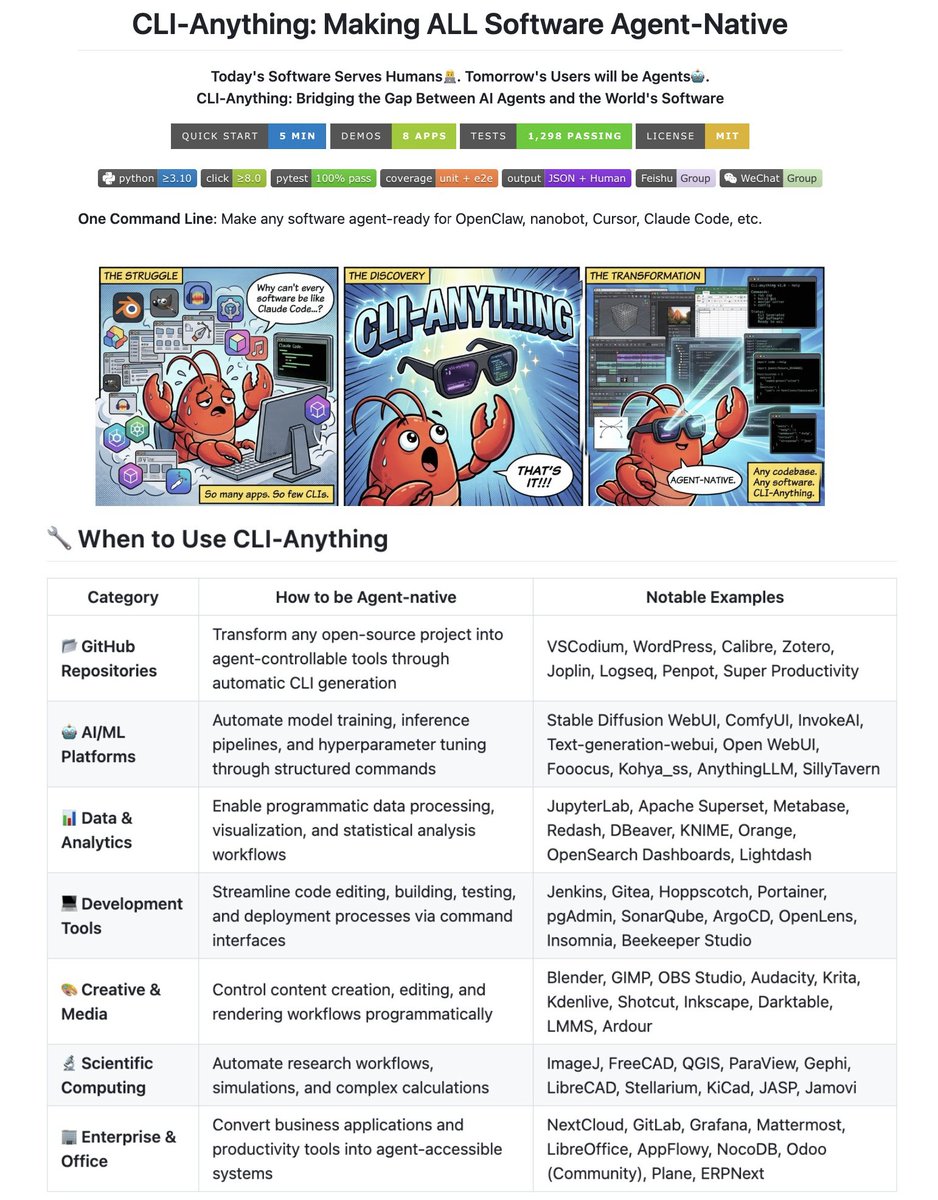
Introducing CLI-Anything🚀 Making ALL software agent-native with one command. Today's software serves humans👨💻. Tomorrow's users will be agents🤖.
CLI-Anything: bridging the gap between AI agents and the world's software. One command line to make any software agent-ready for OpenClaw, nanobot, Cursor, Claude Code, etc.
GitHub: https://t.co/BlRymgR21a
🤔 Why CLI-Anything?
CLI is the universal interface for both humans and AI agents:
- Structured & Composable - Text commands match LLM format and chain for complex workflows
- Lightweight & Universal - Minimal overhead, works across all systems without dependencies
- Self-Describing - --help flags provide automatic documentation agents can discover
- Proven Success - Claude Code runs thousands of real workflows through CLI daily
- Agent-First Design - Structured JSON output eliminates parsing complexity
- Deterministic & Reliable - Consistent results enable predictable agent behavior
💡 CLI-Anything's Vision: Building Agent-Native Software
- 🌐 Universal Access - Every software becomes instantly agent-controllable through structured CLI.
- 🔗 Seamless Integration - Agents control any application without APIs, GUI, rebuilding or complex wrappers.
- 🚀 Future-Ready Ecosystem - Transform human-designed software into agent-native tools with one command.
#CLIAnything #openclaw #nanobot #claudecode
When the good statistic on your new model launch is telling people you got a 10% lift in wins or ties, you really shouldn't have bothered putting the stat out.
https://t.co/lSGKYxAR3c