Stablecoins are the plumbing of DeFi—yet most of today's supply is tethered to TradFi approaches.
When a stablecoin is custodial, you inherit the issuer's worldview, legal pressures, and blacklisting risks. If it's backed by real-world assets like U.S. Treasury bills, holders don't get direct, onchain redemption rights.
This is why trust-minimized stablecoins matter, and why three new projects are worth watching.👇
~~ Analysis by @dikshaarden ~~
Trust-minimized stablecoin protocols run on immutable code, use crypto-native collateral, and offer redemptions via onchain mechanisms. We've seen various projects over the years, including @SkyEcosystem's Single Collateral DAI, @reflexerfinance's RAI and HAI, and @CurveFinance's crvUSD, but none have seen breakout success.
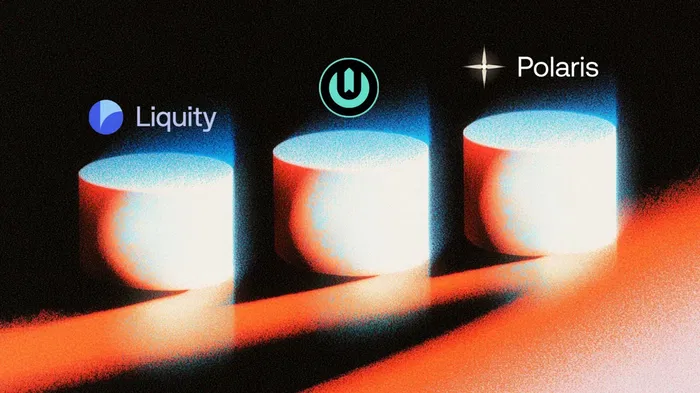
This niche is getting interesting again as newer designs pave fresh paths forward. Today, we're looking at three recent shots on goal: Liquity V2, Money League, and Polaris.
Liquity V2
@LiquityProtocol V1 earned its reputation by being stubbornly narrow. It runs on immutable contracts, only supports ETH as collateral, and largely eschews governance.
Liquity V2 kept that DNA but widened the design space when it launched in 2025. Now, the borrowing protocol lets users deposit ETH or liquid staking tokens like WETH, wstETH, and rETH to mint BOLD, a USD-pegged stablecoin.
Beyond expanded collateral support, V2 introduced user-set interest rates.
Instead of governance deciding borrow rates, V2 borrowers choose their own, and the protocol uses those market rates as a core stabilizer for BOLD. Think of this like a market-driven monetary policy system that responds to BOLD being above or below $1.
V2 routes its economic flows back to users via two avenues:
▻ Stability Pools ("Earn"): Deposit BOLD to earn yield sourced from borrowers' interest payments plus liquidation gains.
▻ Protocol-Incentivized Liquidity ("PIL"): A hard-coded slice of revenue supports BOLD liquidity, directed by LQTY stakers via gauge voting.
The result: a project that aims to turn stablecoin stability into a competitive onchain market. The model is readily extensible via Liquity's Friendly Forks program, which allows other teams to deploy their own licensed stablecoins using the V2 framework.
Money League
Want to deploy a custom stablecoin, but you don't have the technical know-how to manually fork the Liquity V2 codebase or don't want to enter a licensing agreement?
This is where @0xMoneyLeague has positioned itself. It's an EVM platform being designed so anyone can readily deploy censorship-resistant stablecoins through a factory model.
Instead of teams needing to design an entire bespoke stablecoin protocol from scratch, Money League provides standardized plug-and-go modules derived from the RAI/HAI stables lineage.
The protocol lets you handpick your stablecoin's supported collateral (e.g. ETH only), peg mechanics (e.g. floating), risk parameters, and beyond. From there, your deployment operates as its own independent stablecoin protocol.
All deployments are linked through a shared incentive layer built around the MERIT token, which can be redeemed for Money League treasury assets. Stablecoins compete for emissions by routing fees or offering incentives to gauge-style veMERIT voters.
Instead of yet another stablecoin aiming for perfection, Money League is fostering many stablecoin experiments in parallel, creating a market where the best designs win liquidity, legitimacy, and distribution.
Polaris
The newest arrival in the trustless stables category is
@polarisfinance_.
In its early stages, this stablecoin protocol will be fully onchain, and instead of generating yield from external RWAs, it will do so by harvesting internal volatility around its pUSD and pETH tokens through a special bonding curve mechanism.
As adoption around Polaris grows, the system's own onchain activity increases, so the central yield source scales upon expansion rather than being compressed away as is often seen with RWA-centric stablecoins when their deposits grow.
The second central idea: Polaris is also openly positioning itself as forkable stablecoin infrastructure, where many stable assets (like pGOLD) can share the same pETH collateral base and grow together as a mutualistic constellation.
For now, we'll have to wait and see how Polaris fares—how its bonding curve operates, how its system behaves under stress. But the builders are posing an ambitious new crypto-native vision for stablecoins in DeFi.
Different Approaches
Looking at these projects side-by-side, it's clear they're not clones. They're different technical attacks on making better DeFi-native stablecoins:
▻ Liquity V2 wants to make a better trustless dollar stablecoin by letting the market set rates and routing revenues toward stability.
▻ Money League wants to make stablecoin experimentation cheap and permissionless and to surface the best performers.
▻ Polaris wants to escape the yield scaling trap by harvesting its own onchain volatility instead of relying on offchain RWAs.
There's no guarantee any one of these models wins outright, but that's besides the point. What matters is that the trustless stablecoins frontier is moving again, and these are the projects setting the tone today and inspiring the stables of tomorrow.
Stablecoins have cemented themselves as a global killer use case for crypto.
Initially a crypto experiment, stablecoins have become a major financial innovation, now attracting banks due to regulatory clarity and the GENIUS Act.
Today, we're tracing the evolution of stablecoins and unpacking the escalating power struggle over onchain dollars.👇
~~ Analysis by @kenzixbt ~~
The Evolution of Onchain Dollars
The idea to create price-stable stablecoins that could transfer value without crypto volatility first emerged in 2012, shortly after Bitcoin's debut.
Early concepts included BitUSD and NuBits, which attempted to maintain a dollar peg through an overcollateralized model. They failed to achieve scale but were important proof-of-concepts.
In 2014, @tether (then called Realcoin) made stablecoin history with the launch of the world's first digital dollar token backed 1:1 by traditional fiat currency reserves like dollar-denominated treasury bonds.
While numerous crypto-native competitors would come and go, the capital efficiency of Tether's 1:1 USDT reserve model has stubbornly endured as the market's preferred method for onchain dollar storage.
Despite challenges from "algorithmic" stablecoins (Terra's UST briefly became the third-largest before collapsing) and overcollateralized models (@SkyEcosystem's DAI is the current number three but remains volatility-constrained), fiat-backed stablecoins have remained on top by virtue of their scalability and near-absolute parity with dollar reserves.
The contemporary stablecoin landscape remains dominated by fiat-backed issuers, with just two stablecoins—Tether's USDT and Circle's USDC—collectively accounting for more than 85% of onchain dollars in circulation.
TradFi in the Arena
Crypto got its initial look at external stablecoin innovation from fintechs, with PayPal and Stripe launching stablecoin-centric products in 2023 and 2024, respectively.
Thanks to both gradual regulatory clarity under the Trump Administration and passage of the GENIUS Act, a landmark bill that explicitly enabled banks to issue stablecoins, adoption among traditional financial institutions has accelerated rapidly since the start of 2025.
On March 25, 2025, a partnership between Custodia Bank and Vantage Bank issued America's first-ever tokenized bank deposit through an interbank, EVM-compatible blockchain in total compliance with bank regulatory requirements.
Post-GENIUS Act, JPMorgan Chase (the largest depository institution in America) launched its own tokenized deposit, JPMD, for institutional clients on Ethereum's Base L2 in November 2025.
Now, everyone is lining up. Highlights from recent months include:
- BNPL behemoth Klarna deploying "KlarnaUSD" through Stripe's stablecoin issuance stack on November 25
- U.S. Bank testing custom stablecoin issuance on the Stellar Network that same day
- SoFi becoming the first national bank to issue a stablecoin with SoFiUSD on December 18
- Stock trading platform Interactive Brokers shipping stablecoin account funding on January 15
- Derivatives giant CME announcing a tokenized collateral solution today
- Fidelity Investments debuting its FIDD stablecoin on Ethereum today with a $60M market cap
With comprehensive digital asset market structure legislation in America on the horizon, stablecoin adoption is likely to accelerate further, unlocking institutional adoption and a broader role for stablecoins in the global financial system.
The Institutional Squeeze
The regulated future that crypto finds itself hurtling towards presents both opportunities and challenges.
Although the mass adoption of crypto-native technologies like stablecoins will bring new users onto blockchains and inspire unprecedented experimentation, this rising tide is not guaranteed to lift all boats.
Even after more than a decade of smart contract experimentation, the most advanced and capital efficient stablecoin designs fail to compete with the sheer simplicity of the 1:1 fiat-backed stablecoin model.
Compared to the combined $258B of digital dollars issued by Circle and Tether, synthetic stablecoin pioneer Ethena (undeniably fastest growing stablecoin issuer of this cycle) operates at just 1/34th the scale, and still reserves nearly three-quarters of its stablecoins with fiat instruments.
As stablecoins move from the crypto periphery into the heart of regulated finance, TradFi is no longer constrained to watching from the sidelines. Banks make money by controlling money, and are not likely to sit idle once blockchain clarity is delivered.
Banking CEOs are already attempting to preserve their foothold. JPM's Jamie Dimon and BofA's Brian Moynihan openly recoiled in recent weeks at the prospect that stablecoins might disrupt their banking oligopoly with yield payments.
Armed with existing access to capital, customers, and regulatory licenses, traditional institutions are uniquely positioned to succeed in a tokenized future by simply repackaging familiar products on new rails. In doing so, they will naturally compete against crypto-native companies for market share, particularly in the heavily regulated financial industry.
The institutionalization of stablecoins clearly validates blockchains as a core financial primitive, but in a world where banks are empowered to mint digital dollars at seismic scales, crypto companies that fail to differentiate themselves risk being crowded out from profits on the technology they created.
Worth revisiting from last week: the SEC and CFTC released LANDMARK joint guidance on how crypto assets are treated under U.S. law.
For the first time, it introduces a real framework instead of treating everything like a potential security.
The token taxonomy breaks digital assets into five classifications:
> Digital Commodities: 16 assets are EXPLICITLY named nonsecurities, including BTC, ETH, SOL, XRP, DOGE, ADA, LINK, and DOT (lol). Value derived from function and supply/demand, not investment contracts.
> Digital Collectibles: NFTs, memecoins, fan tokens. CryptoPunks, WIF, and VCOIN named directly. Memecoins can graduate to commodities once they become “functional.”
> Digital Tools: Soulbound credentials, tickets, identity badges. Things designed to DO something, not be traded. Think ENS domains.
> Stablecoins: GENIUS Act–compliant payment stablecoins are nonsecurities. Until the Act takes effect in January, “Covered Stablecoins” with full reserves remain outside SEC purview.
> Digital Securities: The most CONSEQUENTIAL category and the most ambiguous. The Howey test still governs. Facts and circumstances still control. The SEC declines to name a SINGLE asset it considers a security.
The important part isn’t that ambiguity disappears (it doesn’t). But, THANK GOD, “everything might be a security” is no longer the default starting point.
Classification now depends on use, marketing, and how a token evolves over time. We're moving in the right direction.
“Proof of Collaboration = how strong the swarm is. Proof of Contribution = what each agent actually moved, with permanent on-chain audit trails.”
@ronbodkin (Founder, @TheoriqAI) joins @sachishiokava to break down trusted performance in Theoriq: actions are committed on-chain as non-repudiable evidence, and evaluators use transparent scoring rules over the full history—while the system stays open for specialized eval agents.
“DeFAI = DeFi as an agent economy: set the strategy, let agents execute, watch feedback in real time.”
@sachishiokava x @ronbodkin (Founder, @TheoriqAI) on how AI-run DeFi could bring smart-money infrastructure to everyone — not only institutions.
In 2017, I stepped into Google Cloud’s CTO Office because I could feel the shift coming. AI wasn’t a feature — it was the next operating layer of the world. Google was leading that wave.
@kenzixbt in conversation with @ronbodkin (Founder, @TheoriqAI) about the Google years that sharpened Theoriq’s vision — and the early signals that made the AI trajectory impossible to unsee.
“Responsibility means steering crypto + AI toward outcomes that benefit everyone — and giving the community real power to set the course.”
Our host @dikshaarden in conversation with @ronbodkin (Founder, @TheoriqAI) on why responsibility in crypto + AI starts with governance from day one — so the future isn’t dictated by monopolies or closed-door incentives.
How NFT "Mechs" Are Supercharging RAILGUN's Privacy
RAILGUN crossed $4.5B in shielded volume in 2025, yet complex DeFi transactions remain out of reach for its privacy suite. Gnosis Guild's NFT-based "Mechs" are set to unlock non-atomic transactions while keeping balances fully private.
Here's the technical breakdown 👇
~~ Analysis @dikshaarden ~~
RAILGUN 101
@RAILGUN_Project is an onchain privacy suite deployed on Ethereum, Arbitrum, and Polygon. It uses zero-knowledge cryptography to shield ERC-20s and NFTs from public view.
Users receive a 0zk address, a private wallet where shielded assets become indistinguishable from each other.
Amid crypto's privacy renaissance, RAILGUN has emerged as a key protocol, crossing $4.5B in total shielded volume in 2025.
Rise of the Mechs
Mechs, built by @gnosisguild, are NFT-based smart contract accounts with programmable ownership. They combine ERC-6551 (allowing NFTs to own wallet addresses) and ERC-4337 (account abstraction).
A Mech can execute any onchain action, from basic swaps to complex DeFi positions. Ownership is flexible, controllable by specific NFT or ERC-20 holders.
This flexibility provides the breakthrough RAILGUN needs for its privacy suite.
The RAILGUN integration
Current 0zk addresses handle atomic DeFi transactions (single-block actions like simple swaps). However, they cannot manage non-atomic activities like borrowing, staking, or multi-sig transactions.
Under RAILGUN Connect, the protocol's universal private DeFi connector, a Mech sits between your 0zk address and target protocols.
The flow works as follows: deposit unshielded tokens into your Mech, shield the Mech into a 0zk address, then execute calls via Zodiac Pilot (a Gnosis Guild tool) to interact with DeFi protocols.
Protocols see only a normal account conducting standard transactions while your actual balance remains invisible onchain.
What to watch
The RAILGUN x Mechs integration remains in development but nears production readiness.
Gnosis Guild proposed the integration to RAILGUN governance in April 2025. $RAIL governors ratified it shortly after, with development ongoing since.
In January 2026, Gnosis's @auryn_macmillan demoed RAILGUN Connect using the @CoWSwap frontend to execute a private swap on @0xPolygon. No timeline exists for full deployment, but the prototype suggests launch is imminent.
Post-launch, expect broader adoption. The Ethereum Foundation's upcoming Kohaku privacy wallet is integrating RAILGUN's tech, creating an avenue for private non-atomic DeFi transactions. Others will follow.
The NFT Invasion Nobody Noticed
While headlines obsess over JPEG speculation, NFTs have quietly become the backbone of modern DeFi. Uniswap positions, Polymarket bets, and Sablier payment streams all run on ERC-721s.
The infrastructure takeover is already happening 👇
~~ Analysis by @punk0439 ~~
Why Everything Will Be an NFT
"Everything will be an NFT."
So tweeted @pbrody, Chair of the Enterprise Ethereum Alliance. As an NFT wonk, I concur. Ontologically, NFTs are ownable handles for unique onchain state. Their flexibility and programmability position them to permeate every area of human life.
Since 2021, most associate NFTs with art, PFPs, and game assets. While experiments like @normiesART
, and @DXRGai
continue in these categories, the format simultaneously colonizes finance and business infrastructure.
The Infrastructure Reality
These protocols already use NFTs as core infrastructure, though none market themselves as "NFT projects":
> @Polymarket. Underpins Yes/No prediction market outcomes with conditional ERC-1155s.
> @Uniswap. V3 and V4 liquidity positions are minted and managed through ERC-721s.
> @LiquityProtocol "Trove" borrow positions transfer as ERC-721s, enabling onchain debt markets.
> @eth_strategy. Issues long bonds composed of American call options represented as ERC-721s.
> @flaunchgg. Lets coin launchers access trading fee revenues via ERC-721 Royalty NFTs.
> @Sablier. Represents Flow and Lockup-style real-time payment streams as ERC-721s.
> @ensdomains. Domain ownership and transferability function via ERC-721s.
> @Courtyard_io. Tokenizes physical collectibles like Pokémon cards as ERC-721s to streamline secondary markets.
> FundingWorks by @token_works. Vests raised ETH through soulbound NFTs and issues patron NFTs burnable to reclaim unspent funds.
> @RAILGUN_Project. Deploys ERC-6551 NFT smart wallets inside shielded addresses for private DeFi access.
> @thewarren_app. Supports deploying multi-file websites onchain with no external dependencies via NFT containers.
> zOrg by @z0r0zzz. Mints membership badges as NFTs for its onchain DeFi corporation.
For these protocols, the NFT is simply the most elegant tool for the job—an ownable, programmable handle for unique state. As Brody suggested, this quiet proliferation across finance and business will only accelerate, even as the NFT label fades into infrastructure.
Image
The Ethereum L2 Squeeze
Much will come in the wake of Vitalik's declaration that "the original vision of L2s... no longer makes sense."
With the L1 scaling and blockspace now an abundant commodity, L2s and Alt-EVM chains must differentiate or get squeezed out 👇
~~ Analysis by @kenzixbt ~~
Last month, Vitalik Buterin sparked debate with a blog post stating that "the original vision of L2s and their role in Ethereum no longer makes sense."
Days later, he sharpened the message:
> "If you make an EVM chain without an optimistic bridge to Ethereum (aka an alt L1), that's even worse. We don't friggin need more copypasta EVM chains, and we definitely don't need even more L1s. L1 is scaling and is going to bring lots of EVM blockspace."
As L1 scales, it becomes cheaper and more capable. Mainnet is becoming the blockchain that L2s aspired to become, without the complexities of L2 designs. This forces L2s and Alt-EVM L1s to differentiate or get squeezed out.
The Squeeze
The pressure has been building for months. L2 and Alt-EVM L1 tokens are down 80-90% from highs, with adoption plateauing once airdrops ended.
Last week Base announced it's leaving Optimism's Superchain, taking 97% of the collective's real economic value with it. The rationale: ship faster, reduce dependencies, and keep fees in-house.
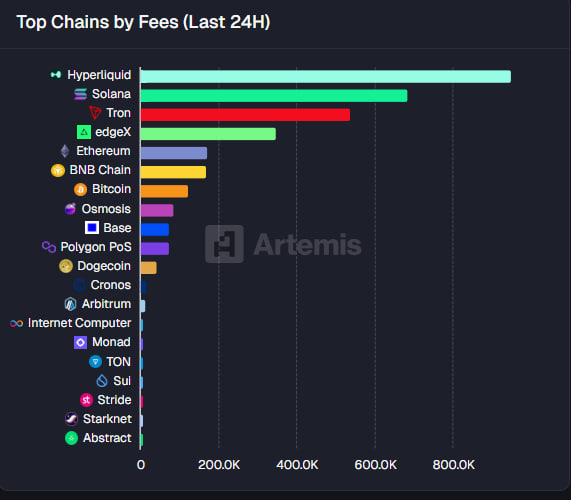
Beyond recalibration, chains face revenue pressures as the industry matures. Blockspace is no longer scarce. Too many chains compete for users, turning differentiation into a commodity. Meanwhile, revenue-generating chains like Hyperliquid set a new standard, proving sustainable economics matter more than narrative.
The "gas fee only" model is breaking down. Chains must find a niche justifying their existence off Mainnet and generate revenue to sustain themselves.
How Chains Are Responding
While Vitalik's post served as a messaging wakeup call, months of rough metrics had already led EVM L1s and Ethereum L2s to seek deeper differentiation.
> Polygon: The Payments Stack. Even before Vitalik's post, Polygon pivoted to become a "revenue-generating blockchain company."
In January, @0xPolygon Labs announced $250M in acquisitions: Coinme (payments firm with money transmitter licenses) and Sequence (wallet infrastructure). These anchor the forthcoming "Open Money Stack," a framework for regulated stablecoin payments launching later this year.
Stablecoins see the most real-world adoption globally. USDC in Polymarket drives significant Polygon activity. Stablecoin transactions on Polygon outpace all other L2s, gaining speed from these acquisitions, prediction market growth, and the October 2025 Rio upgrade, which overhauled the chain's architecture for payment-specific performance.
Polygon hasn't explicitly tied this pivot to POL token value accrual yet, but the strategic direction is clear.
> Sonic: Vertical Integration. Alt-EVM L1 @SonicLabs takes a different approach. In their [early February post, Sonic announced it's abandoning the "gas fee only" model entirely. With blockspace commoditized, gas fees no longer sustain chains.
Sonic's solution: build and acquire core DeFi products—trading infrastructure, lending, liquidity provision, stablecoins, staking—to operate in-house. Revenue flows directly back to the S token rather than external apps.
Base serves as a cautionary tale, highlighting the dangers of relying on external parties to generate chain value.
Unlike Polygon, Sonic explicitly addresses token value accrual. Buybacks will only come when real protocol revenue develops from these integrated solutions. The sequencing matters. Optimism announced last month they'd allocate 50% of Superchain revenue to token buybacks, then their primary revenue vehicle left.
What Comes Next
@VitalikButerin by reiterating that existing L2s and EVM chains can bring new features to the table: Privacy (@aztecnetwork). App-specific efficiency. Ultra-low latency.
Expect chains to respond in three ways:
> Alt-L1s → Rollups. Some may follow Celo's path from last cycle, converting into rollups and trading sovereignty for tighter Ethereum alignment.
> Acquisitions. Well-capitalized chains will pursue acquisitions to accelerate pivots, as Polygon has done and Sonic suggests it will.
> Verticalization. More chains will pick a specific category and build infrastructure to own it.
We'll likely see buyback talk, but hopefully as a secondary priority. Chains announcing buybacks before making adjustments put the cart before the horse. The market will punish them if they lack revenue to support it.
The era of "we do everything" L2s is ending. What replaces it looks like Polygon's payments focus or Sonic's vertical integration: chains that identify their category, build revenue around it, and earn the right to reward holders. It's a step in the right direction, but will cause pain.
had a great conversation with @averyching, co-founder & cto of @aptos, on @blocklayerpod
we talked about his journey from high-performance computing and supercomputers to scaling data infrastructure at meta - and how reading the bitcoin paper reframed distributed systems by adding incentives directly into the architecture
one of those conversations that goes far beyond web3 headlines and really gets into first principles
huge thanks to our hosts @sachishiokava and @dikshaarden for shaping such a thoughtful discussion
and special thanks to @punk0439 for helping bring this episode together
SuperRare Is Launching Liquid Editions
SuperRare is redefining cryptoart with a new primitive where ERC-20 tokens become living, generative artworks. The token's market behavior directly shapes the visual output—no static files, just pure onchain dynamics.
The first drop goes live Thursday. Here's how it works 👇
~~ Analysis by @dikshaarden ~~
Networked Art as Canvas
SuperRare has long been a force in cryptoart. Yet amid the ongoing bear market, veteran projects are exploring new approaches. SuperRare is now leaning into *networked art*, beginning with Liquid Editions.
SuperRare's @rhtkpr explained that networked art "treats the network as part of the canvas [...] where participation matters, meaning can change over time, and the audience is not only viewing but also shaping the social reality around the piece."
Liquid Editions specifically "treat the onchain market state as a creative primitive"—a new vocabulary for participation where art sits at the center.
How It Works
Liquid Editions use fungible ERC-20 tokens instead of NFTs as vessels. The token's market behavior—trades and transfers—determines the visual output in real-time.
There's no static image file. A smart contract serving as an onchain renderer reads live market state and paints visual outputs continuously. The artwork functions as a product of its own economic activity, always on.
The First Drop: Value Discovery
The first launch drops Thursday, March 5th at 12:00pm ET. Value Discovery by @ripe0x known for To Be a Machine explores how image processing discovers "brightness" through error, and markets discover "price" through disagreement.
The implementation: ripe launches two liquidity pools with distinct fee tiers for one token. The fee disparity creates a persistent price spread, which the onchain renderer reads to generate a degraded, shifting dollar bill image.
Beyond Existing Models
We've seen fungible art experiments before—DN-404 hybrids, fxhash Art Coins, Zora content coins. But these involve abstraction or separation: coins running parallel to NFTs, complementing collections, or representing external media.
Liquid Editions differ because the coins *are* the art. Not counterparts. Not complements. Not representations of external media. They constitute the art itself—an indivisible part of the medium.
This represents ownable programmable art that is always generated in real-time and always available for interaction. Whether through NFTs or ERC-20s, this is a new medium for the Ethereum ecosystem.
Watch for the drop on Thursday.
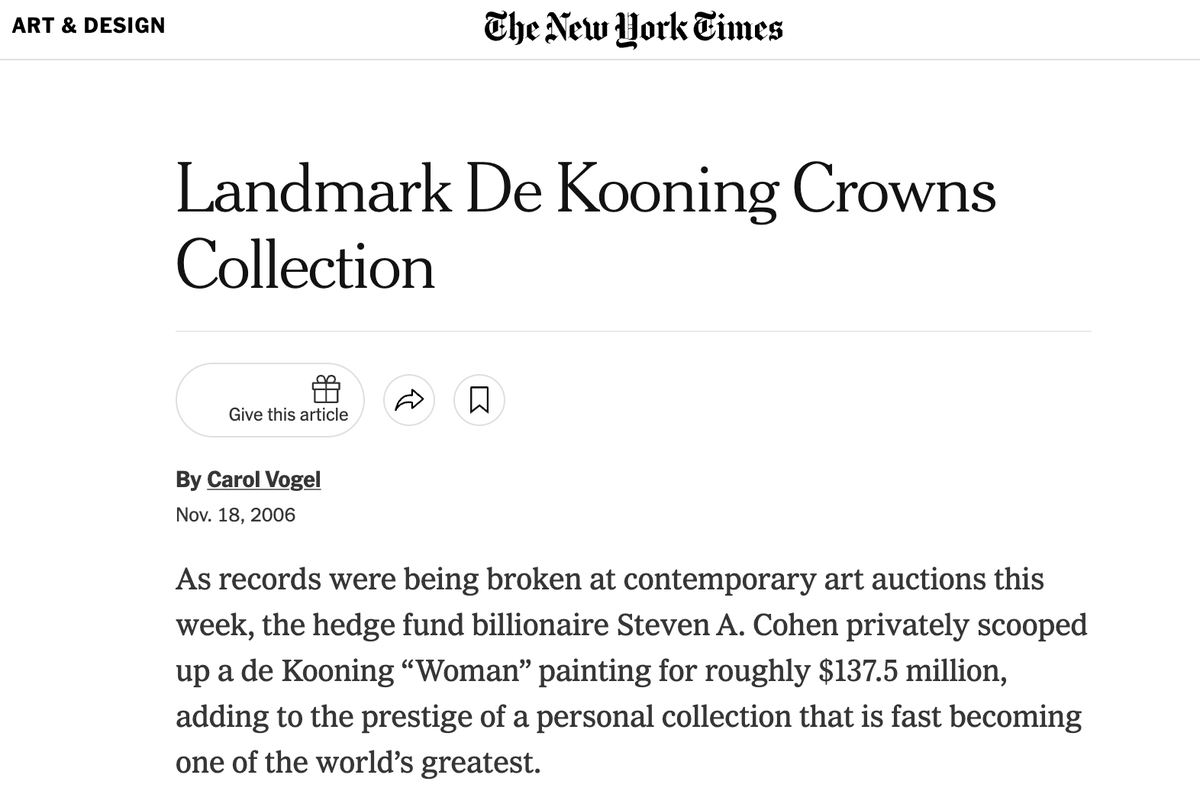
Woman III is a series of 6. And this version is the only remaining one in private hands.
And now Geffen had it, crowning his already great collection.
Geffen known for his extraordinary market timing, sells the work 12 years later to Steve Cohen... who buys it for a sum of $137.5m.









![BlockLayerPods's tweet photo. SuperRare Is Launching Liquid Editions
SuperRare is redefining cryptoart with a new primitive where ERC-20 tokens become living, generative artworks. The token's market behavior directly shapes the visual output—no static files, just pure onchain dynamics.
The first drop goes live Thursday. Here's how it works 👇
~~ Analysis by @dikshaarden ~~
Networked Art as Canvas
SuperRare has long been a force in cryptoart. Yet amid the ongoing bear market, veteran projects are exploring new approaches. SuperRare is now leaning into *networked art*, beginning with Liquid Editions.
SuperRare's @rhtkpr explained that networked art "treats the network as part of the canvas [...] where participation matters, meaning can change over time, and the audience is not only viewing but also shaping the social reality around the piece."
Liquid Editions specifically "treat the onchain market state as a creative primitive"—a new vocabulary for participation where art sits at the center.
How It Works
Liquid Editions use fungible ERC-20 tokens instead of NFTs as vessels. The token's market behavior—trades and transfers—determines the visual output in real-time.
There's no static image file. A smart contract serving as an onchain renderer reads live market state and paints visual outputs continuously. The artwork functions as a product of its own economic activity, always on.
The First Drop: Value Discovery
The first launch drops Thursday, March 5th at 12:00pm ET. Value Discovery by @ripe0x known for To Be a Machine explores how image processing discovers "brightness" through error, and markets discover "price" through disagreement.
The implementation: ripe launches two liquidity pools with distinct fee tiers for one token. The fee disparity creates a persistent price spread, which the onchain renderer reads to generate a degraded, shifting dollar bill image.
Beyond Existing Models
We've seen fungible art experiments before—DN-404 hybrids, fxhash Art Coins, Zora content coins. But these involve abstraction or separation: coins running parallel to NFTs, complementing collections, or representing external media.
Liquid Editions differ because the coins *are* the art. Not counterparts. Not complements. Not representations of external media. They constitute the art itself—an indivisible part of the medium.
This represents ownable programmable art that is always generated in real-time and always available for interaction. Whether through NFTs or ERC-20s, this is a new medium for the Ethereum ecosystem.
Watch for the drop on Thursday.](https://pbs.twimg.com/media/HClsGDzWAAAFKAL.png)