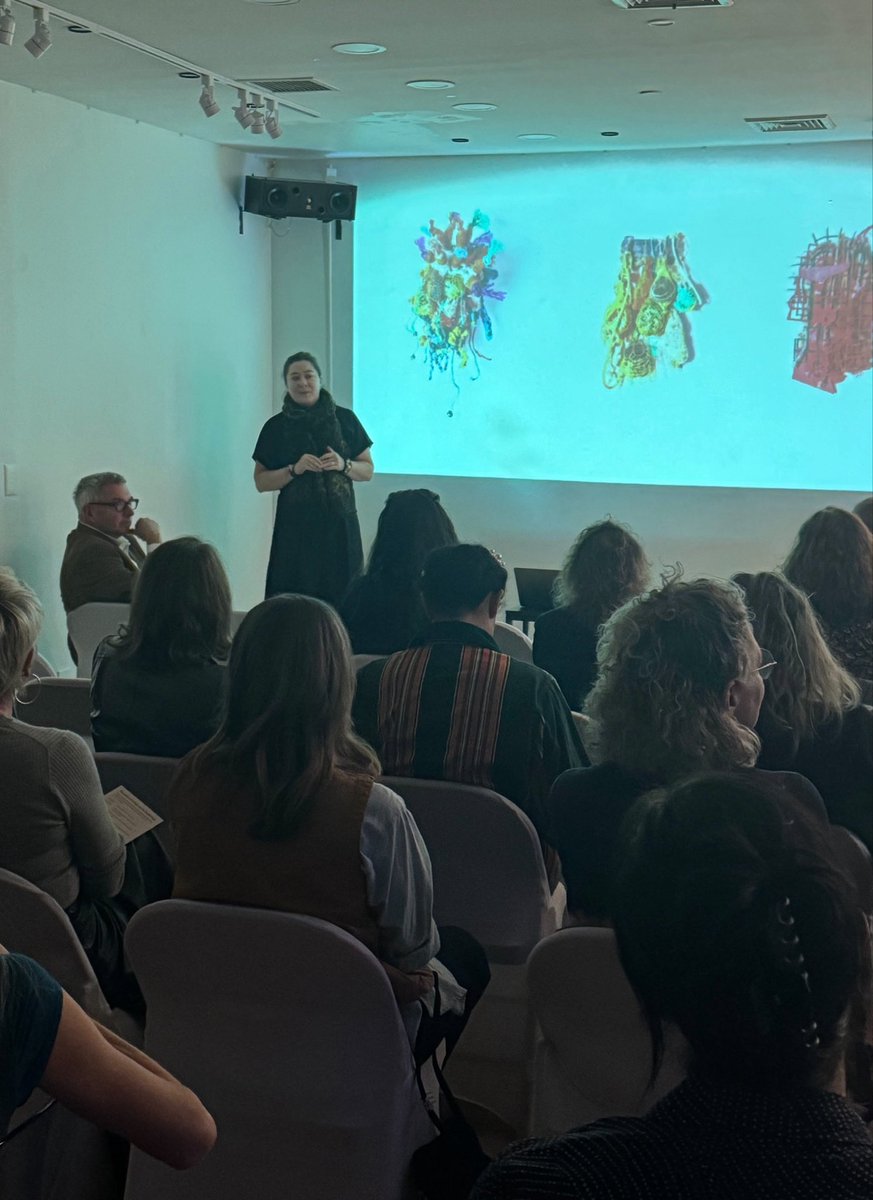
SOUND ON 🔊 TBA21 made a feature length Operator documentary and it premieres April 11th @museothyssen
6:30pm in the Museo Nacional Thyssen-Bornemisza Auditorium
Presented by @TBA21 on st_stage
Directed by @pedrobringasdp
Produced by Walden Studio
Arab Bank Switzerland presents a thematic exhibition SYSTEMS, held in conjunction with the 2026 ABS Digital Art Prize.
On view during @NFCsummit, June 4-6, 2026, Fábrica de Moagem, Unicorn Factory, Lisbon
A Stanford professor spent years trying to prove that people who multitask the most are the best at it. He tested 262 students and found the exact opposite. It was the most embarrassing result of his career.
His name was Clifford Nass.
He had spent decades at Stanford studying how humans interact with technology, and by 2009 he was certain he knew what the results would show before the study even started.
He was wrong about everything.
Nass and his colleagues divided 262 Stanford students into two groups: heavy media multitaskers and light media multitaskers.
People who regularly juggled email, texts, multiple browser tabs, music, and TV simultaneously versus people who mostly did one thing at a time.
The assumption going in was obvious. Heavy multitaskers must have built some kind of superpower. Their brains had been training under constant load for years. They should be faster at switching between tasks, better at filtering out irrelevant information, sharper at holding things in working memory.
They tested all three.
Memory first.
Students were shown sequences of letters and asked to identify when a letter was repeating. The heavy multitaskers did worse and kept getting worse the further they went. The more they had multitasked in real life, the less their brain could hold in the moment.
Filtering second.
Students were shown a grid of red and blue rectangles, which disappeared, and were asked whether any of the red ones had moved. The instruction was clear: ignore the blue ones. The light multitaskers had no problem. The heavy multitaskers could not stop looking at the blue rectangles. They were pulled toward irrelevant information even when explicitly told to ignore it.
Task switching third.
This was the one that ended the argument. Researchers expected that if heavy multitaskers were better at anything, it would be moving between tasks quickly. That is the entire premise of multitasking as a skill. But the heavy multitaskers were dramatically slower and less accurate at switching than people who barely multitasked at all.
Nass described it in the words he would repeat for the rest of his life.
They are suckers for irrelevancy. Everything distracts them.
He went looking for what multitaskers were better at. He found nothing. Not one thing.
What he had discovered was the opposite of what everyone believed. Multitasking is not a skill that improves with practice. It is a habit that degrades the very machinery you need to think. The more you do it, the worse your brain gets at focusing when you finally try.
5 years later, neuroscientists at the University of Sussex put 75 adults in an MRI machine. They measured how often each person used multiple screens simultaneously and then looked at their brain structure.
The heavy media multitaskers had less grey matter density in the anterior cingulate cortex. That is the region responsible for attention, impulse control, and decision-making. Not weaker activation. Less physical tissue. The damage was structural, written into the architecture of the brain itself.
Nass had been warning companies about this for years. In 2012 he stood in front of a room of executives and told them that forcing employees to multitask was not a productivity strategy.
It was a brain safety problem. He used the exact words: OSHA problem. The same language you use when a factory floor is injuring workers.
Nobody changed anything.
The notifications stayed on. The open-plan offices stayed open. The Slack channels kept pinging. The expectation that a good employee responds to everything immediately and handles ten things at once stayed exactly where it was.
Clifford Nass died in November 2013 at 55, collapsing after a hike near Lake Tahoe. He had spent his entire career measuring what constant switching was doing to the human brain. The world listened politely and went back to checking its phone.
A psychiatrist in London had found something related a few years earlier. He gave IQ tests to workers while emails and phone notifications arrived in the background. Their scores dropped 10 points. More than the drop from smoking marijuana. More than missing a full night of sleep. The distraction did not just interrupt the work. It made people measurably less intelligent while it was happening.
Most people read that and laughed and went back to their inbox.
Gloria Mark at the University of California spent years tracking how long office workers actually stayed on one task before something pulled them away. The average was three minutes. And after each interruption, it took 23 minutes and 15 seconds to fully return to the depth of focus they had before.
Do that math across a normal workday and you arrive somewhere most people would rather not look at directly.
You are not bad at focusing. You have been practicing the wrong thing for years, inside systems designed to fragment your attention, and you have been rewarded for it the whole time.
The heavy multitaskers in Nass's study were not careless. They were the ones who said yes to everything, responded to everyone, kept every channel open. They were doing exactly what modern work asked of them.
And their brains were paying for it in ways nobody could see from the outside, until someone put them in a scanner.
The one thing that will not fix this is trying harder to focus while the notifications are still on.
Nass knew that. He said it out loud for years.
The people who would not listen are still sitting in open offices with 14 tabs open wondering why they cannot think straight after lunch.
Very excited to share that we’re giving the closing keynote at this year’s SVSN as part of @FestivalAvignon 🖤 9 July. We’ll be presenting about our Performance Operating System.
Check link below for the full programme!
Human Unreadable Act III update @operator_______
I just finished going through over 300 dancer portfolio submissions & confirmed my selection for the dancers we will invite to the in-person nyc audition in June! 70 dancers invited, will narrow down to 20 for the final cast. 🪧
Wrapped up my first semester teaching the History of Algorithmic Art at @ITP_NYU and just received the anonymous student feedback
I'm sorry BUT 'my understanding of art has fundamentally changed' ??? I will be chasing this high for the rest of my life
huge, well-deserved congratulations to @YesClaudiaHart on her selection for @siggraph's Distinguished Artist Award
an incredibly important figure in digital culture's progression
i was fortunate enough to speak with claudia last year at @lerandomart: https://t.co/4PHLuTHWvn
Pleased to acquire Human Unreadable #263 by @operator_______ for the AB5D collection
This edition of 400 was minted on @artblocks_io in May 2023
This represents work 761 and set 486/500 for AB5D
This is a three act work, and #263 had not had the Act II choreographic score minted (I fixed that immediately)
Yesterday, thinking about a post by @Sonoflasg I posed two questions:
1. Which cultural objects, if any will AI agents covet?
2. In a world dominated by AI agents, which cultural objects will humans covet?
Taking this further, we can extend to:
3. Which works will be valued by both?
We can call these bridge works, and IMHO, Human Unreadable is one of those works.
To specifically code then decode in such an elegant way, the dissolution of human to digital then back again, Operator demonstrate a deep understanding of the tech/humanist tension.
Both a wildly underrated work, and further testimony toward the incredible depth of the Artblocks 500 series.
Can't wait for Act III