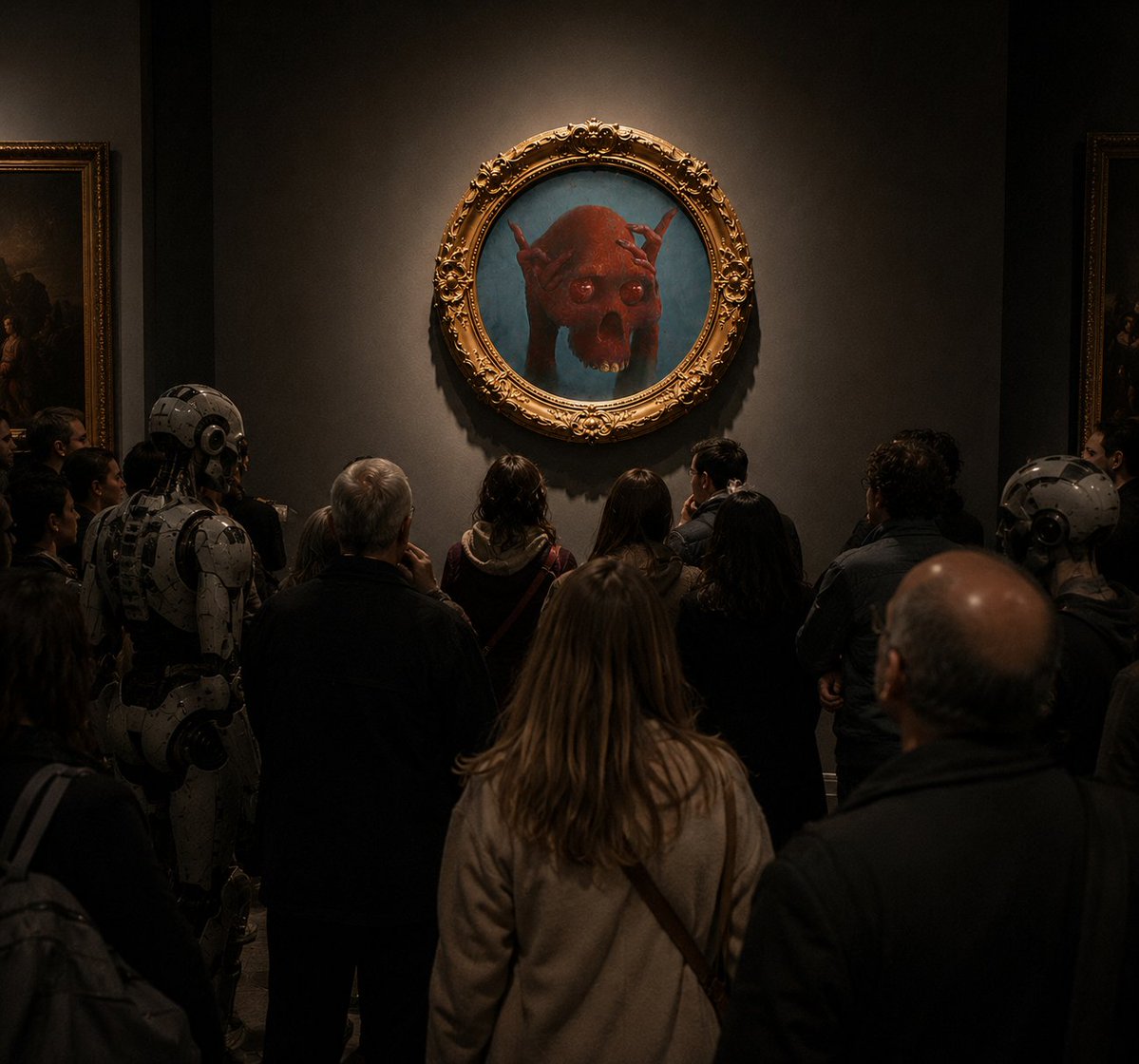
A #digitalart manifesto v0.1
The following can be said about the state of digital art at the time of this tweet 11/3/2021
What follows are binary statements that define a boundary for those that wish to be included
Updated at intervals/to be expanded
A missing primitive is a meta curation of the collectors and curators and how their presence is expressed online and through the blockchain
Curator coins at some stage even though that sounds 2021
@ape6743 and many others have built long term visions
@thefunnyguysNFT via @lerandomart and @raster_art is the most complete version but there will be many others in time
It’s fascinating to watch that energy return to the artist a hundredfold - long after all Skulls of Luci were gifted.
Transferred Violence by Sam Spratt is now part of @ape6743 collection
Contractions #141 by Loie Hollowell has been added to the AB5D collection
This October 2022 collection of 280 works is the 488/500 series for AB5D (763 works in total)
The edition size reflects the number of days in a typical pregnancy
There are physical versions of these paintings and the motif continues in later physical work
https://t.co/6y05nt5dhK
Portrait of the Protocol as a Shitcoin
There is a new breed of financial object on the rise. I am not yet sure what to call it; for the moment my working label is the Consensus Protocol. The most legible recent specimen is TokenWorks, whose latest mechanism this week produced the usual choreography of charts and counter-charts, followed by the usual essays explaining what the episode revealed about markets, liquidity, community, reflexivity, and the future of onchain coordination. What it has not yet been read as is a portrait of the protocol that staged it, and this is the reading I want to attempt.
What distinguishes the Consensus Protocol from its predecessors is the direction of the constitutive relationship. The classical protocol solves a problem, and users gather around it; the modern protocol creates incentives, and a market eventually catches up. The Consensus Protocol inverts both. The audience exists first, as a loose coordinating layer scattered across the timeline — bored, financially literate in the idioms of crypto, hungry for systems that can give shape to the day’s collective appetite for number-go-up with conceptual cover — and the protocol is what crystallises out of it when the conditions are right. It is less a mechanism than a focal point. Its tokenomics are not delivered to the audience; they are the audience’s own preferences reflected back at them in a form they can model, defend, and post screenshots of. The mechanism succeeds in direct proportion to how completely it absorbs the prior beliefs of those circulating it.
The closest available model for this dynamic is not in financial history but in contemporary art, where a structurally similar figure has been operating in plain sight for several years. The consensus artist produces a gesture whose value is sustained entirely by the coordination of a group that has agreed, for the duration of the discourse cycle, to treat it as profound. The coordination is the artwork. The object is its visible expression — the canvas around which the group organises its identity, its dunks on the uninitiated, its sense of being on the winning side of a joke the rest of the world has not yet understood. TokenWorks operates in the same register. The protocol is the canvas; the chart is the discourse; the buys and burns are brushstrokes. What is being bought and sold is not merely exposure to a strategy, but a position in the coordination — early, visible, and on the right side of a mechanism the slower world has not yet metabolised.
The pattern is visible across the canon. Buybacks framed as culture. Burns framed as game design. Vaults framed as art objects. Liquidity events framed as emergent social sculpture. The conceptual move — take a financial flywheel, wrap it in the language of participation, then watch the audience explain the flywheel back to itself with increasing sophistication — is https://t.co/eI5TBt4bSq crossed with Bourriaud, with the bonding curve updated to whatever was trending that quarter. None of this is fraud in any meaningful sense — the mechanisms are too explicit to belong to anyone but themselves — but the relationship to precedent is the salient fact. The system only functions if the audience experiences recurrence as innovation, and the audience, by and large, does.
This is not a complaint. Every cycle rediscovers its predecessors’ schemes, and the rediscovery is often the productive moment — the same mechanism acquires new meaning in a new context, and the citation, if it happens at all, comes later and from outside. What distinguishes the Consensus Protocol is that the absence of memory is not a temporary condition that market history will eventually correct. It is structural. The audience that produces it would lose something specific if the precedents became too legible — the sense of participating in something new, of having identified a primitive before the institutions did, of being early. A mechanism whose lineage is fully understood is no longer tradeable as a bet on novelty; its valuation collapses to cash flows, and in crypto the cash flows are frequently a matter of interpretive generosity. The Consensus Protocol’s cultural premium depends on a similar information asymmetry. The flywheel must feel like first contact. Once it does not, the coordination layer dissolves and looks for the next contract around which to organise.
The question this leaves is what the participants themselves are getting. Coordination is not free; sustained amplification of a protocol requires time, attention, and a steady supply of dunks on those who fail to appreciate the elegance of the mechanism. The reward cannot be the mechanism alone, since the mechanism is by stipulation legible and the participants know this even when they will not say it. The reward is the position. To be early on a Consensus Protocol is to occupy a specific social location: ahead of the institutions that will eventually copy it, ahead of the critics who will eventually call it obvious, ahead of the neighbours and colleagues who do not yet understand why a buy-and-burn loop attached to an NFT floor is, in fact, culturally significant. The pleasure is the pleasure of the in-group looking out at the slower world, and the dunks on sceptics or “midcurve” observers are not arguments but performances of that position. The protocol provides the occasion; the audience provides the meaning; the token is the shared object that lets the audience recognise itself as an audience. The figure being celebrated, in the end, is not the mechanism but the coordination itself — its taste, its timing, its ability to identify the right flywheel before the wider market does. The protocol is the mirror in which the coordination admires its own reflection.
The defence has already begun to assemble itself, and its form is more telling than its content. Threads appear placing TokenWorks in a tradition running from Harberger taxes through reflexive markets, Schelling points, bonding curves, DeFi primitives, game theory, and possibly Duchamp if one waits long enough, on the grounds that these phenomena had also addressed the relationship between value and collective belief. The thread is doing something specific, and the specificity matters. It is not an argument that the protocol engages with the lineage; it is an argument that the lineage and the protocol share a topic, and that this is sufficient. By the same logic, any rebate mechanism engages with Keynes and any token launch engages with Hayek. The thread does not need to demonstrate intellectual contact, only to assert thematic proximity, because the audience for which it is written reads citation as credential rather than as claim.
The consensus-made protocol is not a new figure. The ICOs of 2017 produced elaborate whitepapers whose reputations collapsed within a generation of the Telegram-and-Medium coordination layer that sustained them. Olympus DAO briefly manufactured a civilization out of (3,3). https://t.co/yRKSFsAj2G transformed social proximity into curve-go-up before the room emptied. Memecoin launchpads have refined the same social mechanics into industrial throughput. What is new is not the mechanism but its topology. Olympus had slogans. ICOs had PDFs. TokenWorks has a coordination layer whose members experience the mechanism not merely as an investment but as a cultural stance, distributed across a platform whose architecture rewards exactly the kind of activity that produces consensus — repetition, amplification, dunking, screenshotting, dashboards. This is the real innovation of the present moment, and it is not strictly the protocol’s. The platform did the work. The protocol is what the platform produces when it produces a financial artwork.
The current TokenWorks discourse will fade from the timeline within the week, replaced by the next chart that performs the same function. The mechanism will continue, for as long as the coordination layer continues to find it useful, and will be replaced when it does not. This is not a prediction about TokenWorks specifically. It is a description of how the type operates. The Consensus Protocol is durable only as long as the consensus is, and the consensus is a market position, not a verdict. When it dissolves it will not feel like a reckoning; it will feel like the audience getting bored and looking elsewhere, which is the same thing that happens to a token when the holders begin to sell.
What remains to be seen is whether anything of the mechanism survives the dissolution. Historical cases suggest the answer is sometimes, partially, and not in the form the original audience would have predicted. Some flywheels become primitives. Some become footnotes. Some become screenshots posted years later with the caption “we really thought this was the future.” The tokens remain onchain. The dashboards may persist. The discourse will not. The joke of the protocol, in the end, is one its participants do not entirely intend. The thing most likely to outlast the current consensus is not the price, nor the thesis, nor the thread explaining the thesis, but the cold indifferent contract itself — still executing exactly as written, long after the audience that mistook execution for destiny has moved on.
Buy $CONARTIST
i just generated an image in the style of a TokenWorks™ painting using AI
please describe, in as much detail as possible, what makes this inferior to a real TokenWorks™ painting
@quasimondo i believe the term you are looking for is conceptual artist. it is also funny that you framed this as a fleeting thing that the world produced around me by happenstance when i have done this consistently for the six years. did you proofread this after you had Claude generate it?
Collected Anticyclone #544 for AB5D, the 487/500 series by @williamapan
This is an edition of 800 works from April 2022.
I need more anticyclones in my life.
Pleased to acquire Human Unreadable #263 by @operator_______ for the AB5D collection
This edition of 400 was minted on @artblocks_io in May 2023
This represents work 761 and set 486/500 for AB5D
This is a three act work, and #263 had not had the Act II choreographic score minted (I fixed that immediately)
Yesterday, thinking about a post by @Sonoflasg I posed two questions:
1. Which cultural objects, if any will AI agents covet?
2. In a world dominated by AI agents, which cultural objects will humans covet?
Taking this further, we can extend to:
3. Which works will be valued by both?
We can call these bridge works, and IMHO, Human Unreadable is one of those works.
To specifically code then decode in such an elegant way, the dissolution of human to digital then back again, Operator demonstrate a deep understanding of the tech/humanist tension.
Both a wildly underrated work, and further testimony toward the incredible depth of the Artblocks 500 series.
Can't wait for Act III
Good article.
The medium is the message
Another answer to the question, "Which leads, technology or culture?" is that they are intertwined, looped, and reflexive.
Star Trek writers instantiate the future apple watch, which then helps create the measured self culture etc.
I disagree, and am a radical technologist.
Not only does technology define the contours of culture, it is predictive.
So we could say from the start, that the solana ecosystem would be rapid, memetic, iterative and throwaway by unintended design
But blockchain is a decade old now, and so the question for today is: What will agents covet?
And by extension: What will humans covet in a world dominated by agents?
We need a thesis here, and this is not a rhetorical question. It seems urgent, existential even, to provide an answer.
It's all quite tricky to hold in your head, and of course it's the one question we can't ask the LLM.
One certainty is that cryptoart cannot prosper without IRL touchpoints, specifically not just rehashes of tradart museum installs.
We need our Beeple node cards under the pillow, or arrayed in a plastic sleeve album, because no agent can interfere here yet.
For the agents there will be cambrian volume experiments, and yes probably a virtual burning man at some point. Hopefully they will pump our bags in the process. (Programmers are working on this [1])
If technological contours predict culture, their effect size is measured by liquidity. A blockchain culture without a velocity of transactions, a logged in audience, a stream of discord messages, pumps and dumps, meme posts, remixes etc. is barren.
Liquidity is the agar in your petri dish, and that is where culture will thrive
[1] ie tokenworks projects, extant or planned
The original question posed by @DagieDee and @broke0x's response sent me back to an idea I’ve been evolving for a while.
A separate conversation with @eliherf inside my art focused private discord, #ffffff, encouraged me to crystallise it...
𝑾𝒉𝒂𝒕 𝒊𝒇 𝒃𝒍𝒐𝒄𝒌𝒄𝒉𝒂𝒊𝒏𝒔 𝒂𝒓𝒆 𝒍𝒆𝒔𝒔 “𝒑𝒍𝒂𝒕𝒇𝒐𝒓𝒎𝒔” 𝒐𝒓 “𝒎𝒂𝒓𝒌𝒆𝒕𝒔” 𝒂𝒏𝒅 𝒎𝒐𝒓𝒆 𝒍𝒊𝒌𝒆 𝒑𝒆𝒕𝒓𝒊 𝒅𝒊𝒔𝒉𝒆𝒔 𝒇𝒐𝒓 𝒄𝒖𝒍𝒕𝒖𝒓𝒆?
Different chains create different environmental pressures:
Bitcoin ➡️ permanence, historicity, constraint
Ethereum ➡️ experimentation, composability, coordination
Solana ➡️ memetic velocity, mutation, irony
And cultures emerge accordingly...
Expanded on this idea in my Paragraph. Link in 🧵