We bring together stakeholders to share knowledge and experiences on #Agribiotech with the aim of building an enabling environment for informed decision making.
Kenya is experiencing severe hunger which, according to the United Nations, has directly affected over 2.1 million people, particularly in the northeastern region.
Communities living in these areas are mainly pastoralist, and so cattle have been dying in droves.
As Kenya, and other parts of Africa, face erratic weather patterns, and livestock farmers continue to suffer shortages of feeds, we maintain that adoption of biotech foods and feeds will shield thousands, if not millions, of people and cattle from debilitating famines.
The cost of delay, especially through protracted court battles, is greatly detrimental to our countries' socio-economic wellbeing.
To speed up adoption and ease availability of food and feed to communities in distress is a discussion we seriously need to prioritise.
ISAAA AfriCenter stands ready to support with any information and knowledge products needed towards these initiatives, and convenings to this effect.
Although not the silver bullet to the drought crises, the world has the technology to mitigate effects of droughts, and we should optimize it.
#MakeScienceCount
#FoodForThought
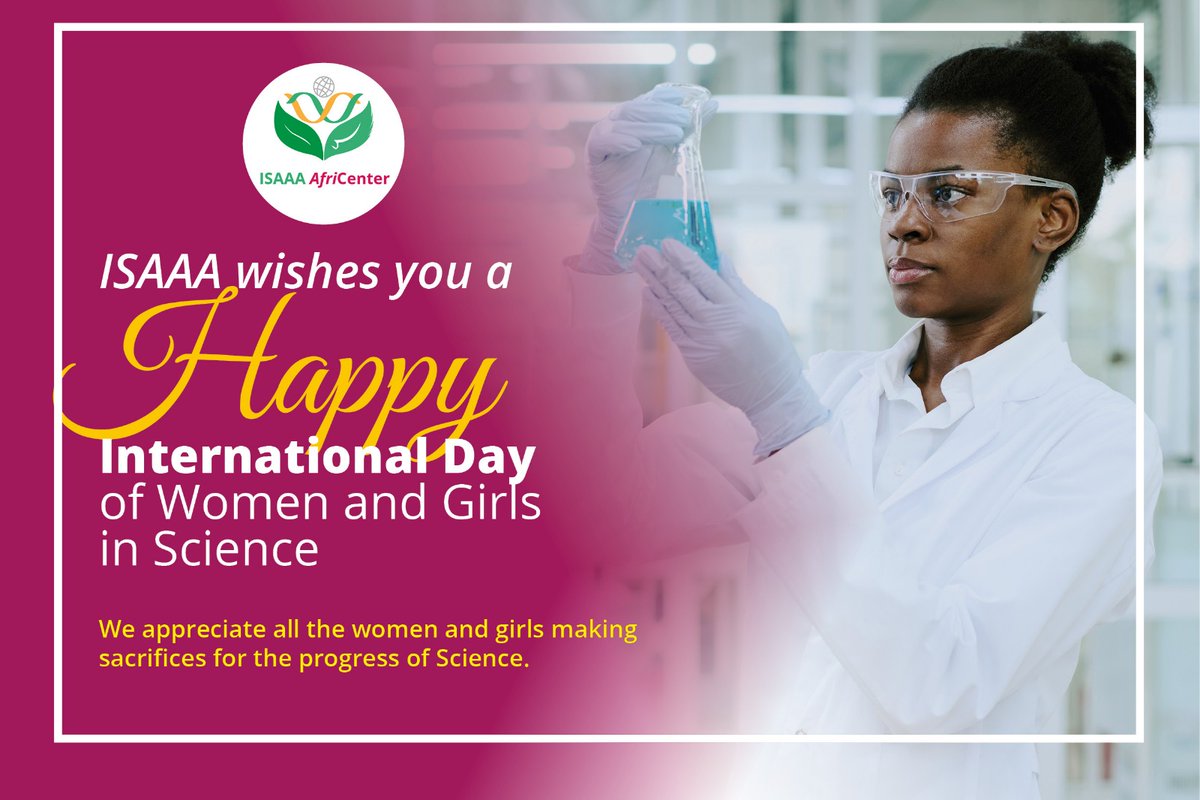
On this day we celebrate YOU, lady in STEM, because YOU are PHENOMENAL.
YOU:
🌟 Realised that STEM is the quintessential cog for national progress, and no country thrives without investment in the same
🌟 Chose to make the world a better place, thus, by joining STEM
🌟 Ignored naysayers, and shunned all stereotypes that would otherwise stop girls, and would have stopped you, from joining STEM
🌟 Continue to show excellence and to inspire young girls to join STEM
🌟 Are, therefore, every wakeful moment, making the world a better place.
Today, we celebrate you. At @afri_isaaa, we send out our best wishes to you on this important day!!
You are important. You are extraordinary. You are PHENOMENAL!
#HappyInternationalDayOfWomenAndGirlsInScience
#WomenInSTEM
#WomenInSTEM
Sometimes, it just takes a parent who is convinced their daughters can be as good in STEM as their sons, says @afri_isaaa Director Dr @MargaretKarembu. She was lucky she had such a father; the encouragement began years ago. "What a man can do, a woman can do," he said, and she listened.
#WomenInScience
#WomenInSTEM
@aatfafrica@OfabAfrica@ILRI@kalromkulima We celebrate our trendsetting women, who commit their lives to agricultural biotechnology, which is inevitable if the continent has to comfortably feed its populations now and in the future.
On this day and every other day in the future, you are our heroines! 🫡
@aatfafrica@OfabAfrica@ILRI@kalromkulima ...and to ensure the continent is food secure. Africa is expected to host over 2.5 billion people by 2050, and facing harsh effects of climate change, disease and strife due to rampant political rearrangements, needs a secure path to food security, hence agribiotechnology.
As we approach The International Day of Women and Girls in Science, to be celebrated on February 11, we hear from Dr @BarbaraZawedde, Principal Technology Promotion Officer at Uganda's National Agricultural Research Organization (@narouganda) and Vice Chairperson, National Biosafety Committee of the @UNCST_Uganda.
For her, it is time girls stood tall in STEM and made an impact while at it.
https://t.co/zMNrJplVDk
Friday, 30th Jan, 0730hrs EAT (0430hrs UTC), we talk to @narouganda's Dr @BarbaraZawedde on the turning wheels of biotech regulation in Africa, and about women and girls in biotech.
No one is more exciting to talk to!!
Join us on The Africa Science Dialogue podcast for this discussion.
📌: https://t.co/mG3ESESz4z
We keep advocating for the adoption of agricultural biotechnology in Africa, and herein are documented discussions towards the same for a food secure continent!!
Drumbeat 90: https://t.co/Uy7UbN2flj…
Another one! DrumBeat 90!
Here is a detailed look into the first month of 2026 which has been, quite frankly, exciting. We are off to a fast start, baton firmly clasped in hand.
With a truckload of experiences and lessons from 2025, there is just enough to ruminate on already, and we are excited for what lies ahead!
Our DrumBeat issue 90 features the @afri_isaaa Director, Dr @mkarembu , presenting her expectations for what we believe, with foundation that has been laid by the team and partners, will be a remarkable 2026.
We also take great pride in Zimbabwe’s launch of the One Health Strategic Plan of December 2025, and we showcase some of the efforts towards this great achievement, alongside expectations now that we are here.
We have been busy convening meetings; we best not divulge what this has been about because all this is available in the DrumBeat here: https://t.co/xMlLHhZW4X.
We are also pleased to share an exciting call for scientists, innovators, and bio-enthusiasts to apply for How To Grow (Almost) Anything (HTGAA), a global, free online program hosted by the MIT Media Lab.
📸: Agri-stakeholders meetings where they pushed for strategic public education on safe pesticide use
Another one! DrumBeat 90!
Here is a detailed look into the first month of 2026 which has been, quite frankly, exciting. We are off to a fast start, baton firmly clasped in hand.
With a truckload of experiences and lessons from 2025, there is just enough to ruminate on already, and we are excited for what lies ahead!
Our DrumBeat issue 90 features the @afri_isaaa Director, Dr @mkarembu , presenting her expectations for what we believe, with foundation that has been laid by the team and partners, will be a remarkable 2026.
We also take great pride in Zimbabwe’s launch of the One Health Strategic Plan of December 2025, and we showcase some of the efforts towards this great achievement, alongside expectations now that we are here.
We have been busy convening meetings; we best not divulge what this has been about because all this is available in the DrumBeat here: https://t.co/xMlLHhZW4X.
We are also pleased to share an exciting call for scientists, innovators, and bio-enthusiasts to apply for How To Grow (Almost) Anything (HTGAA), a global, free online program hosted by the MIT Media Lab.
📸: Agri-stakeholders meetings where they pushed for strategic public education on safe pesticide use
Scientists should purpose to speak clearly about their work, which is of benefit to society, to increase acceptance and adoption.
In agribiotech, amid great need for adoption, even more. @OFABKenya is at the centre of spreading word about agribiotech for Africa's food security.
Probably due to misrepresentation, or poor communication in the past, or both, science has for eons been the bane of many people's lives. Hard to understand. Technical, spoken only in sophisticated labs. Pipettes, crucibles of all shapes, reagents with long names, protracted court cases out of new scientific innovations.
In the end, as it were, the results of painstaking experiments, and crucial discoveries, are meant for the benefit of society. The farmer whose concern is a happy, healthy, plentiful yield. The parent whose child's malady depends on a scientist's eureka moment. The manufacturer whose machines are becoming obsolete.
That is why scientists MUST learn to communicate their work with clarity. Why are we doing this? What do we seek to achieve? When, predictably, will that be rolled out? How are we doing it?
HOW is this going to be of benefit to society?
Without which, unfortunately, the engine will keep firing but the power will never reach the wheels, and the car will never move.
Scientists, here is a quote for you from Dr @CanisiusKana, The Executive Director of @aatfafrica , made during #ABBC2025.
The safety of the people is at the top of the priorities/agenda for researchers every time they step inside that lab, as agricultural biotechnology continues to create a pathway towards a food secure Africa, says Dr @ericmagembe of the @Cipotato.
One of our scientists' sworn duties, and which they never abandon come what may, is ensuring safety of new scientific innovations.
In agricultural biotechnology especially, our forte, scientists work hard so that future generations have access to plenty of safe, nutritious food.
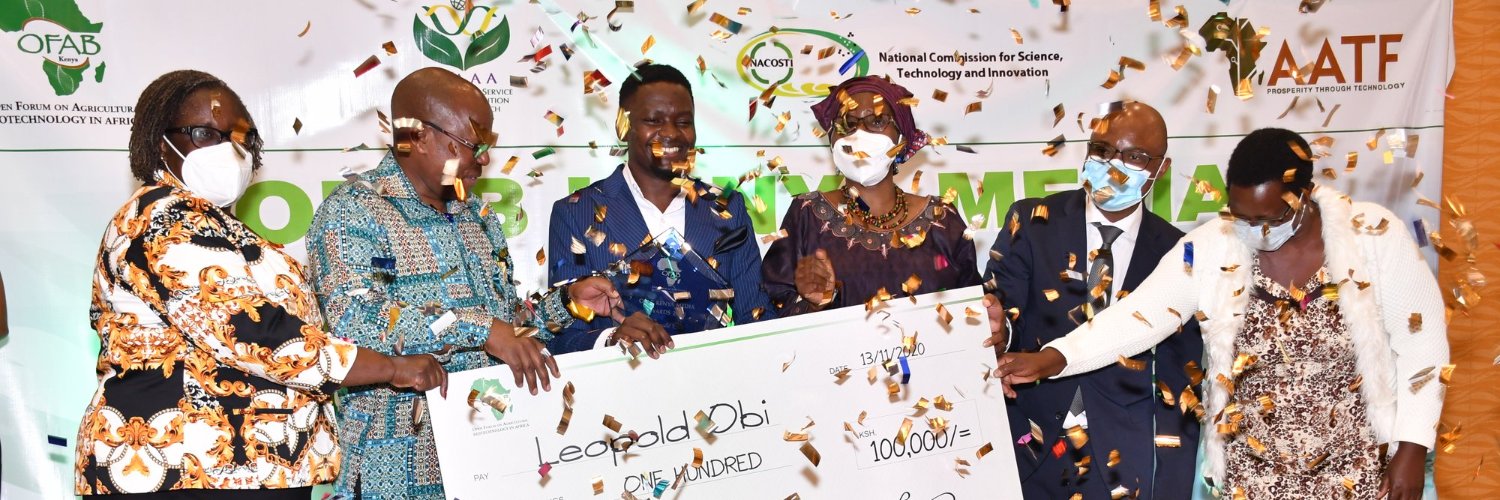
Recognizing the journalists from across the continent who have gone out of their way to report accurately, and in a timely manner, turning facts into nicely weaved stories that inform the masses and have the potential of influence decision making around agricultural biotech.
Our journalists are the interpreters of scientific innovations, translating them into stories that make sense to the wider public. Through your work, misinformation is challenged, public dialogue is enriched, and science becomes accessible.
Dr @MargaretKarembu during OFAB Africa Media Awards in Nairobi, Kenya: Africa stands at a defining moment. Our population is growing, our climate is changing, and
our food systems are under pressure. Yet, we are not without solutions.
👉🏻 In 2000, Africa's population was just above 800 million. In 2025, it is estimated at around 1.5 billion. 👥👥👥👥👥👥👥
👉🏻 In 2050, it could hit- wait for it- 2.5 billion. Two. Point. Five. Billion.
👉🏻 As the population increases, the urban areas 🏢 are stirring. The populations are rising at a rapid pace. In 25 years, over half of Africa will be squeezed in the urban areas.
👉🏻 And- yes, the urban areas are spreading out to accommodate more people, but this is not really it. You see, in the process, huge tracts of land that supported agricultural activities are being converted into real estate. Remember, already in many of our countries- like Kenya- very little land is arable as is.
👉🏻 The concrete jungle is growing. Land fragmentation is negatively impacting agricultural production. We could go hungry, as many other factors, including climate change, conspire to make the future of food security even more bleak.
So what to do?
Prof Curtis Youngs and @ptheuri81 sit to discuss this important topic, here:
https://t.co/FHpbrCZlWm
@IowaStateU@OFABKenya@NEPAD_Agency@OfabAfrica@aatfafrica
A little tweak in our education system to make us all somewhat ready for new agricultural technology, including biotechnology?
Listen to Prof Curtis Youngs. Full version here: https://t.co/AksgsDafy5