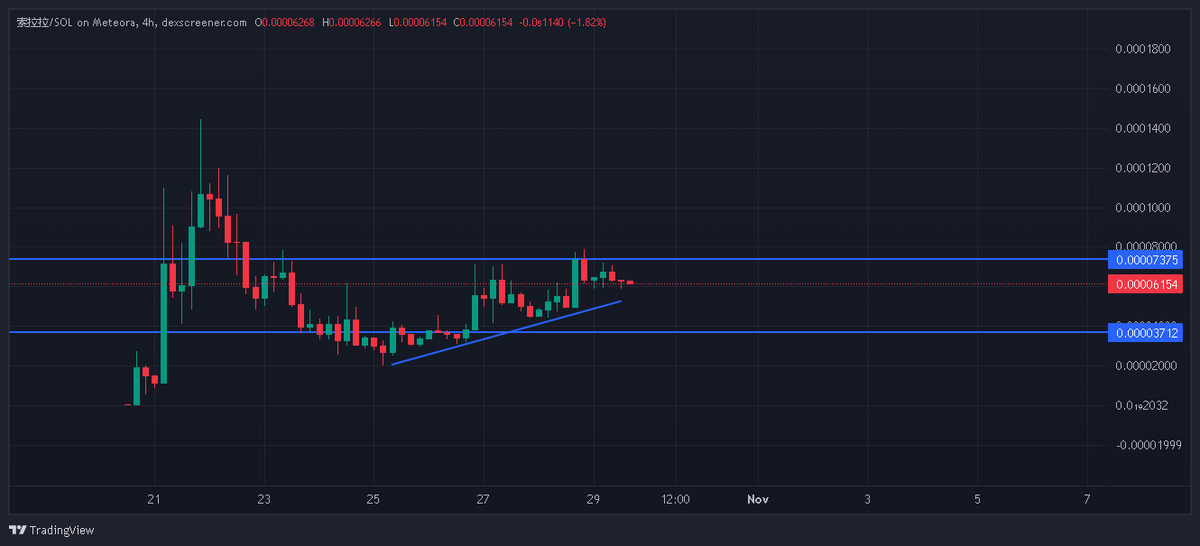
I just closed my position and took profit on this setup with a gain of 114.98%.
It was a result of patience and reading the chart with precision.
Before I entered, I analyzed the structure carefully on @MeteoraAG.
There was a clear support area around 0.00003712 and a resistance near 0.00007375.
Between those two zones, the price formed an ascending trendline, showing that buyers were slowly gaining strength.
For LP users and traders, this setup is a perfect example of how understanding structure changes everything.
Support represents strong buying interest, while resistance is where sellers begin to take control.
Knowing this helps you decide where to position liquidity so it stays active and earns consistently.
Volume and price movement always work together.
When you see higher lows forming along a trendline, it signals steady accumulation and healthy market activity.
That is the moment to stay calm, keep your liquidity within the active zone, and let the market move naturally.
When the price reached resistance, I decided to take profit.
Not because I wanted to predict what would happen next, but because the move had completed its rhythm.
This is the essence of good LP strategy and trading mindset.
You do not fight the market, you read it.
You let data guide your decision, not emotion.
And when you act with patience and clarity, the results follow naturally.
@MeteoraAG@met_lparmy
Psychologically, acceptance is key. LP is not about holding perfect ratios at all times. It is about letting inventory evolve with behavior while staying inside healthy interaction zones. Once beginners accept that inventory tells a story, fear drops and decisions become calmer.
Inventory imbalance started making sense to me after learning through @MeteoraAG and exchanging real experiences with @met_lparmy, because LP is not only about fees, it is also about what assets you end up holding.
Structure helps manage imbalance naturally. Wide balance zones allow inventory to rebalance over time. Tight directional zones accelerate imbalance faster. Choosing structure based on comfort level protects both mindset and capital.
Psychology plays a huge role. Fear pushes LPs to over tighten ranges to compensate for losses. That reaction often increases adverse selection instead of reducing it. Calm observation protects capital better than forced optimization.
Adverse selection became understandable to me after learning with @MeteoraAG and through many discussions inside @met_lparmy, because it explains why LPs feel punished during fast moves.
Recognition is the key skill here. Zones with shallow pauses and weak returns often signal higher adverse selection risk. In these conditions, tighter placement increases exposure rather than efficiency. Giving price more room usually reduces damage.
Strategically, I treat price discovery as a waiting phase. I reduce precision and focus on observing where price finally slows down. Once slowing appears and interaction starts repeating again, structure is rebuilding. That is where LP becomes productive once more.
Price discovery was one of the hardest concepts for me to truly understand, and it only clicked after learning from @MeteoraAG and exchanging deep discussions inside @met_lparmy.
Technically, price discovery is visible through weak returns and shallow pauses. Price moves, pauses briefly, then continues. Interaction is thin. That is not a signal to optimize. It is a signal to survive the transition calmly. Wider placement or patience usually wins here.