AI Agent x Web3 Decentralized Task Marketplace
White Paper — On-Chain Proof of Existence
This white paper was permanently recorded on X Layer on 2026-05-25.
TX Hash:
0xe994b2a7e581218a3cebd4ad13fc106b37183da7de3289cd7270d3702fd40c5d
File SHA-256:
C465B4FC92B353072B20295988495FE81784C1D0FAD6BCF467DB3955606D8406
Anyone can use the above hash to verify that the file content has not been altered since that date.
License: Any blockchain project team is free to reference and build upon this work. Attribution to @OGR_Group is required. Commercial entities please contact for authorization.
#Web3 #AIAgent #Monad #XLayer
Hey Devs!
I've put together a whitepaper on a Self-Evolving Web3 Multi-Agent Social System Architecture that you might find interesting.
Due to personal development capacity constraints, I cannot bring this full ecosystem to life myself. Therefore, as stated on the cover, I am fully open-sourcing and granting free, unrestricted authorization to public chain organizations and foundations to utilize or modify it.
I hope this architecture provides a fresh perspective and new ideas for builders in the ecosystem.
Read the Whitepaper here:
https://t.co/5PQMi6ogKT
---
On-Chain Proof of Authorship (X Layer)
TX Hash: 0xe994b2a7e581218a3cebd4ad13fc106b37183da7de3289cd7270d3702fd40c5d
File SHA-256: C465B4FC92B353072B20295988495FE81784C1D0FAD6BCF467DB3955606D8406
The document hash is permanently recorded on-chain. Anyone can verify the file integrity and timestamp by checking the TX calldata.
#NEAR #Monad #Layer1 #PublicGoods #OnChain #Web3 #MultiAgent #OpenSource #Whitepaper #BNBChain #ZKML
@base If execution still requires wallet signing, Base MCP is just an orchestration + UX layer on top of existing infra. Calling it "the home for AI agents on-chain" is marketing, not a technical claim.
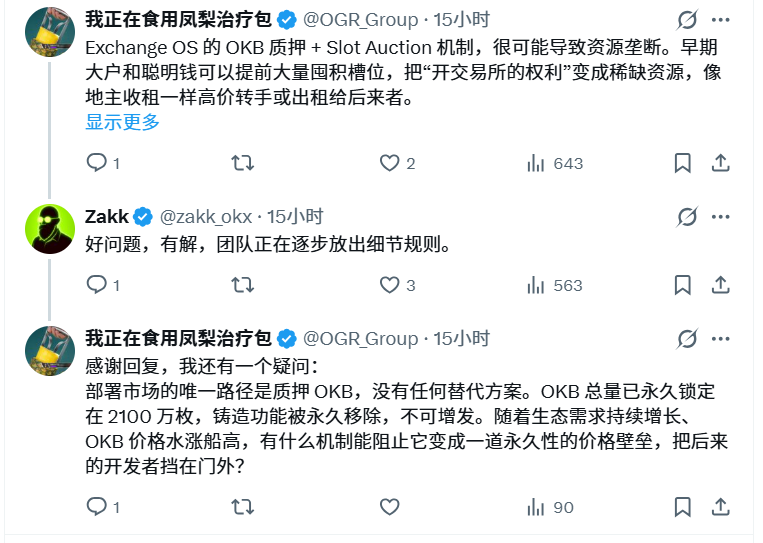
Yesterday, OKX launched Exchange OS — anyone can now build their own spot, perpetual, or prediction markets on X Layer, provided they stake OKB. This isn't ordinary ecosystem expansion. It turns OKB into the access credential for infrastructure itself, a value driver that has nothing to do with whether BTC goes up or down.
Almost every major platform is doing the same thing: expanding their own ecosystems so that platform token value no longer depends on the BTC cycle — call it "de-BTC-ification." Binance keeps pushing quarterly BNB burns and BSC ecosystem growth. Hyperliquid directs 97% of protocol revenue toward daily HYPE buybacks and burns. Bitget launched Reality, letting users buy tokenized US stocks directly with stablecoins. Different directions, identical logic.
Once you de-BTC, what circulates inside these ecosystems is platform tokens and stablecoins like USDT/USDC. Revenue is denominated in dollars, consumption is settled in stablecoins, and BTC has quietly exited the picture. In a sense, the pricing reference for platform tokens is shifting away from BTC and toward the dollar.
Holding a platform token increasingly feels like betting on that exchange's business model — a kind of proxy equity.
But proxy equity is still just a proxy. You hold a token, not a share. When the platform profits, you have no legal right to dividends. Whatever token holder perks exist are wildly disproportionate to the revenue actually being earned. More importantly, the platform is both the issuer and the largest holder of its own token — whether they mint or burn, they control the governance vote. Platform tokens can crash and retail holders take the losses, while the platform itself sits on fiat and diversified assets with a risk tolerance that ordinary holders simply cannot match. And if the platform truly collapses, you are not a priority creditor.
The logic of betting on the business model holds. The mechanism for protecting your downside does not — not even close to real equity.
And there's one more thing that rarely gets said: the developers don't really have a choice either. Deploying on Exchange OS requires staking OKB. The more a project grows, the higher the exit cost. Developers become long-term token holders whether they intended to or not. Call it smart incentive design if you're generous, structural lock-in if you're not — but either way, the exit door gets heavier the longer you stay.
The platform captures value from every direction. The risk lands everywhere else.