There are several things that can limit us from reaching the peak unless we learn to adapt. Without proper education as to what AMS(Acute Mountain Sickness), one can d*3 at an altitude wondering what has gone wrong.
#MOUNTAINRIDERS#EducationReform
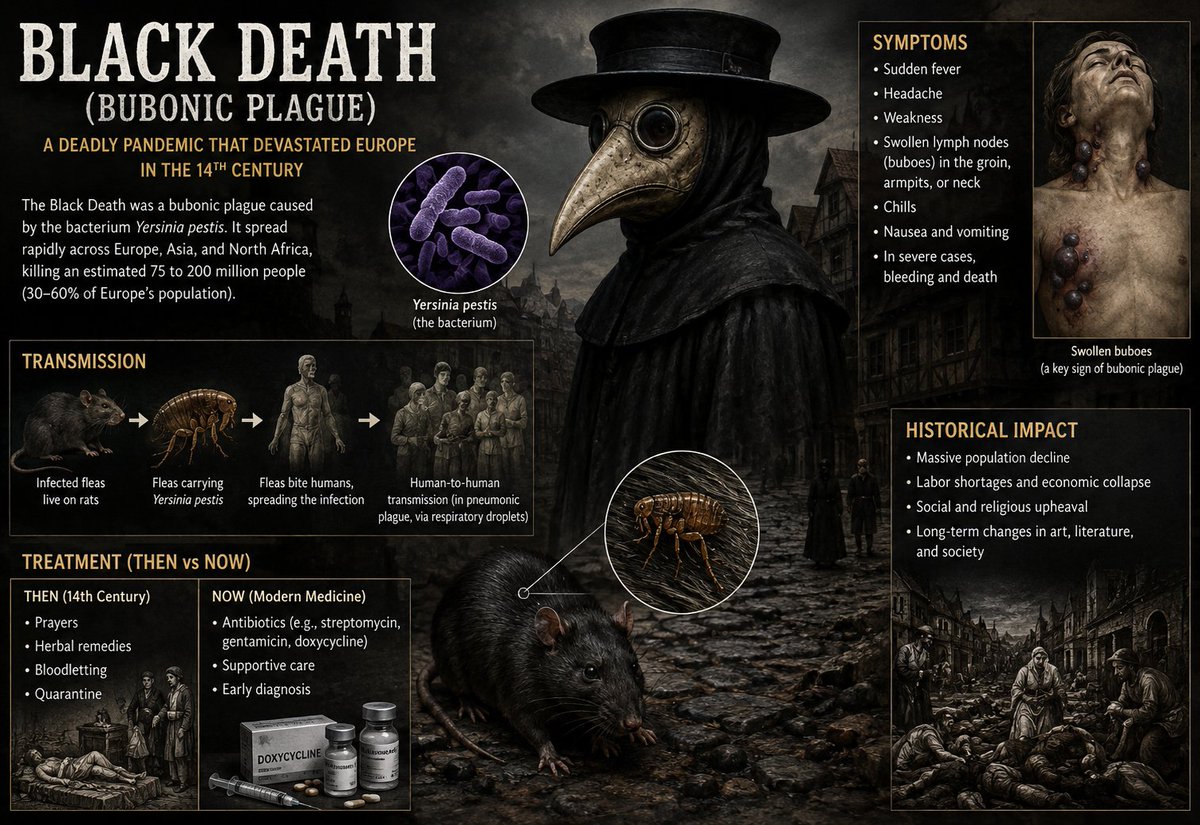
The Black Death reminds us how infectious diseases can reshape civilizations and why science, surveillance, sanitation, and public health remain essential.
History isn't just about the past. It's a lesson for the future.
Today, plague hasn't disappeared.
Cases still occur in some parts of the world, but modern antibiotics can effectively treat it if diagnosed early. Early medical care makes a huge difference.
The Black Death didn't just kill people; it transformed society.
It led to: Massive labor shortages, Economic disruption, Social unrest, Changes in medicine and public health, Lasting impacts on European history
Many believed the plague was caused by bad air, divine punishment, or supernatural forces. Treatments like bloodletting and herbal remedies rarely worked.
In the 14th century, people had no idea bacteria existed.
Many believed the plague was caused by bad air, divine punishment, or supernatural forces. Treatments like bloodletting and herbal remedies rarely worked.
There was also pneumonic plague, which infected the lungs.
Unlike bubonic plague, it could spread directly from person to person through respiratory droplets, making outbreaks even more dangerous.
The most common form was bubonic plague.
Victims developed: • High fever • Chills • Severe weakness • Painful, swollen lymph nodes ("buboes") in the neck, armpits, or groin
Without treatment, many died within days.
The disease was caused by a bacterium called Yersinia pestis. It was commonly spread through fleas that lived on infected rats. When infected fleas bit humans, the disease spread rapidly.
Between 1347 and 1353, one of the deadliest pandemics in human history swept across Europe, Asia, and North Africa. It became known as the Black Death.
An estimated 75–200 million people died.