The Opportunity & Inclusive Growth Institute @MinneapolisFed supports research to expand economic opportunity and inclusive growth for all. RT≠endorsement
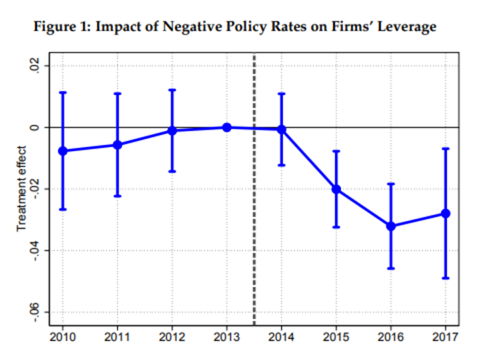
To operate, firms often rely on external financing, so firms’ access to credit may affect workers’ wages + employment. In a new paper, @economoser, Saidi, Wirth, & Wolter examine the heterogeneous effects of credit supply on workers within & between firms https://t.co/UW4CS3XPp0
New Institute working paper looks at the chain from credit to firms to workers. From Christian Moser (@economoser), Farzad Saidi, Benjamin Wirth, and Stefanie Wolter: https://t.co/UW4CS3XPp0
States with larger increases in employer concentration & higher prevalence of noncompete agreements show larger declines in efficiency of on-the-job-search. @NiklasEngbom@aniketbaksy@danicaratelli show how this has affected real wage growth in the U.S.: https://t.co/Sk9xwrVTG6
Why do 40% of high-aptitude students—especially low-income students—skip high-quality universities? @oksana_leukhina@stlouisfed research examines this "quality undermatch" gap and explores solutions to improve equality of opportunity. https://t.co/Mgs3Bxt0mm
Differences in nonwage income later in life may reflect opportunities earlier in life. Even with similar wages, Black and Hispanic households tend to receive less nonwage income in retirement. Our new article explores these patterns. https://t.co/6icDYmPU1N
Median household income reflects not only how much each person earns but also how many earners each household has. Changes in households have had large effects on U.S. trends in real median HH income, as @agoodmanbacon & Richard Liu explain https://t.co/c55UrKcOxE
From Uber driver pay schedules to ACT scores to microequity financing, visiting scholar @k_haggag@UCLAanderson uses economics to explore questions of poverty and inequality across diverse contexts. https://t.co/miBagardpy
In the U.S., the length of family leave benefits is headed up--but the length of actual leave-taking appears headed down. Our article looks at the parental leave landscape with research from @RebeccaSJack, @bdtimpe, and @DannyTannenbaum@UNLincoln: https://t.co/BUWJIkR4pK
Jesse Rothstein wants to understand how jobs differ from each other--why firms in some regions of the country and some industries pay more than others. His research helps economists build a more realistic picture of the labor market. Read his interview: https://t.co/Wl3hgvTi7A
What’s happening to the job ladder in the U.S.? In new paper @NiklasEngbom@aniketbaksy@danicaratelli show that employed workers today are about half as likely to receive a better-paying outside offer as they were in the 1980s. Read the paper: https://t.co/Sk9xwrVTG6
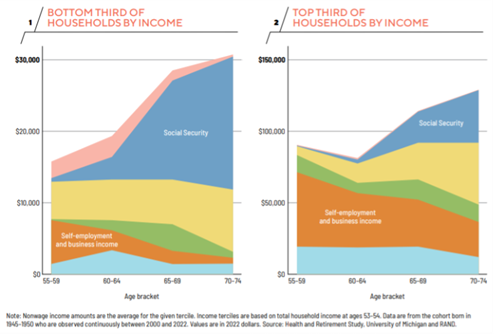
Nonwage income makes up approx 40% of total personal income in US--but differs in important ways from wage & salary income, its more familiar counterpart, and is more unequally distributed. We use IDDA & @hrsisr data to assess this income source: https://t.co/6icDYmPU1N
Parents who welcome a child may use federal unpaid leave, disability insurance, state paid leave, or employer-sponsored benefits for leave. But how much leave do parents actually take? Moms take an average of 7.2 weeks; dads take 3 days. Our article: https://t.co/BUWJIkR4pK
In the U.S., the length of family leave benefits is headed up--but the length of actual leave-taking appears headed down. Our article looks at the parental leave landscape with research from @RebeccaSJack, @bdtimpe, and @DannyTannenbaum@UNLincoln https://t.co/BUWJIkR4pK
Households in the bottom third by income have an avg of $28K in nonwage income at age 65, and Social Security makes up about half. Households in top third have an avg of $114K and Social Security is less than one-fifth. More in For All data dive: https://t.co/XN4n2Ix3Py
“When the data start telling us that things we think should be random don’t look like they’re random, there is a lot of fun in trying to think what could be going wrong." Read our spotlight on @ChicagoFed's Dan Hartley and his research on housing policies https://t.co/c55UrKcOxE
In the new issue of For All, we explore who has nonwage income, sources of intergenerational mobility, access to higher education, and the role of neighborhoods on loan repayment. Grab your copy or check it out online: https://t.co/ZNMupknhac
What does real median household income tell us about Americans' well-being? Senior economist @agoodmanbacon and Richard Liu break down this flagship economic statistic--what it tells us, what it doesn't, and why we need more than just one number. https://t.co/c55UrKcOxE
States with larger increases in employer concentration and higher prevalence of noncompete agreements show larger declines in efficiency of on-the-job-search. @NiklasEngbom@aniketbaksy@danicaratelli show how this has affected real wage growth in U.S.: https://t.co/Sk9xwrVTG6
Most Americans receive relatively little nonwage income--the median in 2023 was just $3K per adult. But 2 groups uniquely rely on it: higher-income Americans & older Americans. We look at how nonwage income matters for these households in new For All https://t.co/6icDYmPU1N
Firm quality and labor market frictions. Nudges to benefits-eligible populations. Universal child care. Jesse Rothstein's work spans many topics, guided by the goal of designing well-functioning policy. He discusses what works in the new For All. https://t.co/Wl3hgvTi7A