CNHI, the corporate owner of @McAlesterNews and several other papers in the state, has ordered the deletion of all X accounts belonging to CNHI properties companywide effective immediately.
The decision cites Blox disabling direct posting to X and low reader referral rates.
This NYT piece is an endless stream of bangers.
I swear, one of the more destructive recent cultural trends has been the combined push to frame all distress or discomfort as mental illness, and then to encourage people to form their identity around being “mentally ill.”
This is absolutely not ok, not the norm and upsetting on so many levels. I take my job very seriously, I hold myself accountable for all I say, I build trust with coaches and never make something up. I know my fellow reporters do the same.
This is extremely infuriating and completely unethical. DON'T FOR ONE SECOND BELIEVE THIS IS THE NORM. This is already a role in a profession that is already stereotyped as just being "eye candy." Good sideline reporters do their homework, talk to players and coaches throughout the week & on game day and most definitely don't make up reports. Period. There's still journalism involved, despite what you may think.
ICYMI: OU Daily was one of 12 media organizations across the state — and Oklahoma’s only college media outlet — named Friday to participate in a groundbreaking project to cultivate trust in local journalism:
https://t.co/4iKvJfhrzi
Florida’s university system was sued Thursday over its effort to silence a chapter of a pro-Palestinian student group, with a free speech group arguing that the state is violating the First Amendment rights of an organization that’s promoting peace. https://t.co/TAoQyV10X9
Thanks to @stevenwaldman for noting Rosemary Avance and @Shortle’s deep dive into local news for @OklaMediaCenter. Their research found Facebook led all social media platforms mentioned as sources of local news and information with 77 percent in #Oklahoma. https://t.co/NxYb96FlFB
“Is it worth it in their lives? Is it really the best way to use that many years?”
OU leaders are pondering the value of a college degree amid shifting attitudes toward higher ed as enrollment dips and tuition increases nationwide:
https://t.co/vx9KtO0tmy
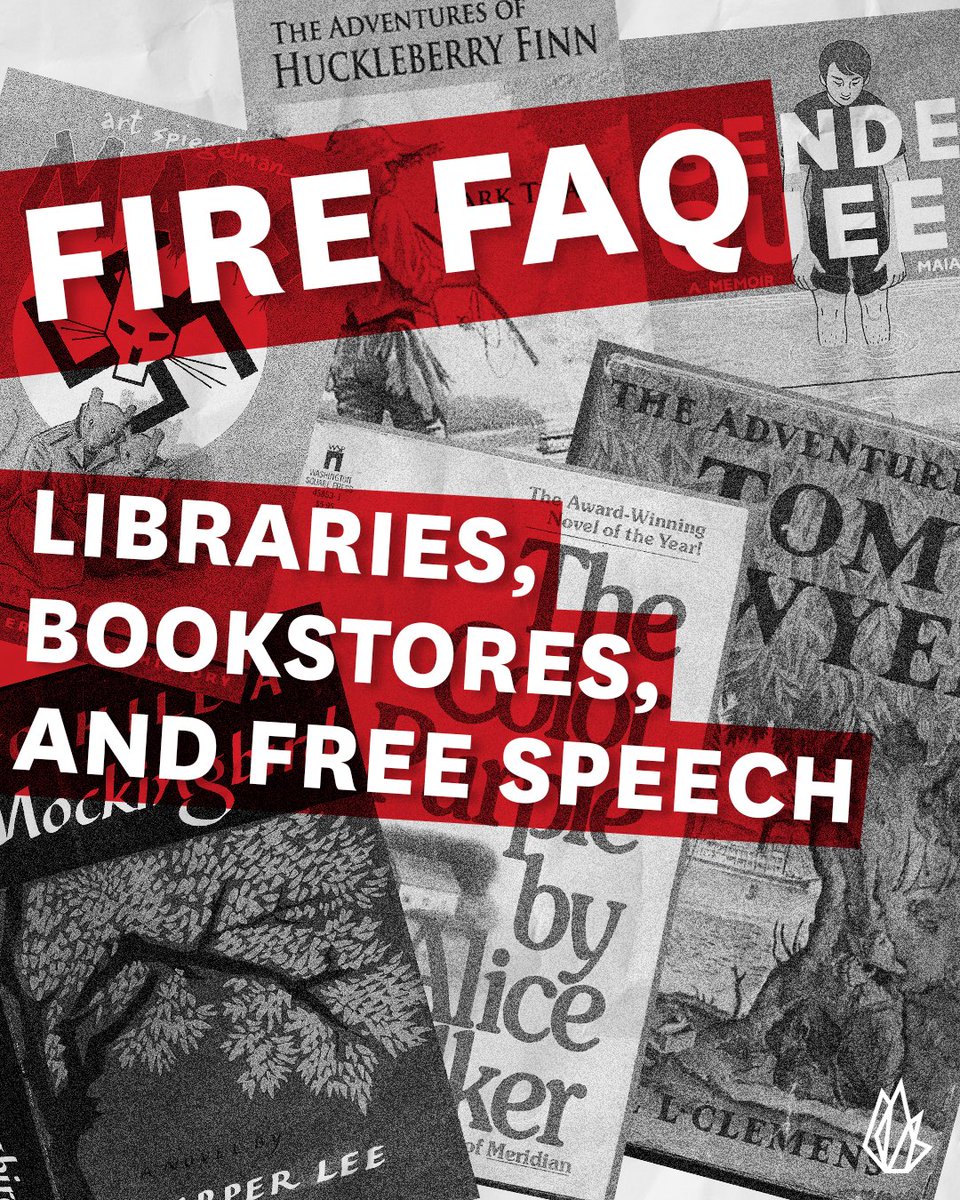
In the last few years, libraries have become an active front in America’s culture war.
States are passing laws or rules that impose vague and broad restrictions on what materials school or public libraries can carry.
At the local level, some governments are seeking to shut down public libraries that refuse to censor. Some books have even been taken to court to ban them from circulation.
These are deeply troubling developments.
Our democracy depends on citizens’ ability to explore, share, and discuss ideas and information free from government interference.
Unfortunately, the debate around library books tends to obscure more than it enlightens.
There are important distinctions — for example, public libraries vs. school libraries, curricular vs. library materials, hostility to views or ideas vs. concerns about age appropriateness — that too often go ignored.
Click here to see how FIRE addresses these issues and other commonly asked questions about restrictions on library materials. ➡️ https://t.co/BtbqIp77Yh
There's a long list of reasons why anonymity is vital to free speech. To pick just one, imagine what eliminating online anonymity would mean for people in the U.S. from unfree countries. They might have to choose between speaking out and protecting family. https://t.co/PdCWu3ZHve
A journalist who was arrested during his coverage of a press conference following the Norfolk Southern train derailment in East Palestine, Ohio earlier this year sued the city and several law enforcement officials on Monday.
https://t.co/AKcM5OtOYc
As campuses reel, a reminder of the First Amendment’s boundaries | @WillatFIRE
The First Amendment protects a vast range of speech and expressive conduct.
But it doesn’t protect all speech and expressive conduct.
The categorical exceptions to the First Amendment are few, narrow, and carefully defined.
To protect freedom of expression, they must remain that way.
But they do exist, each for good reason.
And as campuses grapple with students and faculty expressing raw anger, fear, and shock over events in Israel and Gaza, it’s useful to revisit the boundaries between protected expression and actionable misconduct.
Violence:
Let’s start with the basics: Violence is never protected by the First Amendment.
Sadly, FIRE has seen footage of campus protests turning violent, with some participants physically assaulting others.
Physically confining students within a given space is likewise unlawful.
Anyone who engages in violence should be arrested and face criminal prosecution.
True threats and intimidation:
Just as violence is unprotected, so too are true threats and intimidation.
A true threat is a “serious expression of an intent to commit an act of unlawful violence to a particular individual or group of individuals.”
Intimidation “is a type of true threat, where a speaker directs a threat to a person or group of persons with the intent of placing the victim in fear of bodily harm or death.”
Importantly, the speaker does not need to actually intend to engage in violence for the government to punish threats or intimidation.
As the Supreme Court clarified earlier this year in Counterman v. Colorado, the speaker crosses beyond the First Amendment’s protection when he knows of or “consciously disregard[s] a substantial risk that his communications would be viewed as threatening violence.”
Sadly, we’ve seen true threats these past few weeks, too.
A Cornell student was arrested Tuesday for allegedly authoring online posts threatening Jewish students on campus.
Among other statements, the student said he would “bring an assault rifle to campus and shoot all you pig jews.”
This constitutes a true threat: Both on its face and taken in context, it is a serious expression of an intent to commit unlawful violence against a group of individuals.
By posting it, the author disregarded the obvious risk that it would be viewed as a threat of violence.
If proven to be the author, the student will properly face criminal sanctions.
Other statements are less clear-cut and require contextual analysis.
For example, if students at a peaceful protest chant anti-Israel slogans like “From the river to the sea, Palestine will be free,” that speech, taken alone, is protected political expression.
Even if some understand the phrase to call for the destruction of Israel, it is still — absent more — protected as political speech, advocating in general terms for violence elsewhere at an unspecified time against a broadly defined target.
(For more on why such speech is protected, see the discussion of incitement below.)
But context is determinative: Were the same statement to be directed at a specific Jewish student by a student or group moving threateningly towards him, during a protest that has turned violent and unstable, it may arguably constitute a true threat.
Incitement:
Incitement — speech that is both “directed to inciting or producing imminent lawless action and is likely to incite or produce such action” — is unprotected by the First Amendment.
The standard comes from the Supreme Court’s 1969 decision in Brandenburg v. Ohio, a First Amendment challenge to the arrest of Ku Klux Klan members under an Ohio criminal syndicalism law prohibiting “advocat[ing] . . . the duty, necessity, or propriety of crime, sabotage, violence, or unlawful methods of terrorism as a means of accomplishing industrial or political reform” and “voluntarily assembl[ing] with any society, group, or assemblage of persons formed to teach or advocate the doctrines of criminal syndicalism.”
Journalists captured footage of the armed Klansmen using slurs against black and Jewish people.
The Klansmen stated there “might have to be some revengeance taken” against government officials and announced a march on Congress on the Fourth of July.
Quoting its earlier decision in Noto v. United States for the proposition that “the mere abstract teaching . . . of the moral propriety or even moral necessity for a resort to force and violence, is not the same as preparing a group for violent action and steeling it to such action,” the Brandenburg Court struck down the Ohio law.
Because the statute “purports to punish mere advocacy and to forbid, on pain of criminal punishment, assembly with others merely to advocate the described type of action,” the Court held it violated the First Amendment.
It’s important to emphasize that to lose protection as incitement, the speech at issue needs to be (1) directed to producing (2) imminent lawless action and (3) likely to result in such action.
In other words, the speaker must intend for his audience to break the law all but immediately, and the audience must be primed to do so.
That’s a necessarily high bar, designed to protect a great deal of charged political expression by capturing only that speech that is all but inseparable from the unlawful action that directly follows it.
As with true threats and intimidation, determining whether speech constitutes incitement requires careful consideration of contextual circumstances.
With regard to campus protests, a campus speaker’s exhortations to a willing audience to attack a passerby might lawfully face punishment as incitement.
Discriminatory harassment:
Colleges and universities that accept federal funding — the vast majority of campuses, both public and private — must maintain and enforce policies prohibiting discriminatory harassment on the basis of certain protected class statuses.
Title IX, for example, prohibits discrimination on the basis of sex, and Title VI prohibits discrimination on the basis of race, color, and national origin.
Notably, federal anti-discrimination law does not prohibit discrimination on the basis of religion.
FIRE has called on Congress to remedy that omission.
In the absence of a statutory protection against discrimination on the basis of faith, the federal Department of Education’s Office for Civil Rights has maintained for nearly 20 years a policy of addressing discrimination based on a student’s actual or perceived “(i) shared ancestry or ethnic characteristics; or (ii) citizenship or residency in a country with a dominant religion or distinct religious identity.”
FIRE supports this policy and has called for its codification into federal law.
What do these federal laws mean in practice?
Federal courts have interpreted both Title IX and Title VI to require colleges and universities that accept federal funding to prohibit and address discriminatory harassment — that is, targeted conduct that is so severe, pervasive, and objectively offensive that it denies its target access to an educational opportunity or benefit.
Again, this is an exacting standard by design.
In Davis v. Monroe County Board of Education, the Supreme Court case setting forth the definition of discriminatory harassment in the educational context, Justice Sandra Day O’Connor (writing for the majority) and Justice Anthony Kennedy (dissenting) grappled over whether it was sufficiently protective of student speech rights.
But while the Davis standard is necessarily high, it is by no means insurmountable.
And in this charged moment, it is unfortunately easy to imagine students being targeted for harassment on the basis of their perceived or actual national origin, shared ancestry, or ties to a country with a dominant religion or distinct religious identity.
When that happens, and when the harassment is so severe, pervasive, and objectively offensive that it denies the targeted students access to educational opportunities or benefits — say, being able to attend class or visit the library — it requires an institutional response.
When colleges and universities fail to act to address such discriminatory harassment, properly defined, they violate federal law.
The heckler’s veto:
The First Amendment protects both a speaker’s right to express themself and the right of others to receive that expression.
As Justice Thurgood Marshall put it, “The freedom to speak and the freedom to hear are inseparable; they are two sides of the same coin.”
To that end, taking action to silence the lawful speech of others is illiberal and, in some cases, unlawful.
When a speaker is silenced by those who disagree with their speech, the heckler’s veto is at work, and the First Amendment is under threat.
As the Court has observed, “Speech cannot be financially burdened, any more than it can be punished or banned, simply because it might offend a hostile mob.”
So, for example, when posters or flyers are lawfully affixed in a given space — like on a campus bulletin board — their unauthorized removal to silence their message effectuates a heckler’s veto.
Such removal is vandalism and properly subject to punishment.
Defacing or destroying someone else’s property is not protected by the First Amendment.
Or if a campus student group hosts a speaker in a reserved space on campus, only to be shouted down and forced to cancel by those with an opposing viewpoint, the heckler’s veto is again in play.
Campus administrators have an obligation to facilitate the ability of both groups to speak their minds peacefully, without one effectively overriding the expressive rights of the other.
Only as a last resort may campus administrators or law enforcement prevent a speaker from exercising their expressive rights in the face of an angry or opposing crowd.
As the U.S. Court of Appeals for the Sixth Circuit has observed: “Punishing, removing, or by other means silencing a speaker due to crowd hostility will seldom, if ever, constitute the least restrictive means available to serve a legitimate government purpose.”
In this challenging moment, consistency counts:
Our campuses are roiling in reaction to armed conflict.
The subtext of horror and violence weighs heavily on both those speaking and those listening.
This is a fraught time.
For nearly 25 years, FIRE has worked tirelessly to protect and preserve freedom of expression on campus.
In our experience, extremely challenging and emotionally charged moments like the one in which we now find ourselves are when expressive rights most need delineating and defending.
Times like this may seem to present the most righteous justifications for bending the rules in one direction or the other, to either permit the censorship of protected speech or to allow unprotected speech or violence to go unpunished.
But we cannot let either happen.
Now as ever, it is vital for all of us — students, faculty, administrators, alumni, law enforcement, elected officials, and the general public — to hold steadfast to the First Amendment, remaining both cognizant of its carefully defined exceptions and confident in its continuing protection.
FIRE will stay on task.
The A&M Pride Center will rebrand to the Student Success Center before the end of the year due to SB 17's DEI prohibition. The Queer Empowerment Council, a group of LGBTQIA+ student organizations, will be hosting events the center previously held.
https://t.co/mjxEgZr9Mo
EKU’s editorially independent student newspaper, has spent the better part of the last year — with the help of FIRE’s Student Press Freedom Initiative — battling this unconstitutional gag order. / @OColly@OUDaily, same policy at your schools?