Intimidation & death isn't enough to stop what is coming..
May the souls of all our comrades rest in perfect peace Amen 🕯
A new Nigeria is POssible!
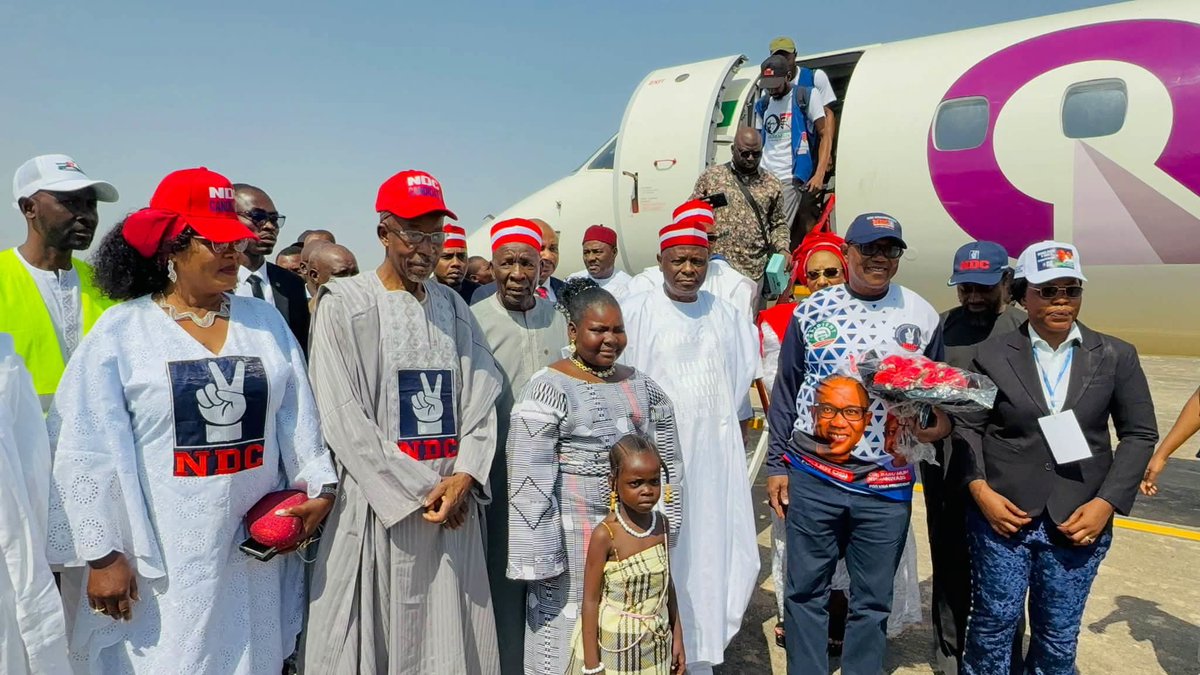
Touch down Taraba..
HE Peter Obi & Engr. Rabiu Kwankwaso are live in taraba for townhall meeting..
The wait time is slim, our new Nigeria is upon us!
#PeterObiinTaraba#AnewnigeriaisPOssible
Touch down Taraba..
HE Peter Obi & Engr. Rabiu Kwankwaso are live in taraba for townhall meeting..
The wait time is slim, our new Nigeria is upon us!
#PeterObiinTaraba#AnewnigeriaisPOssible
From cleaning to mobilisation, the people are ready!
Obi/Kwankwaso✅
Nigeria will be OK✅
A New Nigeria is POSSIBLE!
#OperationCleanUpAbuja#OKMovementFCT
"Everyone who desires a better Nigeria must come out and vote, and remain to protect their votes until INEC uploads the results. No one can rig the 2027 election."
- Mr Peter Obi, NDC Presidential Candidate, speaking today in Niger State.
The call is clear: Vote. Stay. Protect your vote.
#PeterObi #NDC #NigerState #ProtectYourVote #ANewNigeriaIsPossible
NIGERIANS, GO AND VERIFY (7)
LIFTING THE VULNERABLE : ANAMBRA’S BLUEPRINT FOR POVERTY ALLEVIATION AND SUSTAINABLE EMPOWERMENT (2006–2014)
Economic growth that does not translate into improved living conditions for ordinary citizens is incomplete. This is one of our fundamental concerns with President Bola Ahmed Tinubu's government. Development must ultimately be measured by its impact on human lives, particularly those of the poor and vulnerable. This was underpinned by the Anambra Integrated Development Strategy (ANIDS). We believed that infrastructure, education, healthcare, agriculture, and social protection must reinforce one another. Poverty was not merely a shortage of money; it was also a lack of access to opportunities, productive resources, and the basic conditions necessary for a decent life.
Our poverty alleviation strategy, therefore, went beyond temporary handouts. It focused on restoring dignity, creating economic opportunities, and equipping vulnerable citizens with the means to become self-reliant.
Our approach attracted recognition beyond Anambra. In May 2010, Magnus Kpakol, then National Coordinator of the National Poverty Eradication Programme (NAPEP), commended our commitment to poverty reduction, declaring: “We are prepared to support you in the excellent work you are doing in Anambra State.”
1. POVERTY MAPPING: KNOWING WHERE POVERTY LIVES
We recognised that poverty could not be effectively addressed without knowing where it was concentrated and what caused it. We, therefore, undertook a poverty-mapping exercise to identify the most deprived local government areas and communities.
The exercise revealed that some of our poorest communities were also important food-producing areas. Their challenges included poor access to markets, agricultural inputs, electricity, water, and other economic opportunities.
Areas including Anambra West, Orumba South, Awka North, and Ogbaru required particular attention. The findings informed our development priorities, enabling us to direct roads, agricultural support, and social interventions toward neglected communities.
2. EMPOWERING WOMEN, WIDOWS, AND COOPERATIVES
We recognised that rural women, widows, and indigent households bore a disproportionate burden of poverty. Across the 21 local government areas, we provided financial assistance and productive support to thousands of beneficiaries.
Our administration provided financial assistance to support the establishment and expansion of small businesses and farming activities. We also introduced revolving loan schemes to promote enterprise development, economic self-reliance, and improved livelihoods.
We distributed productive equipment, including sewing machines, generators, ovens, cookers, hair dryers, shoe-making machines, and welding equipment. The objective was to help beneficiaries establish sustainable livelihoods rather than remain dependent on government assistance.
We also promoted access to microcredit and cooperative financing to enable small entrepreneurs to expand their businesses, improve their incomes, and create employment.
Our philosophy was simple: rather than merely giving people money to survive today, the government should help them acquire the means to earn a living tomorrow.
3. AGRICULTURE AND FADAMA: MAKING RURAL COMMUNITIES PRODUCTIVE
Agriculture was central to our poverty-reduction strategy because many rural households depended on farming.
Through partnerships with the Federal Government, the World Bank, and other development partners, particularly under the FADAMA programme, we supported farmers with finance and productive assets.
In November 2009, our administration disbursed millions to FADAMA Community Associations across the state. By October 2010, the National FADAMA office was commending Anambra’s commitment. Its National Project Coordinator, Buka Tijjani, represented by Charles Ugwuona, described Anambra as the leading state in the programme.
ZUBA IS MASSIVE! 🔥🔥🔥
Look at the crowd! Look at the energy!
Operation Clean Up Abuja is not just a clean up, it is a MOVEMENT!
Zuba came out in numbers. Traders, youths, women, everyone!
This is what a New Nigeria looks like. The people have decided!
OBI/KWANKWASO✅
Nigeria will be OK✅
#OperationCleanUpAbuja #Zuba #OKMovement #MassiveCrowd #PeterObi #NDC
IT'S TODAY! OPERATION CLEAN UP ABUJA - ZUBA EDITION 🧹🇳🇬
We are not just cleaning Zuba, we are showing what a New Nigeria looks like. Clean streets. Clean leadership. Clean future.
Join OK Movement FCT this morning as we clean, sensitise and mobilise.
📍 Zuba, Gwagwalada Area Council
🕖 7:00am Prompt
Come with your energy. Come with your broom. Come with your PVC spirit.
Nigeria will be OK✅
#OperationCleanUpAbuja #OKMovement #Zuba #CleanUpAbuja #PeterObi #NDC
HE PETER OBI SHUTDOWN ANAMBRA 🔥🔥🔥
No billboard. No rented crowd. No inducement.
From Head Bridge to Ochanja, Onitsha Main Market to Iweka Road to Awka Road.
The whole city stood still.
This is not a campaign. This is LOVE. This is MOVEMENT.
Nigeria will be OK✅
#PeterObi #ObiInAnambra #NDC
FCT OK Movement
Office of the Zonal coordinator Abuja North..
The FCT Zonal Coordinator of Abuja North, in the person of Ambassador Onyefulu Sunday Michael, under the capacity leadership of Mr Itumo Maduabuchi (FCT OK Coordinator) paid a courtesy call to Hon. Hassan Ahmed Grema, (House of Rep Candidate for Amac/Bwari)
The call was aimed at congratulating the House of Rep Candidate on his successful candidature as well as intimating him on core objectives of the OK Movement in the FCT. The Zonal Coordinator relayed most of the accomplished program of the movement as well as prospective events to be carried out, especially the upcoming clean up Abuja exercise coming up on Saturday 21st November 2026 and the need for every candidates in the FCT to be carried along in FCT OK formidable campaign activities..
Our Candidate (Hon. Grema) thanked every member present & pledged his continuous commitment towards the outlined programmes for the OK FCT Chapter. He also reiterated the importance of our Ok structures & appreciated the movement for the great work in the FCT.
So many other things were outlined & discussed, it was a fruitful outing & we look forward to augmenting our already viable structures & re-doubling our efforts in other to achieve a successful election victory.
Represented from both Amac & Bwari Area Council were present..
Signed
Sen. Christopher Chukwu
Director Digital & Social Media
FCT OK Movement
Our aim was to create a state where public resources produced tangible public benefits, institutions existed to serve the people and development was assessed by the lives transformed rather than by the promises made. We therefore began by strengthening the institutions of government, rebuilding their ability to operate effectively and ensuring that they remained accountable to the public interest. Building on these foundations, we advanced development across multiple sectors through careful planning, responsible resource management and leadership grounded in accountability.
In Series 2, we will first consider the measures we took to restore and reinforce the institutions of the state and ensure that government served the people effectively. We will then review our initiatives and accomplishments in education and other essential sectors.
I assure Nigerians that the progress demonstrated in Anambra State was neither a one-time occurrence nor an experiment that cannot be repeated. It reflected a proven model of governance that we are ready to extend to the national level. What we accomplished in Anambra can also be accomplished in Nigeria. With capable leadership, effective planning, responsible management and accountable institutions, Nigeria, too, can work for all its citizens.
Go and verify. -PO
NIGERIANS, GO AND VERIFY (1)
Introduction: Governance as a Public Trust
Peter Obi
When I took office as Governor of Anambra State, our beloved state was at a critical juncture. Leadership had become increasingly disconnected from the people, and many of the essential institutions needed to support a modern society were weak, ineffective, or absent altogether. We understood that governance could not continue according to established habits. It needed to be reconceived as a solemn public trust founded on transparency, prudence, accountability, and demonstrable results.
Our governing philosophy rested on four principles: character, competence, capacity, and compassion. We understood that leadership was not a platform for self-promotion, political slogans, or the pursuit of personal acclaim. Its purpose was to improve the circumstances of ordinary citizens. It meant converting public resources into concrete benefits and ensuring that government’s foremost responsibility was to serve the people. Achieving this demanded more than good intentions; it required a clear vision, careful planning, and disciplined execution.
Among our earliest findings was that the state lacked a unified development plan to direct its priorities and determine how resources should be allocated. We therefore promptly created the Ministry of Economic Planning to establish the institutional foundation for deliberate, coordinated, and sustainable development. After completing the necessary groundwork and consultations, we launched the Anambra Integrated Development Strategy (ANIDS).
At that time, the Millennium Development Goals (MDGs) were being pursued worldwide across eight clearly defined priorities: eliminating extreme poverty and hunger; achieving universal primary education; advancing gender equality and empowering women; reducing child mortality; improving maternal health; combating HIV/AIDS, malaria and other diseases; promoting environmental sustainability; and fostering a global partnership for development.
We adopted ANIDS as our overarching development philosophy and strategic framework for advancing these objectives, tailoring them to the distinctive circumstances, needs and development priorities of Anambra State. Instead of viewing the MDGs as remote international benchmarks, we worked to convert their aims into practical policies, programs and measurable results that would produce tangible improvements in the lives of our people.
We also undertook a deliberate effort to redefine the state’s identity, changing its public image from ‘Home for All’ to ‘The Light of the Nation’. This was not merely a change in slogan; it reflected our resolve to restore public confidence in government, renew civic pride and show that Anambra could serve as a model of purposeful leadership and development.
The ANIDS Blueprint: A Comprehensive Framework for Development
ANIDS served as the foundation for our commitment to broad-based and balanced development. We did not accept the idea that government could focus on a single sector while leaving others behind. We recognized that education, healthcare, infrastructure, security, agriculture and capable public institutions were mutually dependent. Advancement in one area could not be sustained without commensurate progress elsewhere. Accordingly, we pursued development across every sector, guided by defined priorities, disciplined planning and prudent stewardship of public resources.
Central to this vision was the restoration of the dignity of the Anambra person. We understood that dignity could not be restored through rhetoric alone. It was evident in the condition of roads and other infrastructure, the availability of healthcare, the quality of education, the performance of public institutions and the way government treated its workers, pensioners and traditional institutions.