Detail of the Golden Throne of Tutankhamun, c. 1332-1323 B.C.
The golden throne of Tutankhamun was discovered in 1922 by the British archaeologist Howard Carter. It was found beneath a hippopotamus funerary bed in the antechamber of the Tomb of Tutankhamun.
The luxurious armchair is distinguished by the complexity of its technique and an abundance of details. Two projecting lions’ heads protect the seat of the throne, while the arms take the form of winged uraei or rearing cobras wearing the double Pschent crown of Egypt and guarding the cartouche names of the king.
Queen Ankhesenamun holds a salve-cup and spreads perfumed oil on her husband’s collar in a typical Amarna style scene, the sun disc Aten shines above the royal couple. At the time it was made, their names were Tutankhaten and Ankhespaaten.
The scene shows one of the most famous and intimate scenes in art history: the young king appears sitting and being regaled with an ointment by his wife Ankhesenamun.
The king wears a composite crown and a broad collar, and the queen wears a diadem. The bodies and wigs of both of them are inlaid with exquisite coloured glass, and their linen robes are silver.
From the Tomb of Tutankhamun (KV62), Valley of the Kings, West Thebes.
Now in the Grand Egyptian Museum. JE 62028
Read more: https://t.co/C9XqZ3S7Ql
#AncientEgypt #Egypt #Tutankhamun #GrandEgyptianMuseum #History
Solar Eclipse on Mars ☀️
This video captures impressive footage of Phobos—Mars’s potato-shaped moon—crossing the face of the Sun. The eclipse was recorded on April 2, 2022, by the Mastcam-Z camera aboard the Perseverance rover. Unlike solar eclipses caused by Earth's Moon, which last about an hour, Phobos transits the solar disk in roughly 40 seconds. The video shows its passage in real time.
Phobos measures only about 20 km across—far smaller than the Moon’s diameter (3,475 km)—yet its proximity to Mars allows it to cover nearly half of the Sun's disk. Mars never experiences total solar eclipses like those seen on Earth.
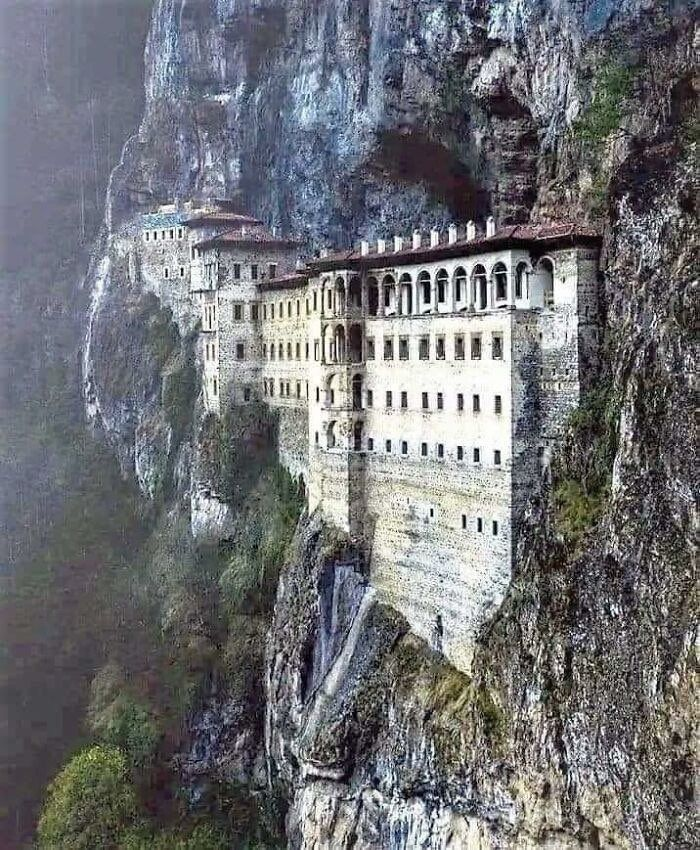
Sümela Monastery doesn’t just sit in the mountains—it seems to emerge from the cliff itself. Perched roughly 1,200 metres above sea level in Turkey’s Pontic Mountains, this Greek Orthodox complex was built into an almost sheer rock face. What fascinates me is how the builders turned such an impossible landscape into a place of worship. Imagine choosing this cliff as the site for a monastery - what made them pick this exact spot?
A CT scan of this 9.7 cm wooden head found a second face of it hidden underneath.
Queen Tiye, c. 1355 BC. She was first carved wearing a silver headdress with a gold cobra. After her husband died, someone wrapped that in linen, beaded it blue, and mounted a goddess crown on top.
She was still alive when they did it.
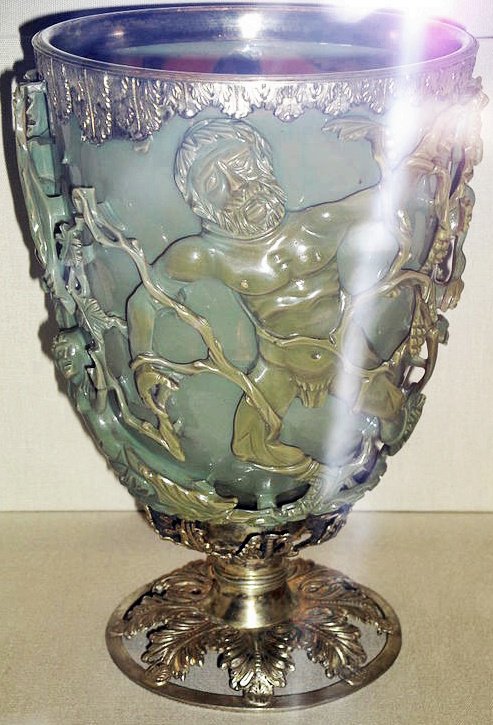
En el Museo Británico se conserva una copa romana del siglo IV, la copa de Licurgo, que se ve verde si la luz le da de frente y roja si se la ilumina por detrás. La explicación no llegó hasta 1990, con el microscopio electrónico. El vidrio lleva repartidas por la pasta partículas de oro y plata de unos setenta nanómetros, mil veces más finas que un pelo, y son ellas las que dispersan una luz y dejan pasar la otra. O sea nanotecnología, hecha en un taller del siglo IV.
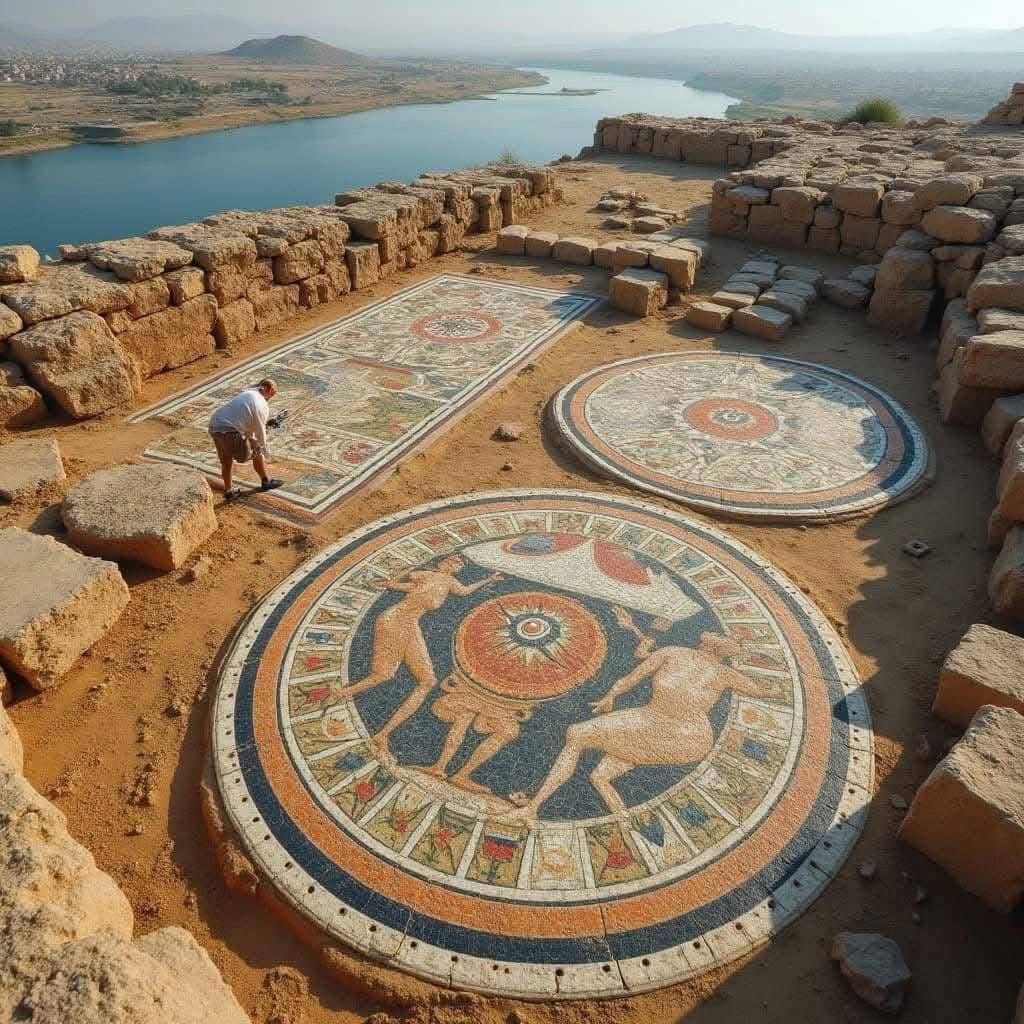
The warm sun of the Levant shines over the ruins of an ancient citadel, high above the blue waters of the Euphrates. Hidden beneath the dust for thousands of years, archaeologists have uncovered beautiful, colorful mosaics.
As the dirt is gently brushed away, bright pieces of stone—orange, red, and deep blue—start to shine again. One round mosaic shows mysterious figures dancing around a glowing eye, revealing the beliefs and creativity of a long-lost civilization.
Standing here, you can almost imagine the people who once lived in this place. It’s a powerful reminder that even though empires fall, the human love for art and meaning never disappears.
Faience Inlay of a King
Late Period–Ptolemaic Period, c. 400–200 B.C.
Reportedly from Memphis (Mit Rahina), Egypt
Met Museum. 26.7.1006
This finely worked polychrome faience inlay depicts the upper body of a king with his arms raised. It belongs to a remarkable group of hieroglyphic inlays thought to have formed part of a large royal inscription, perhaps decorating the side of a wooden shrine.
Most pieces in the group are said to have come from ancient Hermopolis, although this royal figure was reportedly found at Memphis. The surviving divine figures and hieroglyphs may preserve elements of a 30th Dynasty king’s royal names, with those of Nectanebo II (c. 360–343 B.C.) particularly well suited to the surviving arrangement.
The world’s largest ancient mosaic discovered in Turkey.
Archaeological excavations in Antakya, Turkey have turned up the largest floor mosaic at 9,000 square feet (836 m²) made in late Roman period, IV Century CE.
Limestone statue of the wife of Nakhtmin
New Kingdom, late 18th Dynasty, Reign of Tutankhamun, c. 1332–1323 B.C.
This graceful statue depicts the unnamed wife of the military commander and royal scribe Nakhtmin.
She wears a finely pleated linen dress, an elaborate wig adorned with a lotus blossom, and holds a menat necklace, an emblem of the goddess Hathor associated with fertility, protection and joy.
Originally part of a pair statue with her husband, the sculpture bears signs of deliberate ancient damage, likely inflicted during the political turmoil that followed the Amarna Period, yet it remains a superb example of the refined artistry of the late 18th Dynasty.
THEY BRUSHED AWAY THE DUST… AND FOUND THIS 👁️
For thousands of years, this ancient artwork lay hidden beneath the ground near the Euphrates.
Then archaeologists slowly brushed away the dust—and bright colors began to appear. Red, orange, and deep blue stones formed a beautiful mosaic.
But one detail stands out: a strange glowing eye surrounded by figures that seem to be dancing around it.
What did the eye mean? Was it a god, a symbol of protection, or something we still don’t understand?
The people who made this art are long gone. Their world disappeared centuries ago.
But their mysterious message is still here, waiting for us to see it. 👁️
This Roman bath still flows at 45°C 1,900 years later.
Built in the 2nd century AD on a natural hot spring, it kept going through Byzantine, Seljuk, and Ottoman times.
Same spring the Romans used. Still running.
Ancient engineering that never quit.
Basilica Therma in Sarıkaya, Turkey
A glimpse into the past at Ta Prohm: the mysterious dinosaur carving sparks endless curiosity. This ancient wonder draws travelers from all corners, blending history with imagination. Step into a world where time stands still and legends come to life.