Mario Hezonja went fifth overall in the 2015 NBA draft. He was 20, Croatian, nicknamed Super Mario, and he was supposed to be a star.
Five seasons later he was unemployed.
The Orlando Magic drafted him and gave up on him. The New York Knicks took a season. The Portland Trail Blazers took a season. Career average, 6.9 points a game. In November 2020 the Memphis Grizzlies traded for him, and in December 2020 the Memphis Grizzlies waived him before the season even started. He never played a game for them. He was 25 years old and out of the league.
So he went back to Europe, which sounds like a soft landing and is not. Panathinaikos in Greece. UNICS Kazan. Then in 2022, Real Madrid, one of the heaviest jobs in the sport, where being the washed out NBA lottery pick is not something anyone lets you forget.
He stayed four years. He won the EuroLeague in 2023 and lost the final in 2024. In June 2026, at 31 years old, he was named MVP of the Spanish league.
Six weeks later the Cleveland Cavaliers signed him.
Hezonja wrote this on X afterward. "Never liked how I left the NBA but these past 5 years have been exactly what I wanted and much needed!"
Read that first clause again. Never liked how I left. He is 31 and he is still carrying the exit.
At Cavaliers media day in late September, he was asked what is different about him now, and his answer was not about confidence or maturity or any of the things players usually say. It was about his body.
"I was drafted, man, at 6-6, 190. I remember looking like a child even in summer league."
"And now I'm coming back at 6-9, 260, so that definitely adds to the versatility the team can use."
Official listings in 2015 had him taller than 6-6, so take the tape measure loosely. The point he is making is not about inches. It is about the fact that the 20 year old who got drafted on potential has spent six years turning himself into a different physical object.
Asked how, he did not dress it up.
"For the weight, I can tell you from a lot of crazy hard work. Never quitting, always doing extra."
"It's just like crazy, crazy hard work and stupid almost dedication to it."
Stupid almost dedication. That is a man describing six years of work nobody in America was watching.
The honest counterpoint. This is a one year contract, and the Cleveland Cavaliers signed him for frontcourt depth after losing Dean Wade and Keon Ellis, not to be a centerpiece. Being the best player in the Spanish league at 31 has never been a guarantee of anything in the NBA, and his first run produced 6.9 points a game. There is a real chance this ends quietly.
But the fifth pick of the 2015 draft got written off at 25, went somewhere he could be seen failing, and worked for six years until the league asked him back. He does not have to prove it was worth it. He already went and did it.
If you love basketball stories like these, follow us on any platform @ontaphoops
Bennett Stirtz left high school in Liberty, Missouri as a first team all state guard. He averaged 18.3 points, 6.8 rebounds, 4 assists and 2.5 steals a game as a senior. His father was his coach.
He had zero Division I scholarship offers.
Not a few. Not the wrong ones. Zero.
One coach had bothered to come look. Ben McCollum drove out to a Liberty practice during Stirtz's junior year, watched him, and decided he wanted him. McCollum was the head coach at Northwest Missouri State, a Division II school, and he had already won four national championships there before Stirtz ever arrived.
Stirtz went. He was homesick early, even though the campus sat barely an hour from his hometown. He stayed anyway. MIAA Freshman of the Year. Second team all conference twice.
Then McCollum got the job at Drake, and Stirtz followed him there.
One season at Drake. Missouri Valley Conference Player of the Year. Newcomer of the Year. First team all conference. Conference tournament MVP.
Then McCollum got the job at the University of Iowa, and Stirtz followed him again.
This is the part that actually tells you something. By then everybody wanted Bennett Stirtz. McCollum told the Associated Press that some programs were chasing him with far larger offers, and that a few of them were doing it illegally. Stirtz went to Iowa.
"I thought I would regret it if I didn't go," he said.
First team All Big Ten. Iowa reached the Elite Eight in March 2026 and lost to Illinois 71-59, one win short of Iowa's first Final Four since 1980.
Three schools. One coach. Division II to the Big Ten.
In June 2026, Bennett Stirtz was taken 16th overall by the Memphis Grizzlies and traded to the Oklahoma City Thunder, which is how a kid with no Division I offers ended up on the deepest roster in the NBA.
McCollum, asked about all of it, said something you do not hear coaches say.
"I don't think either of us would be here without the other."
Stirtz's version is simpler. He said McCollum shoots you straight and never lies to you. He also said McCollum pushes you past your limit, which is the kind of thing players say about coaches they are grateful for and never say about coaches they merely respect.
The honest counterpoint. Stirtz has not played a minute of NBA regular season basketball. Summer league was encouraging, not conclusive. He has said himself that he has to get better defensively to be useful to the Oklahoma City Thunder, and the Thunder are not a team that hands rotation minutes to rookies out of sentiment. The story so far is about belief, not production.
But somebody drove to a high school practice in Liberty, Missouri to watch a kid nobody else was recruiting, and five years later they are both at the top of the sport. The coach is in the Big Ten. The kid is in the NBA.
Neither of them got there alone. They both say so.
If you love basketball stories like these, follow us on any platform @ontaphoops
In the summer of 2023, a man in Carroll, Iowa sat down and emailed an NBA head coach. He was not asking for tickets.
Carroll Country Club was about to be sold. The golf course on the edge of town, the one where half of Carroll had learned the game, was going to be bought and turned back into cropland, or scraped flat for condos. A resident named James Heller later put it plainly to the Philadelphia Inquirer. They were either going to farm it or they were going to build condos on there.
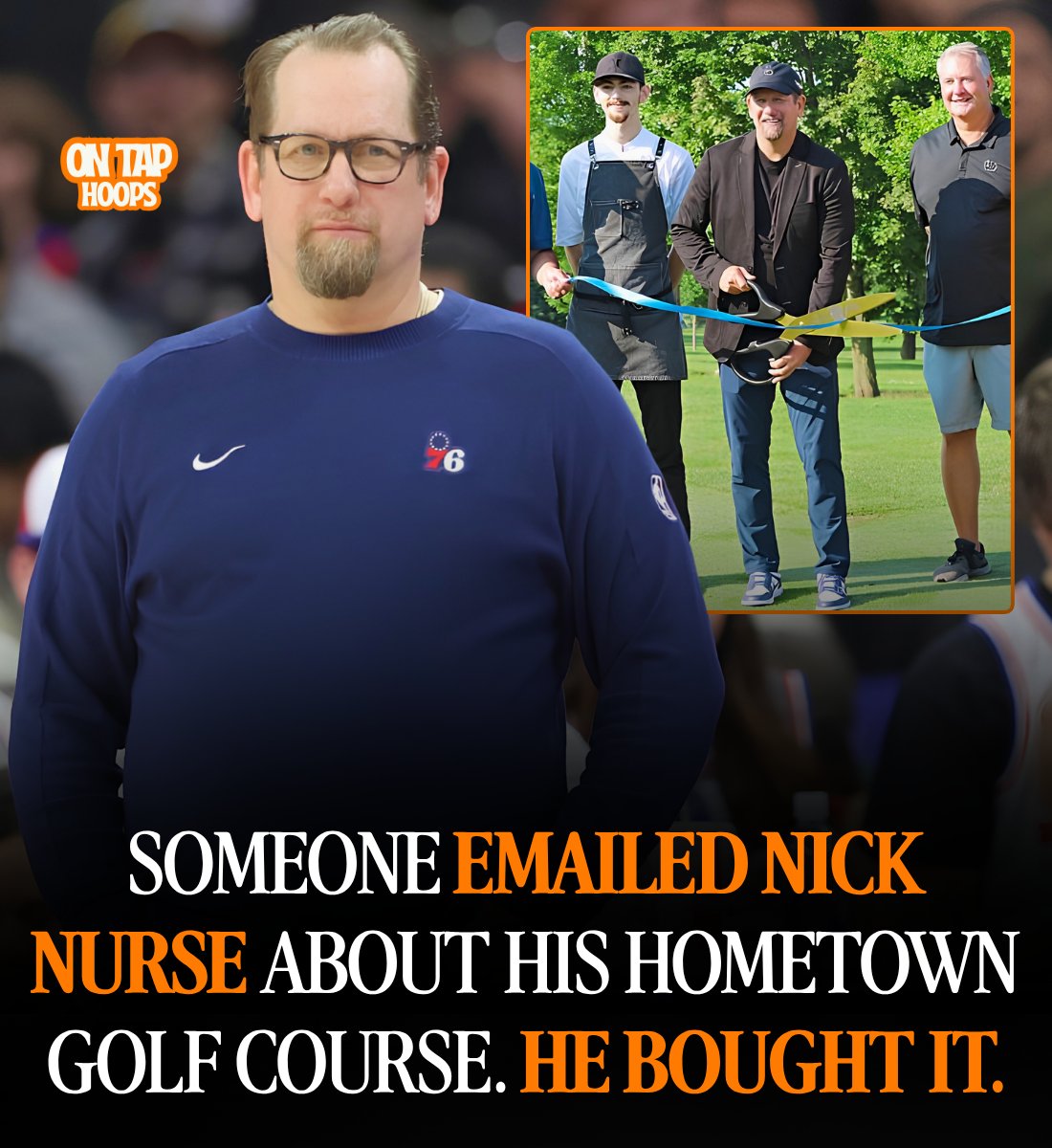
So somebody emailed Nick Nurse.
Nurse is the head coach of the Philadelphia 76ers. He won an NBA championship with the Toronto Raptors in 2019. He spent years coaching overseas and in the minor leagues, in gyms nobody was watching, before any of that happened.
He is also the youngest of nine children from Carroll, Iowa, a town of about 10,000 people.
His parents, Maury and Marcella, who are both gone now, used to drop him off at that golf course in the morning and leave him there for the day. He putted. He swam. He walked into the cornfields along the property line hunting for lost balls. He played the junior tournaments, the father and son tournaments, the club championship. Years later, as a grown man coaching on another continent, he would fly home in the offseason and go play the course with his dad.
His family had been members for more than 35 years.
He read the email. In February 2024, he bought the golf course.
Not a share of it. Not a sponsorship. He bought the whole thing, renamed it Carroll National, and kept the gates open.
Here is the part that is easy to miss. Nurse did not buy it quietly and disappear. He turned it into a two day golf and music festival every summer that raises money for the Nick Nurse Foundation, which works on music, sports and education for kids. The 2025 edition had Jefferson Starship and the Jacksons on the bill. Julius Erving came as a special guest. Which means Dr. J spent a weekend in a town of 10,000 people in west central Iowa because the kid who used to look for golf balls out there grew up to run the Philadelphia 76ers.
Nurse has never been dramatic about any of it. His explanation of why he loves golf is almost disappointingly plain. He told the Inquirer he always played because it is outside and he is with his friends and family, and those are three good things.
The honest counterpoint. Nurse is an NBA head coach with a ring and the means to buy a golf course without feeling it. This was not a sacrifice. Plenty of people leave a town like Carroll and never look back, and nobody would have blamed him for leaving that email unanswered.
He just did not leave it unanswered.
Somewhere in Carroll, Iowa, there is still a kid walking into the corn looking for lost golf balls, on grass that was supposed to be soybeans by now.
If you love basketball stories like these, follow us on any platform @ontaphoops
The man who now coaches the United States basketball team almost skipped the job interview that started all of it.
He had tickets to a Grateful Dead show.
In 1995 Erik Spoelstra was unemployed. He had just finished two seasons in the German second division. Before that he boxed shoes in a Nike warehouse.
A job opened with the Miami Heat. Video coordinator. He applied partly on a bet with his teammates in Germany.
He went to the interview instead of the show. They offered him the job. He almost turned that down too. His sister Monica is the reason he said yes.
Now here is the part that should have ended it.
The job was not promised past that summer.
Months later the Heat hired Pat Riley as head coach. Riley had his own video guy and wanted to bring him along.
He was not allowed to.
"Contractually, Riley wasn't allowed to bring in his video guy, otherwise, Erik would have been out of a job right then."
That is Erik's father, Jon Spoelstra, explaining it years later.
So one of the great coaching careers in basketball survives on a clause buried in somebody else's contract.
His office was a windowless storage room inside Miami Arena. Staff called it the Dungeon. He cut film in there all night so the coaches had it ready at dawn.
For a long stretch Riley had no idea who he was.
"For the first two years he didn't know my name," Spoelstra said.
He was scared most of that time and he has said so plainly. He nearly turned down advance scout. He nearly turned down assistant coach. He said change scared him and that he carried a pit in his stomach about failing.
So he outworked it. Up at 4:45 in the morning building reports on every team in the league.
Video coordinator in 1995. Assistant coach in 1997. Advance scout in 1999. Director of scouting in 2001.
In 2008 Riley stepped down and handed him the team.
Four straight NBA Finals. Championships in 2012 and 2013. The first Asian American head coach to win an NBA title.
His mother, Elisa Celino, is from San Pablo in Laguna province in the Philippines.
In October of 2025 USA Basketball named him head coach of the United States men's national team through the 2028 Olympics in Los Angeles.
Thirty years from a storage room with no windows to the Olympic bench.
Now the honest part.
He was not a stranger off the street. His father was an executive with the Trail Blazers. Chris Wallace, who ran player personnel for the Heat, had known him since high school and pushed to get him the interview.
A door was opened for him. That is true.
It was also nearly shut by a contract he had no part in, for a job nobody promised him past August.
He showed up anyway.
If you love basketball stories like these, follow us on any platform @ontaphoops
Oh, that one quarter when Klay Thompson scored 37 points in 12 minutes and didn't miss a single shot.
13-for-13 from the field. 9-for-9 from three. 2-for-2 at the line.
The Golden State Warriors scored 41 points in that third quarter. Thompson had 37 of them. The Sacramento Kings scored 22 as a team. He outscored every other player on the floor combined.
He didn't even score until 9:44 was left in the period. At one stretch he hit 19 straight points for Golden State.
The old record was 33, held by George Gervin and Carmelo Anthony. His own career high going in was 41 — he nearly matched it in one quarter.
He asked out with 9:28 left in the fourth, up 30, and finished with 52. Oracle chanted his name the rest of the night.
Listen to the Kings announcer on their feed: 27 years calling NBA basketball and he'd never seen anything like it. 🏀
Oh, that one entrance people call the most exciting 25 seconds in college football.
The Clemson Tigers dress in the west end zone, load onto buses, ride all the way around Memorial Stadium, and unload at the top of a grassy hill behind the east end zone. Then they wait.
At the top sits Howard's Rock — a two-and-a-half pound piece of white flint a Clemson alum picked up on the side of the road in Death Valley, California and handed to coach Frank Howard in the mid-60s. "Here's a rock from Death Valley, California to Death Valley, South Carolina." Howard used it as a doorstop for months and eventually told an assistant to throw it in a ditch. The assistant built it a pedestal instead.
Before the 1967 opener against Wake Forest, Howard told his team: give me 110 percent or keep your filthy hands off my rock. Clemson won 23-6. Every player has touched it since.
Tiger Rag plays. A cannon fires. 81,500 people lose it.
The whole thing started for the dumbest possible reason — walking down the hill was just the shortest path from the old field house to the field.
Brent Musburger gave it the nickname in 1985. Before every Clemson-South Carolina game, the Army ROTC guards the rock for 24 straight hours. 🏈
Oh, that one time a major league first baseman got arrested for hitting a sausage with a bat.
Middle of the sixth at Miller Park. The Milwaukee Brewers run their Klement's Racing Sausages around the warning track past the visiting dugout. Pittsburgh Pirates first baseman Randall Simon is standing at the rail holding a bat, due up to pinch hit the next inning.
As the Italian Sausage goes by he takes a little half-swing at the back of the costume. Inside it is Mandy Block, a 19-year-old college student running her first sausage race. She goes down. She takes the Hot Dog down with her. The Polish Sausage stops to help them up, and a 16-year-old in the bratwurst suit sprints past everybody to win.
Simon was taken to Milwaukee County Jail after the game, cited for disorderly conduct, fined $432, then suspended three games and fined another $2,000 by Major League Baseball.
Block thought it was hilarious. She refused to press charges and asked for exactly one thing: the bat, signed. He sent it. The Curaçao tourism board flew her to Simon's home island later that year.
When Simon came back to Milwaukee as a Chicago Cub that September, he bought Italian sausages for 330 fans in section 112.
The Milwaukee Brewers still sell shirts that say "don't whack our wiener." ⚾️
Oh, that one run — 42 years ago today — when Walter Payton became the NFL's all-time leading rusher.
Jim Brown's 12,312 yards had stood for 19 years. Payton and the Chicago Bears hosted the New Orleans Saints at Soldier Field needing 67.
It happened on his second carry of the second half. Jim McMahon called "Toss 28 Weak," Payton took the pitch left and went six yards. 53,752 people in the stands.
Payton had told the Chicago Bears beforehand not to stop the game for a ceremony. They stopped it anyway for a minute. Watch the clip — New Orleans Saints players come over to congratulate him before he even reaches Bum Phillips.
Then photographers flood the field and Payton is on camera telling them to get off it so they can keep playing.
154 yards on 32 carries and a touchdown. Bears 20, Saints 7. It was also his 59th career 100-yard game, passing another Jim Brown record the same afternoon.
Payton never cared much about it. He said his goal was 15,000 and Brown's number just happened to be in the way. He retired with 16,726. 🏈
Oh, that one game when a 22-year-old LeBron James scored 25 straight points and Detroit had no idea it was happening.
Double overtime at The Palace. Cavs and Pistons had split four games, none decided by more than six.
Over the final 16 minutes LeBron scored 29 of Cleveland's 30 points, including the last 25 in a row on 11-of-13 shooting. Game-winning layup with 2.2 seconds left in the second OT.
48 points, 9 rebounds, 7 assists, 50 minutes.
Rip Hamilton said the Pistons didn't realize what had happened until they got to the locker room — they figured he'd hit maybe 10 in a row.
Cavs won 109-107, took Game 6, and went to the first Finals in franchise history.
When Cleveland played that clip on the jumbotron this past January, LeBron cried on the bench. 🏀
Oh, that one night — 15 years ago today — when four teams played the last game of the season at the same time and two seasons died within minutes of each other.
On Sept 2 the Red Sox led the AL Wild Card by 9 games and the Braves led the NL by 8½. Both collapsed. Boston went 7-20. Atlanta went 8-17. Both woke up on the final day tied.
Rays down 7-0 to the Yankees in the eighth. Longoria hits a three-run shot to make it 7-6. Two outs in the ninth, last strike, Dan Johnson — a September callup hitting .108 — hooks one off the right field foul pole to tie it.
Baltimore, 12:02 AM. Papelbon strikes out the first two, then blows it. Robert Andino lines one in front of a diving Carl Crawford. Boston's first loss all season when leading in the ninth. They'd been 77-0.
Three minutes later Longoria lines a walk-off over the lowered section of the left field wall in the 12th.
In Atlanta the Braves blew a ninth-inning lead and lost in 13. The Cardinals had already finished off Houston 8-0 and popped champagne watching it.
Those Cardinals went on to win the World Series. ⚾️
Oh, that one play that ended a playoff game with a walk-off touchdown — the first one in NFL history.
Vikings up 17-0. Brees brings New Orleans all the way back and Wil Lutz hits a 43-yarder for a 24-23 lead with 25 seconds left.
Minnesota's ball at their own 39. Ten seconds. No timeouts. ESPN had them at a 2.6% chance to win.
Pat Shurmur calls "Seven Heaven." Keenum just heaves it toward the sideline. Diggs goes up over rookie safety Marcus Williams, who ducks his head and whiffs on the tackle entirely.
Diggs lands on his feet, stays in bounds, and runs 61 yards untouched.
Vikings 29, Saints 24. The team practiced that play every week and Diggs had never once caught it in practice.
He nearly passed out under the pile in the end zone. Keenum on the broadcast just saying "oh my God" over and over. 🏈
Oh, that one game when a freshman point guard walked into Rupp Arena and beat the No. 1 team in the country.
Lonzo Ball's UCLA was 8-0 and scoring 97 a game. Kentucky was undefeated and No. 1 in the country with Fox, Monk and Bam. 23,976 in the building.
UCLA led 49-45 at half and never let go. Final: 97-92.
Nobody had ever hung 97 on a Calipari-coached Kentucky team. It was only the fifth home loss of Cal's entire UK career, and the first time since 2012 the Wildcats lost at Rupp to a non-conference opponent.
Lonzo went 14 points, 7 assists, 6 rebounds, and honestly he forced some shots — 2-for-8 from three. Didn't matter. Calipari said afterward UCLA manhandled them.
He'd finish the year with 274 assists, a UCLA record, and the first Pac-12 player since Jason Kidd to average 14/6/7. 🏀
Oh, that one night when the whole sport stopped for a guy who just kept showing up.
Cal Ripken Jr. had not missed a game since May 30, 1982. Fourteen years. Lou Gehrig's 2,130 had stood for 56 years and everyone called it unbreakable.
Sept 6, 1995. Clinton and Gore in the building. Bruce Hornsby and Branford Marsalis played the anthem. Ripken homered in the fourth — Clinton was in the radio booth and called it live.
Then the Angels made the third out in the fifth, the game went official, and the banners on the B&O Warehouse flipped from 2130 to 2131.
The ovation went 22 minutes. ESPN never cut to commercial. Chris Berman and Buck Martinez just stopped talking for 19 of them.
Palmeiro and Bonilla physically shoved Ripken out of the dugout to take a lap. He shook hands the entire way around the warning track. He'd called the idea dumb beforehand.
This was 13 months after a strike canceled the World Series. A lot of people think that lap is what brought fans back. ⚾️
Oh, that one game that's still called the best college football game ever played.
Two undefeated teams. USC going for a third straight title with the top three Heisman finishers on the field — Bush, Leinart, and Vince Young. 93,988 in Pasadena. Keith Jackson on the call.
USC up 38-26 with 6:42 left. Young accounts for all 69 yards on the next drive himself.
Texas stops LenDale White on 4th-and-1. Then Young gets them to the 9 and throws three straight incompletions.
4th-and-5, 26 seconds. Shotgun, flushed right, nobody touches him. Walks into the corner of the end zone. Runs in the two-point conversion too.
467 total yards. 267 passing, 200 rushing on 19 carries, three touchdowns.
ESPN later ranked that run the greatest moment in college football history. 🏈
Oh, that one game where the last two minutes were better than most entire seasons.
Three lead changes in 120 seconds. Mahomes hits Tyreek Hill for 64 yards with 1:02 left. Allen answers with a 75-yard drive in six plays — Gabe Davis in the end zone for his fourth touchdown of the night, a playoff record. Bills up 36-33 with 13 seconds on the clock.
Some guys on the Buffalo sideline were already laughing. Josh Allen sat there stone-faced: it's Mahomes on the other side.
Andy Reid to Mahomes before the drive: when it's grim, be the grim reaper.
Two plays. Hill for 19, Kelce for 25. Ten seconds. Butker from 49 as time expires.
Chiefs win the toss, go 75 yards, Kelce walks it in. Buffalo never touches the ball. 42-36.
25 points in the final two minutes of regulation — second-most in any game in Super Bowl history. The NFL changed its overtime rules that offseason because of this game. 🏈
Oh, that one entrance that makes the ground shake. Literally.
August 27, 2000. Virginia Tech installed its first videoboard in Lane Stadium and needed a walkout song. It came down to three: Enter Sandman, Welcome to the Jungle, and Sirius — the Bulls song. Metallica won.
The first time they played it, a thunderstorm rolled in and the game got canceled. Lee Corso's rental car was struck by lightning.
The jumping started by accident. December 2001, freezing night, Miami in town ranked No. 1. One Marching Virginian started hopping to stay warm. The band joined. Then the student section. Then everyone.
Now 66,000 people jump in unison and seismographs around Blacksburg pick it up. It's registered in 2011 against Miami, in 2015 against Ohio State, and again in 2021.
Metallica finally played Lane Stadium themselves in May 2025. The crowd set off the seismographs for them too. 🏈
Oh, that one game when Jack Morris threw TEN shutout innings in Game 7 of the World Series and refused to come out.
126 pitches. Nobody has thrown ten scoreless innings in a postseason game since. Nobody has come close.
John Smoltz went 7⅓ scoreless on the other side. The Braves loaded the bases in the eighth and Kent Hrbek started a 3-2-3 double play to kill it.
Tom Kelly tried to pull Morris after nine. Morris told him no. Kelly let him go back out and he retired the side in order.
Bottom of the 10th: Gladden doubles, Knoblauch bunts him over, Atlanta walks Puckett and Hrbek to load it. Gene Larkin — pinch hitting, bad knees, seventh at-bat of the whole postseason — hits the first pitch over the drawn-in left fielder.
Both teams had finished last in their division the year before. Five of the seven games were decided by one run, three went extra innings. Still called the greatest World Series ever played. ⚾️
Oh, that one play when the marching band came onto the field before the game was over and a guy ran through them for the win.
85th Big Game. John Elway's last college game. Down 19-17 with 53 seconds left and facing 4th-and-17 from his own 13, he converts it and drives Stanford to a 35-yard field goal. 20-19 with four seconds left. Joe Starkey on the Cal radio: only a miracle can save the Bears now.
Squib kick. Cal takes the field with ten men because nobody counted. Five laterals — Moen to Rodgers to Garner back to Rodgers to Ford back to Moen.
Halfway through it Stanford thought Garner was down. Their sideline emptied and all 144 members of the band walked onto the field.
Kevin Moen catches the last one at the 25 and runs through the horn section, flattening trombone player Gary Tyrrell in the end zone.
Cal 25, Stanford 20. Elway called it a farce. Stanford fans still argue about Garner's knee.
Oh, that one play when a 5-foot-10 quarterback beat the defending national champs on the last snap of the game.
Day after Thanksgiving. Rain at the Orange Bowl. Flutie and Bernie Kosar combined for 919 passing yards — Flutie 472, Kosar 447. Miami scored with 28 seconds left to go up 45-41.
Six seconds, ball at the BC 48. The call was "55 Flood Tip" — three receivers run to the same spot and Flutie throws it up hoping someone tips it to someone else.
He scrambles back to his own 37 and throws it 63 yards in the air. Right over the heads of three Miami defenders. Gerard Phelan — Flutie's roommate — catches it on the ground in the end zone.
Flutie thought he'd overthrown it. He only knew they'd won because the Miami players were standing still.
BC 47, Miami 45. Heisman voting had already closed. He won it anyway. 🏈