WAHO is the Specialised Institution of ECOWAS responsible for health issues.
OOAS est l'institution spécialisée de la CEDEAO en charge des questions de santé.
🏥 Strengthening specialised healthcare in West Africa!
#WAHO is advancing harmonised subspecialty training standards to improve access to specialised care, strengthen health workforce capacity and reduce the need for treatment abroad.
🔗 Read more: https://t.co/M4CfqM8ODW
#ECOWAS #HealthWorkforce
🤝 #WAHO and Nigeria strengthen cooperation on maternal and child health, local production of health products and health workforce development.
Together, we are advancing stronger health systems and better access to quality healthcare across #ECOWAS.
🔗 Read more: https://t.co/SpWhck7R4z
📢 RECRUITMENT OPPORTUNITY | WAHO
The West African Health Organisation (WAHO) invites eligible individual consultants to express their interest in the position of Administrative Assistant under the Health Security Program in West and Central Africa (HeSP – P179078).
📌 Required documents:
Updated, dated and signed Curriculum Vitae (CV);
Copies of relevant academic qualifications;
Supporting documents demonstrating relevant professional experience.
📅 Deadline for submission of Expressions of Interest:
Monday, 9 November 2026, at 12:00 GMT.
Interested candidates are invited to consult the full announcement and application requirements through WAHO's official procurement platform.
🔗 Read the full announcement and apply:
https://t.co/g5Y8yuolqD
#WAHO #ECOWAS #Recruitment #JobOpportunity #HeSP #HealthSecurity #WestAfrica
Strengthening health emergency preparedness through regional cooperation.
#WAHO reaffirms its support for Nigeria in strengthening emergency preparedness and response, providing technical and financial assistance, alongside essential supplies to support the national response.
🤝 Together for stronger health security across #ECOWAS.
🔗 Read more: https://t.co/5phI61R6u0
#HealthSecurity #PublicHealth
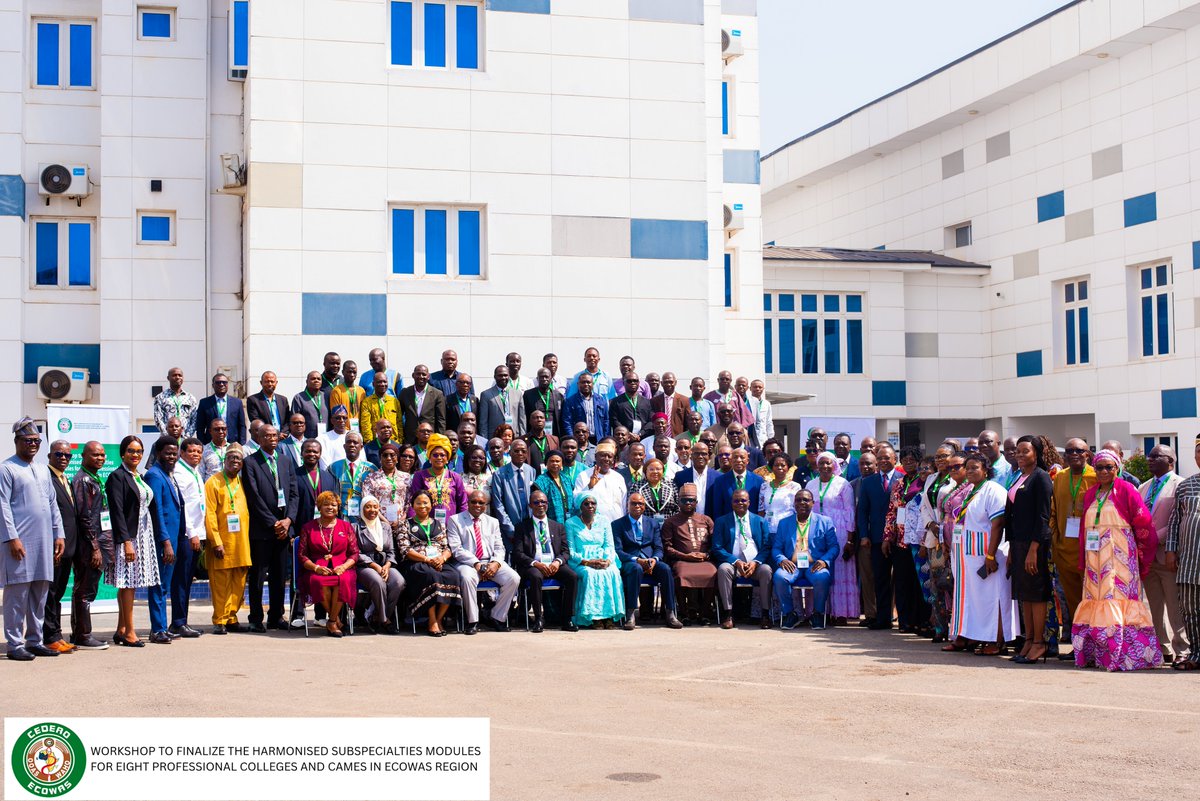
🩺 DES PROFESSIONNELS DE SANTÉ MIEUX FORMÉS POUR DES SOINS PLUS SÛRS EN AFRIQUE DE L’OUEST !
L’OOAS place la qualité de la formation au cœur du renforcement des ressources humaines en santé dans l’espace CEDEAO.
Réunis à Abuja, au Nigéria, du 2 au 4 novembre 2026, les acteurs régionaux examinent les moyens de renforcer la formation, de favoriser la reconnaissance mutuelle des diplômes et de promouvoir une meilleure répartition des professionnels de santé dans la région.
L’objectif : rapprocher les soins de qualité des populations, partout en Afrique de l’Ouest.
🔎 Lire le communiqué de presse : https://t.co/SLsOmQYMCU
#OOAS #CEDEAO #Santé #RessourcesHumainesEnSanté #FormationEnSanté #AfriqueDeLOuest
🩺 RENFORCER LA FORMATION POUR DES SOINS INFIRMIERS ET OBSTÉTRICAUX PLUS SÛRS EN AFRIQUE DE L’OUEST !
L’OOAS œuvre à l’harmonisation des normes de formation, de réglementation et d’accréditation en soins infirmiers et obstétricaux dans l’espace CEDEAO.
Réunis à Abuja, au Nigéria, du 29 au 31 octobre 2026, les acteurs régionaux travaillent à l’élaboration de critères communs et d’outils de formation pour renforcer les compétences des infirmiers et des sages-femmes et améliorer la qualité et la sécurité des soins dans les États membres.
🔎 Lire le communiqué de presse : https://t.co/PnkpjczHvH
#OOAS #CEDEAO #Santé #SoinsInfirmiers #SagesFemmes #FormationEnSanté #AfriqueDeLOuest
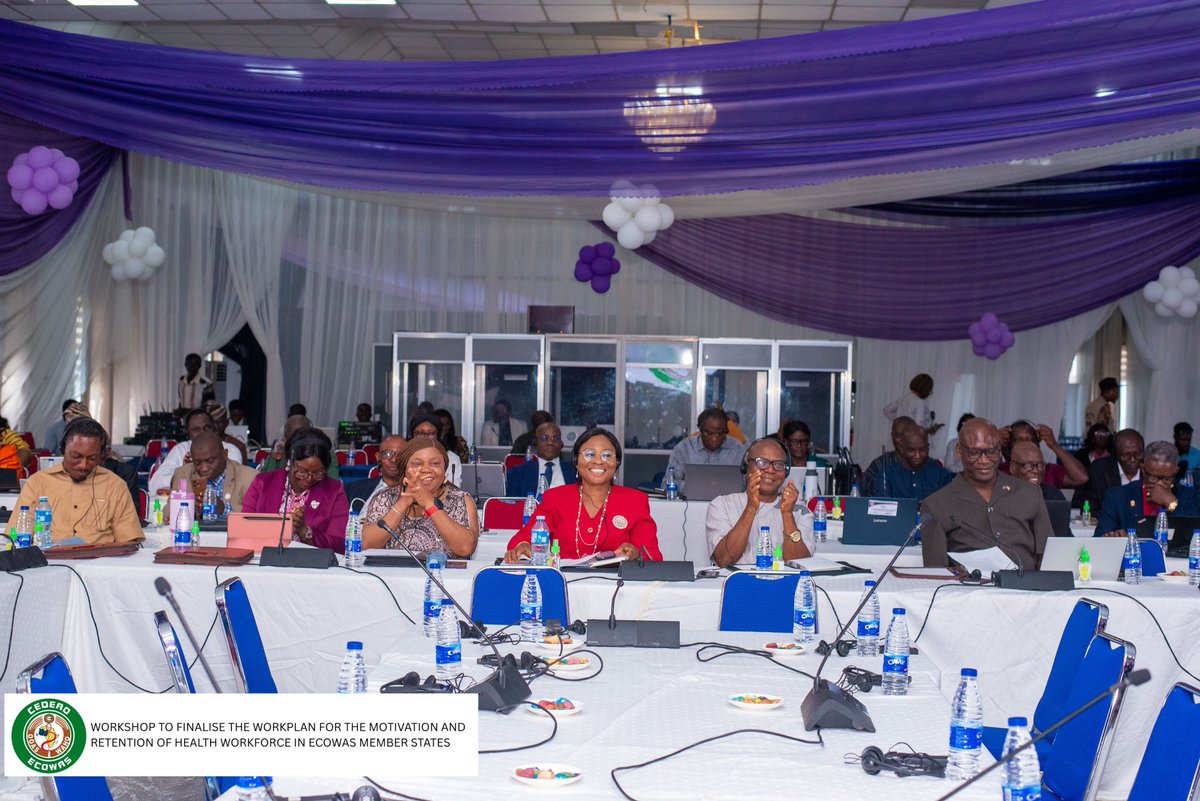
🌍 WAHO BRINGS REGIONAL STAKEHOLDERS TOGETHER TO STRENGTHEN HEALTH WORKFORCE MOTIVATION AND RETENTION
Health stakeholders from across West Africa are meeting in Abuja, Nigeria, to review regional efforts to improve health workforce motivation and retention across ECOWAS Member States.
🔗 Read more: https://t.co/ueuE3Cm4VL
#WAHO #ECOWAS #HealthWorkforce #PublicHealth
🇬🇲 WAHO AND GERMANY STRENGTHEN LABORATORY CAPACITIES IN THE GAMBIA
Through the PROALAB programme, supported by the German Government via KfW, WAHO is helping strengthen laboratory diagnostics, disease surveillance and health emergency preparedness in The Gambia.
🔗 Read more: https://t.co/q2mgHR0SHg
#WAHO #ECOWAS #TheGambia #PublicHealth #PROALAB
🇬🇲 WAHO STRENGTHENS PARTNERSHIP WITH THE GAMBIA
On 26 October, WAHO Director General Prof. Palokinam T. PITCHE met The Gambia’s Minister of Health, Dr Ahmadou Lamin Samateh, in Banjul to discuss regional cooperation and improved health services.
🔗 Read more: https://t.co/N6nemdqZFw
#WAHO #ECOWAS #TheGambia #PublicHealth
🌍 La 2ᵉ édition de la newsletter régionale « Une Seule Santé » est disponible !
📰 « From Field Response to Regional Resilience » met en lumière les avancées en Afrique de l’Ouest en matière de santé humaine, animale et environnementale.
🔗 À lire ici : https://t.co/TX5L80dVH8
#OOAS #CEDEAO #OneHealth #SantéPublique
L’OOAS ET LA COMMISSION DE LA CEDEAO RENFORCENT LES CONNAISSANCES DU PERSONNEL POUR PREVENIR EBOLA
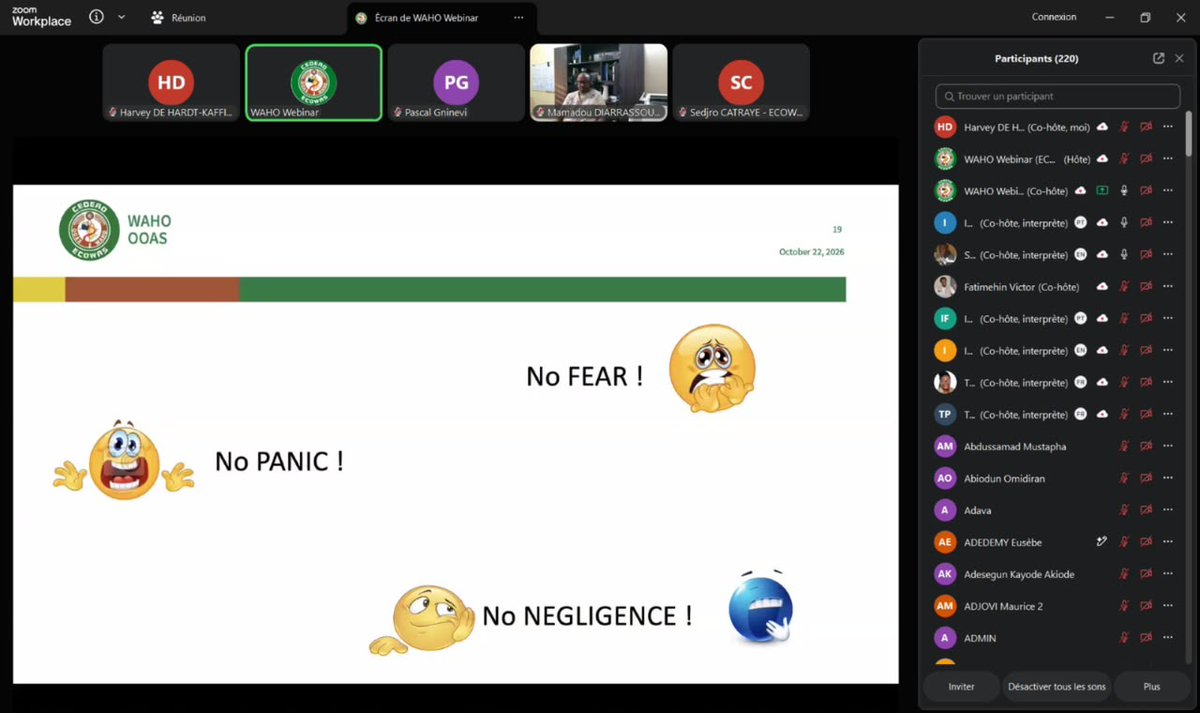
L’Organisation Ouest Africaine de la Santé (@OOASWAHO ), Institution spécialisée de la Communauté Économique des États de l’Afrique de l’Ouest (@ecowas_cedeao ) chargée des questions de santé, à travers le Centre régional de surveillance et de contrôle des maladies de la CEDEAO (@CRSCM), a organisé, en collaboration avec la Commission de la CEDEAO, une session de sensibilisation en ligne consacrée à la prévention de la maladie à virus Ebola, le 22 octobre 2026, à l’intention du personnel des institutions et agences de la CEDEAO.
Cette initiative visait à renforcer les connaissances du personnel sur la maladie, à promouvoir les comportements de prévention et à favoriser la diffusion d’informations fiables. Elle s’inscrit dans les efforts de préparation aux urgences sanitaires et de protection de la santé du personnel, de leurs familles et des communautés.
Ouvrant les travaux au nom de Son Excellence Général Birame DIOP, Président de la Commission de la CEDEAO, le Directeur des ressources humaines, M. Victorino VIEIRA BAMBA, a souligné l’importance de disposer d’informations précises et accessibles, fournies par des professionnels de santé, pour permettre à chacun d’adopter les bons réflexes et de prévenir la propagation des rumeurs.
Le Directeur exécutif du Centre régional de surveillance et de contrôle des maladies de la CEDEAO, agence de l’OOAS basée à Abuja, au Nigeria, le Dr. Mamadou DIARRASSOUBA, a au nom du @DG_OOASWAHO Prof. Palokinam T. PITCHE, rappelé que la protection de la santé collective commence au sein même des institutions. Il a insisté sur la nécessité d’associer une prévention rigoureuse à une communication efficace et a invité les participants à faire de cette session un espace d’échanges et de clarification.
La présentation technique, assurée par le Dr Babacar FALL, chargé de la communication en santé au @CRSCM , a porté sur les caractéristiques de la maladie, ses modes de transmission, les signes et symptômes, le diagnostic, la prise en charge et les mesures de prévention. Les échanges ont notamment mis en évidence l’importance de l’hygiène des mains, de la prévention des contacts avec les liquides biologiques de personnes malades et du signalement rapide de toute exposition à risque aux services sanitaires compétents.
Une attention particulière a été accordée à la protection du personnel dans les bureaux, lors des déplacements et au cours des missions. Dr FALL a présenté des recommandations relatives au renforcement des dispositifs d’hygiène dans les locaux, à la circulation de l’information par les canaux officiels et à la coordination avec les autorités sanitaires nationales.
La session a également permis de présenter les actions conduites par l’OOAS et le CRSCM pour renforcer la préparation régionale, notamment l’évaluation des capacités des douze États membres, les formations techniques et exercices de simulation, le renforcement des capacités des laboratoires ainsi que la communication sur les risques et l’engagement communautaire.
Les questions des participants ont donné lieu à des clarifications pratiques sur les situations d’exposition, les précautions à prendre au quotidien et la conduite à tenir en cas de symptômes suspects. Les intervenants ont insisté sur la nécessité de solliciter rapidement une orientation médicale adaptée et de privilégier les informations émanant des autorités sanitaires.
Dans son allocution de clôture, le Directeur des ressources humaines de la Commission de la CEDEAO a salué l’appui de l’OOAS et du Centre régional de surveillance et de contrôle des maladies (CRSCM), tout en soulignant le rôle essentiel de l’information et de la sensibilisation dans la prévention de la maladie à virus Ebola. Il a réaffirmé l’engagement de la Commission à poursuivre cette collaboration et à examiner les recommandations formulées afin de renforcer les capacités de prévention, de préparation et de riposte au sein de l’institution. Il a également invité le personnel à appliquer les mesures préconisées, à suivre les orientations des autorités sanitaires et à promouvoir une culture de vigilance et de responsabilité partagée.
INVITATION AU WEBINAIRE
L'Organisation Ouest Africaine de la Santé (@OOAS), en collaboration avec le Réseau Ouest Africain de Documentation et de l'Information Sanitaire (ROADIS), a le plaisir de vous inviter à un webinaire sur le thème :
Science ouverte et valorisation de la recherche africaine
Cette session s'inscrit dans la série de webinaires consacrée à la science ouverte, à l'intelligence artificielle et à l'accès à l'information en santé dans l'espace CEDEAO.
📅 Jeudi 29 octobre 2026
⏰ 11h00 - 12h30 GMT
🌐 Interprétation simultanée disponible en français, anglais et portugais
Avec la participation de :
Prof. Palokinam T. Pitche, Directeur général de l'OOAS
Mme Kornelia Tzinova, Représentante de l'UNESCO à Dakar
Dr Cécile Ouattara-Coulibaly, Enseignante-chercheure à l'Université Virtuelle de Côte d'Ivoire
Inscription :
https://t.co/uO6p12fuK3
Nous vous invitons à partager cette information au sein de vos réseaux professionnels et académiques.
#ScienceOuverte #RechercheAfricaine #OOAS #ROADIS #CEDEAO #OpenScience
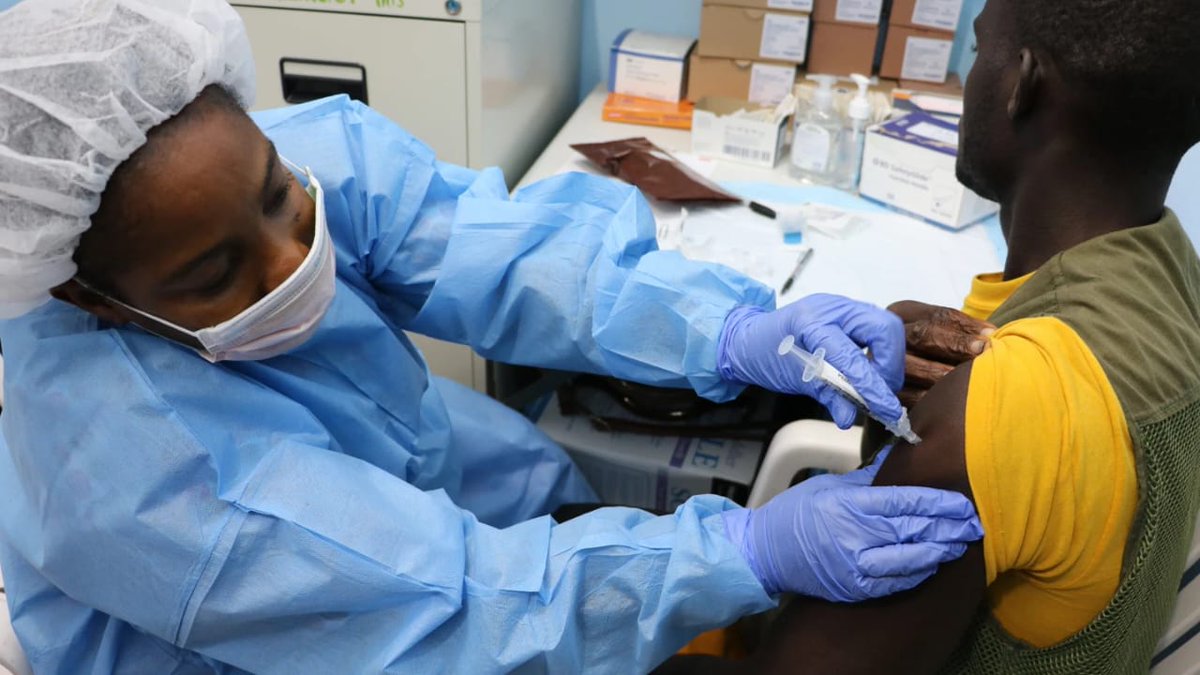
🧪 A major step forward in Lassa fever vaccine research!
The first participants have been vaccinated in Ghana in a @CEPIvaccines -supported Oxford vaccine trial, marking an important milestone for West Africa.
🔗 Read the full article (EN | FR | PT):
https://t.co/fjzB6Uy6zW
#LassaFever #WAHO #CEPI
WAHO STRENGTHENS REGIONAL HEALTH VIGILANCE FOLLOWING CONFIRMATION OF AN EBOLA VIRUS DISEASE CASE IN NIGERIA
The West African Health Organisation (WAHO), the specialised Institution of the Economic Community of West African States (ECOWAS) responsible for health issues, is closely monitoring the health situation in Nigeria following the confirmation, on 20 October 2026, of an imported case of Ebola virus disease in the federal capital, Abuja.
According to information provided by the Nigerian health authorities, the patient, a woman who had recently arrived from Uganda, first developed symptoms on 7 October 2026 and subsequently received care at a private health facility in Abuja on 11 October 2026. The diagnosis was confirmed through laboratory testing on 20 October 2026.
WAHO is closely monitoring developments in liaison with the Nigeria Centre for Disease Control and Prevention (@NCDCgov ), the national health authorities and regional epidemiological surveillance mechanisms.
In line with its mandate to coordinate regional health emergency prevention, preparedness and response, WAHO remains fully mobilised to support Member States in strengthening epidemiological vigilance and preventing the risk of cross-border transmission. To this end, WAHO maintains regular contact with the NCDC and held a briefing on 21 October 2026 with the Directors of the National Public Health Institutes (NPHIs) of ECOWAS Member States.
WAHO emphasises that early detection, prompt notification of suspected cases, epidemiological surveillance and coordination among health services are essential to preventing and controlling the spread of epidemic-prone diseases.
WAHO therefore encourages the public to remain vigilant and observe the following recommendations:
➤ Wash hands frequently with clean water and soap or use an alcohol-based hand sanitiser.
➤ Avoid direct contact with the blood and bodily fluids (vomit, faeces, urine, saliva and sweat) of anyone who is ill or has died, as well as with their clothing, bedding and personal belongings.
➤ Do not handle the bodies of people who have died from suspected causes; ensure that safe and dignified burials are conducted by trained teams.
➤ Avoid handling or consuming bushmeat; do not handle animals found dead or sick, including bats and primates, and cook all meat thoroughly.
➤ If symptoms consistent with the disease develop, including sudden fever, severe fatigue, aches and pains, vomiting, diarrhoea or bleeding, immediately call or seek assistance from a health facility.
➤ Avoid non-essential travel to affected areas and, where travel is unavoidable, strictly follow official health guidance.
WAHO also urges the public to rely on information issued by official sources and to refrain from spreading rumours or unverified information.
WAHO reaffirms its commitment to working closely with the Ministries of Health of ECOWAS Member States and technical and financial partners to strengthen regional health security and protect the health of West African populations.
Through the ECOWAS Regional Centre for Surveillance and Disease Control (@RCSDC), a specialised agency of WAHO based in Abuja, Nigeria, WAHO will continue to monitor developments closely and, in coordination with the relevant health authorities, communicate any pertinent information requiring particular public attention.
NEW LASSA FEVER EVIDENCE TO SHAPE VACCINE RESEARCH AND OUTBREAK PREPAREDNESS ACROSS WEST AFRICA
New evidence from a major Lassa fever research programme in West Africa is expected to inform the next phase of vaccine research, outbreak preparedness and community engagement in research across the region.
Initial findings from Enable, the largest-ever study of Lassa fever disease burden, were recently published in The Lancet Global Health. The programme is supported by the Coalition for Epidemic Preparedness Innovations (@CEPI) the world’s largest funder of Lassa fever research and partners across West Africa. CEPI is also advancing the development of Lassa fever vaccines.
These findings have deepened understanding of Lassa fever disease burden in the communities studied, while highlighting important gaps in existing evidence, including the burden among children, a population historically underrepresented in Lassa fever research and discourse.
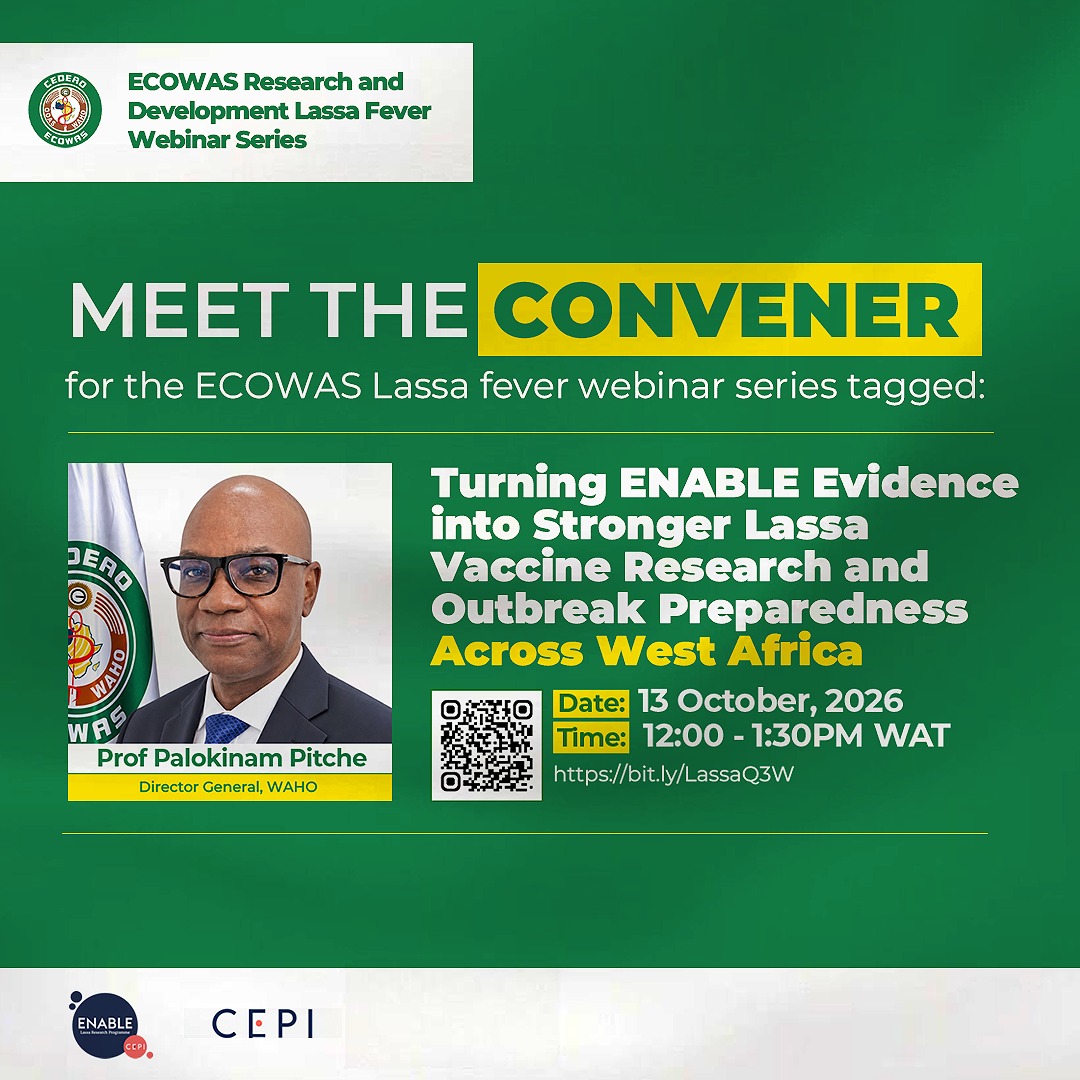
To explore what these findings mean for the future of Lassa fever research and preparedness, the West African Health Organisation (WAHO) and its partners, including CEPI, will host a virtual webinar titled “Turning ENABLE Evidence into Stronger Lassa Vaccine Research and Outbreak Preparedness Across West Africa” on Tuesday, 13 October 2026, from 12:00 p.m. to 1:30 p.m. WAT.
Participants can register at https://t.co/s0YNf0SPro.
The webinar comes ahead of the Enable Lassa Programme Regional Dissemination and Engagement Summit in Nigeria later this month, where partners will discuss the research findings and how to translate evidence into action.
Lassa fever remains a persistent public health challenge across West Africa. According to Africa CDC, historical estimates suggest that approximately 100,000 to 300,000 Lassa virus infections and 5,000 associated deaths occur annually across the region, although the true burden remains uncertain. Enable was established to help investigate this burden. More than five decades after Lassa fever was first identified, there is still no licensed vaccine, while important evidence gaps continue to affect vaccine development and planning for equitable introduction.
The recently published findings from Enable provide important insights into disease burden in the Lassa fever hotspots studied and the populations most affected.
They also demonstrate the value of building stronger research and laboratory capacity in endemic countries. Through the programme, institutions and investigators across West Africa have strengthened their ability to conduct epidemiological and laboratory research and generate evidence that can support future Lassa fever research and wider regional epidemic preparedness.
“The findings from Enable are a critical contribution to our understanding of Lassa fever in West Africa. But evidence only becomes truly valuable when it informs action,” said Dr Gabrielle Breugelmans, Director of Epidemiology and Data Science at CEPI. “This webinar and our upcoming Summit provide an important opportunity to bring researchers, policymakers, communities, vaccine developers and other stakeholders together to consider what these findings mean for the research and preparedness decisions that come next.”
“For West Africa, the Enable findings reinforce the importance of strong regional leadership and collaboration in advancing Lassa fever research and preparedness,” said Prof. Palokinam T. Pitché, Director-General of WAHO. “WAHO remains committed to bringing countries and partners together to translate scientific evidence into coordinated action, strengthen regional health security and support preparedness for future Lassa fever vaccines.”
Alongside discussion of Enable’s findings, the webinar will connect the study data with ongoing efforts to understand future demand for a Lassa fever vaccine. WAHO and the International AIDS Vaccine Initiative (IAVI), working with regional research partners and with support from CEPI, have advanced a Lassa fever vaccine demand forecasting exercise, which was first presented at the 2nd ECOWAS Lassa Fever International Conference in Abidjan in September 2025.
The webinar will place the experiences of study participants and communities at the centre of the conversation. Their participation, trust and contribution have been fundamental to generating the evidence now informing the next phase of Lassa fever research.
Participants will hear directly from experts across the Lassa fever research and development ecosystem, as well as from people and communities who contributed to the Enable study. Discussions will explore how meaningful community partnership can build trust, support participation and guide future research and vaccine development as the region prepares for the potential future introduction of a Lassa fever vaccine.
Speakers include:
· Dr Gabrielle Breugelmans, Director of Epidemiology and Data Science at CEPI.
· Dr N’Faly Magassouba, Principal Investigator at Gamal Abdel Nasser University of Conakry, Guinea.
· Dr Onyinyechukwu Uzoamaka Oka, Community Engagement Lead for the Enable study at Alex Ekwueme Federal University Teaching Hospital, Abakaliki (AEFUTHA), Nigeria.
· Mrs Elsie Ilori, National Coordinator for the Enable Programme in Nigeria.
· The webinar will also feature Prof. Palokinam T. Pitche, Director General of WAHO, who assumed office on 1 September 2026, providing an opportunity to hear his perspective on regional priorities for Lassa fever preparedness and the role of evidence in strengthening health security across West Africa.
What the webinar will cover:
· Key findings on Lassa fever burden in the communities studied.
· Implications for Lassa fever vaccine research and development.
· The burden among children and other populations less visible in previous research.
· How Enable has strengthened epidemiological, laboratory and research capacity across West Africa.
· Community and participant perspectives on trust, participation and meaningful engagement in health research.
· How epidemiological evidence and vaccine demand forecasting can support vaccine preparedness and equitable access.
· Remaining evidence gaps and priorities for future Lassa fever research and preparedness.
Webinar details
Date: Tuesday, 13 October 2026
Time: 12:00 p.m.–1:30 p.m. WAT / 11:00 a.m.–12:30 p.m. UTC
Format: Virtual
Topic: Turning ENABLE Evidence into Stronger Lassa Vaccine Research and Outbreak Preparedness Across West Africa
Registration: https://t.co/s0YNf0SPro
Research evidence has an important role to play in strengthening how West Africa prepares for Lassa fever.
Join the DG of @OOASWAHO & other experts as they explore how ENABLE findings can inform vaccine research, clinical trials & outbreak preparedness: https://t.co/HPoFI9nHyr
Lassa fever vaccine development needs sustained investment and regional collaboration.
On 11 October, @OOASWAHO will support a high-level roundtable at the #WHS2026 in Berlin to explore financing for #vaccine#development, clinical research and regional manufacturing.
#LassaFever
WEST AFRICAN HEALTH ORGANISATION SUPPORTS ROUNDTABLE ON FINANCING LASSA FEVER VACCINE DEVELOPMENT DURING THE WORLD HEALTH SUMMIT IN BERLIN
The West African Health Organisation (@OOASWAHO ) is supporting a high-level roundtable in Berlin on Sunday, 11 October 2026, to explore a collaborative financing framework for Lassa fever vaccine development, research readiness and regional manufacturing.
Convened by IAVI, MedAccess and the Coalition for Epidemic Preparedness Innovations (@CEPIvaccines ), the meeting is organised with support from WAHO and Deutsche Gesellschaft für Internationale Zusammenarbeit (@GIZ), with funding from Germany’s Federal Ministry for Economic Cooperation and Development (@BMZ_Bund ).
The roundtable will bring together regional and global partners to review progress towards a proposed financing framework, explore complementary partner roles and identify concrete next steps, including potential partner commitments.
Lassa fever remains a significant public health threat in West Africa. Advancing vaccine development requires sustained investment in late-stage clinical research, research readiness and manufacturing. Limited commercial incentives for epidemic vaccines underscore the need for collaborative approaches to financing these activities.
The discussions build on the September 2025 Abidjan Ministerial Roundtable, convened by WAHO with the Governments of Côte d’Ivoire and Nigeria, which brought together Ministers of Health or their representatives from 11 West African countries. The resulting Communiqué supported advancing IAVI’s recombinant vesicular stomatitis virus (rVSV) Lassa fever vaccine candidate as a regional pathfinder and committed to mobilising national, regional and global resources through a collaborative co-funding approach.
Building on these commitments, WAHO will bring the priorities of @ecowas_cedeao Member States into the financing discussions, advocating for regional ownership and coordinated investment in Lassa fever vaccine preparedness. Represented by Dr @vlokossou , Director of Healthcare Services, WAHO will emphasise how investments in vaccine development can also strengthen clinical research, laboratory capacity, surveillance, regulatory systems and regional preparedness for future epidemic threats.
Complementing this regional leadership, WAHO has led the regional Demand Forecasting Working Group, drawing on country consultations, expert interviews, key informant inputs and national Lassa Task Forces to generate projections that can inform the Lassa fever vaccine investment case.
The proposed financing framework aims to bring together complementary contributions from public, philanthropic and other financing partners to support the advancement of Lassa fever vaccines. If successful, this approach could also provide a model for financing other priority epidemic vaccines.
IAVI’s investigational rVSV Lassa fever vaccine candidate, supported by CEPI and the European and Developing Countries Clinical Trials Partnership (EDCTP), illustrates the importance of sustained investment in vaccine development alongside stronger regional research and manufacturing capabilities.
Event details:
High-Level Roundtable on Financing Lassa Fever Vaccine Development
Date: Sunday, 11 October 2026
Time: 16:30–18:00 CEST
Venue: Pullman Berlin Schweizerhof, Budapester Str. 25, 10787 Berlin, Germany
Format: Closed-door roundtable