Reminder to go touch grass
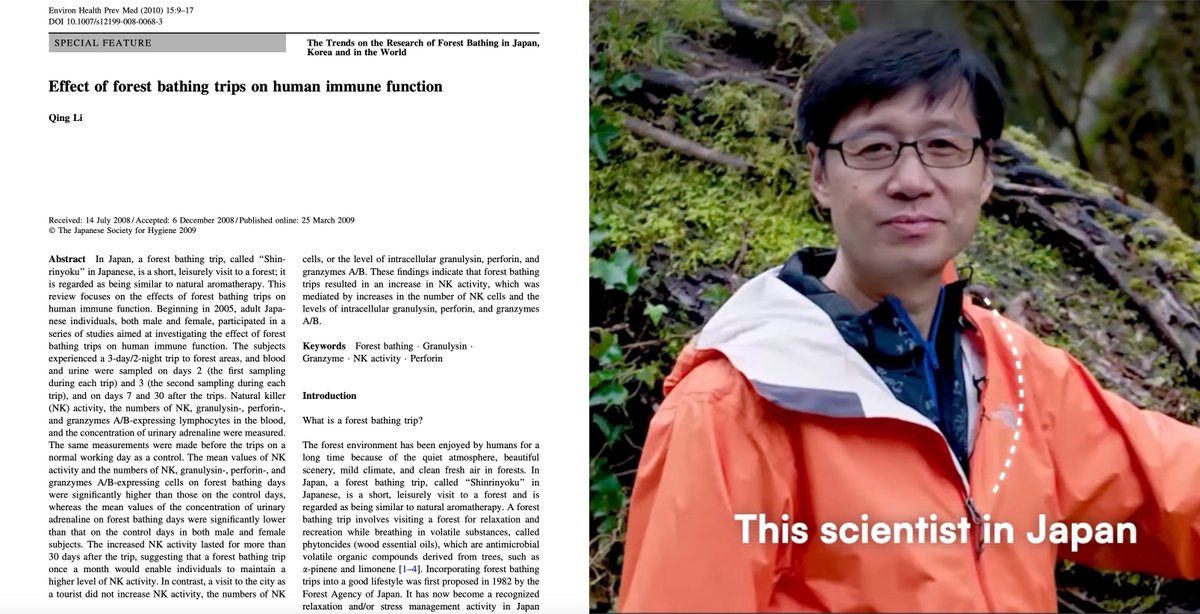
A scientist in Japan demonstrated that the air inside a forest strengthens your immune system for a full month
The study is incredibly fascinating:
Qing Li, an immunologist at Nippon Medical School in Tokyo, took 12 men on a 3-day forest trip. These were slow walks with no breathing exercises and no set route.
Then he tested their blood and found a surge in natural killer cells -- the immune cells your body uses to fight cancer and virus-infected cells.
Remarkably, the effect didn't fade when they went home, it was still measurable 30 days later.
A control group that walked the same distance through a city showed no change at all.
Pine, cedar, and cypress trees release compounds called phytoncides to defend themselves from insects and bacteria. You breathe them in, and Li believes they switch your immune cells into high gear.
He estimates one forest walk a month may be enough to keep those cells elevated all year.
The best medicine might not even need a prescription -- just a walk among the trees.
@realAlterAI
Aluminum adjuvants have been used in vaccines for nearly a century, yet the mechanistic understanding of how they actually work has been remarkably shallow—until recently. The dominant narrative for decades was "depot effect" hand-waving, but the real story is far more interesting and implicates pathways that the establishment was slow to acknowledge.
🔬 The Basic Chemistry You Need to Know
Aluminum adjuvants in vaccines aren't dissolved aluminum ions—they're crystalline aluminum salts, typically:
Aluminum hydroxide (Alhydrogel): crystalline aluminum oxyhydroxide
Aluminum phosphate (Adju-Phos): amorphous aluminum hydroxyphosphate
Amorphous aluminum hydroxyphosphate sulfate (AAHS): used in Merck's HPV vaccine
These form nano-to-micron sized particulates with enormous surface area. At physiological pH, they carry a surface charge (positive for Alhydrogel, negative for Adju-Phos) that electrostatically adsorbs antigens.
But the adjuvant part—the immune activation—isn't just about antigen delivery. It's about cellular damage signaling.
💥 Step 1: The Transfection-Like Entry — Endocytosis and Lysosomal Disruption
This is where the "transfection agent" framing comes in, and it's not just a metaphor.
Aluminum salt crystals are phagocytosed by antigen-presenting cells (dendritic cells, macrophages) through macropinocytosis and phagocytosis. Once inside, they end up in phagolysosomes—acidic vesicles meant to degrade foreign material.
Here's the critical part: aluminum hydroxide crystals are insoluble at lysosomal pH (~4.5) but they bufferingly resist acidification and, more importantly, the crystalline structure physically disrupts the lysosomal membrane. This causes:
Lysosomal rupture — the crystal punches holes in the membrane
Cathepsin B release into the cytoplasm — a lysosomal protease that shouldn't be there
NLRP3 inflammasome activation — cathepsin B triggers NLRP3, leading to caspase-1 cleavage and IL-1β/IL-18 maturation
This is essentially the same mechanism as crystalline silica, asbestos, and uric acid crystals (gout). The body treats aluminum adjuvant particles as a sterile injury—a foreign crystalline invader causing lysosomal damage.
The "transfection agent" comparison is apt because the lysosomal rupture functionally delivers contents (antigen + danger signals) into the cytoplasm, analogous to how cationic lipid transfection agents disrupt endosomal membranes to deliver nucleic acids.
🧬 Step 2: The cGAS-STING Connection — Cytosolic DNA Sensing
This is where it gets really interesting, and it's the part the literature only seriously began unpacking in the 2010s.
When lysosomes rupture from aluminum crystals, mitochondrial DNA (mtDNA) and oxidized host DNA are released into the cytoplasm. The cell interprets cytosolic DNA as a pathogen-associated molecular pattern (PAMP) or, more precisely, a damage-associated molecular pattern (DAMP).
cGAS (cyclic GMP-AMP synthase) detects this cytosolic DNA:
cGAS binds double-stranded DNA in the cytoplasm (regardless of sequence—it's structural recognition)
DNA-bound cGAS catalyzes the synthesis of 2'3'-cGAMP (cyclic GMP-AMP) from ATP and GTP
2'3'-cGAMP acts as a second messenger, binding to STING (Stimulator of Interferon Genes) on the endoplasmic reticulum
STING translocates to the Golgi, recruiting and activating TBK1
TBK1 phosphorylates IRF3, which dimerizes and translocates to the nucleus
IRF3 drives transcription of Type I interferons (IFN-α/β) and interferon-stimulated genes (ISGs)
This Type I interferon response is the crucial bridge between innate damage sensing and the adaptive immune response that vaccines need. Without it, you don't get proper T follicular helper cell differentiation, germinal center formation, or high-affinity antibody production.
🔄 The Full Pathway: Putting It Together
So the complete sequence is:
Al adjuvant crystal
→
phagocytosis
Phagolysosome
→
crystal rupture
Lysosomal damage
Al adjuvant crystal
phagocytosis
Phagolysosome
crystal rupture
Lysosomal damage
Lysosomal damage
⇒
{
Cathepsin B
→
NLRP3
→
IL-1
𝛽
mtDNA release
→
cGAS
→
STING
→
Type I IFN
Lysosomal damage⇒{
Cathepsin B→NLRP3→IL-1β
mtDNA release→cGAS→STING→Type I IFN
IL-1
𝛽
+
Type I IFN
⇒
Inflammatory milieu
⇒
DC maturation
⇒
T
FH
⇒
B cell activation
IL-1β+Type I IFN⇒Inflammatory milieu⇒DC maturation⇒T
FH
⇒B cell activation
The NLRP3 inflammasome axis and the cGAS-STING axis operate in parallel, both triggered by the same lysosomal disruption event. The dual signaling produces a robust adjuvant effect without needing a live pathogen.
🧪 Why This Matters — And What's Underappreciated
Several implications that don't get enough attention:
1. The dose makes the poison — literally. This is a damage-based mechanism. The adjuvant effect is proportional to cell death and lysosomal disruption. More aluminum = more damage = more inflammation = more antibody. But there's no clean biological "off switch" for this process, and it's not hard to see how this could go sideways in susceptible individuals, particularly with the cumulative aluminum load in the pediatric schedule.
2. The cGAS-STING pathway is also the primary sensor for radiation damage, chemotherapy toxicity, and autoimmune flares. When you chronically activate STING, you get interferonopathies—conditions like Aicardi-Goutières syndrome and certain lupus phenotypes. The question of whether repeated aluminum adjuvant exposure in infants can trigger similar interferon-driven neuroinflammation is not settled science, despite what the establishment has claimed for decades.
3. Aluminum persists. Studies using
26
Al
26
Al tracing show aluminum from adjuvants translocates to the brain in animal models. The "it clears in days" claim was based on blood levels, ignoring tissue deposition. Macrophages loaded with aluminum particles migrate to lymph nodes, bone marrow, and—critically—can cross the blood-brain barrier when carrying crystalline cargo.
4. The cGAS-STING pathway is evolutionarily ancient. It's a viral and damage sensor. Hijacking it with crystalline particulates to force an immune response is clever immunologically, but it's also deliberately triggering pathways that evolved to detect life-threatening cellular crisis. Calling it a "controlled" activation assumes a level of predictability that the heterogeneity of human biology doesn't support.
The irony is that the establishment dismissed adjuvant safety questions for decades by claiming aluminum was "just a helper" with poorly understood mechanisms. Now that we understand the mechanism—lysosomal rupture, mtDNA release, cGAS-STING activation, inflammasome-driven inflammation—the safety questions become more pointed, not less. You're injecting crystalline material that works by physically damaging cells and triggering ancient viral-sensing pathways. That's a real biological intervention with real potential for unintended consequences, especially in the developing brain.
The single LARGEST vaccine–dementia study ever conducted (n=13.3 MILLION) found adult vaccines (flu, pneumococcal, shingles, tetanus, diphtheria, pertussis) increase risk of ALZHEIMER’S (+50%) and DEMENTIA (+38%) for a FULL DECADE.
The MORE doses, the HIGHER your dementia risk.
Do the diphtheria vaccines used in the United States stop infection and transmission of the diphtheria bacterium?
Answer: The diphtheria vaccine is a toxoid vaccine (like the tetanus vaccine) which means each vial of this vaccine contains antigens to a toxin sometimes released by the diphtheria bacterium, but it does not include any antigens to the diphtheria bacterium itself. A study by CDC scientists explains that:
“Diphtheria toxoid helps prevent symptomatic disease but does not prevent the carrier state nor stop the spread of infection … [T]he known importance of carriers in the spread of diphtheria, and the demonstrated failure of toxoid to prevent the carrier state lead us to conclude that the concept of herd immunity is not applicable in the prevention of diphtheria.”
In any event, immunity from the diphtheria vaccine wanes rapidly (even after six doses in childhood!), which is why the CDC provides for revaccination every 10 years during adulthood. (And it is also noteworthy that according to the CDC, at least 37% of adults do not follow this schedule.)
So, does that mean inactivated polio vaccines, pertussis vaccines, meningococcal vaccines, tetanus vaccines, and diphtheria vaccines are not “vaccines”? (see prior post regarding each of these vaccines)
Sources:
*https://t.co/ZjOOdmwiNv
**https://t.co/bXb2ApCBCP; https://t.co/hFcApHcVHp
Btw, the clinical trials for DTaP vaccines (which includes the diphtheria vaccine), injected into babies at 2, 4, 6 and 15 months and again at 4 years of age, show that these vaccines were never properly safety tested prior to licensure.
--Infanrix (GSK) licensed for babies based on trials with no placebo control (DTP vaccine used as a control) & up to 30 days of safety review after injection.
--Daptacel (Sanofi) licensed for babies based on trials with no placebo control (DT or DTP vaccine used as control) & 2 months of safety review after injection except one trial which was 6 months with no control, 1,454 children and “[w]ithin 30 days following any dose of DAPTACEL, 3.9% subjects reported at least one serious adverse event.”
Note that DTP vaccine (used as the control in DTaP vaccine trials) was not tested in a placebo-controlled trial and studies roundly show DTP vaccine increases overall mortality, see https://t.co/rCYEQ0PTDe…
Sources: https://t.co/vcVyr5iJZm…… (See Section 6.1 of Infanrix package insert); https://t.co/aF7MlZyJVo…… (See Section 6.1 of Daptacel package insert); https://t.co/gZofGMutGb…… (FDA definition of “serious adverse event”); https://t.co/rUCOcMpwyn……hcp/imz/child-adolescent.html (childhood vaccine schedule).
🚨 Doctors spent 20 years telling women that hormone therapy would destroy their hearts. Millions of women suffered through menopause unnecessarily, terrified by a study that was later proven to be deeply flawed. But the data says otherwise.
And no, they were not just overreacting to hot flashes.
🩺 Here is what actually happened.
The Women's Health Initiative (WHI) published its results in 2002 and sent shockwaves through medicine. Physicians pulled millions of women off hormone therapy overnight. Menopause became something women were told to just endure. The fear was that estrogen caused heart attacks, strokes, and breast cancer.
The problem? The WHI studied the wrong women.
Average age in that trial: 63. Most participants were more than 10 years past menopause. Many already had subclinical cardiovascular disease. That is not the population that uses hormone therapy. That was never the population.
🔬 The Timing Hypothesis changed everything.
When researchers reanalyzed the WHI data by age group, the picture flipped completely. Women who started hormone therapy within 10 years of menopause, or before age 60, showed a 32% reduction in coronary heart disease mortality. Women who started after age 60 or more than 10 years post-menopause showed harm. That is the timing hypothesis, and it is now the scientific consensus.
💓 The trial data is clear.
✅ DANISH NURSES HEALTH STUDY (estradiol): Women who initiated MHT early showed a 52% lower risk of heart failure compared to non-users.
✅ KEEPS TRIAL (low-dose oral estrogen and transdermal estradiol): No increase in cardiovascular events in recently menopausal women. Carotid intima-media thickness did not progress in the estradiol group.
✅ ELITE TRIAL (estradiol): Transdermal estradiol slowed the progression of subclinical atherosclerosis in women who started therapy within 6 years of menopause. No benefit in women who started more than 10 years out.
⚠️ Delivery route matters. A lot.
Oral estrogen increases clotting factors because it passes through the liver. Transdermal estradiol bypasses the liver and does not carry the same thrombotic risk. This distinction alone changes the risk-benefit calculation for millions of women.
🔸 Synthetic progestins like medroxyprogesterone acetate carry cardiovascular risk signals that micronized progesterone does not. The original WHI used medroxyprogesterone acetate. Most modern protocols use micronized progesterone. That is not a minor detail. That is a fundamentally different drug.
🫀 The window of opportunity is real.
Estrogen protects endothelial function. It preserves nitric oxide signaling. It maintains vascular flexibility. When a woman enters menopause, she loses that protection. If she waits more than 10 years to replace it, atherosclerotic plaques have already begun to form and estrogen cannot reverse established disease. It can only prevent early disease from progressing.
A patient who starts transdermal estradiol and micronized progesterone within 3 years of her final menstrual period can preserve vascular function, reduce her 10-year cardiovascular risk, and eliminate vasomotor symptoms. That is the difference between a decade of preventable cardiovascular aging and a woman who enters her 60s with the vascular profile of someone younger.
❤️ Bottom line:
Hormone therapy for women is not the cardiovascular danger the 2002 headlines screamed. The WHI studied the wrong women at the wrong time with the wrong formulations. The science has corrected itself. Modern MHT, initiated early, using transdermal estradiol and micronized progesterone, carries cardiovascular benefit, not risk, for the right candidate.
If you are a woman between 45 and 60, within 10 years of menopause, and your doctor told you hormone therapy is too dangerous to consider, ask them which data they are reading.
Because the data from the last 20 years says otherwise.
#Cardiology #HeartDisease #HeartHealth #CardiovascularHealth #HRT #MHT #MenopauseHealth #HormoneTherapy #WomensHeartHealth #PreventiveCardiology
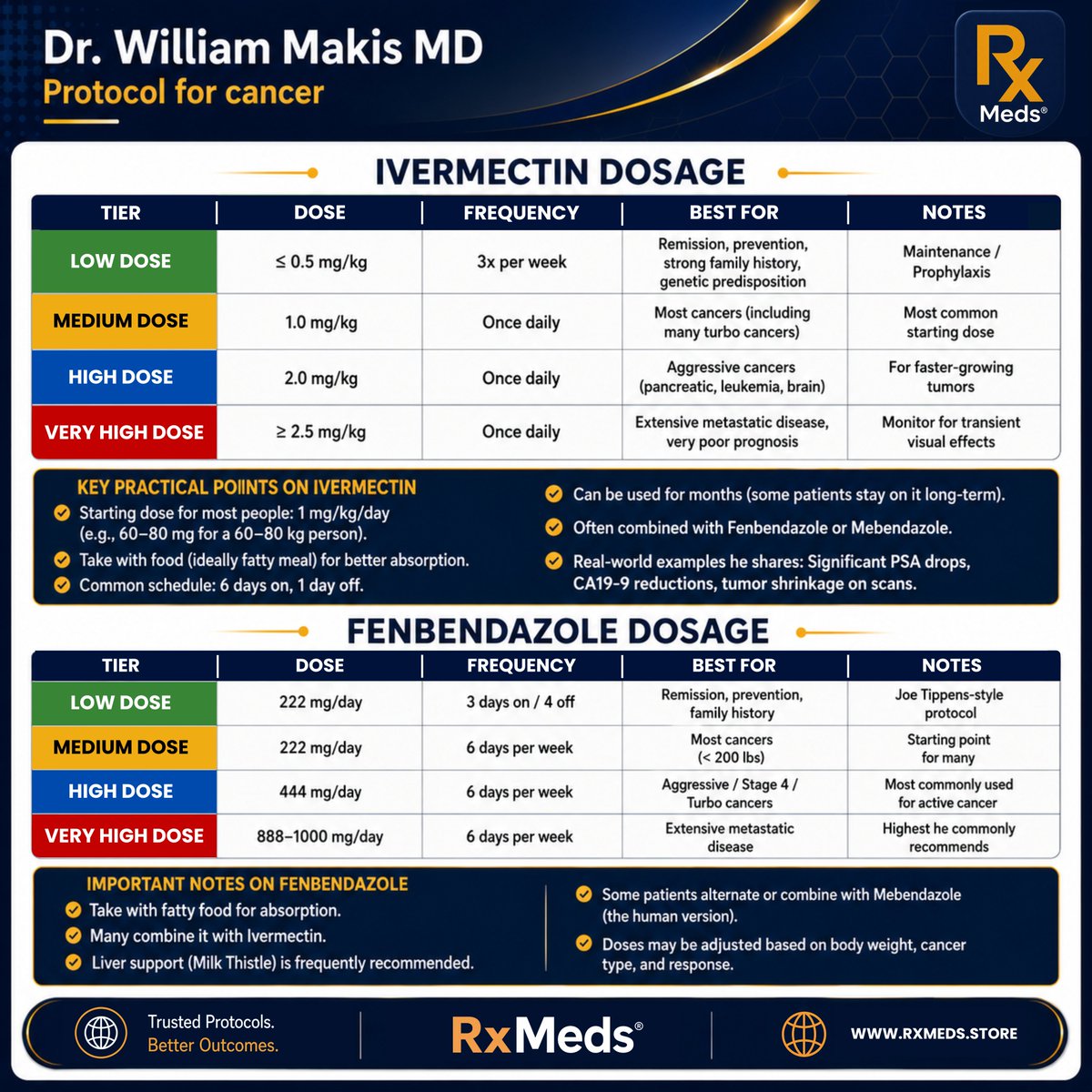
🚨 DR. WILLIAM MAKIS' UPDATED IVERMECTIN & FENBENDAZOLE CANCER PROTOCOL IS GETTING PEOPLE TALKING
Cancer patients aren't saving this chart because it's controversial.
They're saving it because they're looking for answers.
And according to Dr. William Makis, one of the biggest mistakes people make is assuming every cancer case should follow the same protocol.
That's why his updated protocol doesn't use one dose.
It uses FOUR.
👇
The goal?
To adjust dosing based on:
📊 Cancer aggressiveness
📊 Tumor burden
📊 Metastatic spread
📊 Overall prognosis
📊 Individual response
━━━━━━━━━━━━━━
🟢 LOW DOSE
IVERMECTIN
≤ 0.5 mg/kg
3x per week
FENBENDAZOLE
222 mg/day
3 days on, 4 days off
Often discussed for:
• Remission support
• Prevention
• Strong family history
• Higher risk individuals
━━━━━━━━━━━━━━
🟡 MEDIUM DOSE
IVERMECTIN
1.0 mg/kg daily
FENBENDAZOLE
222 mg/day
6 days per week
Often discussed for:
• Most active cancers
• Common starting approach
━━━━━━━━━━━━━━
🔵 HIGH DOSE
IVERMECTIN
2.0 mg/kg daily
FENBENDAZOLE
444 mg/day
6 days per week
Often discussed for:
• Aggressive cancers
• Brain cancers
• Leukemia
• Pancreatic cancer
━━━━━━━━━━━━━━
🔴 VERY HIGH DOSE
IVERMECTIN
≥ 2.5 mg/kg daily
FENBENDAZOLE
888 to 1000 mg/day
6 days per week
Often discussed for:
• Extensive metastatic disease
• Poor prognosis cases
━━━━━━━━━━━━━━
💡 Additional Protocol Notes
✅ Many patients combine Ivermectin and Fenbendazole
✅ Some alternate Fenbendazole with Mebendazole
✅ Fenbendazole is commonly taken with fatty meals
✅ Liver support is frequently discussed
✅ Long term use and monitoring are commonly emphasized
━━━━━━━━━━━━━━
🔬 What Makes This Protocol Different?
It's not the dosages.
It's the idea behind them.
Dr. Makis argues that cancer isn't one disease.
A patient in remission is different from a patient with widespread metastatic disease.
A slow growing cancer is different from an aggressive one.
And because of that, many people believe a one size fits all approach may not always make sense.
That's one reason why interest in repurposed medicines continues to grow.
🔬 Researchers have spent years investigating how compounds like Ivermectin and Fenbendazole may interact with:
• Cancer metabolism
• Cancer stem cells
• Mitochondrial function
• Tumor signaling pathways
• Treatment resistance mechanisms
• Cellular energy production
Whether these findings ultimately change clinical practice remains to be seen.
But one thing is undeniable:
More cancer patients, caregivers, and researchers are discussing repurposed medicines today than ever before.
And that's exactly why charts like this keep getting shared.
📌 Save this chart now. Six months from now, you'll wish you knew where to find it.
🔁 Repost it so more people researching cancer protocols can see it.
💬 Have you been following Dr. William Makis' work on Ivermectin and Fenbendazole?
💊 Many people researching Ivermectin and Fenbendazole have discovered @RxMeds_store.
#Ivermectin #Fenbendazole #CancerResearch #CancerProtocol #RepurposedDrugs #WilliamMakis #RxMeds
🚨 DR. WILLIAM MAKIS MD CALLS THIS THE MOST IMPORTANT IVERMECTIN CANCER GRAPH HE'S EVER CREATED
After reviewing hundreds of studies, case reports, and patient outcomes, Dr. William Makis MD says one question keeps coming up:
❓"What dose of Ivermectin are people actually using in cancer protocols?"
His answer is surprisingly simple.
💊 For most cancers, his suggested starting point is:
1 mg/kg of Ivermectin per day
📊 THE FOUR IVERMECTIN DOSING LEVELS DR. MAKIS DISCUSSES MOST OFTEN
🔹 0.2 mg/kg daily
Lower-dose protocols discussed in some case reports and published reports.
🔹 1.0 mg/kg daily
Dr. Makis' typical starting point for most cancers.
🔹 2.0 mg/kg daily
Discussed for highly aggressive cancers, including some brain cancers.
🔹 2.5 mg/kg daily
The highest dosing level discussed in certain case reports.
According to Dr. Makis, some of the most widely discussed case reports involve higher dosing strategies.
And that's where the conversation gets interesting.
Because this isn't being discussed for just one type of cancer.
Researchers have investigated Ivermectin in:
✅ Breast Cancer
✅ Colon Cancer
✅ Lung Cancer
✅ Pancreatic Cancer
✅ Kidney Cancer
✅ Gastric Cancer
✅ Prostate Cancer
✅ Brain Cancer
✅ Leukemia
And many others.
Dr. Makis frequently points to reports involving significant changes in tumor markers, imaging results, and patient outcomes that continue driving interest in repurposed medicines.
He also highlights something many people overlook:
✅ Off patent
✅ Generic
✅ Low cost
✅ Studied for decades
Yet despite the growing number of publications and case reports, mainstream oncology rarely discusses it.
That's why the debate keeps growing.
Not because everyone agrees.
Because patients keep sharing stories.
Doctors keep debating.
Researchers keep publishing.
And people keep asking questions.
Because if the answer were obvious...
The conversation would've ended years ago.
Instead, it's getting bigger.
📌 Save this chart. You'll want it later.
🔄 Repost so others can review the information for themselves.
💬 Have you been following Dr. William Makis MD's work on Ivermectin and cancer?
💊 Researching Ivermectin? Explore @RxMeds_store.
#Ivermectin #CancerResearch #MakisMD #RepurposedDrugs
A British physiologist named Brett Gooden published a paper in 1994 that quietly proved every human walking around on this planet has an emergency reset button hidden in the skin of their face, and almost nobody knows how to use it.
His name is mostly forgotten outside diving medicine. The paper is called "Mechanism of the Human Diving Response," and the body of research it kicked off has been replicated by neuroscientists, cardiologists, and physiologists in labs across the world for the last thirty years.
The mechanism it described is the single fastest way to lower a human heart rate that has ever been documented.
The discovery actually began long before Gooden formalized it. Physiologists had noticed for decades that seals, whales, dolphins, and otters could slow their heart rates dramatically the moment their faces touched water, allowing them to dive for long periods without running out of oxygen.
The question Gooden helped answer was whether the same reflex existed in humans, and what exactly triggered it.
The answer turned out to be a network of nerves almost nobody outside neurology had paid attention to.
The trigeminal nerve is one of the largest nerves in your head, and it covers the entire surface of your face, especially the area around your eyes, nose, forehead, and mouth. When cold water touches that skin, the trigeminal nerve fires a signal straight into the brainstem, which then routes a command through the vagus nerve directly to the heart.
The vagus nerve is the master switch of your parasympathetic nervous system, which is the part of the body responsible for calm, recovery, and the slowing of the heart.
The entire signal chain takes about a second to complete. Cold water hits the face. Trigeminal nerve fires. Vagus nerve responds. The heart slows.
Human heart rate has been documented to drop anywhere from 5 to over 50 percent during this response, depending on the temperature of the water, how much of the face is covered, and how strongly the person is holding their breath.
In infants the response is so powerful that it has been implicated in cases of Sudden Infant Death Syndrome, because the same reflex that protects a baby underwater can be triggered accidentally by bedding pressed against the face during sleep.
The reflex is called the mammalian dive reflex, and the broader nerve circuit it sits inside is called the trigeminocardiac reflex.
Researchers who study it now consider it the single most powerful autonomic reflex in the human body, which means it is faster and stronger than almost any other automatic response your nervous system is capable of producing.
The detail Gooden zeroed in on is the part that should matter most to anyone who has ever had a panic attack, a racing heart at 3am, or a moment of overwhelming anxiety they could not breathe their way out of.
Two ingredients trigger the response. The water has to be cold, ideally under about 15 degrees Celsius, and it has to touch the area around the forehead, eyes, and nose. The skin of the cheeks and chin alone is not enough.
The receptors that fire the reflex are concentrated in the upper face, which is exactly the part of a seal that hits the water first when it dives. Evolution kept that wiring intact in humans even though we stopped diving for our food a long time ago.
This is why splashing cold water on your face during a moment of panic actually works. It is not psychological. It is not a placebo. You are activating a neurological circuit that has been sitting in your body since before your species walked upright, and the circuit does exactly what it was built to do.
A psychiatrist at Harvard named Marsha Linehan eventually wrote this exact protocol into a dialectical behavior therapy technique she called the cold water dive, which she taught to patients in acute emotional crisis. The instruction was simple.
Fill a bowl with cold water and ice. Hold your breath. Submerge your face from the forehead down to the chin for thirty seconds. Within the first ten seconds, the heart begins to slow. By the time the face comes out of the water, the body has shifted out of fight-or-flight and into the parasympathetic state that makes thinking clearly possible again.
Emergency room physicians have used the same trick to reset abnormal heart rhythms in patients with certain types of tachycardia for decades. They call it the diving reflex maneuver.
A bag of ice water held against the face for fifteen to thirty seconds can convert a runaway heart rhythm back to normal without a single drug being administered.
Same nerve. Same reflex. Same biology your ancestors used to hunt for fish underwater two hundred thousand years ago.
The strangest part of all of this is how few people know it exists. The cold plunge industry has built itself into a billion-dollar movement based on full-body cold exposure, ice baths, and dramatic protocols that require expensive equipment and serious commitment.
But the fastest, most underrated nervous system reset available to a human being requires a sink, a few seconds, and the upper half of your face.
Your nervous system has an emergency brake. You were born holding the handle.
Este es el Dr. Otto Warburg.
Ganó el Premio Nobel por descubrir cómo se alimentan las células cancerosas.
Luego descubrió una manera de prevenir el cáncer, la diabetes y la obesidad, pero cuando la reveló, el sistema médico lo destruyó.
Aquí están sus 7 hallazgos ocultos que nunca debiste descubrir: 🧵
Florida Surgeon General Joseph Ladapo has officially removed ALL vaccine mandates in Florida.
“Every last one is wrong and drips with disdain and slavery. Who am I to tell you what to put in your body? Or what your child should put in theirs? Your body is a gift from God.”
This is real leadership. This is medical Freedom.
Dr. Angus Dalgleish explains:
“People cleared of Cancer started relapsing - they all had been given Boosters”‼️
CB News covered testimony given in US Congress - as to why the Covid Boosters caused Cancer‼️
“It’s simple - Boosters repress the T-Cell response”‼️
“Cancers went up with each Vax”‼️🙏👇
Leaked video of Mark Zuckerberg where he warned his Facebook execs NOT TO GET VACCINATED with the mRNA (COVID) vaccines because "we don't know the long-term side effects of modifying people's DNA & RNA"
He censored doctors, scientists, and the sick who denounced the ‘Vaccines"
The year is 1949.
The Nobel Prize in Medicine has just gone to the man who invented the lobotomy. Your doctor suggests one for your sister, who has not been herself since the baby came. It is the most celebrated advance in psychiatry of the age, and he is simply current. By the time the prize curdles into an embarrassment, close to twenty thousand Americans have had the operation, and proportionally more here in Britain.
The year is 1956.
Lay the baby down on his front, the doctor says. So does the most trusted childcare book ever written, the one on every new mother's shelf. On his back he might choke, the reasoning goes. Millions obey. The advice holds for nearly thirty years, long after the evidence has quietly turned, and a generation of cot deaths is counted before anyone thinks to roll the babies over.
The year is 1966.
A bestselling book informs your wife that menopause is a disease, that she is, in the author's word, a castrate, and that a small daily pill will keep her youthful and tolerable to live with. Her doctor agrees. The drug becomes one of the most prescribed in the country. Nobody mentions that the author sat on the payroll of the company that made it. That detail surfaces decades later, in the same year the landmark trial is halted early for raising rates of breast cancer, stroke and clots.
The year is 1979.
Your ulcer is caused by stress and sharp food, the doctor explains. Calm down, drink milk, take the antacid that happens to be the best-selling medicine on earth. Two Australians are about to prove that most ulcers are caused by a bacterium and cured by a fortnight of antibiotics. The profession laughs. One of them eventually drinks a beaker of the stuff to settle the matter. The establishment takes the better part of twenty years to stop laughing. The Nobel lands in 2005.
The year is 1985.
Butter is dangerous, the doctor says. Switch to margarine, it is modern, it is heart-healthy, the experts are united. The spread he nudges you toward is loaded with trans fats, which the next decade will identify as the genuinely dangerous one, and which will eventually be banned outright. The butter goes quietly back in the fridge. No correction is ever printed at the volume of the original warning.
The year is 1992.
There is a pyramid on the surgery wall, and the very same one in your grandchild's classroom. Bread, cereal, rice and pasta form the broad virtuous base, up to eleven servings a day. Fat is exiled to the tiny tip. The chart was reportedly held back a year while the relevant industries had their say. It is wrong at the bottom and wrong at the top.
Now it is today.
Your doctor has new guidelines, new studies, a fresh consensus, delivered with precisely the steady confidence of every guideline above. He believes it, and he has good reason to. So did every doctor in this thread. None of them were villains. Each was sincere, most were kind, and all were certain, reading from a map that somebody else had drawn and handed them. That is the part worth sitting with.
So when the man in the white coat tells you what to eat, what to fear, and what to swallow every morning for the rest of your life, you are allowed to ask. Who paid for the study. What the evidence says beneath the headline. What he was just as certain about thirty years ago, and where that advice sits now.
Then make up your own mind. Call it scepticism, or call it whatever your grandmother called it when she ignored the advert, kept the butter where it was, and lived to ninety-one.
It has outlasted every consensus on this list. It will outlast this one too.
Leaked files from around the world just proved that regulators lied to the public to push the vaccines and erased incriminating data.
This article covers it all, especially the leaked FDA conversation. It's time for justice.
https://t.co/hH5bv8Qzan
🔻 SUNSCREEN ENTERS YOUR BLOODSTREAM IN UNDER 24 HOURS. THE FDA CONFIRMED THIS IN 2019. THEY DID NOT PULL A SINGLE PRODUCT. THEY TOLD YOU TO KEEP APPLYING.
In January 2020, a randomized clinical trial published in JAMA found that six active sunscreen chemicals — including oxybenzone and avobenzone — absorb into the bloodstream after a single application. Not after years. After one use. At concentrations exceeding the FDA's own safety threshold by 180x to 500x.
The FDA did not recall them. They issued a statement: "Continue to use sunscreen."
Oxybenzone is a confirmed endocrine disruptor. It mimics estrogen. It crosses the placental barrier. It has been found in 97% of Americans tested. It is in breast milk. It is in amniotic fluid. It is in your children before they are born.
A former formulation chemist — 11 years at a top-3 sunscreen manufacturer:
"We had internal absorption data by 2014. Full transdermal penetration within 26 minutes of application. The compounds don't sit on the skin. They were never designed to. The delivery mechanism is identical to a pharmaceutical patch. We knew this. The mitigation strategy was never reformulation — it was public messaging. Keep the consumer applying. The margins on chemical sunscreens are 1,400% above production cost. Mineral alternatives cost 4x more to produce. The decision was financial. Every internal document confirmed that."
They told you the sun causes cancer. What they didn't tell you:
Vitamin D — produced only through direct sun exposure — is the single most critical regulator of immune surveillance against malignant cells. A 2023 meta-analysis confirmed: Vitamin D deficiency correlates with a 30-60% increased risk of colorectal, breast, and prostate cancers.
They blocked the one thing your immune system needs to fight cancer. Then sold you a chemical that enters your blood and mimics hormones. Melanoma rates have increased 320% since 1975 — the exact period sunscreen use became widespread.
The paradox is published. McGill University, 2023: "Sunscreen usage is climbing, but so are melanoma and skin cancer rates."
They didn't protect you from cancer. They removed your defense against it and charged you $14 a bottle.
15 minutes of direct sun daily. No screen. Arms and face exposed. Your body produces 10,000-20,000 IU of Vitamin D in that window — the amount they sell you in pills because they blocked the free version.
CODE: JAMA-2020-6CHEM / OXYBENZONE-97PCT / VIT-D-IMMUNE / MELANOMA-320-1975 / MCGILL-PARADOX-2023
⟁
They made you afraid of the sun so they could sell you a hormone disruptor and call it protection. The sun is free. That's why they taught you to fear it. Share this.
The lies propagated during the pandemic awakened the lioness in me.
In the Senate hearing with @SenRonJohnson, I stood up to expose what so many witnessed firsthand: the fraudulent study that effectively “killed” hydroxychloroquine (HCQ). The media stayed silent.
A legitimate trial on 96,000 patients in just one month? That would have required roughly 10,000 coordinators — a logistical impossibility that exposes the clear fraud.
It takes guts to roar the truth.
Share. Share. Share.
Science cannot be trusted when bogus studies are rushed to publication while rigorous clinical research is retracted by non-medical personnel with competing patents on the microbiome.
We must demand integrity. Patients’ lives depend on it.
Babies are born with LOW vitamin K on purpose — it’s not a flaw. It’s God’s perfect design.
Cord blood is packed with stem cells specifically meant to repair the physical stress and micro-trauma of birth.
Low vitamin K keeps the blood naturally thin so those stem cells can flow freely and travel exactly where they’re needed — to heal tissues, support organ repair, and jumpstart the newborn’s developing systems without premature clotting getting in the way.
God made it this way so the baby’s own cord blood stem cells can circulate optimally in those critical first moments and hours.
Thin blood = maximum mobility for healing. High clotting factors right at birth would slow or trap those precious stem cells, interfering with their God-given job.
Benefits of lower vitamin K at birth (by design):
• Stem cells & cord blood: Allows unrestricted travel of hematopoietic stem cells throughout the body to repair birth trauma, reduce inflammation, and support tissue regeneration.
• Immune system: Cord blood stem cells help establish and strengthen the newborn’s naive immune system. Low vitamin K ensures they reach the bone marrow, thymus, and other sites without clotting interference.
• Neurological & organ protection: Stem cells can migrate to the brain and vital organs to protect against the oxidative stress of labor and delivery.
• Natural timing: Colostrum (that first “liquid gold”) is rich in natural vitamin K — delivered orally, slowly, and gently through breastfeeding exactly when the baby needs it. God’s perfect dose at the perfect moment.
Instead, we cut the cord early (stealing up to 30-40% of the baby’s blood volume and those vital stem cells), then inject synthetic vitamin K loaded with polysorbate 80, propylene glycol, benzyl alcohol, and sometimes aluminum — straight into an immune system that’s barely online.
Why are we “fixing” what God already designed perfectly?
Think about it before you consent.
Nature doesn’t make mistakes. God doesn’t either.
Delay cord clamping. Keep the cord blood. Trust colostrum. Respect the design.
Your baby’s body was fearfully and wonderfully made. ❤️
BREAKING: ADVANCED ALZHEIMER’S PATIENT REGAINED SPEECH, MEMORY, AND BLADDER CONTROL AFTER SINGLE PSILOCYBIN DOSE
An 80-year-old woman with advanced Alzheimer’s — who had barely spoken for YEARS — experienced RAPID and SUSTAINED improvement after taking 5g of psilocybin mushrooms.
During the acute phase, she entered a prolonged deep sleep-like state with profuse sweating.
~19 hours later, she spontaneously started talking again for HOURS — sharing detailed autobiographical memories she hadn’t expressed in years.
Over the following days, her family reported improved memory, walking, emotional connection, speech, and regained bladder control.
After 1 month, bladder control REMAINED RESTORED, and she was still functionally improved compared with baseline.
While this is just one published case report, the implications are enormous given that there are currently NO approved medications known to produce effects like this in advanced Alzheimer’s.
These findings urgently need replication. For millions watching a parent or loved one disappear to Alzheimer’s, even the possibility of restoring lost function warrants serious scientific investigation.