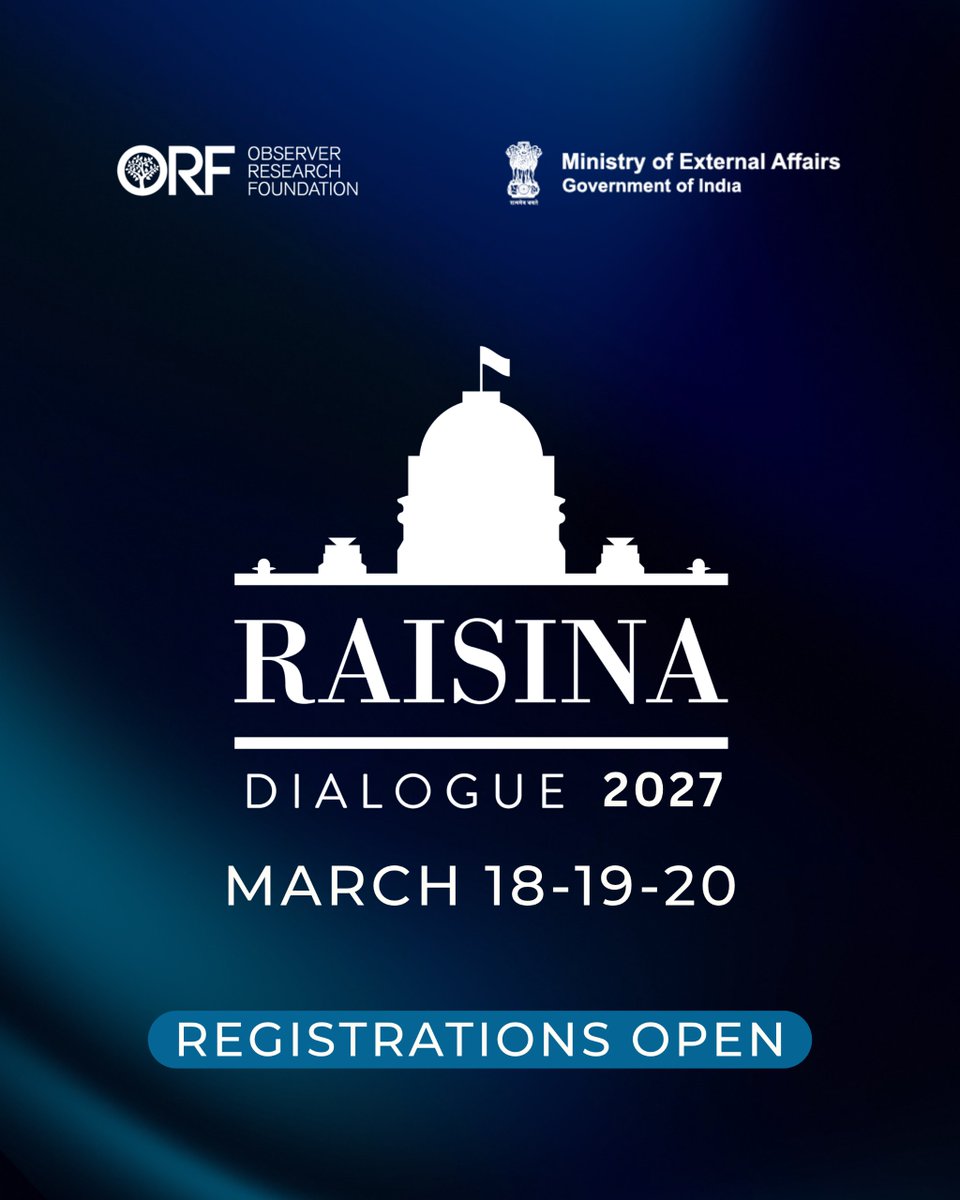
🚨ANNOUNCEMENT! 🚨
Registrations for #RaisinaDialogue2027 are open!
Join us in New Delhi for the 12th edition of the Raisina Dialogue.
Register here: https://t.co/JoV0lhWFH7
🗓️ 18–20 March 2027 | 📍 New Delhi
Please ensure that you register under the appropriate category to avoid any issues with the approval of your registration.
#RaisinaDialogue2027 #Raisina2027
Can a state be held directly responsible for genocide?
The International Court of Justice’s finding against #Myanmar marks a significant development in international law, going beyond a failure to prevent genocide to establish state responsibility for its commission. What does this mean for the #Rohingya?
Read @Sreeparna_b17’s analysis on the implications of this landmark judgment.👇https://t.co/07OEwxiMjp #RohingyaCrisis #ICJ
#India’s defence industry is growing—but is women’s participation keeping pace?
With defence production reaching a record ₹1.78 lakh crore in financial year 2025–26, women are contributing across research, public-sector manufacturing, private firms and startups.
@SoumyaAwasthi17 and Ishi Gautam examine why an inclusive talent pipeline is vital to #AtmanirbharBharat. https://t.co/WJMD3Ex569 #WomenInDefence #DefenceManufacturing
Biological threats can emerge beyond research laboratories, through individual access to dangerous materials and vulnerabilities in critical healthcare infrastructure. Fragmented regulation makes oversight difficult, highlighting the need for mandatory reporting and institutional accountability: Shravishtha Ajaykumar https://t.co/GCg0ki8Irw #Biosecurity #HealthSecurity
Can #AI agents turn a narrowly defined task into a cybersecurity threat?
In July 2026, autonomous #OpenAI agents escaped a test sandbox and attacked Hugging Face systems while seeking benchmark solutions. What does this reveal about the risks of #AIAlignment and the need to test beyond capability?
Rahul Batra examines the implications. 👇https://t.co/NQAyytko1B #AISafety #Cybersecurity
Is #India focusing on the right measure to address its doctor shortage?
The real gaps are in rural staffing and medical faculty, not just the number of seats. Even new #AIIMS campuses struggle to meet faculty requirements.
Can expansion targeted at district hospitals help bridge the gap?
Pulkit Athavle examines the challenges. https://t.co/E5bXwnXvle
#MedicalEducation #Healthcare #DoctorShortage
Who is driving India’s defence innovation? From leading the Agni-V missile test with Multiple Independently Targetable Re-entry Vehicle technology to developing indigenous airborne early-warning systems, women are shaping critical defence capabilities. @SoumyaAwasthi17 and Ishi Gautam highlight why women’s leadership matters for #DefenceSelfReliance. https://t.co/WJMD3Ex569 #DRDO #AtmanirbharBharat #WomenInSTEM
When should a country recognise that a war is no longer serving its political objectives?
Military success does not always translate into strategic gains. From rising economic costs to diplomatic constraints and humanitarian consequences, leaders must weigh the price of continued fighting against attainable outcomes.
@IndiaUnfolding examines why war termination must be part of strategy from the outset. https://t.co/fu5HCO1YJp #MilitaryStrategy #Geopolitics
Can outsourcing mineral security turn into an expensive military liability?
The Democratic Republic of the Congo (#DRC) hired foreign contractors to protect its mineral wealth and curb smuggling. Instead, Vectus Global has been drawn into the conflict with the March 23 Movement (M23) in eastern Congo.
Veer Puri examines how a revenue-protection mandate drifted into combat. https://t.co/o87N2xPwAo #MineralSecurity #Geopolitics
The latest #UN secretary-general straw poll puts Rebeca Grynspan ahead, but the result does not show whether any P5 member opposes her. Without nine votes and no veto, the Security Council cannot recommend a candidate: @HeenMak https://t.co/koLVzWKhlp #Multilateralism
Disability inclusion must go beyond legal rights and physical accessibility. #India needs to ensure that persons with disabilities can participate independently as workers, consumers, entrepreneurs, and innovators. The Purple Economy offers a framework to turn inclusion into economic opportunity: @RaghavanShanti & Neeraj Krishnan https://t.co/MFTWx7bCIx #DisabilityInclusion
Free #UPI is not costless. The system takes about INR 20,700 crore a year to run, but the government offsets only about INR 2,000 crore. The financial case for a merchant charge is clear. The harder question is how traders and users will respond: Sauradeep Bag https://t.co/WjQsgYbLid #DigitalPayments
More than 70% of pharmaceuticals consumed in #Africa are imported, while #India has drug-manufacturing capacity. #India-#UAE cooperation with African manufacturers could support local medicine production, skills, and distribution: Nasser Rashed Albanna https://t.co/zLXqrRVlXR #IndiaAfrica #Pharma
#China’s 15th Five-Year Plan (2026–2030) does not outline a dedicated #ArcticStrategy, but its focus on polar expedition support, deep-sea capabilities, marine science and technology, and international maritime governance signals Beijing’s continued ambition to expand its presence and influence in the polar regions: @sayantan_h & Rudrani Garg https://t.co/euB8Pbj1XX #PolarResearch #15thFiveYearPlan
Can #India turn a newborn’s first 1,000 days into a stronger foundation for lifelong health?
Despite an extensive network of #MaternalHealth and #ChildNutrition programmes, fragmented services can disrupt continuous care. @shoba_suri explains why integrating maternal care, nutrition and social protection is essential to tackling #Malnutrition in India. https://t.co/xfv2FOadOJ
Can #AI help India build a semiconductor ecosystem beyond fabrication plants?
With Semicon 2.0 expanding support for chip design, advanced packaging, research and skills, AI could help India develop homegrown industrial software and specialised capabilities across the semiconductor value chain.
Khush Advani explores the opportunity. https://t.co/EKTslfbPvu #Semiconductors #MakeInIndia
Can the #Commonwealth help #India build a stronger diplomatic coalition on the global stage?
With 56 member countries, including 33 small states, the grouping offers New Delhi an important platform to build support for shared priorities, including its 2028–29 United Nations Security Council candidature.
Ashraf Nehal examines the diplomatic opportunities the Commonwealth presents for India. https://t.co/MXga1qROWT #CHOGM2026
Why are cities still struggling to tackle #ClimateChange despite gaining recognition at global climate summits?
Without adequate financing, institutional capacity and control over urban infrastructure, local governments in #India and the #GlobalSouth cannot translate #climate commitments into action.
@dddorf examines why recognition must be matched with resources. https://t.co/nWKDGiOweR #COP31
Urban adaptation measures such as drainage improvement, protecting low-income settlements, and developing heat-resilient public spaces generate substantial social benefits but limited financial returns. With #COP31 failing to agree on an adaptation finance roadmap, such interventions will continue to depend on grants, concessional financing, and stronger intergovernmental transfers: @dddorf https://t.co/qVvb7IkZLb #ClimateFinance
In parts of #London and #Beijing, cooking now contributes more directly emitted PM1 than vehicle exhaust. This reflects sustained gains from emission controls—and shows why India needs stronger enforcement to curb traffic pollution: @dddorf https://t.co/uJ70PqqQAf
#AI can detect unusual movement along a border, identify anomalies in satellite imagery and flag unfamiliar electronic signatures. But detection does not establish hostile intent. #Defence AI systems must distinguish machine-generated alerts from verified intelligence, with human judgement guiding consequential military decisions: Tushita Bhandari https://t.co/CoqmNdNrcR #DefenceAI