The List of selected candidates for the MBBS/MPH Internship Program 2026 is announced on ORG website.
Click on the below link to check the results.
https://t.co/E48hZpbkP4
Congratulations to all the selected candidates.
Research at #iiscbangalore shows that bioenzymes & biopolymers can increase soil strength by 2.5x! This sustainable stabilization method for sand-kaolin mixtures offers a green, low-carbon alternative to traditional cement
#ResearchHighlights#SustainableEngineering#SARAL#ANRF
New #IISc research shows that disordered molecular nanotubes can mimic natural photosynthesis @ room temperature. Structural disorder surprisingly enhances energy transfer, a new blueprint for artificial light-harvesting tech
#SARAL#ANRF#ResearchHighlights#ScienceCommunication
New @iiscbangalore research shows long-term #meditation boosts "#gamma" brain waves, key to attention and healthy aging. The study reveals that meditation strengthens inhibitory circuits in the brain, potentially protecting against cognitive decline
#SARAL#ANRF@SupratimRayIISc
New research from @iiscbangalore reveals how to control nanopore shapes in 2D MoS2. By tuning the chemical environment, researchers can grow perfectly triangular pores, opening doors for better water desalination and DNA sequencing
#SARAL#ANRF#ResearchHighlights#Nanotechnology
New @IIScBengaluru research reveals how glucose transporters dynamically cycle at the cell surface to trigger insulin secretion. This process is disrupted in #Type2#Diabetes, but understanding it may lead to new ways to restore insulin levels.
#SARAL#ANRF#ResearchHighlights
Are atoms really spheres? #IISc researchers say no! Their study reveals that hydrogen atoms in bonds are actually elliptical. This new understanding of long & short radii helps scientists predict molecular structures with far greater precision
#SARAL#ANRF#Shivkumarkalyanaraman
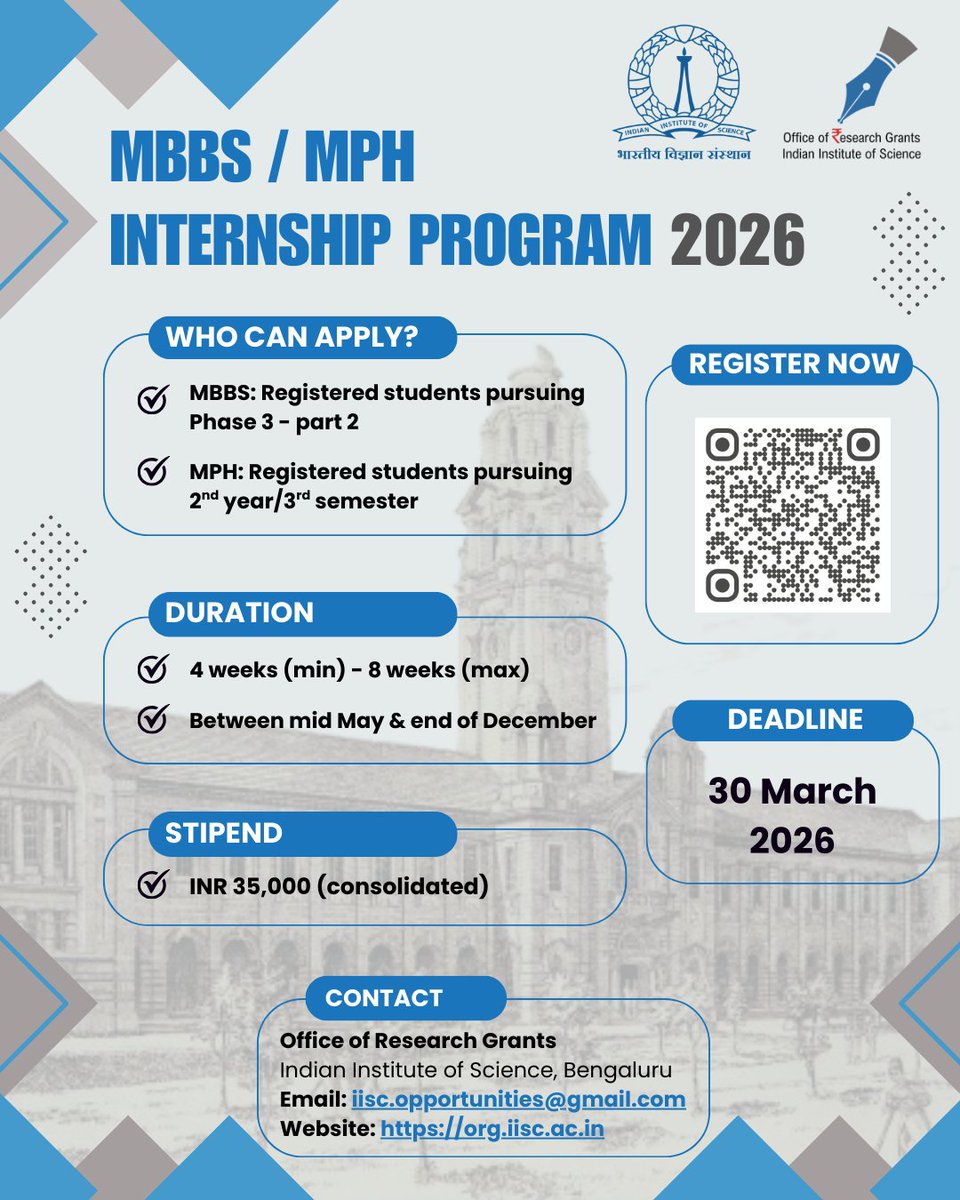
Applications are open for the #IISc#MBBS & #MPH#Internship Program
🔬 Work with IISc faculty
📅 4–8 week internship
💰 Stipend: ₹ 35000
📌 Apply by 30 March 2026
Great opportunity to gain research exposure & explore the path of a physician-scientist
#ResearchInternship#STEM
Applications are open for the #IISc#MBBS & #MPH#Internship Program
🔬 Work with IISc faculty
📅 4–8 week internship
💰 Stipend: ₹ 35000
📌 Apply by 30 March 2026
Great opportunity to gain research exposure & explore the path of a physician-scientist
#ResearchInternship#STEM
#IISc researchers have identified how the CX3 protein complex safeguards our genome. By recruiting the FANCM enzyme to resolve R-loop tangles, it prevents DNA damage & links to cancer and Fanconi anemia. A major step in genomic stability research!
#SARAL#ANRF#ResearchHighlights
#IISc researchers have designed new "molecular rotors" that act as tiny sensors for cellular health! By swapping atoms like sulfur & selenium, these probes can detect the formation of amyloid fibrils linked to diseases like #Alzheimer’s
Video via #SARAL#ANRF#ResearchHighlights
New @iiscbangalore research reveals how protein LIN-5 (NuMA) acts as a molecular architect during cell division. It ensures contractile proteins are perfectly positioned to "pinch" and split the cell on time. A key discovery in understanding cellular life cycles.
#SARAL#ANRF
#IISc researchers are speeding up battery tech! 🔋Using transfer learning & graph neural networks, they’ve developed a model to predict ionic migration barriers with 80% accuracy that is crucial for faster-charging batteries.
Video via #SARAL#ANRF#ResearchHighlights
#IISc researchers have developed a predictive framework for molecular memristors! By tailoring ruthenium complexes, they’ve created a single circuit element that reconfigures for logic, memory, and synaptic functions. A major step for brain-like computing. 🧠💻
#SARAL#ANRF
How do cells control the speed of chemical messaging? #IISc researchers found that the lipid PIP2 acts as a "stabilizer," slowing down the opening of vesicles during cargo release. This discovery highlights the critical role of lipids in cellular communication.
#SARAL#ANRF
New research @iiscbangalore reveals how RNA "antitoxins" must form a closed-cyclic loop to neutralize bacterial toxins. Even tiny mutations in the RNA’s pseudoknot structure can activate toxins, halting bacterial growth. Key for future antibacterial design!
#SARAL@ANRFIndia