"Over the past year, @tether $USDT boasted a staggering increase in market cap of over 41%, from $68.2B to $96.2B. Not all stablecoins have fared as well however, with @circle $USDC seeing a decline in market cap from $41.5B to $27.73B over the same period."
@OTellalian@ournetwork__
Unlocking the potential of Solana LSTs with SolBlaze
What are LSTs
To understand Liquid Staking Tokens (LSTs), you first need to understand what staking is in a Proof of Stake (PoS) blockchain. Unlike Proof-of-work blockchains like Bitcoin, where mining is used to earn block rewards, PoS blockchains utilize the process of staking. Here, the probability of validating a block and receiving that block's rewards is proportional to the number of tokens, like ETH or SOL, that participants have locked into the protocol. Staking provides a mechanism for token holders to earn income through rewards for securing the network.
When you stake tokens to earn these rewards, they are locked and cannot be transferred or used in decentralized finance. Liquid staking addresses this limitation by allowing people to stake their cryptocurrencies without losing their use of them. When users stake their assets through a liquid staking service, they receive a representative token in return, which reflects their staked investment plus any potential staking rewards.
There are three primary motivations for utilizing Liquid Staking Tokens (LSTs). A key reason is the desire to simultaneously participate in decentralized finance (DeFi) activities while earning staking rewards. For instance, an individual could leverage an LST as collateral to secure a loan. This opportunity to engage in financial activities that require liquidity, such as borrowing, while still earning staking rewards, exemplifies the unique advantage offered by LSTs, a flexibility not available through traditional staking methods. The second reason is to distribute validator risk. When tokens are staked, they are locked to a validator, and if the validator is malicious or ineffective, it can be slashed and lose some of the tokens staked to it. By holding an LST, it's like having your staked tokens distributed among many validators, so if one misbehaves, there is a much smaller financial penalty than if you were staking to that validator directly. The third major reason is convenience. If you are sending your tokens often, then it might be simpler to hold an LST that you can send to people rather than unstaking your tokens, which can take up to 6 days on Solana. Additionally, on some Cosmos blockchains, the unstaking period is longer, and on Ethereum, you cannot directly stake your tokens unless you have 32 ETH to stake ($73,600), so different blockchains have different inconveniences to staking that LSTs can address.
LST in DeFi
Currently, there are two major use cases for LSTs in decentralized finance. The first use case is for collateral, which is significant because it enables individuals to utilize their capital in two ways simultaneously: earning yield on their asset and serving as security for a loan or a derivative position they wish to undertake. Given that the vast majority of loans and positions in DeFi are overcollateralized and not based on credit, there is a high demand for collateral in these markets.
One interesting strategy that has been used to farm BLZE in @marginfi and @Kamino_Finance involves using the bSOL as collateral to borrow SOL, staking that SOL for bSOL, and then depositing it back into the money market. This process can be repeated multiple times but becomes increasingly risky with each loop. The advantage of this strategy is that if the interest rate of SOL is lower than the combined staking rewards and BLZE airdrop rewards of the bSOL, the borrower can profit from the borrowed funds. However, the risk is that if the bSOL depegs against SOL, it could trigger a liquidation of the position and cause the borrower to lose their collateral. This occurred with mSOL in Q4 of 2023, leading to significant liquidations.
The second major use case of LSTs in DeFi is as liquidity in Automated Market Makers (AMMs). People opt to use LSTs in AMMs because they can earn yield from both staking and AMM fees simultaneously. The incorporation of LSTs in DeFi allows the entire crypto ecosystem to become more liquid, as users do not have to choose between staking and providing liquidity. Furthermore, deeper liquidity pools provide better rates for traders, benefiting the entire ecosystem.
SolBlaze stake pool delegation
@solblaze_org's stated mission when it comes to their delegation is "to strike the right balance between high-rewarding validators, high-scoring validators, and smaller validators to ensure that we can help decentralize the network without sacrificing on staking rewards." Currently, the BlazeStake pool is split into three parts: 80% algorithmic strategy, 10% Custom Liquid Staking pool, and 10% BLZE gauges. Let's dive into how validators are chosen for delegation in these three portions of the pool.
For the Algorithmic pool, the first rule is no delegation goes to the "security group". The security group refers to the group of around 32 validators that control more than 33% of the staked SOL. The reason that no delegation goes to them is, "If these 32 validators hypothetically colluded (which they are heavily disincentivized from doing), they would not be able to submit fake transactions, but they would be able to stop new transactions from being approved." Each validator that is not in the security group is given a stake coefficient; this coefficient is determined by validators' rewards, skipped slot rate, voting success rate, and commission, with data sourced from @ValidatorsApp and @laine_sa_. Delinquent validators, suspicious validators, and validators with a commission above 10% are not included in this pool. Validators with higher coefficients are given more stake out of this portion of the pool. To get the exact formula of how this coefficient is determined and how stake is divided based on the coefficient, go to this link: https://t.co/FQ2M5yL72X.
Custom Liquid Staking (CLS) allows people to choose the validator or validators that receive the stake they add to the stake pool. If the delegators' bSOL balance decreases, then the amount of SOL directed to the chosen validators through the CLS decreases. It should be noted that using bSOL in supported DeFi protocols, including @orca_so, Kamino, Marginfi, and more, counts towards the SOL that can be directed with CLS.
Holders of BLZE, the token of SolBlaze, can lock their tokens in realms for up to 5 years. Lockers of the token get the power to direct this 10% portion of the stake pool; the longer the tokens are locked, the more stake the staker can direct per token locked. Gauge votes are applied in one-week increments. The votes are tallied at the end of each week-long voting period, and the pool rebalancer will shift the stake in the BlazeStake pool accordingly as part of standard rebalancing procedures.
The state of LSTs on Solana
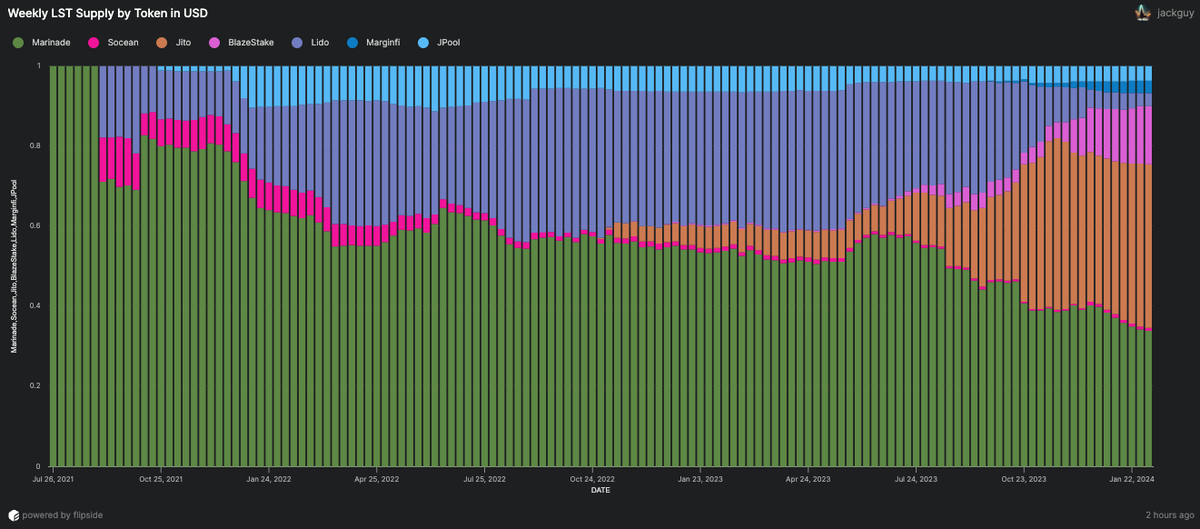
In the lead-up to the @FTX_Official collapse, there was a notable decrease in the volume of SOL being liquid-staked. However, in the aftermath, there's been a significant resurgence in SOL staked across the network, with the amount increasing from approximately 8.5 million SOL to nearly 18 million SOL. By the end of 2022, @MarinadeFinance's mSOL and @LidoFinance's stSOL were the predominant forces in the Solana Liquid Staking Token (LST) market. Since then, there has been a notable shift in market dynamics, with stSOL's market share plummeting from one-third to less than 3%, and mSOL's share decreasing from about 55% to around 35%. This shift paved the way for new entrants in the Solana LST arena—@jito_sol, SolBlaze, and Marginfi, reshaping the competitive landscape. Currently, Jito leads the market, accounting for 40% of the liquid staking tokens, while SolBlaze has emerged as a significant player, securing about 14% of the market share. This evolving landscape highlights the dynamic nature of the Solana ecosystem and the growing interest in liquid staking solutions. Check out this @flipsidecrypto dashboard to see the data https://t.co/MYkqxbVoM5
When comparing the liquid staking ecosystem of Solana to Ethereum, there is definitely room for growth. Currently, only about 3% - 4% of SOL is liquid staked, in contrast to Ethereum, where approximately 10% of all tokens are liquid staked. One of the primary uses of liquid staking tokens is in DeFi, and Ethereum has a much more mature DeFi ecosystem than Solana for using these tokens. As more DeFi opportunities on Solana open up for SOL stakers to leverage their LSTs, using their staked SOL in DeFi, there is significant potential for sector growth. Projecting that liquid-staking tokens will reach the same percentage of total tokens as on Ethereum, we should expect the number of liquid-staked SOL to be in the range of 43M - 57M tokens, representing a 100% - 200% increase from where it currently stands.
🎥 New Podcast Episode Out Now 🎥
🌟 Tune in as @jackthepine chats with @Austin_Federa from the @SolanaFndn! 🌐
Discover the latest happenings and breakthroughs in the @solana ecosystem.
🔥 Get the inside scoop on Solana's journey and future in this engaging talk.
🗣️ Join @Red_eyed_Bear as he delves into the promising prospects for @Shade_Protocol token stakers. Get the lowdown on how real yield is evolving in our ecosystem.
(1/5) 📈 Did you know that after October 2022, @axelarcore governance voting activity when from just 20-40 wallets to between 200-500 wallets per proposal?
Let's dive into the data👇
(1/5)🧵 @stride_zone just launched their liquid staking module!
Stakers of $ATOM can now convert staked ATOM to liquid staked ATOM (stATOM) seamlessly.
In just 11 days, a staggering $7 MILLION worth of staked ATOM was converted to stATOM!
Dive in to learn more👇
Over the last six months, the Dimension X NFT Collection has amassed a sales volume of over 400,000 FLOW through 3,000+ transactions, reflecting an average sale price of roughly 130 FLOW per NFT!
Don't miss this chance to earn rewards for joining one of the best games on Flow.
113 Flow Tokens for 1 new player.
Req:
-Play DMX on @flow_blockchain w Account made TODAY
-Level 5 sidekicks to lvl 3
-Equip 5 Sidekicks
-get 1 Sidekick's Power to level 5
-Comment w/ Dapper Wallet Address
-Ends: 9-22 at 5 PM CST
Will select 1 winner on Friday.
#NFTDay2023
(1/5)💥@avax has marked $10 million in NFT secondary sales. A noteworthy milestone in its journey. Let's delve into these figures using @flipsidecrypto data. 👇
(1/5)🧵 The @Axl_Satellite bridge on @axelarcoree has done over $4.5 Billion in bridge volume in 2023!
This bridge is the nexus for EVM assets moving to the IBC ecosystem.
Let's delve into the bridge's activity in 2023👇
(1/8)🧵 @aerodromefi, a nascent force in the DEX arena, is making waves on @BuildOnBase.
Its TVL growth to nearly $200M in mere days is nothing short of astonishing.
As we proceed, we'll dissect its swap activity, TVL, and AERO token's dynamics.
(1/4) 🧵Over recent months, the @tensor_hq NFT Marketplace has witnessed a transformative trend with the emergence of CNFTs on @solana.
Launched not so long ago, CNFTs now constitute between 15% to 25% of all NFT sales on Tensor each week.
Let's delve deeper.
(1/7)🧵Exciting times for the @cosmos ecosystem!
A collaboration between @axelarcore and @LidoFinance is bridging LDO staked tokens to Cosmos.
Let's dive into the data to understand the implications and activities around this. 👇
📢 Fresh Clip Drop!
@abhayait sheds light on the significance of on-chain analytics and its unparalleled ability to validate on-chain activities.
Dive in to understand why it's the gold standard in blockchain verification! 🚀