Those slandering Sh Hamud bin 'Uqla Shu'aybi rh, know that the people you look up to, the Saudi media, were forced to apologise to apologise and recant their statements to the Shaykh
The newspaper even wrote the Shaykh was teacher to most of Hay'ah Kibar Al-'Ulema'
Freeing Imāms of Najdi Daʿwah from Hazimi Pre-Atheists
Shaykh Muhammad ibn ʿAbd al-Wahhab and Shaykh ʿAbd al-Rahman ibn Hasan
“Among them are those who show enmity towards them but do not declare them Kuffar. This category, too, has not fulfilled what the statement La ilaha illa Allah indicates in terms of negating shirk, nor what it necessitates of declaring those who commit it to be disbelievers after clarification of consensus has been made.”
[Al-Durar al-Saniyyah fi al-Ajwibah al-Najdiyyah, 2/207]
Shaykh Sulayman ibn ʿAbd Allah ibn Muhammad ibn ʿAbd al-Wahhab
“If he is doubts their Kufr, or is ignorant of their Kufr, then the proofs from the Book of Allah and the Sunnah of His Messenger regarding their Kufr are to be made clear to him. If, after that, he continues to doubt or hesitate, then he is a Kafir, for the scholars have unanimously agreed that whoever doubts the disbelief of a disbeliever is himself a disbeliever.”
[Awthaq ʿUra al-Iman]
Shaykh Muhammad ibn ʿAbd al-Latif Al al-Shaykh رحمه الله
“Whoever singles out certain places for acts of worship, or believes that whoever stands at those places is absolved of the obligation of Hajj, his disbelief is something about which no one who has even a trace of understanding of Islam would have any doubt.
Whoever doubts his disbelief must first have the proof established against him, and it must be clarified to him that this is disbelief and shirk, and that adopting these stones is an imitation of the religious symbols of Allah, at which Allah has prescribed standing as an act of worship of Him.
Then, if the proof is established against him and he persists, there is no doubt concerning his disbelief.”
[Al-Durar al-Saniyyah fi al-Ajwibah al-Najdiyyah, 10/443]
Shaykh Muhammad ibn ʿAbd al-Latif Al al-Shaykh رحمه الل�� also said,
“Know that these practices belong to the religion of the pre-Islamic era of ignorance (Jahiliyyah), against which the Messenger of Allah ﷺ was sent to denounce, eradicate and remove its traces, because they constitute major shirk, whose prohibition is established by the decisive verses.
These festivals resemble the festivals of the pre-Islamic era of ignorance. Whoever believes that they are permissible and lawful, and that they constitute an act of worship and a religion, is among the most disbelieving and most misguided of Allah's creation.
And whoever doubts their disbelief after the proof has been estzablished against them is himself a disbeliever.”
[Al-Durar al-Saniyyah fi al-Ajwibah al-Najdiyyah, 10/440]
The Imām of Sunnah, Qiwām As-Sunnah Al-Asbahāni rh [457-535AH]
In his newly published Tafsīr
They wish to seek Judgement of Taghut while they have been ordered to do Kufr in it
“At-Taghūt
- At-Tāghī [Crossing the boundary/hadd] in his k-fr [i.e. higher kufr than normal kufr]
- Ordered to make takfīr in every Book
- it is Hākim who rules by other than Allah’s hukm”
The meaning: Have you not seen those who claim that they believe in what has been revealed to you (from the Qur’an) and what was revealed before you (from the Scriptures sent down to the Prophets), yet they wish to seek judgement from the Ṭāghūt?
(TAGHUT) That is, one who transgresses in his kufr. Yet they were commanded in every revealed Book to disbelieve in the Ṭāghūt — meaning the ruler who judges by other than the حكم (judgement) of Allah.
If you voted, make tawbah, retake your shahada, and avoid shirk going forward.
Continue learning about tawheed & aqeedah, and pray not to be misguided after guidance.
Expecting actual lasting benefit and results from Shirk is nonsense.
الحكومة السعودية تحذف آية وتفسير "ولن ترضى عن اليهود ولا النصارى حتى تتبع ملتهم" من منهج التفسير للمرحلة الثانوية
حذفت الآيات التي كانت في منهج التفسير بشكل مستمر لمدة 40 سنة
#تغيير_المناهج_السعودية
Seeking Judgement from Taghut is Kufr and Shirk - Qadi Iyyad
Al-Qāḍī said:
“Seeking judgment from the Ṭāghūt must be considered Kufr, and not being pleased with the judgment of Muhammad ﷺ is Kufr, for several reasons”
First reason:
His statement:
“They wish to seek judgment from the Ṭāghūt, while they have been commanded to disbelieve in it.
He thus made seeking judgment from the Ṭāghūt the opposite of Kufr in it. This necessitates that seeking judgment from the Ṭāghūt is Kufr in Allah, just as Kufr in the Ṭāghūt is Imān
in Allah.”
Second:
His statement, the Most High:
“But no, by your Lord, they will not believe until they make you (O Muhammad) judge concerning that over which they dispute among themselves, and then find within themselves no discomfort concerning what you have judged, and submit with full submission.”
[Sūrah al-Nisāʾ, 4:65]
This is an explicit text concerning the Tākfir of the one who is not pleased with the judgment of the Messenger ﷺ.
Third:
His statement, the Most High:
“So let those who oppose his command beware, lest a trial strike them or a painful punishment befall them.”
[Sūrah al-Nūr, 24:63]
These verses indicate that whoever opposes anything from the commands of Allah and His Messenger has departed from Islam, whether his opposition stems from dount or from defiance and rebellion.
This establishes the correctness of the position adopted by the Companions (may Allah be pleased with them) concerning their judgment that those who withheld zakāh were Murt@ddeen.
Judging by Man-Made Laws is Shirk
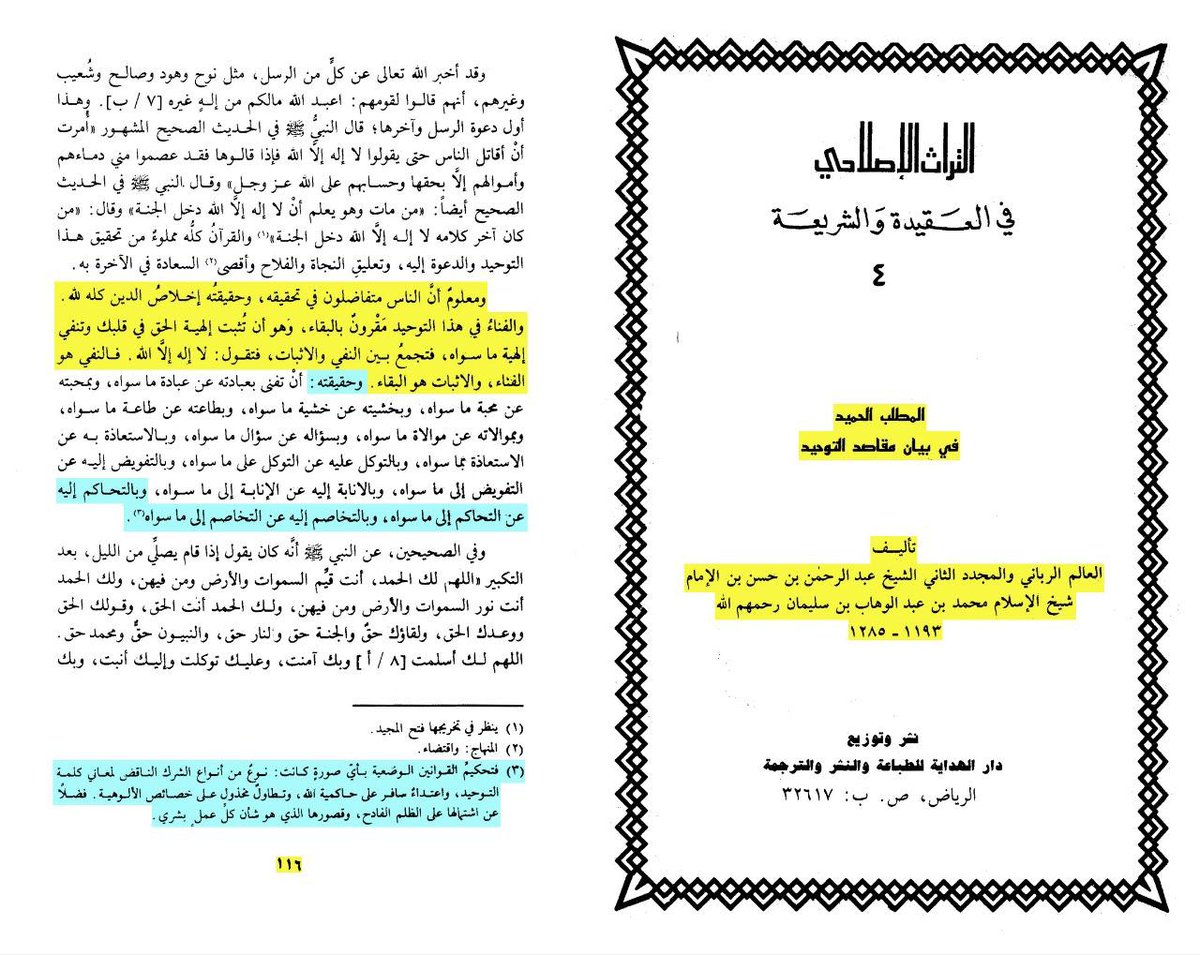
Shaykh Abd Al-Rahman Hassan said:
"It is well known that people differ in how fully they fulfil Tawḥīd. Its true meaning is to sincerely devote the entire religion to Allah alone.
Negation in this Tawḥīd is accompanied by affirmation. This means that you establish in your heart that Allah alone is worthy of worship and reject the worship of everything besides Him.
Thus, you combine negation and affirmation, saying:
Lā ilāha illā Allāh — There is no deity worthy of worship except Allah.
Negation: Rejecting the divinity of everything besides Allah.
Affirmation: Affirming that Allah alone is worthy of worship....
Its true reality also entails Tahakumm (seeking Judgement) from Allah alone, rejecting turning to anything besides Him for Tahakkūm, and bringing disputes before Him rather than before anything besides Him.....
(3) Judging by Man-Made Laws, in whatever form, is a type of shirk that nullifies the meanings of the word of Tawḥīd. It is a blatant violation of Allah’s exclusive authority to legislate, and a grave transgression against the attributes exclusive to divinity. This is in addition to the severe injustice they entail and their deficiencies, which are characteristic of every human undertaking."
Taking Laws from other than Prophets is greatest form of Shirk
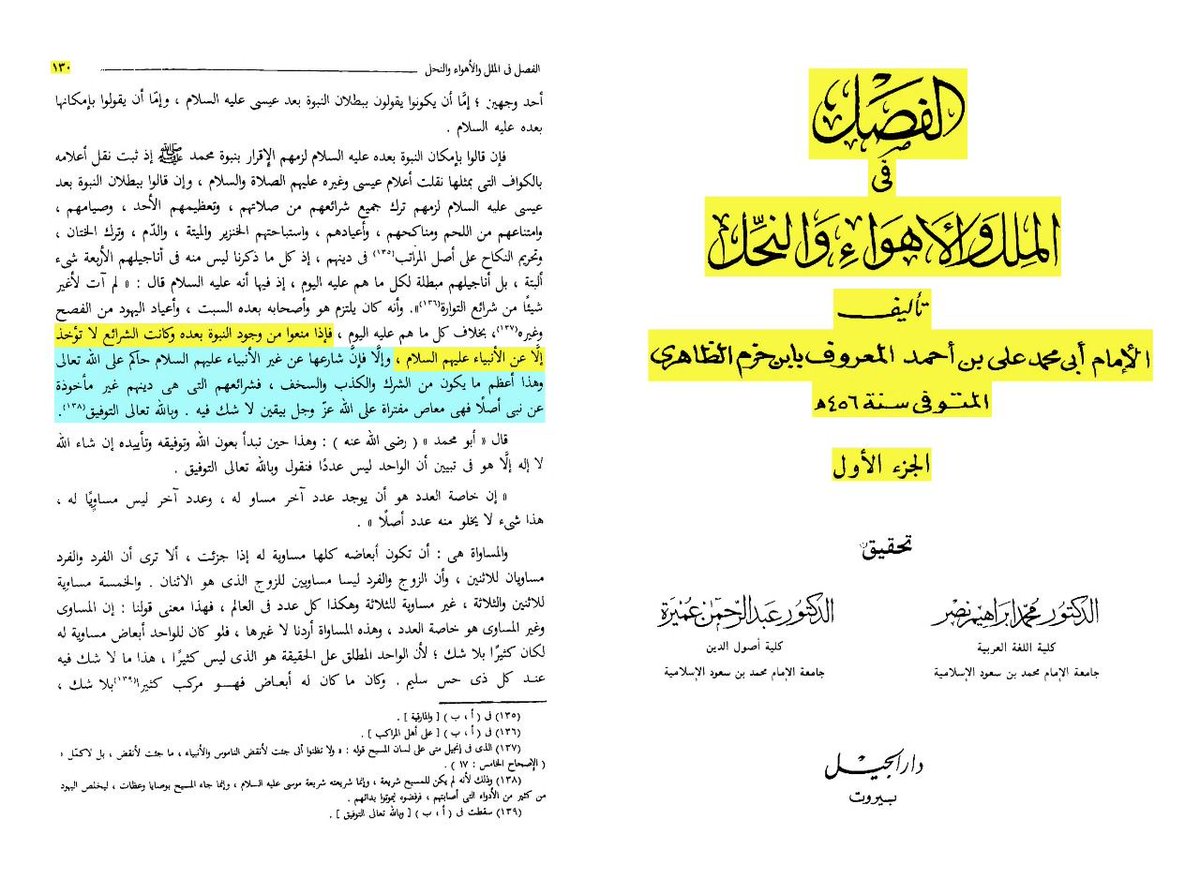
Imām Ibn Ḥazm (رحمه الله) said:
“Thus, if they (Christians) deny the existence of prophethood after him (Jesus, peace be upon him), while Laws can only be received from the Prophets (peace be upon them)—for otherwise, whoever legislates them independently of the Prophets (peace be upon them) would be setting himself up as a judge over Allah Most High, and this is among the gravest forms of associating partners with Allah (shirk), falsehood and absurdity—then their laws, which is their Deen are not derived from any Prophet whatsoever.”
📕 Al-Fiṣal fī al-Milal wa-l-Ahwāʾ wa-l-Niḥal 1/130
Shaykh ʿAbd al-Laṭīf Āl al-Shaykh’s Position on Ḥākimiyyah
I have seen Madkhali Nusayri Murtaddeen attributing their Pagan religion to this noble Imam.
As Allah, ʿAzza wa-Jall, says:
“Indeed, the worst of living creatures in the sight of Allah are the deaf and dumb who do not use reason.” (Qur’an 8:22)
“Had Allah known any good in them, He would have made them hear. And even if He had made them hear, they would still have turned away, refusing.” (Qur’an 8:23)
1. Tākfir of one who does Istibdal of Shari‘ah
Shaykh Abdūl-Latif Al-Shaykh said:
“So examine the reports of those who came before them.
They abandoned the Book and replaced it (Istabdalū).
And they replaced their ways because of their deviation (Istabdalū).
And likewise, they replaced the glorification of our Lord, Glorified be He, with insults (Istabdalū).
What did they see in the leaders of disbelief?
They replaced the divine law with that tyrannical law (Istabdalū).
They replaced the teachings with legislation from Satan (Istabdalū).
They replaced the worship of the Most Merciful with ignorance and the setting up of rivals to Him (Istabdalū).
They replaced His rulings in people's minds (Istabdalū).
And they replaced faith with disbelief (Istabdalū).
They accepted the rule of a state that opposed them.
And they replaced His revelation with laws that contradicted it (Istabdalū).”
2. Takfir of one who seeks Judgement (Tahakkūm) from other than Shari‘ah
Shaykh ʿAbd al-Laṭīf ibn ʿAbd al-Raḥmān was also asked:
“What is the ruling regarding the people of the sawālif (traditional customs) among the Bedouins and others, who judge according to the customs of their fathers and forefathers? Are they declared disbelievers on that basis after the clarification has been made, and so on?”
He replied:
“Whoever seeks Judgement from other than the Book of Allah and the Sunnah of His Messenger, after the clarification has been given (that his customs oppose Shari‘ah), is a Kafir.
Allah, the Most High, said:
‘And whoever does not judge by what Allah has revealed, then it is those who are the disbelievers.’ (Al-Mā’idah 5:44)
And Allah, the Most High, said:
‘So is it other than the religion of Allah that they seek?’ (Āl ʿImrān 3:83)
And Allah, the Most High, said:
‘Have you not seen those who claim that they have believed in what was revealed to you and what was revealed before you? They wish to seek judgment of Ṭāghūt, while they were commanded to reject it…’ (An-Nisāʾ 4:60)
And Allah, the Most High, said:
‘And We certainly sent into every nation a messenger saying, “Worship Allah and avoid Ṭāghūt.”’ (An-Naḥl 16:36)
And there are many verses conveying this meaning.”
3. Takfir of one who attends Parliement and Legislative Councils
“Among the greatest of sins and misguidance that nullify the asl of Islam is supporting the enemies of Allāh...
Included in the first category are also attending gatherings in which the rulings of Allah and the rulings of His Messenger are opposed, judgment is made according to the laws of the Franks, the Christians, and those who abolish or reject the truth, and one witnesses mockery of the rulings of Islam and its people.”
4. Takfir of Judges of Constitution and Man-Made Laws
Shaykh ʿAbd al-Laṭīf Āl ash-Shaykh writes in response to Muḥammad ibn ʿAjlān:
❝As for you permitting seeking aid from them [the mushrikīn] — the dispute is not [only] regarding this particular issue, but rather in appointing them, bringing them, and establishing them in an Islamic land wherein they destroy the symbols of Islām, the foundations of the religion, and the principles (ʾuṣūl) and branches (furūʿ) of the religion.
Among their leaders [of the mushrikīn who are brought in] there exists a law and a ṭāġhūt that they have established to judge between the people concerning blood, wealth, and other matters — opposing and contradicting the revealed texts (nuṣūṣ).
I hate this feeling when everyone ignores us and no help reaches us, as if we are just numbers.
We are starving... we have nothing left to eat. We need $30 to buy food for my family.
https://t.co/4evOG8UcLI
3 replies — even dots — can break the algorithm 🙏
We urgently need 50$ to buy food.😭🤲
Is there anyone willing to volunteer generously to help?👇👇💔
https://t.co/4UZLok7tFs
3 replies — even dots — can break the algorithm 👇
I am still undergoing treatment and I hope for your support so that I can provide food for my children.
[https://t.co/s3RemzkbEj]
Seeking Judgment (Taḥākum) from Other Than the Sharīʿah Is Seeking Judgment from Ṭāghūt
Allah سبحانه وتعالى says:
﴿ يُرِيدُونَ أَن يَتَحَاكَمُوا إِلَى الطَّاغُوتِ وَقَدْ أُمِرُوا أَن يَكْفُرُوا بِهِ ﴾
“They wish to seek judgment of Ṭāghūt, while they have been ordered to Disbelieve in them.”
[Sūrah An-Nisāʾ 4:60]
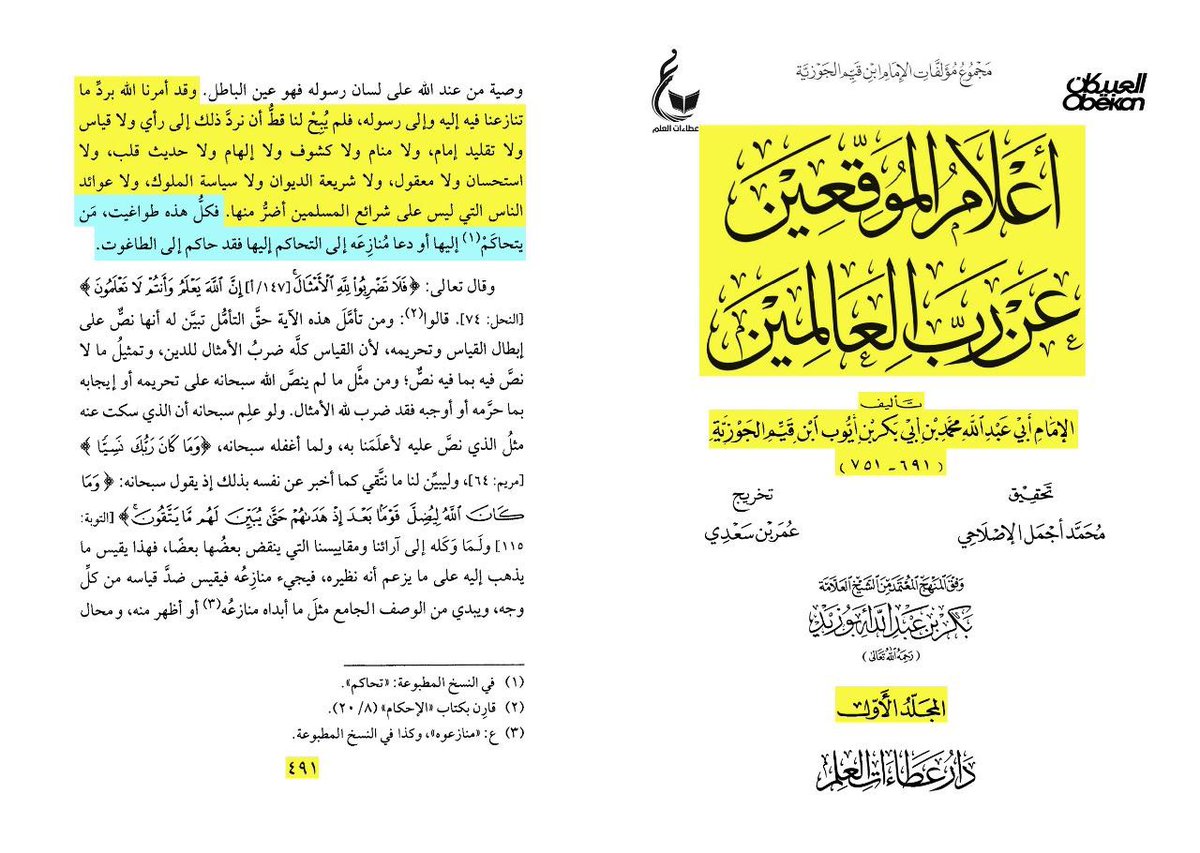
Imām Ibn al-Qayyim al-Jawziyyah رحمه الله stated:
“Allah has commanded us to refer whatever we dispute over back to Him and to His Messenger. He has never permitted us to refer such matters to personal opinion, analogy, or the blind following of an imam; nor to dreams, mystical unveilings, inspiration, what one’s heart tells them, juristic preference, rational judgment, the laws of the state, the policies of kings, or the customs of people—among which there is nothing more harmful to the laws of the Muslims than these customs.
All of these are Ṭawāghīt (false authorities to whom judgment is referred). Whoever submits to their judgment, or calls upon his disputant to seek their judgment, has indeed sought judgment from Ṭāghūt.”
• So one who legislated Lāws in opposition to Shari‘ah is Taghut
• One who set up Man-Made Courts in opposition to Shari‘ah is a Taghut
• Judge who puts these Laws forward for disputing parties to seek Judgement from is a Taghut
• One who enforces the authority of these Courts binding people to refer Judgement to them from police and soldiers are soldiers of Taghūt and Shirk
Once you understand this, you would will know that Kufr Duna Kufr is restricted to individual court Judgement, that does not become a reference for people to seek Judgment from
And Madkhalis and their likes are Murtaddeen who defend and cement the thrones of Tawaghīt, and these Murtaddeen have came into obedience to Taghut whose rule they consider Islamically valid
I’m sorry to bother you… 💔🥺
Donations have stopped. Please help break the silence. £5 can make a difference, or simply repost. 🙏🏻
🏠 Only £227 left. 🇾🇪💔https://t.co/X4rLeY3AUQ
@NurHasanEmon3@Truth_willxz Up to the discretion of ruler, but regular rape was usually punished by death (as per the opinions of many major scholars), so child rape would be even more severe
Ruling by other than Shari‘ah is Major Kufr
Shaykh ʿAbdullāh ibn Muḥammad ibn ʿAbd al-Wahhāb رحمه الله said:
“The action of this man who assaulted the man he found in the house is forbidden. It is an act of transgression and injustice. He must be disciplined and punished with a discretionary punishment (taʿzīr) sufficient to deter him and others like him from committing such an act.
He is also liable to legal retribution (qiṣāṣ) where retribution is applicable, and blood money (diyah) where retribution is not possible—unless the injured party agrees to accept blood money in place of retribution in all cases.
As for the accused man, the most that the ruler may do is discipline him through a discretionary punishment, such as beating or imprisonment, according to his judgment. Anything beyond that is injustice, transgression, and a violation of the limits set by Allah.
If the assailant denies causing some of the injuries while admitting to others, the burden of proof rests upon him regarding his claim that someone else participated in causing those injuries. If he cannot produce evidence, then the statement of the injured party, supported by an oath, is accepted regarding the attribution of those injuries to that particular individual, in view of the circumstantial evidence indicating that all of them were caused by this assailant.
Every believer must be pleased with the judgment of Allah and His Messenger ﷺ, and must find no resistance within himself toward what Allah and His Messenger have decreed, whether it agrees with his desires or opposes them.
Whoever has sickness or hypocrisy in his heart submits to the Sharīʿah when it agrees with his desires, but opposes it when it conflicts with his desires and customs. This is among the hallmark of the hypocrites, concerning whom Allah said:
‘Have you not seen those who claim that they believe in what has been revealed to you and what was revealed before you? They wish to refer judgment to Taghut, even though they were commanded to reject them. Satan wishes to lead them far astray.’
— Qur’an 4:60
Whoever seeks a judgment other than that of Allah and His Messenger has sought the judgment of ṭāghūt.
And how astonishing it is that a person hears words of disbelief and hypocrisy in his gathering (ie Judge judging by other than Shari‘ah), yet does not condemn the one who speaks them. Rather, he remains silent, thereby becoming a partner in the wrongdoing.”