4-bit quantized models do seem to be pretty fast on CPU, but is the precision tradeoff against fp16 gpu based models worth it? This seems to only be an issue with smaller models (7B). > 35B models work great with 4-bit quantization though
Here is 4-bit inference of LLaMA-7B using ggml:
https://t.co/NSetwCti03
Pure C/C++, runs on the CPU at 20 tokens/sec (M1 Pro)
Generated text looks coherent, but quickly degrades - not sure if I have a bug or something 🤔
Anyway, LLaMA-65B on M1 coming soon!
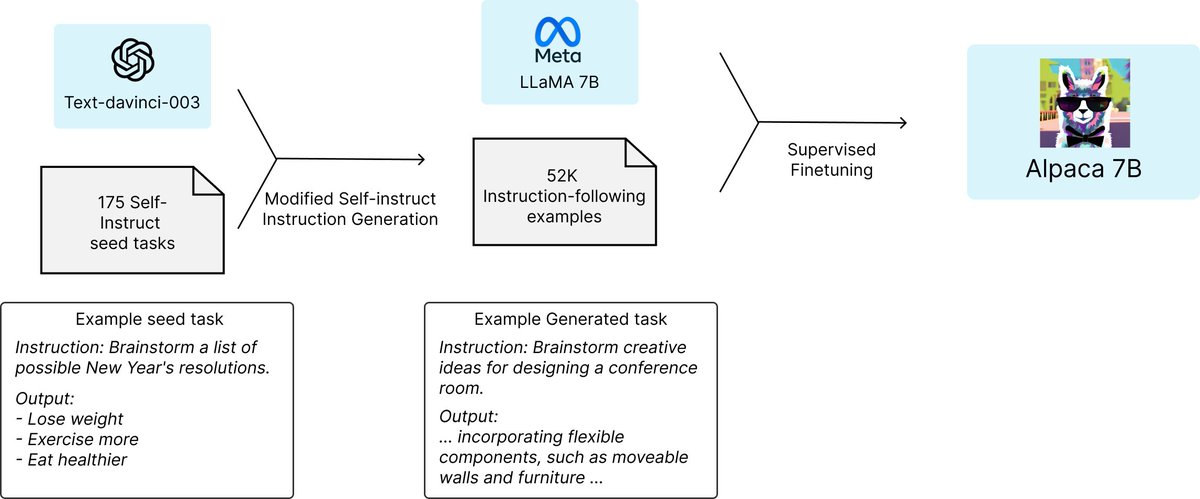
LLaMA has been fine-tuned by stanford,
"We performed a blind pairwise comparison between text-davinci-003 and Alpaca 7B, and we found that these two models have very similar performance: Alpaca wins 90 versus 89 comparisons against text-davinci-003."
@Kdenkss That’s a pretty optimistic outlook. More likely there’ll be a sharp divergence in what it means to be 1st world and 3rd world. One has all the compute, the other is an open mine for compute resources. Think Elysium
"What Makes Convolutional Models Great on Long Sequence Modeling?"
CNNs—not transformers—now dominate the hardest sequence modeling benchmark.
Here's how this happened: [1/14]
Twitter viewable version of my completed film, taking extracts from James Joyce's novel 'A Portrait of the Artist as a Young Man', used word for word as prompts, in the style of artist John Lavery, using #stablediffusion#deforum
@Kdenkss You should give midjourney AI a try. Their model seems to be a lot better suited for picturesque/cinematic art. Prompt: “An Igbo man looks over the village he grew up in:: in the style of Caravaggio”