One of the most mind boggling yet underrated achievement of modern construction technology and ingenuity is the establishment of giant dry docks
Imagine a structure, into which 500000 ton ships can sail directly into, get hoisted on some mechanism, after which the sea water is drained out and people can walk in and repair it as if they are repairing a car in a garage.
And once they are done, they simply let the water in and sail away again.
To put it in perspective the enormity of this, a 500000 tons ship is also 20 WW 2 Aircraft carriers put together. And they repair it like a car.
The funny part is, most of us hardly even know the existence of a structure known as a dry dock
A lonely goodbye to Madhav Gadgil, one of the tallest environmentalists of our times.
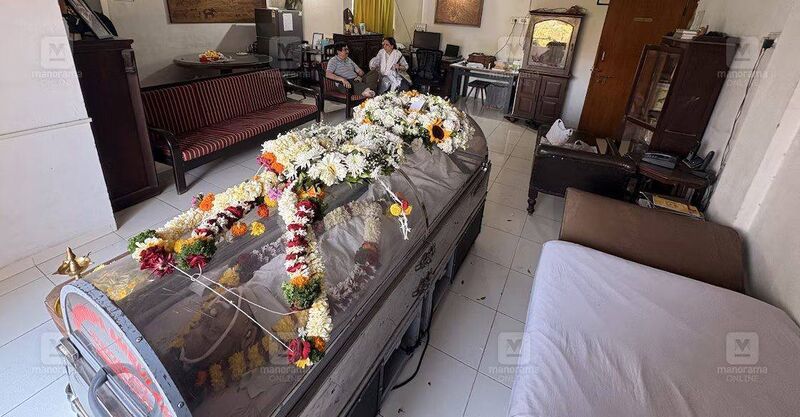
Under the banyan trees of Navi Peth in Pune, Madhav Gadgil was taken for cremation last evening. The gathering was small, some forty, perhaps fifty people.
No ministers. No senior officials. No tricolour to drape the body. No guard of honour salutes. No ceremonial rifle volleys.
One expects a crowd, the usual press cameras and public mourning. Instead, there was a pause, a quiet uncertainty, as if this farewell were happening somewhere it wasn’t meant to.
State honours had been promised, but never quite arrived. Even the police escort lost its way. For nearly half an hour, Gadgil’s body lay waiting, wrapped in simple white, while the city carried on around it, indifferent.
For me, this was not the death of a distant public figure.
In the 1990s, when I was starting out as a science correspondent with the Press Trust of India in Bengaluru, Madhav Gadgil was already a towering presence at the Indian Institute of Science (IISc). At the IISc's Centre for Ecological Sciences, he stood out, not by volume or self-importance, but by intellectual rigour and moral clarity.
I walked into his office many a time in those years, notebooks open, deadlines close. He listened carefully, answered precisely, never spoke down. He believed knowledge carried responsibility, and that science without ethics was incomplete. Those conversations stayed with me, shaping how I understood both journalism and ecology.
This was also the man who later led the Western Ghats Ecology Expert Panel, producing a report that treated the mountains not as real estate or mineral stock, but as living systems. The Gadgil Committee Report spoke of ecological limits, decentralised governance, community rights, and long-term survival.
A Padma Bhushan awardee. A UN Champion of the Earth. A lifelong defender of forests, rivers, biodiversity, and uncomfortable truths. In death, he was treated as someone easily forgotten.
The trees were not.
The old banyans stood quietly, their leaves stirring in the afternoon air. Gadgil had given his life to them. Trees remember. Animals remember. They show up when people don’t.
Had this been a politician or an industrialist, roads in Pune would have been sealed, helicopters circling, television studios filled with tributes and theatrical grief. Power is never allowed to pass quietly.
But a man who tried to protect the land that sustains us all was sent off almost unnoticed.
The trees stood witness.
The rest of us moved on.
Goodbye, Madhav Gadgil.
Forgive us.
We did not know how to honour you.
(Photo Courtesy: R S Gopan)
@MasalaBai Had a similar experience when I lost my wallet in the Delhi Metro last month, a guy called me and left the wallet with CISF for safekeeping so I could pick it up from my metro station. Most people are good :)
Echoing the lament of an 18th c Delhi poet who versified his cough-inflicted state as follows: "So completely has this disease melted by frame (body), that even the Huma (a mythical bird believed to feed on stone & skeletal remains) would need spectacles to discover my bones."
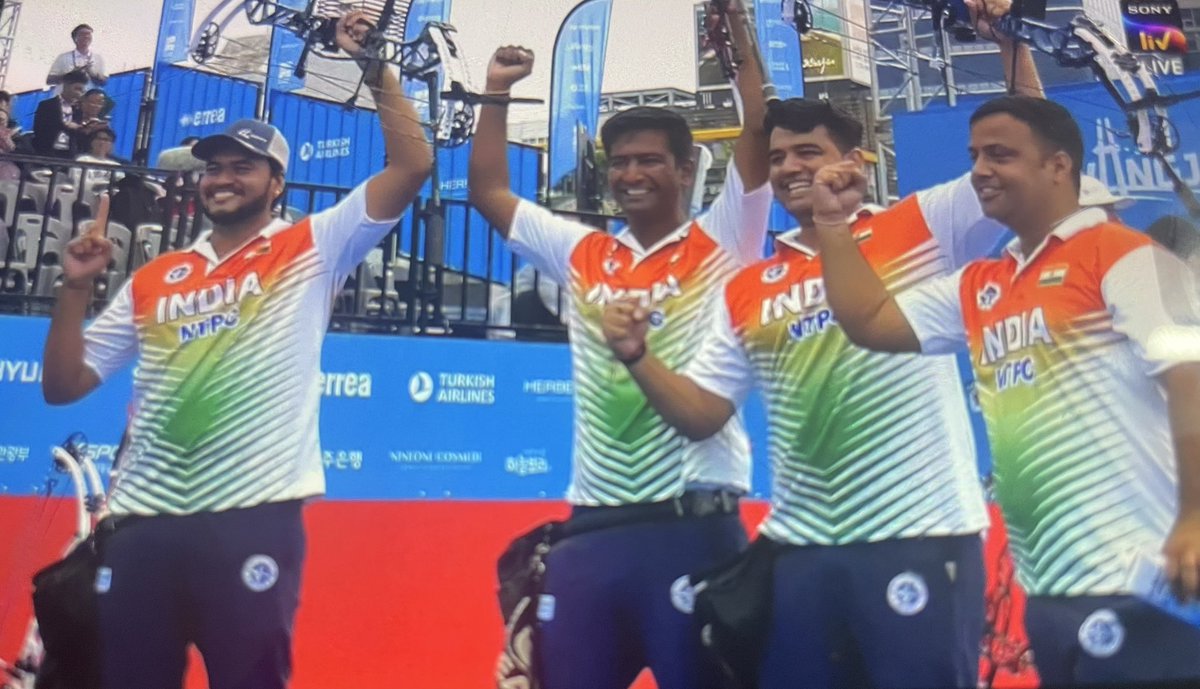
Indian compound team of Rishabh Yadav, Prathamesh Fuge and and Aman Saini win the gold with a 235-233 win against French team of Nicolas Girard, Jean Boulch and Francois Dubois in the World Archery Championships in Gwangju, Korea. It’s the first gold medal for the Indian men’s team in the worlds. @IExpressSports
To have two series like Ind Aus 20-21, and Ind Eng 2025 within five years beggars belief. Two of the finest test series in our history!
And no scriptwriter could have written this ending better!
Nasser Hussain, even in the afterglow of one of the greatest series of all time, shows real class:
"Not every country has the luxuries we have. So we, and India and Australia, have to keep an eye out for the future of Test cricket.. and look after those who are not as fortunate"
This unforgettable #EngvInd series following on from the incredible #AusvInd summer & South Africa being crowned world champions must safely allow Test cricket to have a cup half full attitude towards its health even if there are a few niggles here & there at the grand age of 148
Mohammed Siraj has joined Kapil Dev as the only Indian bowlers to play all 5 Tests in an away series on three occasions and pick up 10 or more wickets each time. No other fast bowler in the world has played more than three such away series in 21st century...
India's first Test win at The Oval in 1971: Abid Ali from Hyderabad hit the winning runs
India's latest Test win at The Oval in 2025: Mohammed Siraj from Hyderabad takes the final wicket
Someone who should actually be credited for Siraj's rise, would be Bharat Arun. He fast tracked Siraj for the Hyderabad cricket team, and since then it's been a story.
Had an eye for the talent.