Out Now (Open Access): The Atlas of Digitised Newspapers and Metadata: Reports from @OceanicEx, edited by @mhbeals and @EmilyJLB. https://t.co/bxdPkBdx0h #dh#dhist
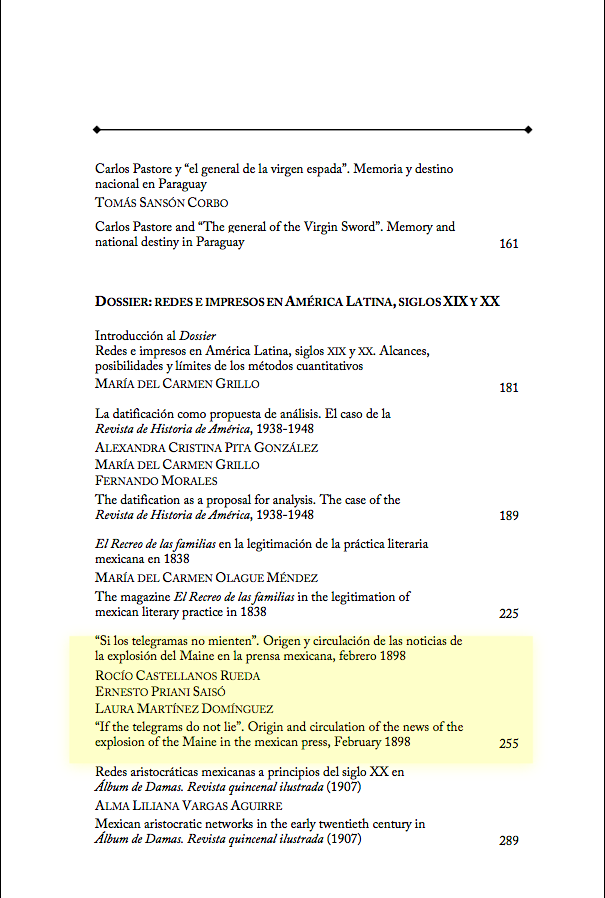
Nos publicaron un articulo al grupo de @OceanicEx. #historia#HumanidadesDigitales “Si los telegramas no mienten” Origen y circulación de las noticias de la explosión del Maine en la prensa mexicana, febrero 1898 | Revista de Historia de América https://t.co/sImcDKHE9i
La Revista de Historia de América nos ha publicado una investigación realizada por el equipo OcEx-México,
📌
“Si los telegramas no mienten” Origen y circulación de las noticias de la explosión del Maine en la prensa mexicana, febrero 1898 https://t.co/0qvhW4DjXT @OceanicEx
The face of the newspaper has changed substantially over time, and also varies widely between publications. Find out more from @EmilyJLB at the Atlas of Digitised Newspapers: https://t.co/URBodOUenu
The face of the newspaper has changed substantially over time, and also varies widely between publications. Find out more from @EmilyJLB at the Atlas of Digitised Newspapers: https://t.co/URBodOUenu
Alongside the @OceanicEx Atlas of Digitised Newspapers, me and @mhbeals are publishing blog posts to highlight pecularities of the data/collections. Read the latest: 'Lost Indices: Integrating Contemporary Metadata into Digitised Newspaper Collections' https://t.co/TbRp6X5oJS
Happy Friday! What better way to wind down your week than by reading a fabulous new post about the Atlas of Digitised Newspapers and Metadata from the team over @OceanicEx? Read all about it on our blog: https://t.co/AFwV5i7Hrl
To you work with digitised newspaper collections? Would you like to contribute to the Atlas of Digitized Newspapers? Find out how here: https://t.co/yBxl03sT70
For anyone interested in #digitalhistory, our paper is now available in #OA: it explores the selection criteria that shape public and commercial digital archives of historical newspapers. With @juliannenyhan, @EmilyJLB, @melissaterras & @mhbeals.
https://t.co/sPoMH4WwB4
I made an @OceanicEx infographic to show what we were working with, in terms of numbers, when we made the Atlas of Digitised Newspapers and Metadata. Yes, we really did make a spreadsheet of over 3000 metadata fields (and you can download it from DOI:10.6084/m9.figshare.11560110)
And the feuilleton was a new newspaper term for me! So now we’ve got an example, if you’re not sure what it means: https://t.co/o2Llev52aL. I can also recommend this great article about ‘foolitons’: https://t.co/b9gc9Qgzof
How do #digitizednewspapers collections begin? In 1999, the @KB_Nederland initiated the Roaring 20s and War & Revolution projects, in which 3 newspapers from the 1920s and 300k pages from the 1910s were digitised and OCR'd. Learn more at "The Atlas": https://t.co/doZ44dbYpa
Really pleased to contribute to this wonderful work by @mhbeals and @EmilyJLB and team @OceanicEx! An open access guide to openly licensed digitised newspapers around the world, so you don't have to figure out all the metadata schemas yourself when wanting to reuse them.
Newly available on the Library of Congress website are the newspapers edited & published by Frederick Douglass, who escaped slavery in 1838 and became a voice for abolitionists as a journalist, orator & author. More: https://t.co/zQSOMi6zT6
Digitization results in digital objects often accessed in isolation, out of context.
Awesome work @OceanicEx makes visible "relationships btw a database’s internal components, btw data & metadata among collections and btw the digital object & its physical predecessors." #access
"Además de útil este trabajo es intelectualmente esencial ya que reúne investigación bibliográfica (historias orales, documentación, etc) de cómo fueron construidas - qué decisiones se tomaron, por quién y por qué." (trad.)