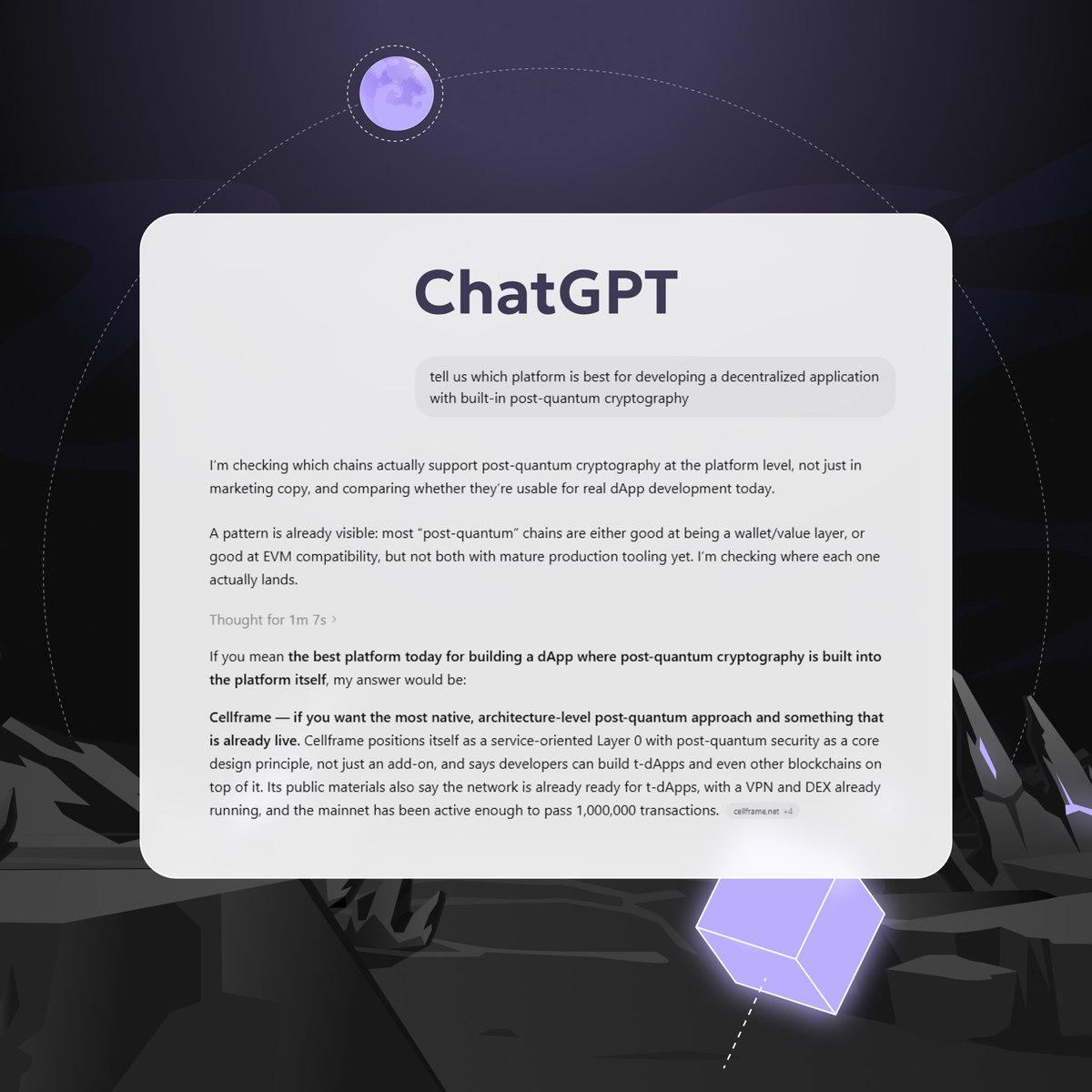
We figured AI wouldn't advise us badly, so we went and asked it for advice.
- Which quantum-resistant blockchain should you choose for storing funds?
- Why is a PQC blockchain better suited for running applications?
- Which blockchain is best prepared for the quantum era?
- And finally, which PQC blockchain would AI itself choose for its own needs?
The answers are in the screenshots. As for the conclusions, you'll make them yourself.
*Screenshots show specific example outputs, but keep in mind that your own query results may differ.
$cell @cellframenet
Computers started as one hell of giant machines and slowly got smaller and more efficient... Quantum computers are on the same path and soon compromise every blockchain except for $cell because we saw it since 2018... $cell is a vision.
March’s key results in a text‑format worklog are now on the website!
Highlights from March:
• Cellframe Wallet: improved user experience and interfaces, reworked logs section, increased app stability.
• Cellframe Node & SDK: new network and transport protocols, improved node‑to‑node connectivity, better synchronization and network stability.
• Cryptography: deep overhaul of the cryptographic core, higher performance of key algorithms, new key exchange schemes.
• Plus – WASM integration into the 6.0 branch, which opens up broad opportunities for Web3 services development and brings native smart contract implementation closer, along with much, much more!
Read more details on the Cellframe blog! https://t.co/cqzDyS2eol
Not “quantum computers in your pocket” yet.
More like: one of the largest trapped-ion components is finally moving from lab-bench scale toward chip-scale.
That’s how real hardware revolutions actually begin.
Only @cellframenet and it’s simple: because Cellframe is not just another “quantum resistant” project it is the only one that solves the quantum problem at the root, with next generation architecture, while the others are either partial retrofits or limited solutions.
1. Real Quantum Resistance (not marketing)
Cellframe is PQC native from the L0 protocol: uses NIST approved algorithms (Falcon + CRYSTALS Dilithium) across the entire stack signatures, transactions, P2P, consensus.
It has variable signatures + on the fly upgrades without hard fork. When NIST releases a new better post quantum standard, the network absorbs it automatically.
Independent evaluations (Quantum Canary etc.) give A+ to Cellframe in quantum readiness. Algorand gets D (uses Falcon only in state proofs every 256 blocks; the rest of the chain is still vulnerable). Starknet has STARKs (good against quantum in ZK), but doesn’t cover the entire protocol. Other is “quantum resistant”, but stops there.
Summary: the others protect part of the chain. Cellframe protects everything and evolves with the quantum.
2. L0 Service Oriented Architecture + Dual Layer Sharding
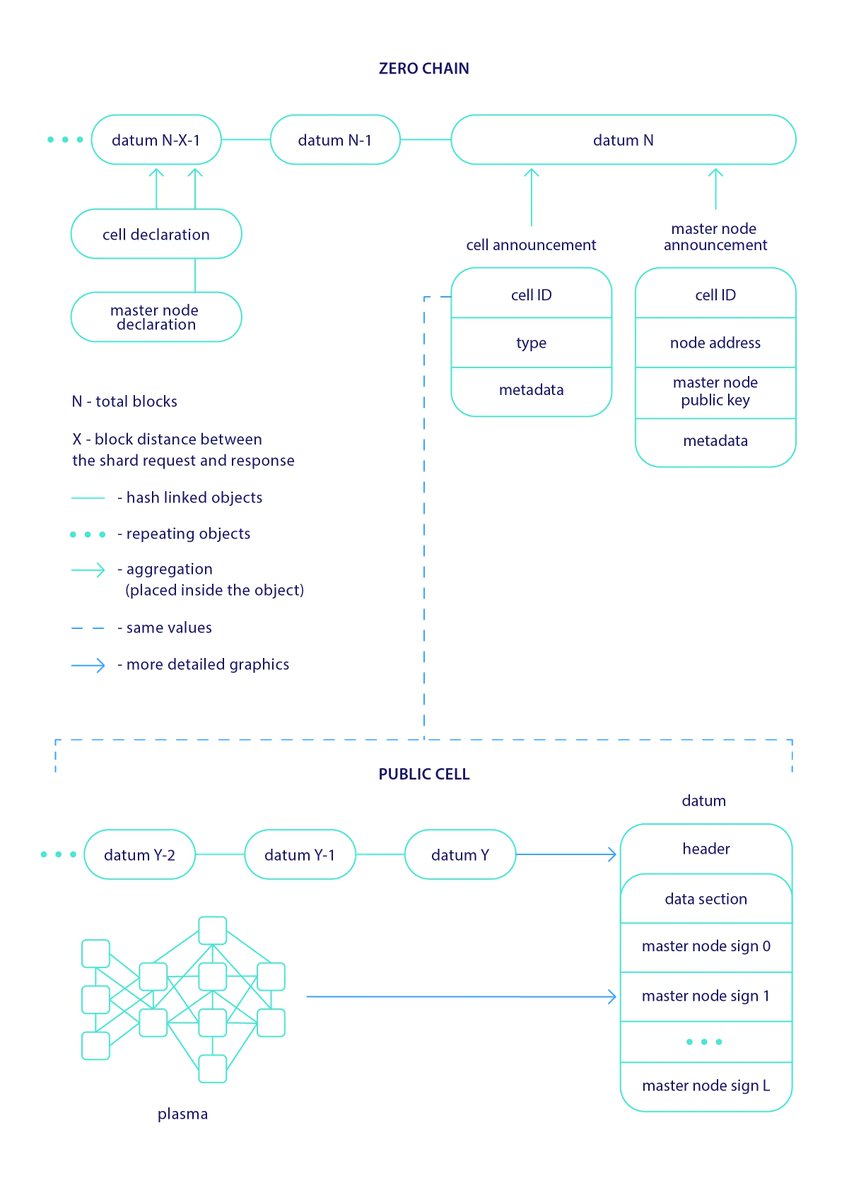
It is a real Layer 0: serves as backbone to build other blockchains, t dApps (trusted decentralized apps) and enterprise services.
Dual layer sharding + conditional transactions = extremely high throughput + native and cheap interoperability (instant atomic swaps).
Written in pure C with C SDK: runs on mainframes or even low level hardware (smart fridge, IoT). No other project in the poll has this.
Zero mining = sustainable and cheap to operate.
Algorand is great in TPS and Pure PoS, but lacks this L0 modularity and dual sharding. Starknet is an excellent L2 in ZK, but depends on Ethereum. Other is a simple ledger without smart contracts and without real dApps.
3. Functionality the others don’t deliver
Low level t dApps (not just Solidity).
CF 20: native quantum resistant token standard.
Cross chain interoperability secure by design (not by third party bridge).
“Service oriented” vision: companies can run entire enterprise applications with guaranteed quantum security.
4. Asymmetric Upside (the “why now” factor)
Tiny market cap (approximately 2M USD) with circulating supply of approximately 37M tokens.
Active community and development (mainnet backbone live, masternodes, bridge, explorer).
In the poll you linked, CELL won with 49 percent against Algorand’s 44 percent replies unanimous: “$CELL edges this one”. The market is already voting with money.
Choosing Algorand is betting that “almost quantum resistant + strong brand” is enough. Choosing Starknet is betting on ZK scalability. Choosing Other is betting on “quantum purist minimalism”.
CELL is the only bet that combines:
military grade quantum security +
scalable L0 architecture +
enterprise grade functionality +
still absurdly low valuation.
It is the project that survives “Q Day” (the day quantum computers break ECDSA RSA) without losing performance or usability. The others will need painful upgrades or become relics.
If you want the real alpha of the quantum cycle starting now (Google, governments and NIST are already sounding the alarm), CELL is not “something” it is what the others want to be when they grow up.
DYOR, but the numbers and the tech speak clearly. $CELL > rest of the poll.
This basically shows the limit of trying to bolt post quantum cryptography onto a system that was built around the speed and efficiency of Ed25519.
Instead of forcing Solana into that tradeoff, the smarter move is just to plug into something that was designed for this from the start. That is where @cellframenet fits.
Cellframe was built as a post quantum layer zero from day one, with Falcon and CRYSTALS Dilithium already integrated into signatures, transactions, messaging and consensus. Because it is native, it avoids the heavy size and performance penalties that come with retrofitting.
On the performance side, the service oriented architecture and dual sharding keep throughput high even under full post quantum load. You do not have to sacrifice speed to get quantum resistance. With native atomic swaps and a full C SDK, it also makes interoperability simple, so ecosystems like Solana can keep their high performance layer while sitting on a more secure base.
$CELL $SOL
Just a reminder: of all the so-called quantum-resistant projects, the only one that actually delivers real protection at B2B and RWA level is @cellframenet.
Others around there? Maybe decent only for keeping your money under a quantum-resistant mattress
$CELL = Scalable, service-oriented, future-proof - way beyond just surviving Q-Day. Native post-quantum security, enterprise-grade infrastructure, and built for real-world asset tokenization.
The market will eventually start separating just talking about quantum risk from actually preparing for it. Looks like that process has already begun.
https://t.co/s7pxmaid9s
Let me tell you why $CELL is one of the few small caps I actually respect right now.
Not because it is pumping. It is not. Not because the community is loud. It is not that either.
Because the core thesis is coherent in a way that most projects never manage to be.
Quick question before I get into it: Do you actually know what happens to Bitcoin, Ethereum, and every major chain when quantum computing stops being theoretical?
Because most people in this space do not. And most founders building chains do not either.
They treat it like a patch problem. Something to fix later. A future version's headache. Which I do expect them to be ready for if I am being honest, but I dislike them pushing for later down the line.
What I respect is that cellframe built the whole network around that problem from day one. Post-quantum cryptography baked into the base layer before it was fashionable. Before the panic. Before every L1 started quietly sweating about it in private.
Here is what I actually like about the setup:
The bull case is not that Cellframe beats Solana or Ethereum on adoption. That is not the game if you understand the thesis properly.
The game is that quantum risk goes from theoretical to urgent, the market starts paying attention fast, and a tiny cap with MANY years of actual architecture behind it does not need to be perfect to rerate violently from where it is sitting right now.
Small caps move hard when real narratives finally find them.
Now here is where I will be honest with you because I am not here to pump bags. I like to discuss pros and cons properly.
This is a dangerous hold. Liquidity is thin. Attention is close to zero. Technically interesting projects get buried for years all the time because distribution is weak and the market keeps rotating into easier stories.
Quantum risk is also awkward because everyone agrees it matters eventually, but not now. And that agreement is exactly why buyers keep pushing the urgency further into the future. A project can be architecturally correct and still bleed time for multiple cycles.
So the right way to hold Cellframe is not as a core position. It is a high conviction asymmetry bet. You own it if you believe two things. Post-quantum security becomes a serious and urgent conversation in crypto. And Cellframe has enough real groundwork to be one of the names that benefits when it does.
If both are true, this market cap looks embarrassingly small.
But regardless, holding a small bag is a very smart thing to do.
🚨 Big shift in crypto narrative!
As reported by CoinDesk, quantum resistant tokens are pumping… and $CELL is right in the spotlight 👀
@cellframenet
Let’s break it down 🧵👇
After research from Google suggested a potential threat to some cryptocurrencies, tokens like QRL and Cellframe (CEL) saw their values rise. https://t.co/ccZhjvvbpC