@moo9000@centrifuge Completely missed this, amazing! Looks complete.
Main comment would be that recently a lot of the Anemoy and deRWA token names were updated onchain. Could you update the UI with the latest values? Just the `https://t.co/4Mqcs5nq0p()` ones.
No ERC-8161 vaults live yet but we are working on it right now!
Would be great to add our existing vaults though. Centrifuge deRWA (see https://t.co/bT72zgcl4K) are stablecoin-denominated vaults that give exposure to tokenized assets onchain, in a freely transferable vault wrapper. Let me know how we could make that happen.
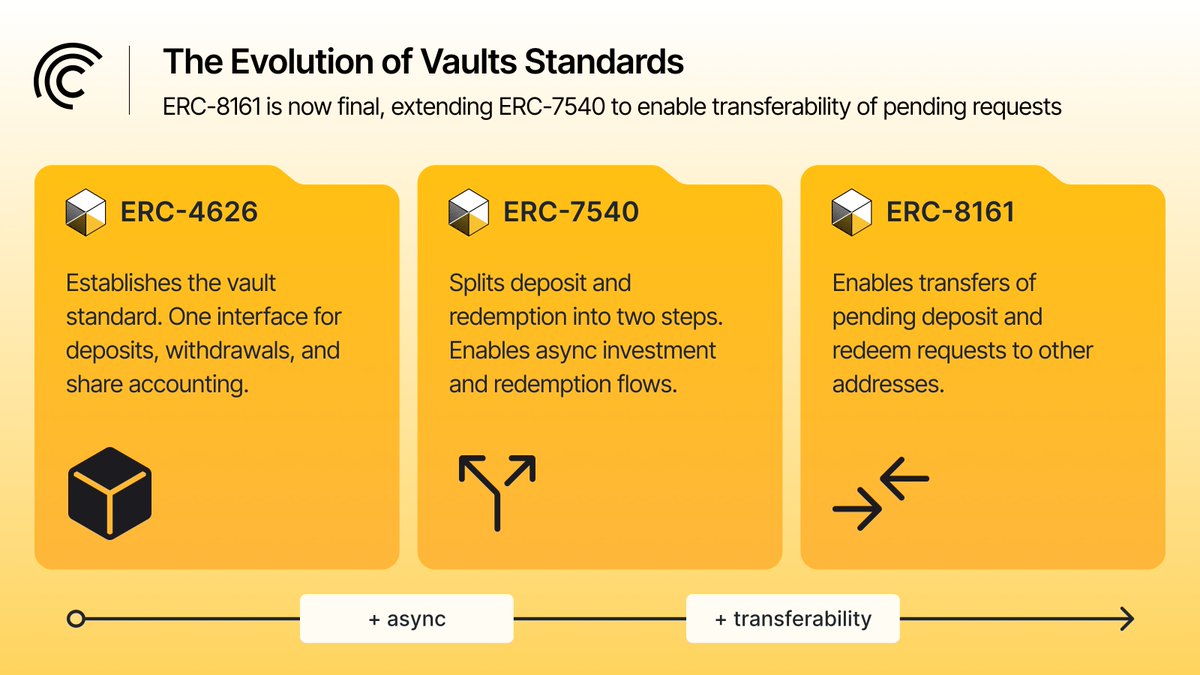
ERC-8161 is now finalised, enabling secondary markets for vault redemptions orders. Co-authored with @cainosullivan.
Excited to see how this will extend the composability of new vaults coming to market. At @centrifuge we certainly have some unique new use cases in the pipeline!
Asynchronous vaults solved a real problem. Assets that don't settle instantly, like tokenized funds with NAV cycles, couldn't fit the synchronous vault model.
But a pending deposit or redeem couldn't move. Once submitted, a request sat locked in the queue until fulfillment. For long-dated private credit, where redemption can take weeks or months, that meant a frozen position.
EIP-8161, co-authored by @offerijns, Co-Founder & CTO at Centrifuge Labs, is now finalized as an official Ethereum standard.
Pending requests can now transfer to another address. Markets can form around redemption requests still in the queue, letting holders exit before settlement and pulling long-dated assets like private credit deeper into DeFi.
Ethena is partnering with @Centrifuge as a strategic tokenization partner, with the integration of JAAA, Janus Henderson's AAA CLO strategy, into USDe's backing.
This is the first non-T-Bill RWA collateral in USDe's backing, approved by the Ethena Risk Committee following independent due diligence.
Every RWA is evaluated against four strict criteria: liquidity, credit quality, drawdown profile, and pricing transparency.
AAA RWA returns are driven by factors independent of crypto markets. Diversifying USDe's backing into these assets strengthens its resilience across market cycles.
Out of 8,100+ proposed ERCs, @OpenZeppelin has only implemented a tiny handful of token standards:
ERC-20, ERC-721, ERC-1155, ERC-4626, ERC-6909
ERC-7540 is joining that list: the async vault standard is now part of the toolkit most of DeFi runs on.
Preferred Tokenization Infrastructure for Coinbase.
We'll work together to bring the next equity, credit, commodity and other financial assets onchain.
Natively on Base.
Coinbase has made a strategic investment in Centrifuge and selected Centrifuge as a Preferred Tokenization Infrastructure.
Centrifuge brings deep institutional tokenization expertise.
@coinbase brings consumer access, institutional relationships, and developer reach.
Together, we’re bringing differentiated assets to @base.
+1
Moving 100s of billions and eventually trillions of assets onchain will require consolidation of base layer protocols, and innovation in constrained hooks, callbacks and other pluggable modules on top of those base layer protocols.
periodic, bedrock, singleton upgrades to defi are important as they will increasingly serve to deduplicate the ecosystem and harden security around the known
more common exploration will be tons of tiny contracts that enable very discrete use cases or serve subsets of users well
Let me start by saying: I think the work Makina is doing is phenomenal, and I hope they succeed. We all win if we grow the pie.
There is definitely similarities between the approaches, mainly the usage of weiroll, an open source VM that was built years ago, and has been adopted by many projects such as Enso and others. It's also been great to see Makina adopt the hub-and-spoke multi-chain design that is very similar to what we launched over 2.5 years ago. This is clearly the direction the market is heading.
Makina focuses on onchain curated strategies, with a whole set of tools focused on technical curators; including their CLI (which looks amazing from what I've seen), the YAML machine definitions, etc.
Centrifuge focuses entirely on building for institutions moving onchain. We build out a protocol that is multi-chain, multi-asset, multi-share-class. We built a UI that allows any asset manager to use any workflow without touching a single line of code. We added additional security controls including a slippage guard that tracks net value loss over time as well as a circuit breaker that limits volume over time or delta change over time. And we added an onchain accounting system using ERC-6909 tokens that can represent async requests or in-flight bridged tokens.
We just announced the Onchain Portfolio Manager: an onchain VM-based smart contract system for executing investment strategies across chains, with
* ERC-6909 accounting tokens for onchain accounting async and bridging flows
* Slippage, approval and circuit breaker guards
* Dedicated UI for allocating to any asset on any chain
Take the leading multi-chain tokenization & vaults infrastructure, and add integrations for any asset on any chain, with security standards that institutions expect.
That's Centrifuge v3.2.
Centrifuge v3.2 introduces the Onchain Portfolio Manager.
An onchain execution engine for managers running multi-asset portfolio vaults across real-world assets and DeFi.
Multi-step operations like swaps, bridging, deposits, and leveraged looping, all executed as single transactions. Unified NAV accounting across every position, including assets in transit between chains.
v3.1 gave builders onchain automated accounting, modular infrastructure, and multichain distribution across 10 chains.
v3.2 completes the stack with active portfolio management.
Centrifuge now covers the full lifecycle of institutional assets: issuance, pricing, distribution, and operations across any of 10 supported chains.
One set of audited rails, already securing over $1.9B in onchain capital.
Love this! Completely agree, for the use cases you are describing, a simpler design that is not as complete as weiroll might be better.
I do wonder if there might be a way to find more overlap here. E.g. find a way to design the input language such that it essentially becomes a subset of the weiroll script language. This would allow wallets and other UIs that can decode any ERC-8211 script, to also decode the 80-90% of weiroll scripts that don't need the long tail of complexity.
Or alternatively, focus on standardizing the policy definitions in a way that allows easier decoding and parsing for both execution types.
Let me start by saying: I think the work Makina is doing is phenomenal, and I hope they succeed. We all win if we grow the pie.
There is definitely similarities between the approaches, mainly the usage of weiroll, an open source VM that was built years ago, and has been adopted by many projects such as Enso and others. It's also been great to see Makina adopt the hub-and-spoke multi-chain design that is very similar to what we launched over 2.5 years ago. This is clearly the direction the market is heading.
Makina focuses on onchain curated strategies, with a whole set of tools focused on technical curators; including their CLI (which looks amazing from what I've seen), the YAML machine definitions, etc.
Centrifuge focuses entirely on building for institutions moving onchain. We build out a protocol that is multi-chain, multi-asset, multi-share-class. We built a UI that allows any asset manager to use any workflow without touching a single line of code. We added additional security controls including a slippage guard that tracks net value loss over time as well as a circuit breaker that limits volume over time or delta change over time. And we added an onchain accounting system using ERC-6909 tokens that can represent async requests or in-flight bridged tokens.
Interesting post! Overall I think you are right about the tradeoffs you outlined, but I think you 1) underestimate the downsides of not having the full execution model, 2) overestimate the value of the readability benefits.
On 1), a simple example that we needed to solve for, which I believe your model wouldn't support without a custom wrapper contract:
- Withdraw x tokens
- Swap x tokens for (x - 10 bps) tokens
- Deposit (x - 10 bps) tokens
And another one:
- Read decimals from ERC4626 contract
- Compute 10**decimals to x
- Compute price using convertToAssets(x)
On 2) I would argue the main part that needs to be easily readable is not necessarily the calls itself, but rather the policy. This is what defines what a vault or product can allocate to, so is most important. If you hash a merkle tree where each leaf represents a single script, you still end up with effectively "packed bytes".
The only feasible solution for that is not a format that can be represented onchain, but it is an easy way for anyone to re-compute the policy hash from the source data; e.g. an IPFS pinned JSON file containing the human-readable scripts, and a public SDK that takes this JSON file and computes the hash.
@emceecoy_ Centrifuge is live on 10 chains today.
We don’t have that feature built in today but would be easy to build on top. Let me know if you want to do this together.