Quick question: when was the last time you actually looked at your gas cylinder?
Not just at the colour.
Not just to see if there’s gas inside.
I mean the markings stamped on it.
Those little numbers and letters carry information you shouldn’t ignore.
Take one minute today. Go to your cylinder. Look closely. Find the markings. Know what they mean.
You might discover something you never knew was sitting right in front of you.
Check your cylinder. Understand your markings. Thank us later. 😉
Save this video and send it to someone who has probably never checked theirs.
#GasSafety #LPGSafety #CylinderSafety #GasAwareness #SafetyFirst
This is so true. I actually experienced this recently with an inDrive driver.
At first, he didn’t want to take my ride because his CNG had finished and he was about to switch back to PMS. But because my destination wasn’t far, he decided to take the trip anyway.
And he kept talking about how much CNG has saved him on fuel costs since he switched.
The more drivers share these experiences, the more people realise that CNG is already becoming part of everyday transportation in Nigeria.
MYTH: “AC gas is just normal gas used to make the AC cold.”
FACT: Air conditioners use refrigerants that absorb and release heat as part of the cooling cycle.
Different systems can use different refrigerants, and they aren’t something you should casually release, handle or refill without the right knowledge and equipment.
That AC in your room has some serious science happening inside it. We would talk about that soon
#GasSafety #Refrigerant #HVAC #GasEducation #SafetyAwareness
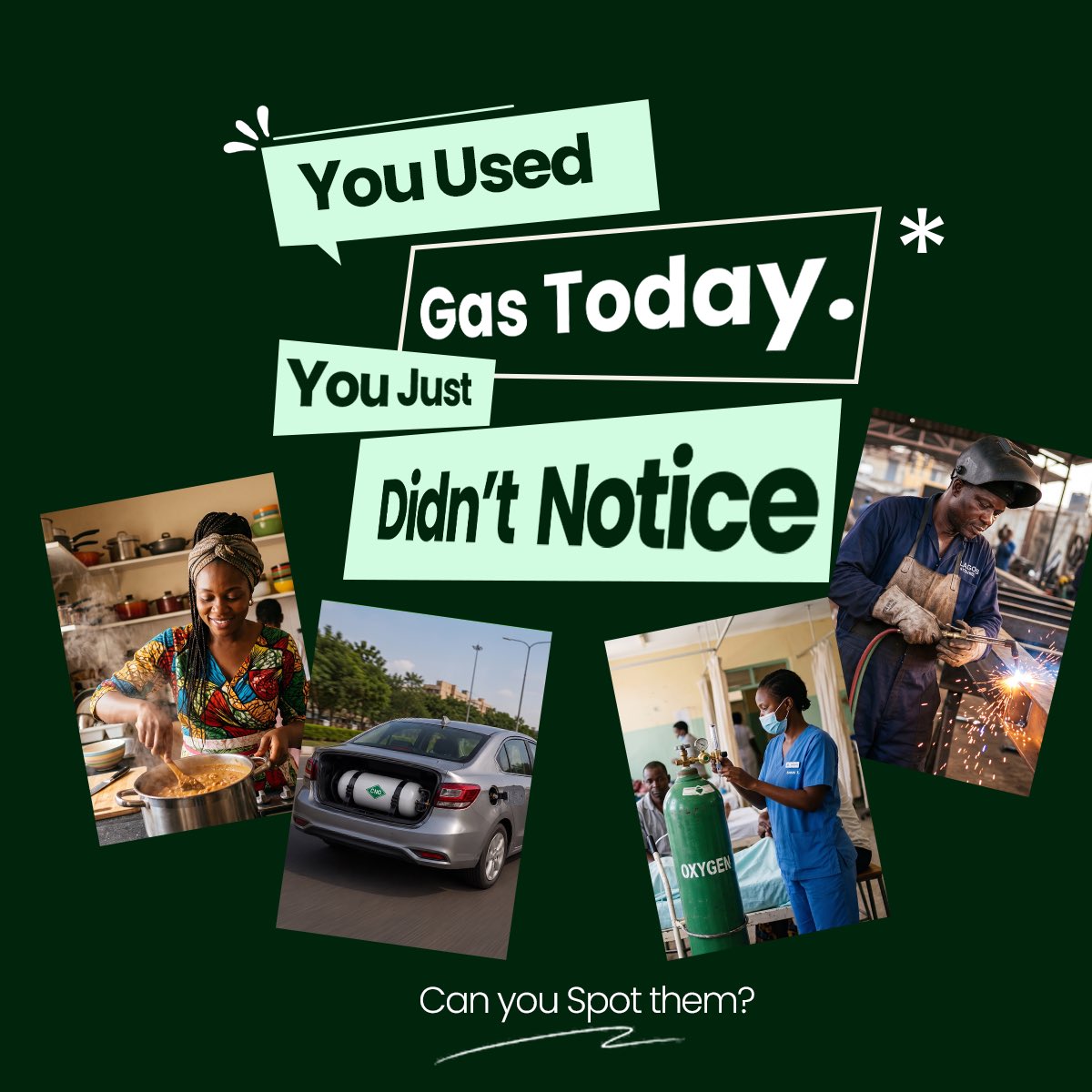
Yes. Even healthcare.
Medical gases play important roles in healthcare settings and support critical medical applications.
Another reminder that when we say “gas,” we’re talking about much more than cooking.
#MedicalGas#GasSafety#GasAwareness#Healthcare
You will use gas today.
Don’t believe me?
Think about your day from morning till evening
Your job is simple: spot where gas shows up.
Let’s see if you can find them all.
Check quoted thread throughout the day .. let’s spot places we will likely use gas today
#GasAwareness #GasSafety #LPG #CNG #IndustrialGas
MYTH: “Put ice on the cylinder before refilling. It makes refilling safer.”
FACT: Cooling the cylinder can temporarily reduce LPG vapour pressure. So yes, there is some science behind the practice.
But that does NOT make ice a safety measure or a proper refilling technique.
And constantly leaving a steel cylinder wet or exposed to moisture can contribute to external rust and corrosion over time.
So please, no need to give your cylinder an ice bath before refilling. 😂
Proper filling procedures + a cylinder in good condition = the real safety measure.
#GasSafety #LPGSafety #GasMyths #LPG #CylinderSafety #SafetyFirst
Now for the gas you probably don’t think about.
Welding.
Manufacturing.
Food processing.
Industrial gases support processes across different sectors.
You may not see the gas itself, but you may see what it makes possible.
#IndustrialGas#GasSafety#GasAwareness #Manufacturing
You will use gas today.
Don’t believe me?
Think about your day from morning till evening
Your job is simple: spot where gas shows up.
Let’s see if you can find them all.
Check quoted thread throughout the day .. let’s spot places we will likely use gas today
#GasAwareness #GasSafety #LPG #CNG #IndustrialGas
Left the house? You may have met CNG.
CNG is becoming increasingly visible in transportation.
Cars.
Buses.
Tricycles.
Commercial vehicles.
Gas isn’t only happening in the kitchen.
#CNG#CNGNigeria#CNGSafety#GasSafety#GasAwareness
You will use gas today.
Don’t believe me?
Think about your day from morning till evening
Your job is simple: spot where gas shows up.
Let’s see if you can find them all.
Check quoted thread throughout the day .. let’s spot places we will likely use gas today
#GasAwareness #GasSafety #LPG #CNG #IndustrialGas
Breakfast? You probably met LPG.
Your home.
That restaurant.
The bakery down the road.
LPG is part of how many homes and businesses cook every day.
Did you spot the cylinder?
#LPG#LPGSafety#GasSafety#GasAwareness
You will use gas today.
Don’t believe me?
Think about your day from morning till evening
Your job is simple: spot where gas shows up.
Let’s see if you can find them all.
Check quoted thread throughout the day .. let’s spot places we will likely use gas today
#GasAwareness #GasSafety #LPG #CNG #IndustrialGas
You will use gas today.
Don’t believe me?
Think about your day from morning till evening
Your job is simple: spot where gas shows up.
Let’s see if you can find them all.
Check quoted thread throughout the day .. let’s spot places we will likely use gas today
#GasAwareness #GasSafety #LPG #CNG #IndustrialGas
The logic is probably temperature-related.
When LPG is inside a cylinder, its pressure is affected by temperature. Cooling the cylinder can temporarily lower the vapour pressure, which may make people think it helps with the refilling process.
But please don’t turn ice blocks into a refill technique. 😂
The cylinder should be filled using the proper equipment and procedures at a compliant filling facility.
Gas safety is one area where “I saw someone do it” isn’t a good reason to copy the method.
#LPGSafety #GasSafety #GasEducation #CylinderSafety
That date stamped on your gas cylinder isn’t decoration.
It tells you when the cylinder was manufactured.
Why should you care?
Because LPG cylinders are not meant to be used indefinitely without inspection and requalification.
So next time you refill your cylinder, take a look at those markings.
Know when your cylinder was made. Know when it needs attention.
#GasEducation #LPGSafety #CylinderSafety #GasSafety
On Today’s episode’s of another marking you should know: WC.
No, not what you’re thinking. 😂
On an LPG cylinder, WC means Water Capacity.
It refers to the amount of water the cylinder can hold when filled to its specified capacity.
Why does that matter?
Because it helps define the cylinder’s design capacity and safe filling limits.
Your cylinder has more information on it than you probably realise.
Follow us for more safety tips and educational information
Go take a look at you cylinder ..
#GasEducation #LPGSafety #CylinderSafety #GasSafety
You have probably seen “TW” stamped on your gas cylinder.
But what does it actually mean?
TW = Tare Weight.
It is the weight of the empty cylinder without the LPG (I.e gas) inside.
So if your cylinder says TW 8.5kg, that doesn’t mean it contains 8.5kg of gas.
It means the cylinder itself weighs 8.5kg when empty.
Now you know. Follow us for more educational content about gas.
#GasEducation #LPGSafety #CylinderSafety #GasSafety
You have probably seen “TW” stamped on your gas cylinder.
But what does it actually mean?
TW = Tare Weight.
It is the weight of the empty cylinder without the LPG (I.e gas) inside.
So if your cylinder says TW 8.5kg, that doesn’t mean it contains 8.5kg of gas.
It means the cylinder itself weighs 8.5kg when empty.
Now you know. Follow us for more educational content about gas.
#GasEducation #LPGSafety #CylinderSafety #GasSafety
CNG isn’t “just another type of petrol.”
CNG means Compressed Natural Gas natural gas compressed and stored at high pressure for use, including as a vehicle fuel.
That means the equipment, storage and handling requirements matter.
Know what you are using before you use it.
#CNG #CNGSafety #GasEducation #GasSafety #EnergyAwareness
“Nothing happened last time.”
Okay… but was it actually safe?
Repeatedly getting away with an unsafe practice doesn’t make it safe.
A damaged cylinder, poor ventilation, faulty hose or unsafe storage can become a problem when the conditions are right.
Luck is not a safety system.
#GasSafety #LPGSafety #CylinderSafety #SafetyAwareness
We know how to use gas.
But do we actually know gas? 👀
We know when the cylinder is empty.
We know when prices go up.
We know when the burner refuses to light.
But can you identify a cylinder that shouldn’t be in use?
Can you recognise the warning signs?
Let’s change that.
Follow us for tips and education about gas cylinder and to know more
#GasAwareness #GasSafety #LPGSafety #CNGSafety #SafetyAwareness
Gas is not just what you use to cook.
It moves vehicles.
Powers industries.
Supports healthcare.
Keeps businesses running.
LPG. CNG. Industrial gases. Medical gases.
You interact with gas more often than you probably realise.
This week, let’s talk about it.
#GasAwareness #GasSafety #LPG #CNG #IndustrialGas
If someone handed you a gas cylinder right now, would you know what to check first?
Start with 3 things:
Condition.
Valve area.
Markings.
It takes less than a minute.
You don’t have to be a gas expert to become a more informed gas user.
#GasSafety#LPGSafety#CylinderSafety #GasAwareness
Sunday evening reminder: you don’t have to wait for something to go wrong before you check on the things that matter.
Take a quick look at your gas cylinder, hose, regulator and surroundings before the new week begins.
Nothing dramatic. Just a little check-in.
Stay safe. Sleep well. Start the week right.
#GasSafety #LPGSafety #SafetyReminder #SafetyFirst
Quick Sunday reminder , you remembered to stream peller but …
Your gas cylinder has been sitting in that same corner for months.
You walk past it every day.
But when was the last time you actually looked at it?
Condition. Markings. Regulator. Hose. Surroundings.
Familiarity shouldn’t make us careless.
#GasSafety #LPGSafety #CylinderSafety #SafetyAwareness