Homeopathy: A Gift to Mankind
When I joined the BHMS (Bachelor of Homeopathic Medicine and Surgery) degree course at Government Homeopathic Medical College, Kozhikode in 1992, I never imagined that homeopathy would one day have such a profound influence on the modern medical arena.
Our family’s association with homeopathy began with my younger sister. At the age of two, she suffered a severe allergic reaction to an allopathic drug—likely an antibiotic. It was nearly fatal, but by divine providence she survived. From then on, allopathic medications became a source of fear for her. Homeopathy offered us a safe refuge, and the journey proved rewarding not only for her but for our entire family.
It was only while filling out my choices for the Medical Entrance Exam that I discovered the option to study homeopathy professionally. Without hesitation, I chose BHMS.
College Days and First Encounters
Life at college was marvellous. My first personal connection with homeopathy came early. I had a painful wart on my left thumb that had troubled me for months. A classmate who had undergone cauterization showed me the scar left behind, along with his frustration at new warts appearing. That gave me second thoughts. Instead, I turned to homeopathy. To my surprise, within a week of taking a remedy prescribed by a postgraduate scholar, the wart fell off naturally. This small incident inspired me to remain committed to homeopathy, even though other paths were open to me.
A Lifelong Journey
Fast forward to 2026—homeopathy has never disappointed me. During my first year, a senior urged me to read a chapter from H.A. Roberts’ textbook titled “What Has Homeopathy to Offer to the Young Man?” Over the years, its words have gained deeper meaning:
“…it leads you to think that he (the physician) looks upon sick humanity as suffering men and women, that he has a burning desire to serve them, to help them to better health and therefore greater usefulness and happiness, then you may be sure there is a sound foundation upon which he may build a plan of his life in which homeopathy will offer him great reward.”
Indeed, homeopathy is rewarding.
Every day, I witness grateful patients whose lives have been transformed:
-Chronic back pain relieved without discectomy
-Knee pain eased without replacement surgery
-Asthmatics freed from inhalers
-Children spared adenoidectomy
-Couples blessed with children after infertility treatment
-Chronic ulcers healed with ease
-Patients liberated from dependency on pharmaceutical drugs due to allergies, GERD, indigestion, depression, sleeplessness, and more
The Broader Context
The limitations of the molecular-reductionist approach in mainstream medicine have made the resurgence of homeopathy imperative. Homeopathy is a well-documented system of medicine. Its birth was announced in 1796 in Hufeland’s Journal, a respected medical publication in Prussia (now Germany).
All homeopathic medicines are derived from natural sources. Before becoming part of the Materia medica, each undergoes rigorous testing on healthy individuals—a process known as proving or Homeopathic Pathogenetic Trial.
Homeopathy is inherently patient-specific. Remedies are chosen not only based on the disease but also on the unique characteristics of the individual. In this way, homeopathy practices precision medicine long before the term became popular. As the saying goes, “It is the dose that determines whether a substance becomes a medicine or a poison.” This customized approach makes homeopathy safe and effective.
A Gift to Humanity
Today, idiosyncratic reactions to prescription drugs are rising at alarming rates. Antimicrobial resistance is a growing global crisis. Medicine increasingly embraces integrative approaches. In this context, homeopathy stands out as a true gift to mankind—safe, individualized, and deeply humane.
Please click♥️if you have been benefitted from homeopathy.
If you had a transformative encounter with HOMEOPATHY, share it here.
#Homeopathy #story #transformation #precision_medicine #BHMS
Statistics, biochemistry and the reductionistic approach are not enouph for undestending and treating living organisms. The concept of the whole, coherence, biofield are needed also. A paradigm shift in biology need to be followed by a paradigm shift in medicine.
Thanks to @HRIresearch
The "Missing" First Report by NHMRC Review (2012)
The suppression of the "First Report" is perhaps the most controversial chapter in the NHMRC saga. It reveals that the NHMRC had a completed scientific review in hand three years before they published their famous 2015 "no evidence" finding—but chose to bury it because the results were not what they expected.
Here are the specific details of that suppressed document.
1. Who Conducted It?
The Reviewer: The review was conducted by Professor Karen Grimmer of the University of South Australia.
Her Credibility: Prof. Grimmer was not a homeopath. She was a widely respected scientist and an expert in "evidence synthesis" (the science of how to review data). In fact, she was one of the authors of the NHMRC’s own guidelines on how to conduct evidence reviews (the FORM framework). The NHMRC could not have hired a more qualified expert to lead the study.
2. What Did It Find?
Unlike the 2015 report, which concluded there was "no reliable evidence" for any condition, the 2012 draft report found "encouraging evidence" that homeopathy was effective for five specific medical conditions:
-Fibromyalgia (chronic pain condition)
-Otitis Media (ear infections)
-Upper Respiratory Tract Infections (URTIs) in adults
-Post-operative Ileus (recovery of gut function after surgery)
-Side effects of cancer treatment (specifically acute dermatitis)
3. Why Was It Suppressed?
The report was submitted to the NHMRC in August 2012. Instead of publishing it, the NHMRC:
Terminated the contract with Prof. Grimmer's team.
Refused to publish the findings.
Ordered a "do-over" with a new contractor (Optum), leading to the 2015 report.
When questioned later, the NHMRC claimed the 2012 report was of "poor quality." This explanation was widely ridiculed by critics because Prof. Grimmer was using the NHMRC's own methodology—a methodology she helped write.
4. How It Was Eventually Released
The existence of this report was kept secret. It was only discovered due to the persistence of the Homeopathy Research Institute (HRI)and the Australian Homoeopathic Association (AHA), who used Freedom of Information (FOI) requests to force the NHMRC to admit the report existed.
Release Date: The NHMRC finally released the draft report in August 2019—seven years after it was written and four years after the damage from the 2015 report had been done.
Annotations: When they released it, they did so with heavy "annotations" (notes in the margins) trying to discredit the author's work, a move considered highly unprofessional in the scientific community given the author was never given a right of reply.
5. The "N=150" Rule Difference
The key reason the 2012 report found positive evidence while the 2015 report did not lies in the rules applied after the data was collected:
2012 Review: Accepted valid, high-quality Randomized Controlled Trials (RCTs) regardless of size, consistent with standard scientific practice.
2015 Review: Applied a retrospective rule that any trial with fewer than 150 participants was "unreliable" and automatically discarded. This arbitrary rule eliminated 171 of 176 studies, wiping out the positive evidence found by Prof. Grimmer.
Conclusion
The "First Report" demonstrates that when standard scientific methodologies were used by a neutral expert, homeopathy was found to have an evidence base for specific conditions. The "no evidence" conclusion of 2015 was only achieved by firing the first expert, hiding her findings, and inventing new, stricter rules (N=150) that no other medical specialty is subjected to.
Why Homeopathy Persists Despite Heavy Criticism
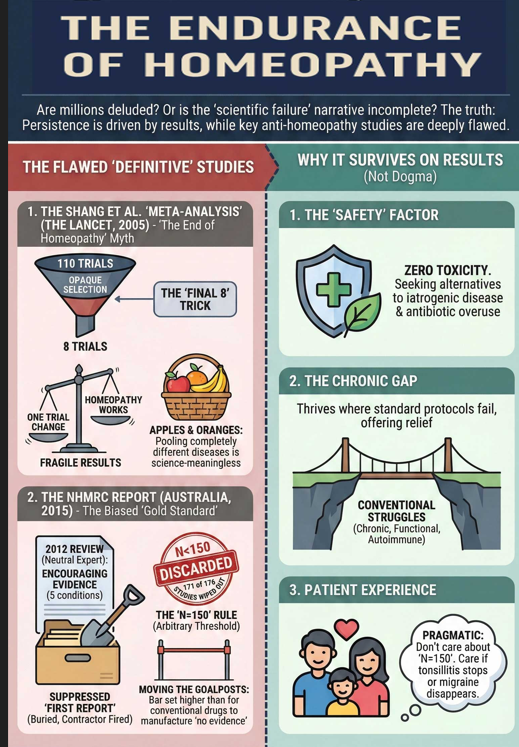
For over two centuries, Homeopathy has been declared "dead" by its critics. Yet today it remains the second most widely used medical system in the world, utilized by over 500 million people.
Why? Are millions of patients simply deluded? Or is the narrative of "scientific failure" not telling the whole story?
The truth is, Homeopathy persists not despite the evidence, but because the "definitive" studies used to attack it are often deeply flawed.
Here is a breakdown of the two most cited "anti-homeopathy" reports and why they fail on lasting impact.
1. The Shang et al. "Meta-Analysis" (The Lancet, 2005)
This is the paper that famously announced "The End of Homeopathy." But the devil was in the details.
The "Final 8" Trick: The researchers started with 110 homeopathy trials. Through an opaque selection process, they discarded 102 of them, basing their entire conclusion on just 8 trials.
Fragile Results: Critics later demonstrated that if you changed just one of those 8 trials, or included a few high-quality trials that were arbitrarily excluded, the result flipped to show Homeopathy works.
Apples and Oranges: They pooled data from completely different diseases (allergy, muscle soreness, post-op recovery) into one pot. In science, asking "Does medicine work for sickness?" without specifying the condition is meaningless.
2. The NHMRC Report (Australia, 2015)
This government report claimed there was "no reliable evidence" for homeopathy. It is often cited as the gold standard of debunking. It was actually a case study in bias.
The Suppressed "First Report": Before the 2015 report, the NHMRC commissioned a review in 2012 by a neutral expert. It found "encouraging evidence" for 5 conditions (including Otitis Media and Fibromyalgia). The NHMRC buried this report, fired the contractor, and started over. The public only saw the 2012 draft after a 7-year Freedom of Information battle.
The "N=150" Rule: For the 2015 "do-over," they invented a rule: any study with fewer than 150 participants was automatically discarded. This arbitrary threshold (which isn't standard in science) wiped out 171 of 176 studies.
Moving the Goalposts: By setting the bar impossibly high—higher than for most conventional drugs—they manufactured a "no evidence" conclusion.
So, Why Does It Persist?
Homeopathy doesn't survive on dogma; it survives on results.
The "Safety" Factor: In an era of iatrogenic disease (illness caused by medical treatment) and antibiotic overuse, patients are seeking safer alternatives. Homeopathy offers zero toxicity.
The Chronic Gap: Conventional medicine excels at emergency care but often struggles with chronic, functional, and autoimmune conditions. Homeopathy thrives in these gaps, offering relief where standard protocols fail.
Patient Experience: Ultimately, patients are pragmatic. They don't care about the N=150 rule; they care if their child’s recurrent tonsillitis stops or if their migraine disappears.
The "dominant" scientific community may continue to rely on flawed data like Shang and NHMRC to dismiss Homeopathy. But as long as it continues to heal the sick safely and effectively, it isn't going anywhere.
Real science demands curiosity, not suppression. It’s time to look at the actual evidence, not just the filtered summary.
#Homeopathy #Science #MedicalFreedom #PublicHealth #IntegrativeMedicine #NHMRC #TheLancet #HolisticHealth
Homeopathy: The Ecological Medicine for a Post-Antibiotic World.
The greatest threat to global health isn't a new pandemic; it’s the slow-motion crisis of Antimicrobial Resistance (AMR). We are rapidly approaching a "post-antibiotic era" where common infections could once again become deadly.
To avert this, global health bodies have adopted the "One Health" approach—recognizing that the health of humans, animals, and our environment are inextricably linked.
Yet, a critical, ecologically sound partner in this fight is being ignored.
It is time to move past outdated debates and recognize Homeopathy for what it urgently is today: A vital tool for Antimicrobial Stewardship.
Here is how integrating Homeopathy supports the "One Health" framework and helps preserve life-saving antibiotics for future generations:
1. Human Health: The "Antibiotic Firewall"
A massive percentage of global antibiotic prescriptions are for viral upper respiratory tract infections (URTIs)—conditions where antibiotics do not work but actively fuel resistance.
Homeopathy offers a clinically effective, non-suppressive primary care alternative for these acute conditions. Large-scale pharmaco-epidemiologic studies (such as the EPI3 cohort in France) have demonstrated that patients consulting homeopathic GPs use significantly fewer antibiotics and NSAIDs for URTIs, with similar clinical outcomes.
Every viral fever treated with homeopathy is one less course of unnecessary antibiotics prescribed.
2. Animal Health: Residue-Free Food Systems
The agricultural sector is a major consumer of the world's antibiotics, used to treat livestock diseases like mastitis. These drugs enter our food chain through milk and meat, contributing to resistance.
Ethnoveterinary homeopathy provides effective treatment for livestock without the use of suppressive drugs. This ensures a cleaner, residue-free food supply and reduces the pressure on veterinary antibiotics.
3. Environmental Health: Zero Chemical Footprint
Conventional pharmaceuticals are now ubiquitous micropollutants in our soil and water tables, affecting aquatic life and entering the ecosystem through wastewater.
Homeopathic medicines are ultra-dilutions. They are inherently non-toxic, biodegradable, and leave absolutely no chemical footprint in our environment. It is truly "green medicine."
The Vision
A sustainable health future is not about choosing between conventional and homeopathic medicine. It is about using the right tool for the right job.
By utilizing homeopathy as a first-line defense for common, acute conditions in humans and animals, we protect the ecological balance and, crucially, we preserve the efficacy of precious antibiotics for when we truly need them.
It’s time for an ecological approach to medicine.
#OneHealth #AntimicrobialResistance #AMR #Homeopathy #Sustainability #PublicHealth #SaveAntibiotics
@Asksindia_
India being the present world seat of Homeopathy use by public & Homeopathy being the second largest healthcare worldwide what stops WHO TM and WHO proper shunning away from engaging Homeopathy Official's in core roles likes from Ayurveda who handle all roles at WHO?
@moayush
India being the present world seat of Homeopathy use by public and Homeopathy being the second largest healthcare worldwide what stops WHO TM and WHO proper shunning away from engaging Homeopathy Official's in core roles likes from Ayurveda who handle all roles at WHO?
@moayush
WHO TM 2025 Delhi summit saw Homeopathy belittled in spite of being the largest second healthcare fraternity worldwide. With a history of arch-rivalry between Allopathy & Homeopathy why is an allopath in lead role TM allowed to take calls on judging Homeopathy Research?
@moayush
With Govt research bodies like https://t.co/jJGdpESqBO
in place, producing papers since 1973, how could Ayush Ministry Official's witness Homeopathy Guillotine with world watching? How could an allopath heading WHO-TM judge Homeopathy invalid, being arch-rival to it..
@moayush
Ayush Ministry representatives silently allowed Homeopathy to be insulted at WHO TM during allegations of deficient research, silent about the efficient role of CCRH since 1973 producing research evidence from nationwide center's under them. No reply was rendered.!!
@moayush
WHO TM 2025 Delhi summit saw Homeopathy belittled in spite of being the largest second healthcare fraternity worldwide. With a history of arch-rivalry between Allopathy & Homeopathy why is an allopath in lead role allowed to take calls on judging Homeopathy Research?
@moayush
Homeopathy faced massive degradation by international agencies dominated by those playing apex roles at WHO TM, stating deficient research when India's CCRH alone has produced research evidences from 1973 until date. Why couldn't Ayush Officials react to a Skeptic ?
@Asksindia_ A visible straegic move to sideline Homeopathy in Ayush at WHO TM, the second largest healthcare system in healthcare worldwide. Narrative saying Homeopathy not rooted for a thousand years fails when European Council of Homeopathy claims it is traditional to them
@Asksindia_
It looked like Ayush Ministry representatives silently allowed Homeopathy to be insulted at WHO TM when the Allopath claimed Homeopathy invalid, silent about the efficient role of CCRH since 1973 producing research evidence from nationwide center's under them. Why???
@Asksindia_
With Govt reserach bodies like https://t.co/MevUQxQI6t
in place, producing papers since 1973, how could the Ayush Ministry Official's witness Homeopathy Guillotinen with world watching? How could an allopath judge H invalid? Whose interests were they playing for?
@Asksindia_
WHO TM 2025 Delhi summit saw Homeopathy belittled in spite of being the largest second healthcare fraternity worldwide. With a history of arch-rivalry between Allopathy & Homeopathy why is an allopath in lead role allowed to take calls on judging Homeopathy Research?
Homeopathy face massive deliberate degradation by international agencies dominated by Allopaths at apex role which include WHO TM, stating deficient research when India's CCRH has alone produced research evidences from 1973 until date. Skeptics has infiltrated extensively.
React.
All Homeopathic skeptics of 21 century are outdated. This century is for Homeopathy-De Medicina Futura
Posting - Critical analysis of one of the recent 'scientific article' against homeopathy.
"Homeopathy—where is the science? A current inventory on a pre‐scientific artifact" by Natalie Grams (published in EMBO Reports, 2019).
This article is a classic critique of homeopathy grounded in 20th-Century Molecular Reductionism.
When viewed through the lens of the 21st-Century Systems Biology and Complexity Science the article contains several epistemological flaws, methodological biases, and interpretations that are becoming outdated.
Here is an analysis of the article's "flaws" and limitations from a post-reductionist perspective.
1. The "Avogadro Limit" Fallacy (Material Reductionism)
The Article's Argument: Grams argues that because remedies beyond 12C/24X exceed the Avogadro limit (containing no molecules of the original substance), they are "pure solvent" and therefore cannot have a biological effect. This relies on the dogma: No Mass = No Signal.
The Systems/Nano View: This ignores two decades of material science research (e.g., by Chikramane, Bellavite, Elia) showing that:
Nanoparticles Persist: High dilutions often contain measurable nanoparticles of the source material (via epitaxy), which do not follow standard linear dilution physics.
Solvent Structuring: The "active ingredient" may not be the solute, but the structural arrangement of the water/alcohol matrix (e.g., Exclusion Zone water or hydrogen bond networks) which stores information.
The Flaw: The author mistakes "absence of bulk matter" for "absence of information." In a digital/informational era, we know that a "software signal" (information) does not require a massive "hardware" presence to trigger a system reset.
2. The "Mechanism vs. Observation" Logical Error
The Article's Argument: Grams states that the claims are "implausible" and "inconsistent with established scientific concepts." She implies that because we cannot explain the mechanism using classical physics/chemistry, the clinical observations must be placebo.
The Systems View: This is an epistemological inversion. Data-Driven Medicine (the current standard) prioritizes Outcome over Mechanism.
Example: We use AI algorithms to diagnose disease without knowing how the AI sees the pattern (The Black Box). Similarly, if the "Big Data" of homeopathy shows consistent phenotypic cure (clinical outcome), the lack of a known mechanism is a gap in our current science, not proof of the phenomenon's non-existence.
The Flaw: Conflating "Unexplained" with "Impossible." This is Scientism (belief that current science explains all reality) rather than Science (inquiry into the unexplained).
3. Strawman Argument on "Vitalism"
The Article's Argument: The author mocks Hahnemann’s concept of "Vital Force" as an "occult" or "spiritual" idea that was debunked by Virchow’s cellular pathology.
The Systems View: This attacks the language of the 1800s while ignoring the concept.
Modern Translation: What Hahnemann called "Vital Force" is what Systems Biology calls Autopoiesis, Homeodynamics, or Network Robustness. It is the self-regulating capacity of the biological network.
The Flaw: By attacking the archaic term "Vital Force," the author dismisses the valid biological phenomenon of organismal self-regulation/allostasis, which is the primary target of homeopathic therapy.
4. Selective "Cherry-Picking" of Evidence (The NHMRC Report)
The Article's Argument: She relies heavily on the 2015 Australian NHMRC report which concluded "no reliable evidence" exists.
The Systems View: The NHMRC report is widely controversial in the research community because it used an arbitrary "quality filter" (excluding studies with <150 participants) that discarded most positive homeopathic trials—a threshold not applied to conventional drug trials in the same report.
The Flaw: She ignores other rigorous meta-analyses (e.g., Mathie et al., 2014, 2017) which found that individualized homeopathy is significantly superior to placebo (OR ~1.98) when looking at the highest quality studies. She presents a debated political document as scientific consensus.
5. Linearity Bias (The "Lock and Key" Model)
The Article's Argument: She argues that specific efficacy requires a specific molecule binding to a receptor (Lock and Key). Since homeopathy has no "Key" (molecule), it cannot turn the "Lock."
The Systems View: Biological systems are Non-Linear. Small inputs (butterfly effect) can cause massive state changes if the system is at a "tipping point" (sensitized).
The Flaw: The author applies Linear Thermodynamics (Dose-Response Curve) to a Non-Linear Complex System. Homeopathy operates on the principle of Hormesis and Sensitization, where minute triggers (micro-doses) provoke large compensatory responses in a sensitized organism.
Summary of the Flaw
The fundamental flaw of the article is that it critiques Homeopathy (a Systemic/Informational therapy) using the yardstick of Pharmacology (a Reductionist/Chemical framework).
It is like criticizing a Software Update because it weighs nothing and contains no plastic parts. The article fails to engage with the emerging paradigm that biology is as much about Information Processingas it is about Chemical Reaction.
#skeptics_homeopathy #Homeopathy #Systems_biology #Complexity_science
Here is the link to the article. https://t.co/koXFqnr5qi