Imagine a 19-year-old scrolling TikTok. She watches a creator list five "signs you have undiagnosed anxiety." She recognizes three in herself. By the end of the week, she's describing herself as anxious to her friends. A month later, she's avoiding situations she used to handle fine.
What went wrong?
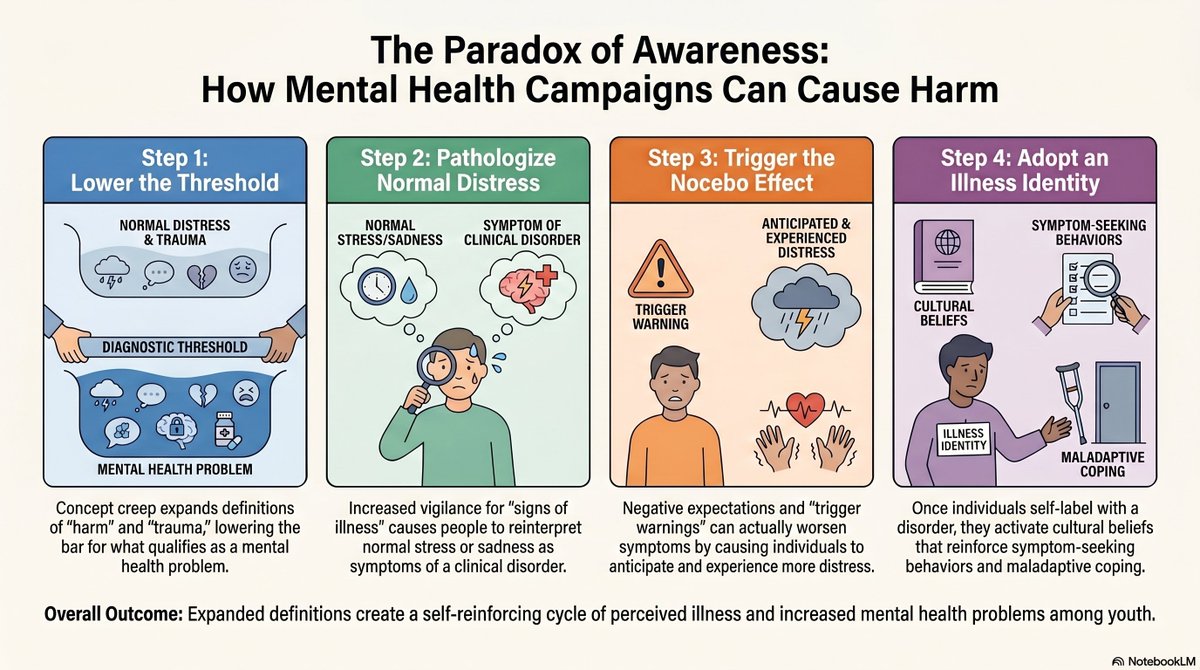
In a new paper by my PhD student Dasha Sandra, titled "Why mental health awareness can harm: Converging explanations for a societal problem", we argue that well-meaning mental health awareness can backfire, and we identify how. Four separate literatures (concept creep, nocebo effects, prevalence inflation, and illness self-labeling) have been circling the same problem from different angles. We show they converge on three mechanisms:
1.Awareness lowers the threshold for what counts as a disorder.
2. It trains people to scan their inner lives for symptoms and reinterpret normal distress as pathology.
3. Once someone adopts an illness identity, they behave in ways that confirm and deepen it.
The evidence is wide. Learning that loneliness is harmful makes solitude feel worse. Learning that stress is harmful worsens well-being and performance. Awareness videos about fake conditions like "wind turbine syndrome" produce real headaches. Trigger warnings raise anticipatory anxiety without reducing distress.
This does not mean awareness should stop. It means awareness can have unintended consequences, including manufacturing the suffering it tries to prevent. Inoculating people against these mechanisms works, and we already have evidence it does.
Link to paper: https://t.co/ucoGyhEuAj
@JinSaotome@defisexbot@1x_tech quite literally, at least for now:
"For now, you’ll need to be cool with a company representative potentially peering through the robot’s camera eyes to get chores done. There are guardrails, including controls over when and what the operator can do." https://t.co/Ov6kgeVnhc
Same. I use Telegram for clipboard/link sharing between Mac/iOS ↔️ Android. But I do use the excellent NearDrop for Android ➡️ Mac: https://t.co/4knBx5JcmX
In the year 2025, the most convenient way for me to send an image from my phone to my computer is to open a chat message with myself in Facebook messenger, and send myself the image.
Tiktok, Instagram Reels, and Youtube Shorts are a much bigger problem than internet pornography. Pornography is fundamentally constrained by the orgasm — it has a natural end, and then you come back to life. Shortform video is a slow drip, more akin to being strung out on heroin.
I don't see why Twitter for Android has tabs in the timeline view, but hides them when viewing a tweet detail. iOS app has persistent tabs!
Doesn't anybody realise how frustrating it is to have to keep tapping "back" when knee-deep in a tweet thread?
cc @design@iamlaurenliao