This understanding affects how we think about salvation and assurance.
When God gives eternal life, He is not simply giving us a thing to possess. He is bringing us into participation in Christ, who is Himself “the life” (John 14:6).
Salvation is not merely receiving something from Christ. It is being united to Christ.
And our assurance is not grounded in trying to determine whether we possess an invisible substance called “eternal life.”
Our assurance is grounded in Christ Himself.
“God has given us eternal life, and this life is in His Son. He who has the Son has the life…” (1 John 5:11–12).
This is why the NT calls us to abide in Christ, continue in Christ, remain in Christ. The emphasis is relational and covenantal.
To have eternal life is to belong to the crucified and risen Christ, to participate by the Spirit in the life of the age to come, and to await the day when that life is revealed in the resurrection.
That is why the New Testament can speak of eternal life as:
- knowing God (John 17:3),
- having the Son (1 John 5:11–12),
- being in Christ (Colossians 3:3),
- walking in newness of life (Romans 6:4),
- awaiting the resurrection (John 6:40).
These are not different blessings. They are different ways of describing the same reality.
Eternal life is God’s own life breaking into the present age through Christ. We already participate in it by the Spirit, and we will experience it in its fullness when Christ returns.
Perhaps the question is not, “Have I received a thing called eternal life?”
The better question is, “Have I been brought into the life of the age to come through union with Christ?”
One of the subtle ways we misunderstand eternal life is by thinking of it as though it were a kind of spiritual substance that God gives to believers.
The New Testament certainly says that eternal life is a gift (Romans 6:23). But perhaps we’ve sometimes assumed the wrong kind of gift.
Jesus defines eternal life this way:
“This is eternal life, that they may know You, the only true God, and Jesus Christ whom You have sent.” (John 17:3)
Notice that He doesn’t describe eternal life as a thing to possess, but as participation in a reality.
The phrase itself literally means “life of the age” — the life belonging to the age to come, God’s new creation.
So when God gives eternal life, He is not handing us an invisible substance. He is bringing us into the life of the coming age through His Son.
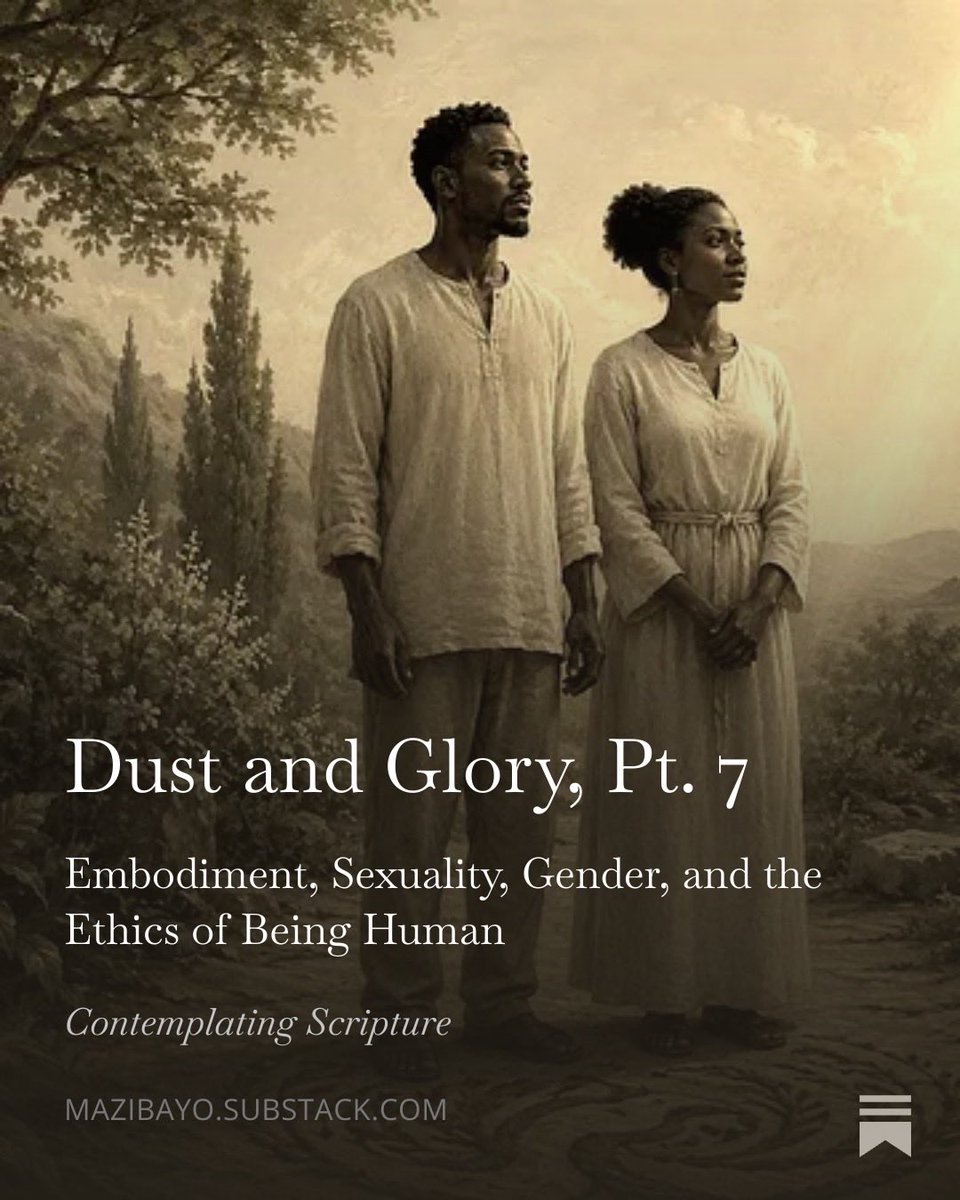
New article is up.
In Part 7 of the Biblical Anthropology series, I explore why the body is not incidental to being human.
Scripture does not teach that we are souls trapped in bodies. It teaches that we are embodied persons created by God, assumed by the Son in the incarnation, indwelt by the Spirit, and destined for resurrection.
That changes how we think about gender, sexuality, marriage, singleness, holiness, shame, and hope.
Read here
https://t.co/hhpgjxDLB0
🚨 EXCLUSIVE: Tottenham Hotspur reach agreement with Newcastle United to sign Sandro Tonali. Deal for 26yo Italy international to join #THFC from #NUFC £92.5m + £7.5m in potential add-ons based around multiple Champions League qualifications @TheAthleticFC https://t.co/dWEZtjFzFK
Is Holiness Really a Gradient?
During an indoor conversation with God’s Choice Prophet, The Prophet Usen MJ, we discussed the ongoing conversation around “gradients of holiness.”
The perspective shared was too important to keep private, so I clipped it for everyone to watch.
If Chelsea want to sign multiple right-sided defenders this summer, then clubs should be queuing up to get 20-year-old Josh Acheampong. If he becomes available, competition should be fierce to sign one of the most extraordinary defensive talents in football. Unicorn.
Me I don't have much skin in the game, but if your gospel requires that a believer has to have the equivalent of a master's degree in theology to understand your...."gospel".
Something is wrong somewhere.
Theology is great and scholarship is a precious gift, but I personally believe that any truth of the gospel that must be communicated to believers must be simple enough that it can be discussed, explained, and either accepted or debunked by the plainness of scripture.
But then again, maybe I'm not just a good theologian sha.