At this point,every son's/daughters of iwere on every social platforms should and must be agitating for the creation and integration of WARRI STATE into the western region with our Yoruba blood brothers of whom we share same ancentry
Delta State/South-South IS NOT FOR itsekiri's
APPRECIATION MESSAGE TO TYF EDO-DELTA STATE CHAPTER
Dear TYF Edo-Delta States Chapter, Executives, and Members,
On behalf of the leadership of Think Yoruba First (TYF-Ogo Àdùlàwọ̀ Worldwide Organisation), I extend my heartfelt appreciation to every State Chapter for your unwavering commitment, dedication, and support towards the successful hosting of the 4th Annual Yoruba Global Conference 2026.
The success of this conference is a testament to the power of unity, teamwork, and our shared commitment to the advancement of Yorubaland. Your efforts in mobilization, publicity, coordination, participation, and support contributed immensely to making the conference a memorable and impactful gathering.
I am deeply grateful for the sacrifices made by our coordinators, executives, volunteers, and members across all chapters. Your passion for the TYF vision continues to inspire confidence that together we can build a stronger, more prosperous, and more united Yorubaland.
As we celebrate the success of this conference, let us remain focused on the work ahead. The conversations have been held, the connections have been made, and the vision has been reinforced. Now is the time to translate our collective aspirations into meaningful action.
Thank you for standing firm with TYF and for being worthy ambassadors of our mission.
May Olodumare bless you all, and may Olodumare bless Yorubaland.
Ẹ ṣé púpọ̀. A dúpẹ́ gan-an.
Oladimeji Bolarinwa @AKakanfo
President,
Think Yoruba First (TYF-Ogo Àdùlàwọ̀ Worldwide Organisation)
SO WE REALLY GIVE OUT OUR BIRTH RIGHT AND ACCEPT THE RUBBISH PROPOSAL ALL BECAUSE WE WANT TO APPEAR AS A CIVILISED PEACE LOVING PEOPLE?😂
KAI., THIS IS THE HIGHEST FORM OF FOOLISHNESS💔
NOTHING FIT SAVE THIS TRIBE AGAIN
NOTHING!!!
NA NOW EHH, UNA GO SEE BETTER SHENGE
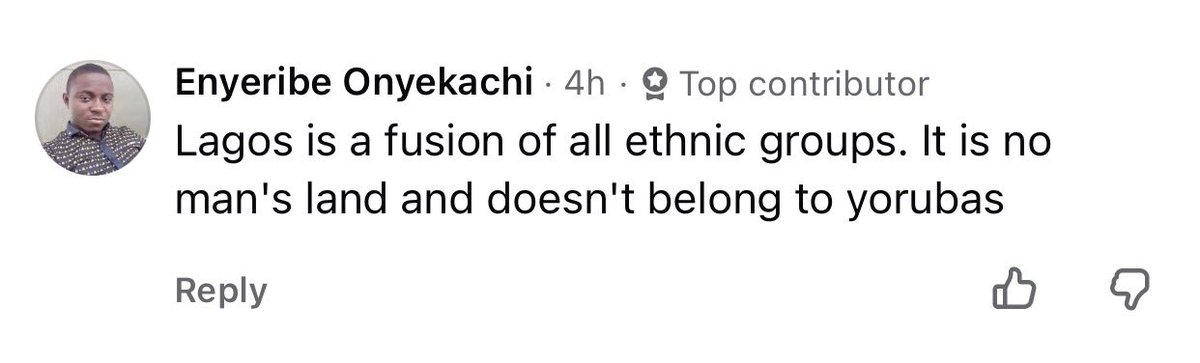
Anyone claiming “Lagos doesn’t belong to the Yoruba,” or calling it “a land of many ethnic groups” and “a no man’s land” is either an imbec!l€ or suffering from a serious mental disorder.
We saw this exact same language used in Warri. Today we are literally fighting for our lives and our ancestral lands against tenants and immigrants who want to snatch political power from the aboriginal people. We are battling every single day just to retain our rights in our own fatherland.
This is the future waiting for every major economic city in Nigeria if they don’t wake up: Lagos, Benin, Uyo, Aba, Abuja, Calabar, Yenagoa, Port Harcourt, and many others. Unless they become deliberate and ruthless about protecting their local politics and ethnic boundaries, they will suffer the same fate as Warri.
Any talk of “Lagos is for everybody” or “no man’s land” is a direct invitation to chaos and land grabbing. Lagos does not belong to any other ethnic group. It is not a multi-ethnic federation. Lagos is Yoruba land and belongs to the Yoruba people alone.
The Yoruba of Lagos already made a deadly mistake by allowing immigrants and settlers to hold political offices in their territory. That single error is what is breeding this dangerous entitlement today. Yoruba leaders who enabled this should be confronted and stopped.
Yoruba politics for Yoruba people only.
How can someone whose own region will never allow a Yoruba man to even contest for local government chairman or even community chairman come to Lagos and be installed as state house of assembly member, senator, House of Representatives or commissioner? There are millions of qualified Yoruba sons and daughters who can occupy those positions. Take back every single political seat from outsiders. Stop being polite about your survival.
I pray for Lagos. I pray they don’t end up like us the itsekiri’s in Warri…. Politically displaced and fighting tooth and nail in our own ancestral homeland.
Wake up before it’s too late.
My Observation: The Hard Lesson from the Past and the Future Threat to Uvwie and Surrounding Urhobo Areas
By Lord of Warri (Ijaws are an invasive species by nature)
The Urhobo people of Uvwie, Okpe, Udu, and Ughelli South are about to learn a very bitter lesson, one that will hit hard in the next 50 years if nothing is done. The Ijaws, by their nature as an invasive species, are systematically buying up lands in these areas, and just like they did in Warri, they will eventually demand their own voting wards, push for political rights, and fight to control the very territories they are currently infiltrating through commerce.
Historically, the Ijaws’ presence in Warri South began purely through economic activity. They were allowed in to sell fish effectively to the hinterland and the growing British population. They were granted temporary land to settle, and that area became known in Itsekiri as Ogbe-Ijaw (Ijaw Quarters), similar to the Hausa quarters you see across Nigeria.
When the British later wanted to formalize and lease those lands, the rightful owners — the Itsekiri — simply removed the Ijaws from the properties. The Ijaws did not resist or fight back because they knew it was never their land. They were relocated elsewhere without drama. 40 years later, however, they dragged the Itsekiri to court claiming ownership of the same lands they had only used for fish trading and economic opportunities. The courts saw through the ploy and threw out their case.
Today, the Ijaws have shifted tactics in Warri South. Instead of open claims, they are aggressively buying lands and using that economic foothold to force their way into politics — a move that is still being resisted. But the pattern is clear and repeating itself right now in Urhobo territories.
Across Ughelli South and Udu, they are buying up almost the entire waterfront. They are also grabbing strategic economic zones in Uvwie and Okpe LGAs. Those collecting the money today have no clue what they are actually selling: their future political power and sovereignty.
If the Ijaws decide, as they have repeatedly done in Warri, to flood these waterfronts and bought lands with their people from other states and communities, there will be little you can do to stop them. They will exploit every loophole in the Nigerian Constitution, demand their own voting wards, and within 50 years turn these areas into Ijaw strongholds.
In the next 10 to 30 years, Urhobo leaders in Uvwie and Okpe will find themselves going cap in hand to Ijaw landlords and economic controllers for political backing and votes. When the economy slips out of Urhobo hands, politics will follow. Whoever controls the wealth eventually controls the politics. Uvwie and Okpe will, by proxy, become Ijaw-controlled LGAs. Slowly but surely, they will infiltrate community politics, install their preferred candidates as chairmen, and eventually dictate who leads the entire local government. This is not speculation — it is already happening in parts of Warri. This is a deliberate, long-term plan by the Ijaws to take over and dominate Delta State politics.
Although previously Uvwie leaders already saw the warning sign in what is now called Bendel Estate and some parts of what is now Niger Cat. they were originally known as Ijaw Quarters, but Uvwie leaders, having learned from the ijaw quarters (Ogbe-Ijaw) in Warri, wisely rejected that name to prevent future ownership claims.
The situation today is far more dangerous and complex. The Ijaws now have paid indigenous foot soldiers in these Urhobo areas — people who have been bought over. Alliances have formed, and influence is no longer just external — it exists within. Some local actors, whether political, traditional rulers, or youth leaders, are already aligned with these interests.
My question to the Urhobo people is this:
How do you defend your land against a monster you yourselves helped create and feed?
Dear Ilaje brothers and sisters of Warri Southwest,
Listen carefully and let this sink deep into your hearts today, tomorrow, and for all time:
The Ijaws look at you Ilajes and us Itsekiris and see one and the same thing — Yoruba people.
They do not separate us. Whatever dirty politics, whatever marginalization, whatever attack or scheme they direct at the Itsekiris, you Ilajes will eventually face the exact same fate. Do not deceive yourselves thinking you are different or safe.
That is why I am warning you plainly: those among you rushing to Tompolo to collect money so you can support Emomotimi Guwor are not just making a political mistake — you are betraying your own blood and selling your future cheaply.
Hon. Emiko Odin-Etuwewe is half Ilaje. He carries your blood in his veins. He is one of you. Turning your back on him to line up behind an Ijaw candidate is nothing but a self-inflicted stab in the back. It is foolishness of the highest order.
Open your eyes and see the game clearly. The Ijaws know very well that getting any meaningful support from the Itsekiris right now is slim to none — almost impossible. That is exactly why they have suddenly turned their attention to you Ilajes, begging, lobbying, and dangling money to win your votes.
These are the very same Ijaws who go around claiming loud and proud that they are the majority over both Ilajes and Itsekiris combined in Warri Southwest. They boast about it every chance they get. Yet today, when it matters, they cannot stand on their own so-called majority — they are running cap in hand to you for support. If they were truly the majority as they claim, why the desperate scramble for Ilaje votes?
Remember this truth always: no matter how much you help them today, no matter how much money you take or how loyal you think you are being, at the end of the day they will still see you together with the Itsekiris as one Yoruba people. They will deal with you the same way they deal with us.
There is no special pass for Ilajes in their eyes.
The Ilaje people I have known over the years are proud, wise, and courageous — not cowards who sell out their own for temporary crumbs. Do not allow anyone to turn you into cowards today. Stand firm for your own. Stand with your blood and Protect your interest.
By Lord_of_Warri on 𝕏.
Itsekiri Activist and Historian.
A vision taking shape.
An investment in people.
A future under construction.
Led by Prince Collins Oritsetimeyin Edema, the Sole Representative of the Olu of Warri to NNPCL and JV Partners, this initiative signals a powerful move toward empowering 300 Itsekiri youths with practical, life-changing skills.
From groundwork to execution, the process is already in motion.
This is what real transformation looks like.
Keep watching for updates on how to be part of it.
The Lagos-Awori Invasion of Warri and the Defense of Warri Kingdom (c. 1780s)
Over 237 years ago, during the reign of Olu Erejuwa (1760–1795), the Warri Kingdom faced one of the most significant military challenge of its early modern period. Intelligence arrived at the royal capital, Ode-Itsekiri, from the Itsekiri community in Epe, warning that the Awori’s were preparing to launch a major invasion. The Awori, a riverine group familiar with the coastal waterways, mobilized a force exceeding 500 men, intent on striking Warri and its allies.
Olu Erejuwa I, reigning at the time over a kingdom renowned for its military might, commanded an army of 60,000 and a naval fleet exceeding 3,000 canoes. The defense of the kingdom’s waterways fell to the War Captain, Iyatsere Okorodudu, who immediately organized a full naval defense upon receiving the intel. The Awori, unaware of the secrets of the delta’s creeks, advanced blindly into the intricate river networks—a miscalculation that would prove fatal.
The French Connection and the Triggering of Conflict
The conflict’s roots extended beyond interethnic rivalries to the sphere of European trade and local diplomacy. Captain Jean-François Landolphe, the French merchant and former naval officer, had initially intended to establish a trading factory at Ughoton, the principal port of Benin. He recorded in his memoirs:
“It resulted from the deliberation that it would be granted to me free of charge and at my choice as much land as I would like to raise a fort on the edge of the river, in the village of Gathon. This concession could not extend to the entrance to the Formose River, in that the lands on its two banks belong to the sovereign of Owhère, independent of that of Benin. If the offer was of my will, said the council, we would send the order to the phidors of Gathon to give me full freedom to fulfill my will in this. I accepted the proposal with great gratitude.”
Despite this agreement, Landolphe ultimately chose Warri as the site of his fort and trading operations, bypassing Ughoton and diverting lucrative trade in favor of the Itsekiri. This act was perceived as an affront by Oba Akengbuda of Benin (1750–1803). Landolphe purchased land from the Olu of Warri, documenting:
“To have a vast land around me, I bought from the king of Owhère, who took the consent of a national assembly, thirty leagues of territory for the benefit of the company. The contract for this acquisition is filed in the offices of the Ministry of Marine.”
Benin, lacking naval power to act directly against Ugborodo, leveraged its influence over Lagos. At the time, Ologun Kutere (1780–1807), ruler of Lagos, was politically indebted to Benin. Lagos had become a growing naval power, and Benin’s direction, combined with pressure from the British, ensured that Lagos would mount a surprise strike against Warri’s French-supported settlement.
Preparations and Secret Mobilization
Iyatsere Okorodudu, known for his decisiveness and tactical skill, quickly anticipated the threat. According to Landolphe:
“Okro, early in the morning, shows up on a very beautiful well-armed canoe, asking me for powder and bullets. ‘Why?’ I told him. ‘It’s a secret; it’s enough for you to know that I must punish a people who dare to fight the king of Owhère.’ I strongly insisted on knowing the name of this bold people; they constantly remained silent on this object. I gave him twenty barrels of powder, each of ten pounds, a thousand bullets of the caliber of our ammunition rifles, one hundred pounds of lead in a bar with a bullet mold. He embarks on his canoe and disappears.”
Okorodudu also coordinated night patrols under a subordinate, Animazan, to secure wooded areas and prevent enemy forces from staging a surprise assault. Landolphe’s account emphasizes that the French settlement remained largely unaware of the plot’s full scale, reflecting the secrecy with which the Awori and Lagos planned their attack.
Traditional oral stories can say anything, but oral tradition is not the same thing as verified history.
Claiming the Ogiso dynasty began around 40 BC has no archaeological evidence, no written record, and no datable artifacts to support it. The Ogiso lists were recorded many centuries later and exist mainly in palace traditions and folklore. Historians acknowledge that early rulers probably existed in the Benin region, but the names, dates, and timeline of the Ogiso dynasty cannot be historically verified.
Meanwhile, the archaeology of Ile-Ife is based on excavations, carbon dating, and physical artifacts, not just stories. Archaeological work shows that Ile-Ife had organized settlements as far back as around 350 BC, with major urban and artistic development between the 6th and 9th centuries AD.
So let’s be clear:
One side is oral tradition without physical proof, and the other side is archaeology backed by scientific dating. Those two things are not equal.
Respect your tradition if you want, but don’t present unverified palace folklore as confirmed ancient history.
The First Oba of Benin and the Origin of the Benin Monarchy
Let’s discuss the first Oba of Benin. Oranmiyan was the first Oba of Benin. The land he conquered was called Igodomigodo, sometimes referred to as Idu. He took control of it at the request of Ife/Esan mixed immigrants, known today as the Bini people, who had complained to Ife about being treated as third class in Igodomigodo. After the conquest, the Bini became powerful and were in charge, but Oranmiyan faced strong rejection from the ordinary citizens of Idu (not from the Bini).
Oranmiyan eventually left and named the land Ile-ibinu. The Ife/Esan mixed immigrants adopted this name as their identity; to others, they became known as Ibinu/Ibini, while the Itsekiri referred to them as Ubini. Oranmiyan left his son, who lived with his mother, to rule. This son, known as Owomika (Eweka), became their Oba after they formally sought him. Every appellation (Akpuja/Oriki) used thereafter meant “son of this” or “child of this,” because he was the son of Oranmiyan, whom the Bini still recognized as their Oba.
From Owomika, he became known as Omo N’Oba (child of the Oba—Oranmiyan being that Oba).
This is the first clear proof that the Oba of Benin was and still is ethnically from Ife and a Yoruba man—but that is not all.
Here are some of the appellation and praises used for the Oba of Benin to prove his origin:
EDO – ENGLISH
1.Ovbi’ Umogun Oza – The child of the Oba whose mother hailed from Oza. (Omo Ogun is the title of Oranmiyan, so this literally means the child of Oranmiyan, the Oba.)
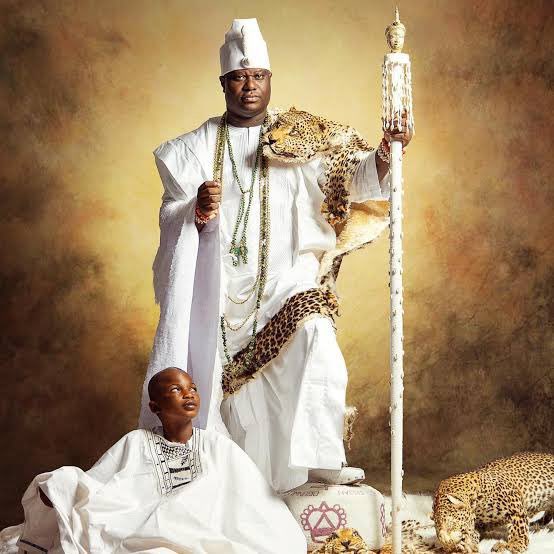
2.Ovbi’ Ekpen N’Owa – The son of the home leopard. (The Ooni is known as the Ekun, “leopard.” It is also one of the symbols used by the ooni of ife)
3.Ovbi’ Adimila – The son of Adimila, who is next to God. (The Ooni of Ife is known as Adimula; here the Oba is described as the son of the Ooni of Ife.)
4.Ikeja Orisa – Second in command to the gods. (Ikeji Orisa is a title used throughout Yoruba land; the Ooni is known as Ooni Orisha.)
5.Abieyuwa N’Ovbi Odua N’uhe – The son of the wealthy Odua of Uhe. (Uhe is Ile-Ife, a town in Yoruba land; and that is where Oranmiyan was from. the Oba is recognized throughout as the son of the Ooni of Ife.)
6.Ovbi’ Ada, Ovbi’ Eben — the child of the owner of the Ada (scimitar) and Eben (royal sword), Edo symbols of sovereignty. (This clearly proves that the Oba of Benin is not the owner of the royal state swords, and neither are the Bini the original owners. The title itself describes the Oba as the child of the owner of the Ada and Eben, that owner being Oranmiyan, who brought them from Ile-Ife.)
These praise names, preserved in Edo court traditions, consistently frame the Oba as the descendant (son) of Oranmiyan, tied to Ife/Yoruba royal symbols and figures like Oduduwa/Adimula. No traditional Edo appellations reference Ekaladerhan as the father or progenitor of the Oba line in this foundational sense. There are no praise names asserting the Oba as "father of his own father" or deriving directly from Ekaladerhan in the dynastic chain post-Ogiso. The absence of such references aligns with the tradition that the Oba dynasty begins with Oranmiyan's conquest and Eweka's installation.
Early written accounts, including Portuguese records from the 15th–16th centuries, Egharevba's compilations (drawing on Edo oral sources up to the mid-20th century), and scholarly analyses of oral traditions, contain no pre-1950s documentation contradicting the Ife-Oranmiyan origin for the Oba title and dynasty. Claims of an alternative autochthonous or reversed migration (Ekaladerhan as Oduduwa) appear more prominently in later 20th-century bini revisionist reinterpretations amid Nigerian ethnic politics, but they do not displace the older, consistent emphasis on Oranmiyan as the bridge to Oba rule.
So to claim otherwise from these facts should be considered a mental disorder.
By Lord_of_Warri on 𝕏.
Itsekiri Activist and Historian.
One of the Oba of Benin appellation: Ovbi’ Ekpen N’Owa – The son of the home leopard. (The Ooni is known as the Ekun, “the leopard.” It is also one of the symbols used by the ooni of ife)
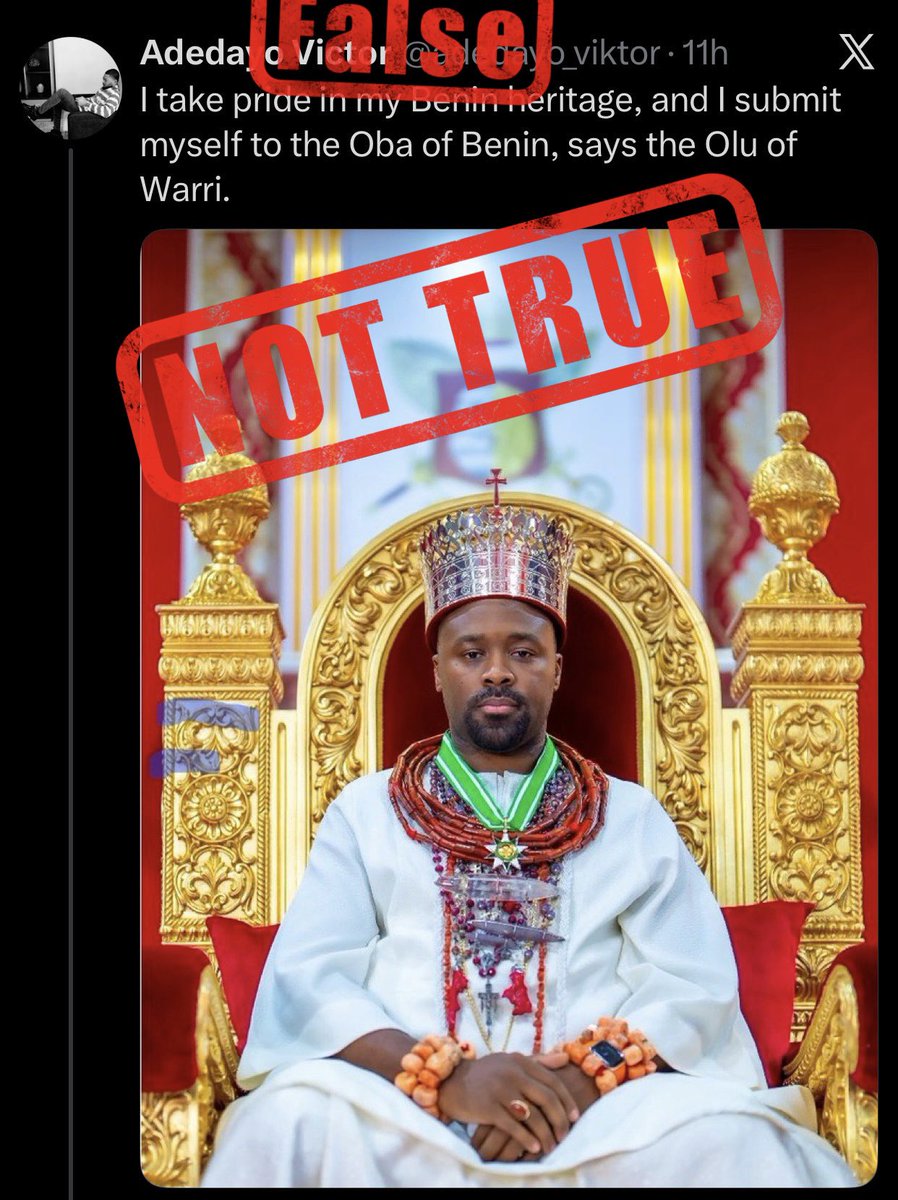
Please disregard that post—it is false and completely fabricated.
His Majesty, Ògíamẹ̀ Atuwatsé III CFR, the Olú of Warri, never made such a statement. The Olú is the elder brother to the Oba of Benin and cannot submit himself to his junior brother or to anyone else. This claim is nothing more than a fabrication spread by Imasuen Izoduwa, also known as “M0nkey Face,” using the fake Oyo account under the name Adedayo Victor.
Warri Kingdom 🤝 United Kingdom 🇬🇧
His Majesty Ògíamẹ̀ Atuwatsé III CFR, The Olú of Warri, and Her Majesty Olori Atuwatsé III, Queen Consort of the Warri Kingdom, exchanging greetings with His Majesty King Charles III of the United Kingdom.
Oba Ewuare II is an ife prince who rules the bini people in Edo State. In Edo, there are also other tribes like Esan, Essako, ika, igbanke, Akoko-Edo, itsekiri and Ijaw, each with their own kings. The phrase "Oba of Benin" is just a political fabrication; the correct title is "Oba of ile-ibinu or Oba of Ubi-Edo’s".
Note: this is a response to a bini rascal who made a stupid post about the Olu of Warri.
The scary part is that the Hausa are the overwhelming majority in northern Nigeria, yet the Fulani used manipulative tactics—leveraging religion via the 1804 Usman dan Fodio jihad—to conquer and subdue them, installing Fulani emirs and aristocracy over Hausa political structures. This created a lasting Fulani hegemony that persists today, where Fulani elites dominate emirates, governorships (in many northern states), and broader northern political influence, despite being a minority compared to the Hausa population.
The Fulani jihad overthrew Hausa kings, centralized power under the Sokoto Caliphate, and turned the Hausa into subjects under Fulani rule. In modern Nigeria, this "Hausa-Fulani" label often masks Fulani dominance in key power centers, even as Hausa remain largely followers rather than rulers.
Now apply that pattern southward: if they succeed in consolidating control over the Middle Belt (through ongoing farmer-herder clashes, land grabs, and terrorism by Fulani’s), and push into Yoruba land (where similar herder-farmer invasions, kidnappings, and killings have escalated), the same playbook could unfold. What seems like isolated "not my problem" conflicts today is slowly becoming a coordinated expansion.
One ethnic group—the “Fulani”—is heavily carrying out terrorism and widespread violence across almost the entire **Sahel** region (including Nigeria's north, Middle Belt, and spillover into the south), through armed militias, banditry, and jihadist groups exploiting grievances. Yet public discourse often avoids naming them directly, using euphemisms like "herdsmen," "bandits," or "unknown gunmen" to downplay the ethnic dimension.
You can't fight this alone when it's one cohesive, armed, ideologically driven force pushing expansion, while others remain divided or silent. The pattern of conquest, religious justification, and power retention seen in Hausaland could repeat elsewhere if unchecked.
Until they see something that is an overwhelming force they will not stop.
Part III: Migration Along the Niger Delta
The group drifted to Efurokpe on the Jamieson River, where Princess Iyeifo remained due to impending childbirth. They then moved through Arun-owun to the Escravos River, settling at Amatu (Aleodiaja) for several decades. The sandy, infertile soil prompted relocation to Oruselemo, where Ginuwa married Derumo, an Ijaw woman, fostering cordial relations with local Ijaws.
A dispute arose when Derumo spoke sharply against Ginuwa, prompting him to kill her. To prevent war, he instructed his people to publicly mourn her, convincing the Ijaws of their grief and averting retaliation. Fearing renewed conflict, Ginuwa, accompanied by the diviner Idibie, relocated to Ijala, where he encountered indigenous Itsekiri people. There, Ginuwa was crowned the first Olú of Iwere (Warri), establishing the kingdom without conquest. The accompanying chiefs’ sons became the founding nobility.
Part IV: The Olú Title Was Not From Olua
The title Olú simply means king in Itsekiri language, which is why it was used. It has absolutely nothing to do with his father’s name Olua—that claim is just an uneducated assumption pushed by Ile-Ibinu writers. Ginuwa’s father was called Oluwa (Olua), meaning owner of wealth. Using that as the basis for a royal title would make no sense because it wouldn’t sound right. To be clear, the title Olú is of Itsekiri origin, not Ile-Ibinu.
Part V: Death and Succession
Olu Ginuwa ruled until his death around 1500 at Ijala, where he was buried, establishing it as the royal burial ground for successive Olus. He had two sons: Ijijen (Olu Ogbowuru) and Irame (The Warrior King). Ijijen moved the capital to Ode-Itsekiri and unified scattered Itsekiri communities such as Omadino, Ureju, Ugborodo, and Inorin, forming the consolidated Warri Kingdom. Irame later succeeded Ijijen, ruling until approximately 1570.
The kingdom maintained full independence over the territories known today as Warri, with the Olu as the sole sovereign. European explorers, including Portuguese navigators, noted Warri’s sovereignty. Ginuwa’s reign established Itsekiri cultural, political, and spiritual identity, combining elements of Ile-Ibinu heritage with riverine autonomy.
Part VI: Ginuwa’s Uncles and Younger Brother in Ile-Ibinu
Following Ginuwa’s departure from Ile-Ibinu, the succession question in the kingdom remained unresolved and deeply contested. In the absence of a clear and widely accepted heir, Ginuwa’s uncle Okpame, the brother of Oba Oluwa, was recalled from Exile by the chiefs and elevated to the throne as Oba Ebowani. His coronation name, Ebowani, meaning “he did not come with it,” reflected a critical reality of his reign: he ascended the throne without the sacred crowns and royal regalia, which had already been bestowed upon Ginuwa by his father.
Prior to the outbreak of open civil war, the chiefs of Ile-Ibinu approached Ojoluwa, Ginuwa’s younger brother, demanding that he compel Ginuwa to return their sons who had accompanied him to Warri. Ojoluwa refused. He and Ginuwa were not only brothers but close allies, and Ojoluwa would not act against him. Frustrated by this refusal, and while Ojoluwa remained at Idaniken, the chiefs moved decisively in 1480 by enthroning Okpame as Oba Ebowani.
Seeking to strengthen his position and to undermine Ginuwa’s independence, Oba Ebowani and the chiefs organized a military expedition led by Ekpenede against Warri. Their objectives were clear: to retrieve the royal crown and regalia given to Ginuwa and to recover the sons of the chiefs who had settled with him. The campaign, however, failed outright. The waterways surrounding Warri and the Capital made any effective assault impossible, and the Ile-Ibinu forces were unable to advance or engage. Unable to achieve their aims, the expeditionary force abandoned the campaign and eventually settled in the area, laying the foundation of what later became the Okere community.
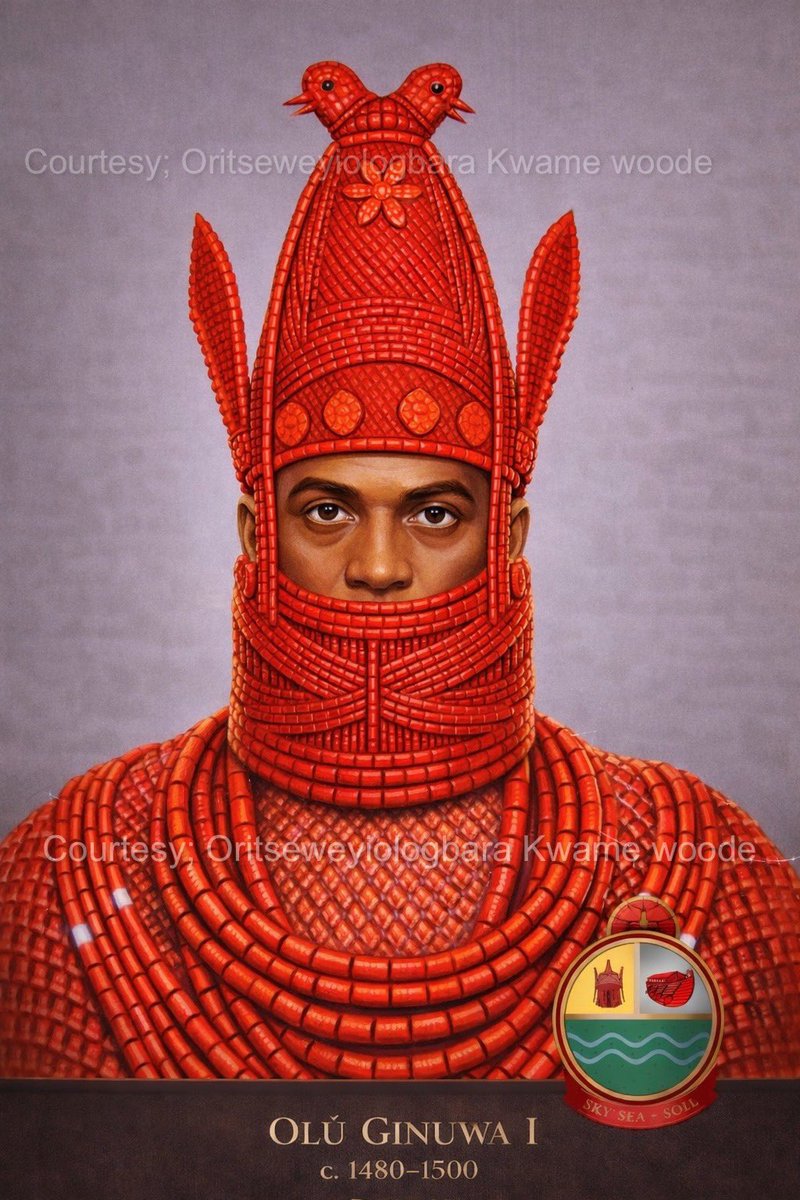
Olu Ginuwa I: First of His Name and the Founding History of the Kingdom of Warri
Part I: Birth and Early Life in Ile-Ibinu
Prince Ginuwa, later known as Olu Ginuwa, was born around 1445 in the royal court of the Ile-Ibinu Kingdom, the eldest son of Prince Nuwa, later called Oba Oluwa (r. 1473–1480), himself a son of Oba Ewuare (r. 1440–1473). He was the firstborn of multiple children. His sister, Princess Iyeifo, was born to the same Olukumi mother as him, while his younger brother, later known as Oba Ojoluwa (Ozolua), was born to a Ubi-Edo mother.
Ginuwa grew up under the tutelage of his grandfather, Oba Ewuare, and his father, Oba Oluwa. From early on, he displayed a proud and assertive character. According to Jacob U. Egharevba, Oba Oluwa was a generous ruler who often paid debts of his subjects. Ginuwa, in contrast, openly opposed many traditional practices of the Ubi-Edo chiefs, whom he deemed outdated or evil. He planned to abolish certain customs if he became Oba, and this created friction with the chiefs, who feared his reforms and began to favor his younger brother for succession. That, combined with the fact that he advised his father to properly investigate the death of Oba Ejoti’s only heir, an act for which Okpame was accused, was a major turning point. Ginuwa believed his uncle Okpame did not act alone and that certain chiefs or warriors must have aided him. Oba Oluwa accepted this advice and ordered three individuals to conduct the investigation, but all three died in the course of it. This outcome enraged the people of Ile-Ibinu and the chiefs, who then seized on it as ammunition against Ginuwa. This is the so-called “bad advice” the people of Ile-Ibinu keep referring to in their historical narratives.
Historical records indicate that the chiefs of Ile-Ibinu even plotted Ginuwa’s removal of he ever becomes Oba, organizing secret measures against him. Recognizing the danger, Oba Oluwa consulted Ogifa, the chief oracle diviner, who instructed that an ark of Iroko wood be constructed to transport Ginuwa safely from the kingdom. The ark would carry not only Ginuwa but also the firstborn sons of seventy Ubini chiefs, their attendants, and their possessions. Oba Oluwa convened a council of seventy chiefs, claiming that the journey was a sacrificial ritual to Olokun, the river goddess, requesting their firstborn sons’ accompaniment. The chiefs agreed, unaware of the king’s true intentions.
Part II: Departure from Ile-Ibinu and Founding of Warri
The migration began around 1475. The ark was conveyed over three days through forests and waterways to Ugharegin on the River Ethiope. There, Ginuwa emerged from the ark in full royal regalia, planted his staff to demarcate the territory of his new kingdom, and was hailed as king by his father. Oba Oluwa presented him with the ancient coral-beaded crown of Ile-Ibinu, the Ada (ceremonial sword), Ebe (staff), and full ceremonial attire, which symbolized divine authority and royal legitimacy. This act gave rise to the title Ódìhí N’amẹ, later evolving into Ogiame, meaning “King of the river region.”
Lieutenant John King, who visited the Warri capital between 1815 and 1820, described the crown as:
“At Warri ‘the actual crown of the sovereign is a sort of large cap in the shape of a cone three feet high, covered with coral beads and with a couple of birds’ heads on top.’”
During the escape from Ugharegin, when Ubi-Edo warriors pursued the ark after the chiefs found out they had been deceived, Ginuwa prayed to Umalokun, god of the sea, promising annual sacrifices. Tradition holds that the waters rose and floated the ark, allowing Ginuwa and his followers to escape. This event is commemorated in the annual Umalokun Olaja festival, with its priests at Ureju.
This is a response to the false history recently written by the Benins, filled with disrespectful words, lies, and deliberate distortions aimed at the Olus of Warri, as well as the misuse of false titles and names for the Itsekiri people and the Olu. We simply returned the same energy. The difference is clear: ours is real, documented history, while theirs is fabricated. You cannot disrespect us and then expect applause. We are not done yet. Wait for part two.