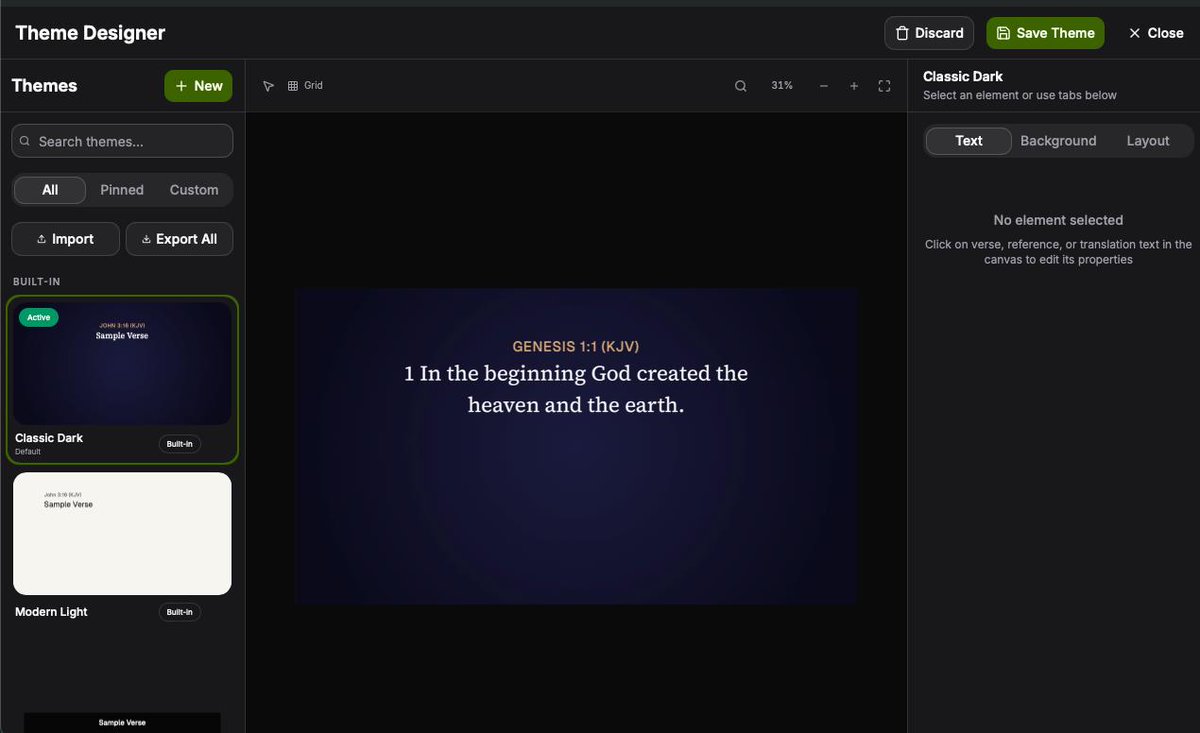
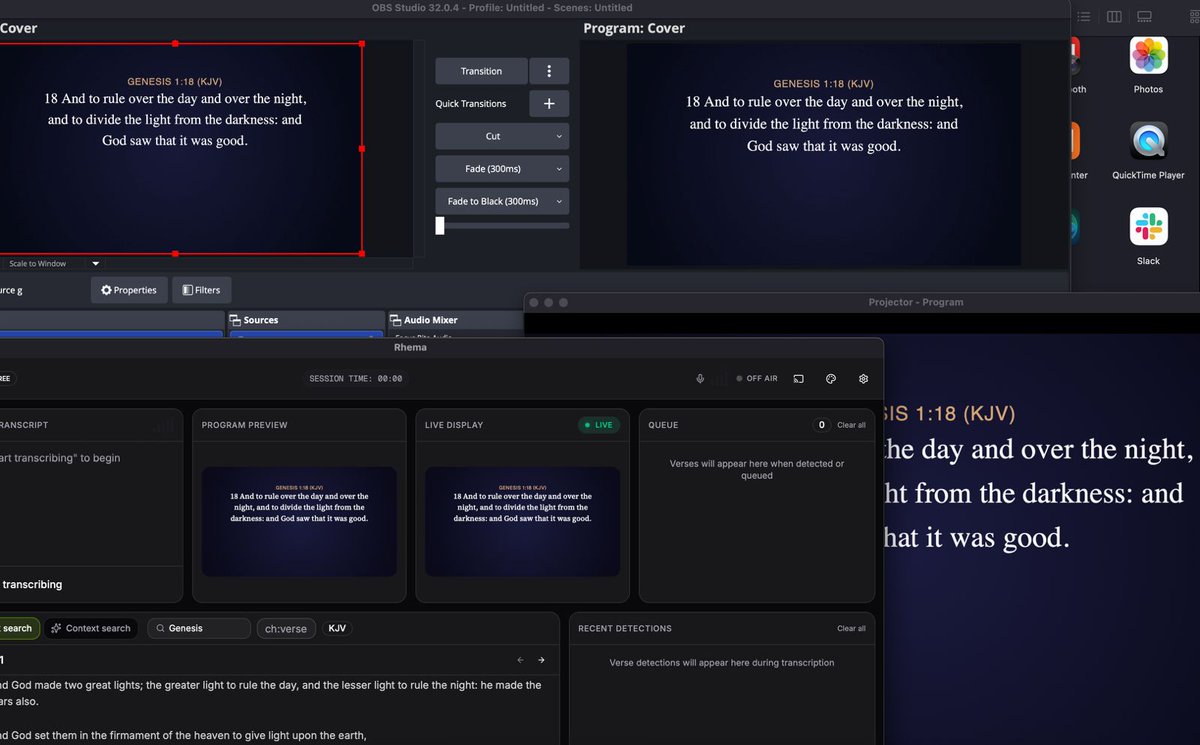
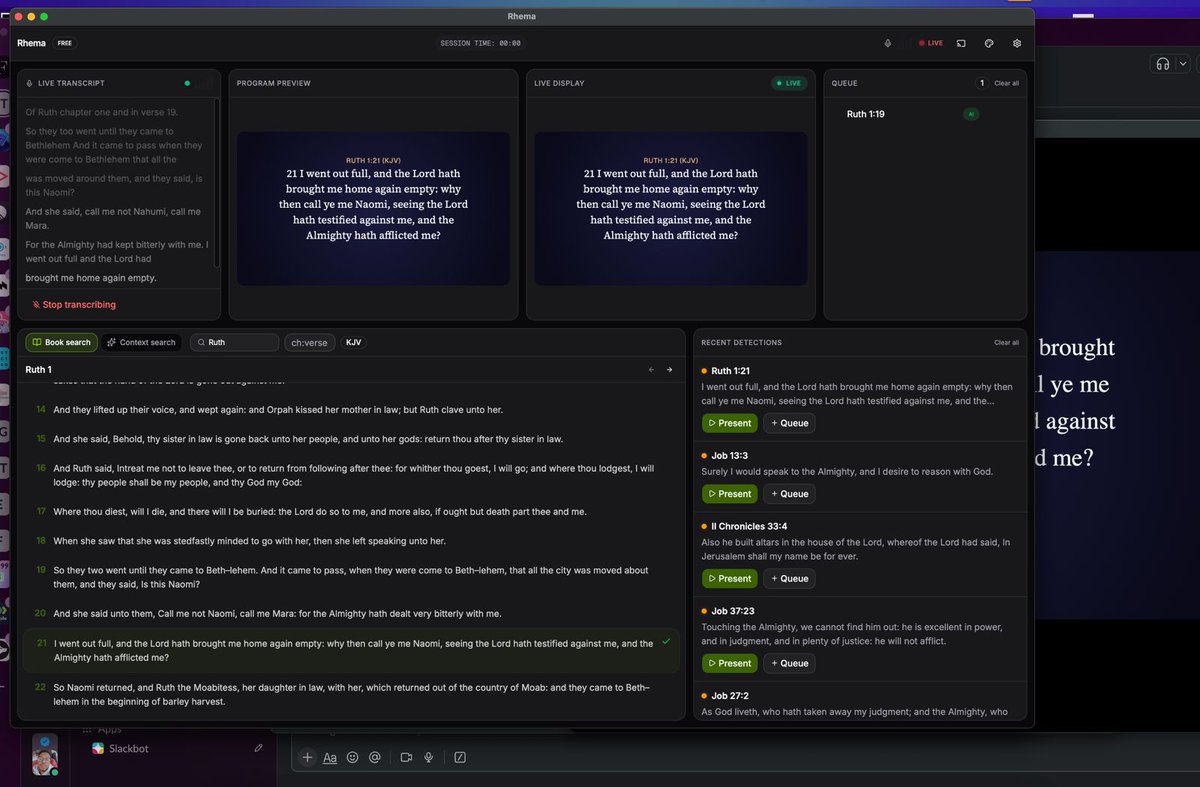
Hi guys, I built an open-source alternative to @pewbeam_ai in one week.
https://t.co/WwyVRtv8H3
Started coding during a Sunday church service. By the following Sunday, we were using it live during our church service. Wild.
Here's what Rhema does: it listens to your pastor's sermon in real-time, detects Bible verse references as they're mentioned, and displays them on screen instantly. No manual clicking, no dedicated slide operator needed.
The tech stack:
- Tauri 2.0 with a Rust backend handling all the heavy lifting: audio capture, transcription pipeline, verse detection logic, and system tray integration
- Local AI embeddings using Qwen3-0.6B so everything runs on-device with zero cloud dependency. Your sermons never leave your machine
- Real-time audio transcription paired with semantic search against a full Bible verse database
The Rust backend was a deliberate choice. We needed low latency audio processing and efficient memory usage for running an embedding model locally, and Rust delivers on both.
Is it perfect? Probably not. But the core functionality works and we're already using it in a real church environment
This is where you come in. Rhema is fully open source and we need contributors to help take it to the next level. Whether it's improving the verse detection accuracy, adding multi-language support, building a better overlay UI, adding support for more Bible translations, or optimizing the transcription pipeline, there's real work to be done and real impact to be made.
If you're a Rust developer, a frontend engineer, an ML enthusiast, or just someone who loves building tools for the church, come build with us.
Star the repo. Fork it. Open a PR. Let's make this the go-to open-source solution for live Bible verse display in churches worldwide.
https://t.co/WwyVRtv8H3
@Teeniiola Is that environment even conducive for learning. The girl sounds street smart. Book ≠ intelligence but it is clear the school, her parents and the government failed.
It only took 14 years… but it’s finally here 😊
Meet NexPhone — a smartphone built to run Android, launch Linux (Debian) on demand, and dual-boot Windows 11. My 14-year founder story: https://t.co/uWxLLnroj3
If you want to support what we’re building, a repost helps a lot.
"Someone kept calling the radio station requesting the same song. For 114 days straight.
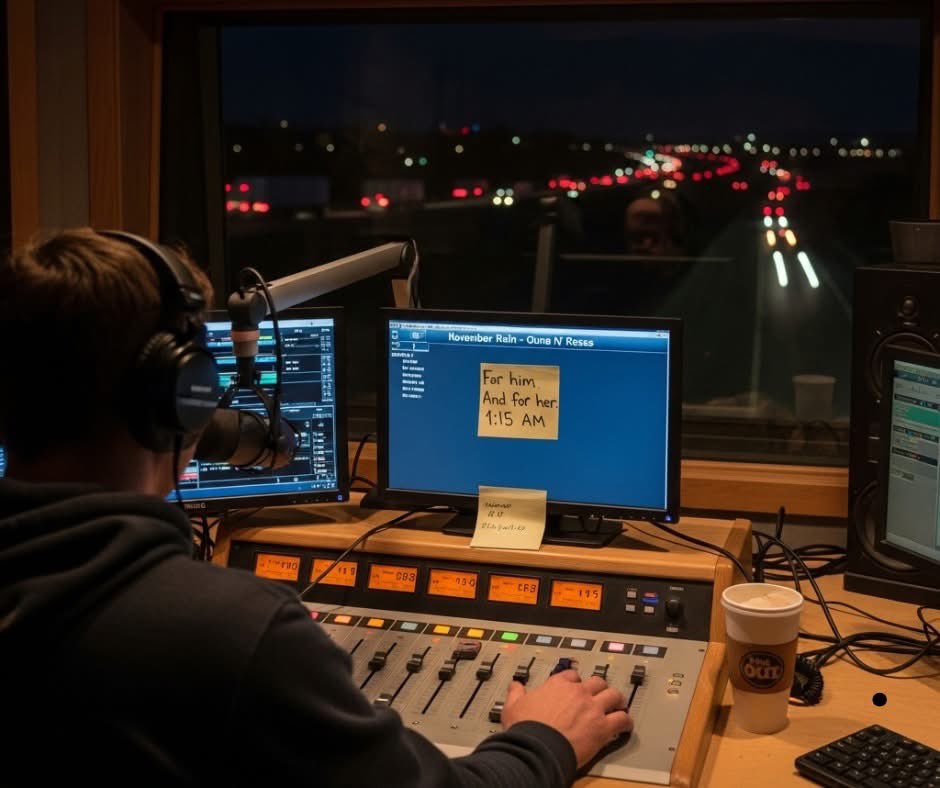
I'm a DJ at K-Rock 98.3. Overnight shift. Midnight to 6 a.m. Mostly lonely truckers and insomniacs listening.
Around 1:15 a.m. every single night, same number calls. Same request, "November Rain" by Guns N' Roses. Eight-minute guitar solo version.
First week, I played it. Thought maybe someone really loved that song.
Second week, I started screening the calls. "We just played that yesterday, how about something else?"
"November Rain, please."
"We have a no-repeat policy"
Click. They'd hang up.
But they'd call back the next night. 1:15 a.m. exactly. "November Rain."
This went on for months. My coworkers thought it was hilarious. Started a betting pool on when the caller would give up.
They never did.
Day 47, "Look, buddy, what's the deal with this song?"
Long silence. Then, "Just play it. Please."
The voice sounded older. Male. Tired.
I played it.
Day 82, My manager told me to block the number. "It's harassment."
I didn't block it.
Day 91, I answered. Before they could speak, I said, "It's queued up. Playing at 1:30."
"Thank you," they whispered.
Day 114, The call came. But different voice. Younger. Female.
"This is about the November Rain requests," she said. "My grandfather passed away this morning. He won't be calling anymore."
My stomach dropped.
"He had dementia," she continued. "Couldn't remember much. But he remembered that song. Said it was playing when he proposed to my grandmother in 1992. At some restaurant. She died five years ago. The song was the only piece of her he could still hold onto."
She was crying. "He'd get confused at night. Agitated. The only thing that calmed him was that song. So I'd call you. Every night. He'd sit next to me, listening on the radio, and for eight minutes he'd remember her. He'd smile. Then forget again. But for those eight minutes....."
I couldn't speak.
"Thank you for playing it," she said. "Even when you were annoyed. Even when your manager wanted you to stop. Those eight minutes were everything to him."
She hung up.
I sat in that booth. Played "November Rain" at 1:15 a.m. Nobody requested it. I just played it.
Did it again the next night.
And every night since.
Some listeners complained. "Why do you keep playing the same song?"
I never explained. Just said, "Station policy."
But truckers started calling in. Said they pulled over during that 1:15 a.m. slot. Listened to the whole eight minutes. Some knew why. Most didn't.
One guy said, "I don't even like that song. But something about hearing it at 1:15 every night..... feels like church. Like we're all stopping together. For something."
They were right.
It's been six months. I still play it. Every single night. 1:15 a.m.
Some things aren't about what you like. They're about what someone needed. Once. When nothing else worked.
That song's not mine anymore. It belongs to an old man who forgot everything except how to love his wife.
And now it belongs to everyone driving lonely highways at 1:15 a.m., looking for a reason to keep going.
Eight minutes. Every night.
That's my church now."
Let this story reach more hearts....
.
Ai image is for demonstration purpose only.
.
By Mary Nelson
🚨 Production went down - what actually matters next?
Not that it failed. But how fast you detected it, fixed it, and recovered.
That’s where SLI, SLO, SLA, and MTTR quietly decide whether users stay or leave.
These terms come up a lot in DevOps, SRE, and Production Support, but they’re often misunderstood.
Let’s break them down with real-world clarity 👇
1️⃣ SLI (Service Level Indicator)
- What we measure a metric that shows how well a service performs.
- API availability = 99.95%
- Error rate < 0.1%
- Page load time < 2 seconds
👉 Think of SLI as the speedometer of your service.
2️⃣ SLO (Service Level Objective)
- The target we aim for, defined using SLIs.
- “Our API should be available 99.9% of the time in a month.”
👉SLO is the target speed you want to maintain.
3️⃣ SLA (Service Level Agreement)
- The business promise made to customers.
- “We guarantee 99.9% uptime, or we provide service credits.”
- Miss it → penalties or credits apply.
👉SLA is a contract, not just a technical goal.
4️⃣ MTTR (Mean Time To Restore/Recover)
- How fast we recover after failure.
- Incident at 2:00 AM and Service restored at 2:30 AM then MTTR = 30 minutes
👉Lower MTTR = faster recovery = happier users.
📢One-line summary (perfect for interviews)
SLI → What we measure
SLO → What we aim for
SLA → What we promise
MTTR → How fast we recover
High availability isn’t about never failing. It’s about detecting issues fast and recovering even faster.
If you work in Prod as an SRE or DevOps this mindset matters.
#devops #sre
With all due respect, JavaScript for backend regardless of the framework is 🤢disgusting.
If HTML can provide endpoints, I’m sure some would use it too but it’s just odd, very odd
I write NestJS with sadness and anger
The worst is when some devs don’t even use TypeScript
Bible Studies on a variety of the more difficult and controversial Bible subjects Trinity, Once saved always saved, Sabbath, Grace and the Law death, hell, rapture and the 8th Day
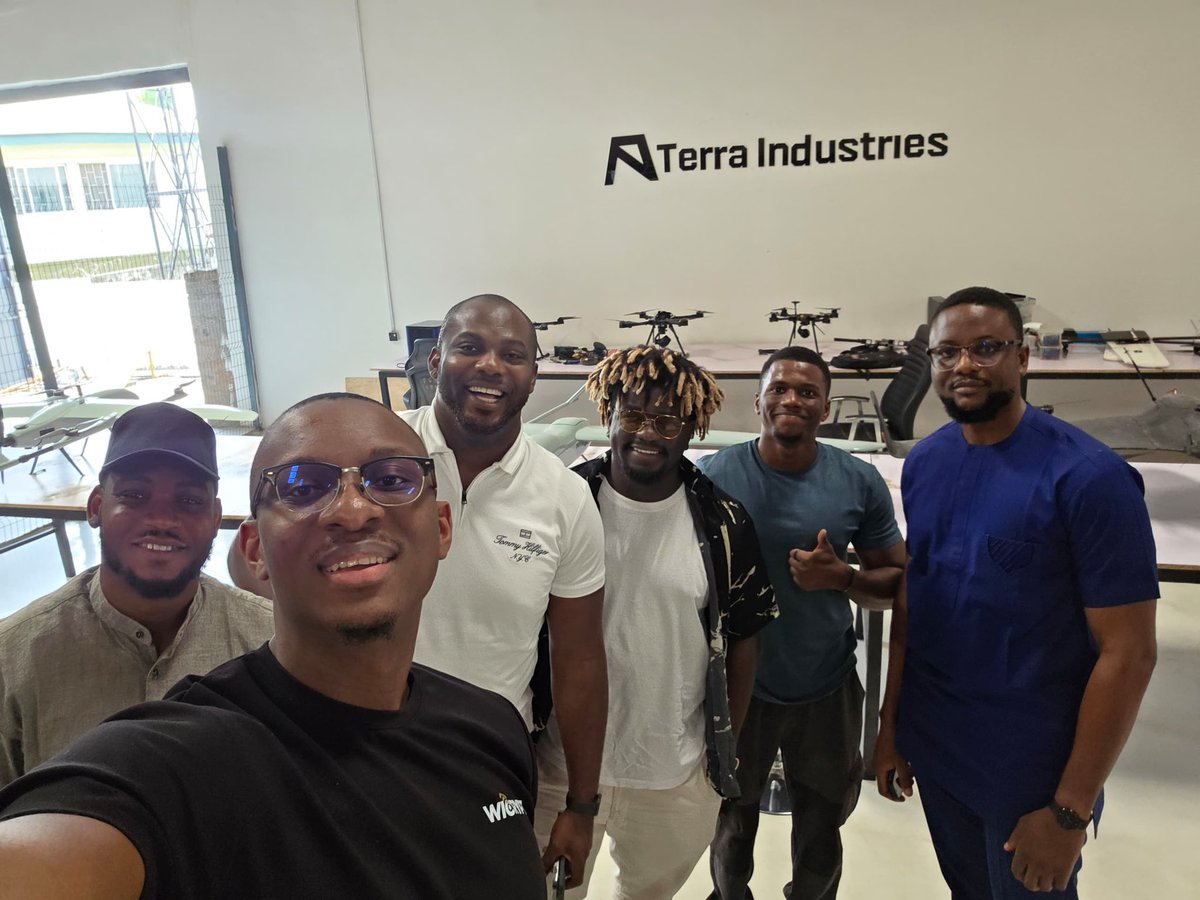
Ugo is building a $15 million dedicated telecoms hardware manufacturing facility in Enugu called Quantum Forge Labs starting this January.
Nathan co-own Terra Industries which is Africa’s largest defense manufacturer.
Chris is running Mamae which is Nigeria’s first organic spice hoping to hit $2 million in revenue by next year.
These are wise men from the East and we spent the whole day discussing intersection between education and industries in Nigeria with focus on the South East.
Enugu will be the Africa’s destination for hardware manufacturing in 3 years.
Pushing education in the region is strategic and we encourage a lot more useful innovations to push the region forward.
@General_Somto Na their way. My experience with them has been poor and I vowed never again. I don't recommend them for similar reasons. Service and delivery are not a priority for them after they have taken your money.
Stripe offered to acquire us for $1.2 billion when we had $2M in revenue.
Today, we've raised $330M at an $8B valuation and reached $1B ARR.
We could've died three times during this journey.
This is the story I've never told anyone before:
Wait Microsoft just released an open source tool to run AI models locally?!
Zero cloud dependency, subscription, or authentication.
Everything is 100% private.
And integrates seamlessly in apps with an OpenAI-compatible API.
Just type the following into your terminal:
→ winget install Microsoft(dot)FoundryLocal (Windows)
→ brew install microsoft/foundrylocal/foundrylocal (macOS)
Link to all documentation below