A lot of crypto maxis believe Web3 will completely replace traditional financial giants. But history shows us a completely different outcome.
Just look at what digital piracy actually did to the music industry—and what Web3 is currently doing to TradFi.
We keep waiting for the next generation of users to embrace crypto's cypherpunk roots. But there is a massive, fundamental shift in how Gen Z interacts with tech today that makes this highly unlikely.
Imagine using your commodities, money market funds, and crypto to dynamically offset each other and unlock massive leverage. It sounds impossible with traditional settlement times, but there is a way to do it instantly.
Every crypto conference has their compliance guys who are not really into crypto, but they still have heavy opinions.
I was at the conference and one such guy tried to drag me into debate.
Whether you keep your bags on an exchange or use self-custody wallets, there is a dangerous interdependence operating in the background. If one specific type of infrastructure player falls, we all go down with it.
We keep relying on insurance models to protect crypto assets, but insurance is painfully slow. There’s a better mechanism that traditional markets use to keep everything liquid even during a catastrophic default.
I sat in a room full of TradFi collars, and they told me how they perceive crypto (costing the market billions in capital)
The reality is such that global insurers are terrified of underwriting crypto protocols! They are charging prohibitive rates to prove it, but it's not because they think the tech is fundamentally flawed.
Even in high-level finance, people often lack the education on what is realistic and what is simply a misunderstanding of market structure.
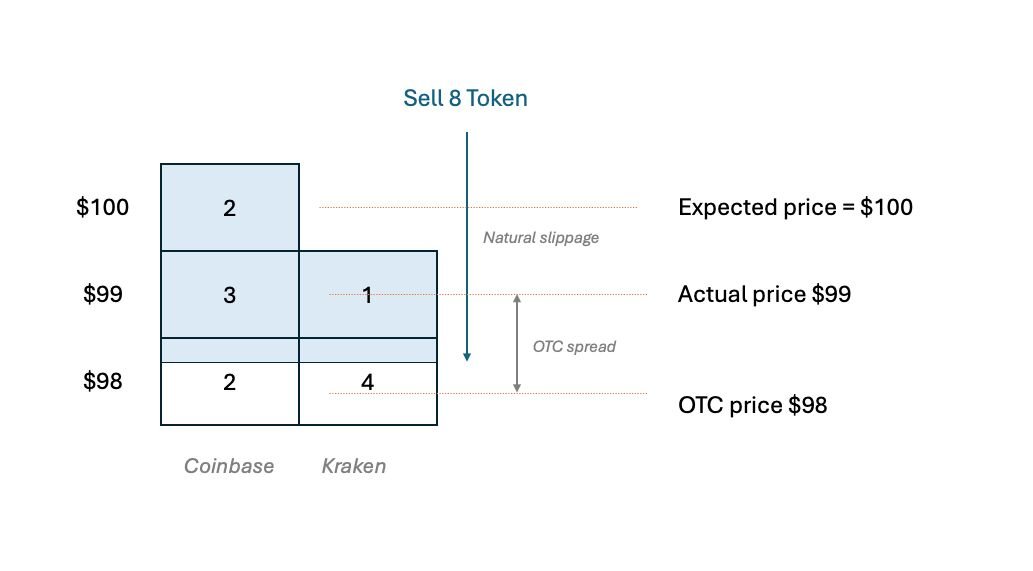
We had a client using a "fill or kill" feature recently. They argued that we were adding a spread because they saw a "better price" on a centralized exchange.
But you cannot execute the full amount at the top of the book price.
It is a tough world to explain because clients expect us to always be better than the public exchanges. I like the analogy: a flight aggregator will not give you a better price than the airline directly. The same holds true for small sizes, but SOR may beat a single exchange on larger sizes.
The value is that while we can’t always beat the raw exchange price, we are transparent, unlike many OTC desks. Often, there is no benchmark for the trade, so the desk can add lots of spread on altcoins. Then, the desk is not likely to have internal offsetting flows on that coin, so they will not warehouse the risk but instead get rid of it on the markets using an algo (which we can give directly to the clients). Aplo executes on exchanges rather than sending the flow to other market makers who then apply what I described above. We beat other brokers because we are transparent and the pricing is fair.
Unfortunately, It is easier for people to be lazy and assume a broker is "adding spreads" than to look at the flows and understand how liquidity actually works. Visualizing this for clients is key, and it’s a big part of the job we are doing.
We’ve spent years watching banks run ‘pilots’ on private chains. In 2026 they jump straight to public blockchains with trillions.
2026 feels like the year institutional DeFi moves from proof-of-concept to production scale.
After years of private/consortium chains and cautious pilots, the momentum has shifted decisively toward public blockchains. Regulatory clarity (especially in the US) has derisked participation, turning wait and see into active blockchain strategies across banks, asset managers, and corporate treasuries.
I attribute the key driver to enterprises that are no longer starting with basic custody or brokerage. Many are jumping straight to advanced use cases like tokenized funds, onchain borrow/lend desks, or yield-bearing stablecoin integration, often before building foundational rails.
Why would they if they can move onto a neutral settlement layer?
The next 12–24 months won't be small pilots. I expect trillions in real-world assets flowing onchain, validating public infrastructure.
What’s interesting is that "D" in DeFi increasingly stands for delivery. Enterprises seem to prioritize faster settlement, reduced counterparty risk, and automated operations over pure decentralization.
Let me explain what’s looping, and why it’s a big part of DeFi.
You deposit stablecoins $USDC/$USDT as collateral => borrow stablecoins at low interest => swap if needed => deposit again => repeat 3–8 times.
As a result, you multiply exposure to base yield.
Base stablecoin yield: ~4-12% APY (lending, RWA, basis trades). With looping: you can get up to 15-30%+ APY. Even higher if you factor in incentives, points, or airdrops.
Essentially, looping is leveraged yield farming but with lower volatility because the underlying asset is stable.
Risks still exist:
Liquidation risk if LTV is too high.
Borrow rate spikes.
Smart contract exploits.
There’s some regulatory pressure in place (especially US discussions about restricting stablecoin yield) but DeFi remains permissionless for now.
In traditional finance, retail traders never touch the NASDAQ directly. You must go through a broker. Crypto has completely collapsed this stack.
In TradFi, there are layers of separation designed to protect the user and prevent conflicts of interest. Crypto is different because we now have major players acting as the exchange, the broker, the custodian, and sometimes even the market maker: all under one roof. They service the retail mom-and-pop trader and the massive institutional VIPs simultaneously.
In TradFi, this blend of services was strictly regulated and separated to avoid Payment for Order Flow issues and opaque pricing (the "dumb flow" problem).
Whereas PFOF in TradFi is heavily audited to ensure you still get the ‘best execution’ price, in crypto, the pricing is often opaque and the spread you pay can be 5x to 10x higher than in TradFi without you realizing it. Mostly because the exchange and the wholesaler are often the same company (or close affiliates)
Imagine a salesperson hears a client say they want to offload "discounted Bitcoin" quickly. Discounted BTC usually means one of two things: a massive seller taking a risk, or shady origins.
If you aim to be compliant, the alarm bells should ring immediately. But if raising that alarm means the deal dies, the commission vanishes, and the sales team is penalized for losing flow, then you have broken the system. They won’t flag it next time.
This shortcut culture is everywhere. You have account managers at major exchanges actively coaching clients on how to structure their answers so compliance doesn't ask questions. They treat compliance as an obstacle to be bypassed, rather than a filter for quality.
Building a real culture of compliance means aligning the incentives so the front office wants to be the first line of defense. It means proving that a compliant business is the only sustainable business. If the team feels penalized for doing the right thing, you don’t have a compliance program.
Europe’s crypto OTC market looks very different from the US.
In the US you have a handful of big, well-known names that handle most institutional flow — Coinbase Prime, Anchorage, Fidelity, etc. One-stop custody + execution.
Europe is far more fragmented. You have strong local champions like SCRYPT in Switzerland, Flowdesk in France, and B2C2/Woorton that has grown global. Many smaller desks tied to local banking rails and languages.
Institutions often prefer local for operational comfort: they like sharing the same language, easier euro wires, less risk of frozen transfers.
Many of these desks don’t even hold custody. If you're small, you might not operate as a large-scale market maker, so you might not have your own prop book. Instead you'll rely on third party prices. You're still acting as principal, taking on limited market risk.
What’s the most underrated OTC desk in Europe, in your opinion?