Grok Bot has saved me at least 5 hours a week so far.
(I’m not an AI expert)
Here are some things I’m using it for in marketing:
- Uploading videos to Google Drive
- Uploading emails into ESP & scheduling
- Building automations within CRMs/ESPs
- Formatting google docs or notion pages
- Updating data tracking sheets automatically
- Building landing pages & funnels (with claude code)
- Bulk uploading contacts into CRMs and organising them
- Reading fathom transcripts and taking things off my plate
The nuance here is that I’ve had many years of marketing without AI.
So I have the experience to know what works and how to do it.
Which means AI is like an extension / clone of me for lower level stuff.
There’s still a lot I’d never give to AI like important copywriting, graphic design, market research ect.
But if something can save you time and still get results, why not leverage it?
I’m 22 and have gone against the grain in many areas of my life:
- I never went to Uni
- I hate roast dinners
- I’m getting married young
- Don’t like all inclusive holidays
- I don’t watch the news or any tv
- I don’t own any designer clothes
On one hand it makes it hard to “fit in” and easily make friends.
On the other I think it’s a massive bonus:
1. Filters out people who are not aligned
2. Makes genuine connections stronger
3. I don’t have to pretend to be anyone else
I think the same principle applies to marketing.
Because as Marty Neumeier said: "When everyone zigs, you zag"
A helpful rule of thumb:
• Positioning: appeal to someone, not everyone.
• Differentiation: stand out in a crowd.
• Uniqueness: give people something to remember.
With AI, brands end up looking and sounding the same.
Sure, fitting in can work in the short term.
But look at some of the other brands in different spaces:
- Apple (Tech)
- Hormozi (Coaching)
- LiquidDeath (Ecom)
They were all disruptive and different to others in their industry.
So this is why I always tell brands to look at their messaging.
Make it clear who your offer is for and what makes it different.
If the same words could sit on another business's page, get more specific.
Long term, I'd rather stand out than fit in.
This isn't a sexy idea but one of the problems with AI now is that people aren't putting in the reps to learn stuff because they can just get quick and easy information from AI.
AI has unlocked mass content creation and distribution. The thing with content is it makes you feel like you're learning and doing stuff but its literally just procrastination.
You don't actually learn anything from content. You might see a hack or a tip but you're not learning anything of substance right? Real learning comes from doing the reps.
Over the past few years as a marketer, I have written thousands of hooks from scratch, thousands of emails, ads, years of social media content for some brands ect.
And they were absolutely shredded by copy mentors, destroyed by CMOs and CEOs that I worked with, and I watched things that I had a ton of belief behind get no results and fall flat.
I think that feedback and those failures are so important for shaping your creative taste which so many brands are desperate for these days. The creative taste is something AI will never be able to replicate and most people just don't have the knack for.
Imo this comes from putting in the reps.
I also think that while having name association or achievements is a strong form of proof, having reps and failures behind you will become more valuable too.
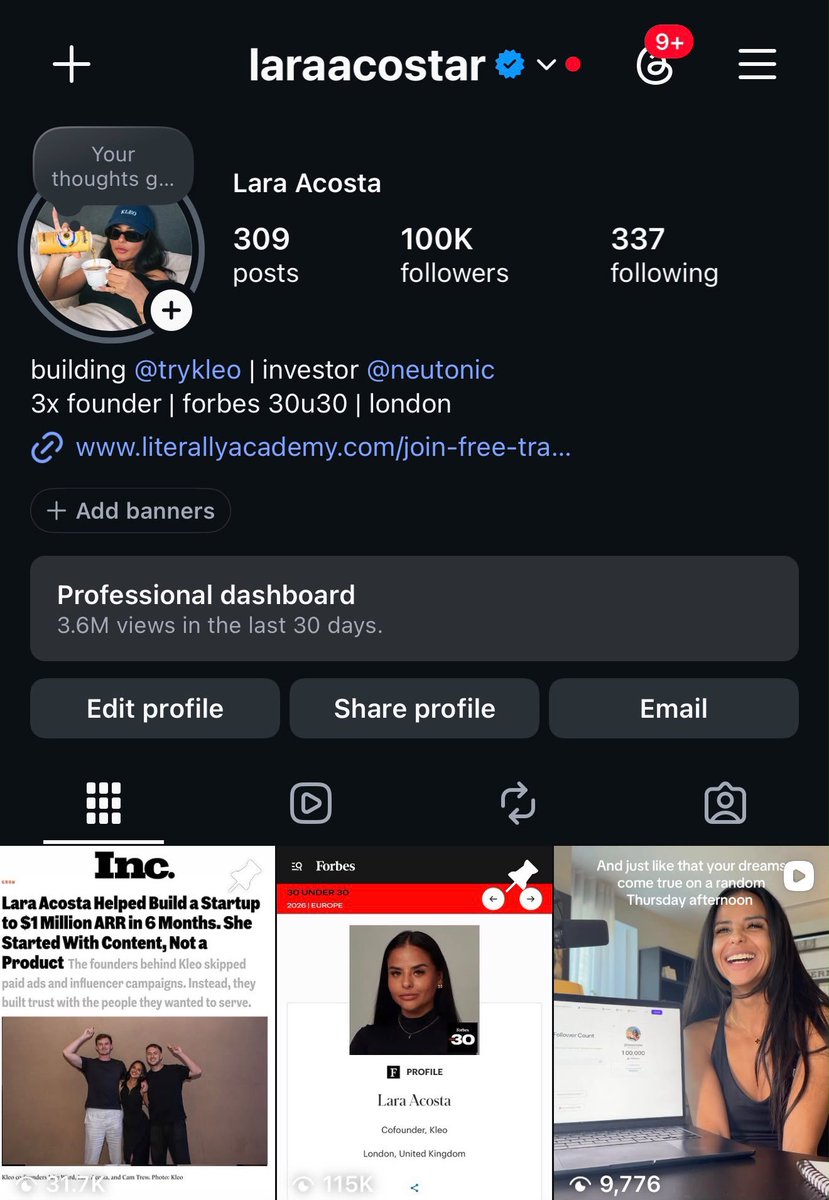
Just crossed 100k andgot 3.6M+ views on Instagram. 20k followers gained in the last 7 days... insane!
Some thoughts on this:
There are 2 games you can play on any platform: quantity or quality.
On LinkedIn, I overindex for quality. 4x posts a week, detailed and structured. Nearly perfect.
It get's me 10k~ followers a month regardless of algo changes, and got me to 360k there.
I tried to play the exact same game on IG.
It didn't work. Nothing that i'm about to say is novel, revolutionary or crazy insightful, but...
The moment I started posting 2x a day.
Post 1: Widest TAM (relationships, jokes, etc)
Post 2: Niche Education (Biz, LinkedIn + content)
I grew 10x more because of volume, but also the goals of each post.
Some other basic things that I just needed to do rather than say "yeah i know" and go on and not do them:
Trial reels: Gotten 1,000+ followers from 1 single trial reel and posted on main which made that 3,000+ new followers for the same post.
Pattern recognition: Volume game can't be played if you don't know what good content looks like, so it's not post 2x a day and you'll grow...
It's more like post 2x a day with content that has proven to perform across other platforms and reduce the ideation/creation part.
And the last thing I will say, It wasn't "easy".
In general I've spent at least 3-4hrs a day looking at content, scripting some of it, getting ideas, shooting it and more "research" scrolling.
And also someone pissed me the fuck up telling me that because i didn't have 100k on ig i couldn't do x or y AND TRYING TO GIVE ME BRAND ADVICE LIKE SORRY?
Actually ginore everything that I just said, just find someone to piss you off and you'll be at 100k tomo x
Also:
The teams across @trykleo and my other businesses gave me 60 days to try and scale it up and I delivered while they just held it down with ops.
Time to now turn this into a conversion engine for our saas!
I'll prob do a detailed breakdown on the strategy in itself once I can fully articulate it and have a bit more time!
Every marketing task I’ve done recently
(Ranked by money-generating activity)
1. YouTube strategy (6/10)
2. Building a sales page (9/10)
3. Building lead magnets (4/10)
4. Writing an autoresponder (8/10)
5. Strategising launch offer (10/10)
6. Writing promotional emails (9/10)
7. Email deliverability management (7/10)
8. Creating a viral hook bank for IG (5/10)
9. Building AI content-reposting Strat (4/10)
In business, there are 3 types of activity:
1. Tasks that make money
2. Tasks that solve problems
3. Tasks that solve future problems / make future money
I want to spend as much time as possible on number 1.
Naturally, number 2 needs attention sometimes.
But a lot of companies and marketing teams get stuck on number 3,
If you're a founder or part of a marketing team, look at what fills your time.
Compare how much of it makes money with how much is work for a possible future return.
Looking back at my tasks, not all of them were number 1.
My long-term goal is to reach a point where almost all are revenue-generating.
At that point, I would delegate 2 and 3 to other team members.
It's funny how this game works. I tell people around me all the time:
It's not always about learning the next, new thing. Most of the time, you just need to be reminded of things you already learned.
Combed back through my socials today and needed to be reminded of some of these.
Sunday evenings thoughts:
• take your health and performance seriously, but over-optimisation leads to depression
• most of ur intrusive / negative thoughts in biz come from short-term thinking (Watch Steve Jobe interviews for context)
• if you’re good at what you do, and can actually help people, then you shouldn’t care about losing a sale
• a cup of tea never goes out of style
• You can’t “scale” if people are only buying from you once. If you can get money out of somebody multiple times, paying for traffic is easier
• only way to make great cash in this game is with an offer
• taking time to recoup and detach by leaning into vices actually promotes productivity and longevity
• this app is filled with guys with self-worth issues and just say shit to get views
• finding your life partner or best friend in the game makes everything 10x clearer
Everyone talks about writing new headlines, fancy page copy or new business models to run...
But nobody talks about awareness levels and how important they are for a converting offer.
Never get bored of the basics.
For example, people running the book a call model will complain about their calls being unqualified or show up rate bad.
But their leads are only watching 2 minutes of the VSL before booking the call.
So sure, they have an idea of what you teach...
But they have NO idea what your offer is because they didn’t stay long enough to hear it.
So you end up getting people on the phone who kind of know about the topic, but they have no buying intent. Wrong awareness level.
Another example:
You’re targeting the solution aware with your ads and messaging.
The ads are working. You increase spend. They stop working and CPA goes up.
The ads have fatigued, you’ve exhausted the solution aware pocket. You can duplicate them and relaunch a few times, and that may work for a while.
But in the end, you realise the majority of your market is going after this same audience so you’re all competing for the same leads.
Where as if you can speak to a different awareness level, like problem aware?
You have a much larger pocket of people to tap into and CPA goes back down - and all you did was change the messaging and positioning of the offer.
80% of the success will come from the basics.
A good message that people want, put in front of the right people, enough times.
This is the mindset it takes btw
you never failed
nothing is ever bad
you never got something wrong
It's all learning curves and opportunities to learn & get better.
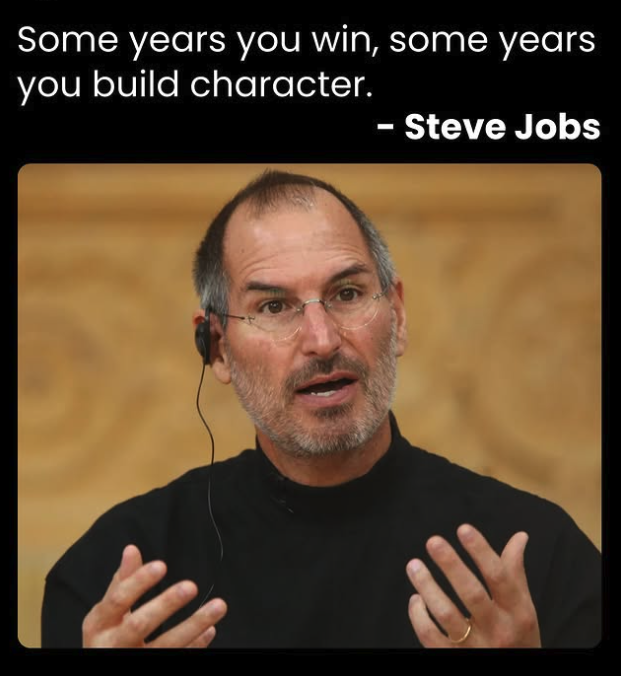
Character building. Always reframing the situation to your advantage.
It’s funny how many people love the idea of growth and progress until something hard comes up.
Going through the hard things IS growth
- Being unsure about how a launch will turn out
- You try something that doesn’t work
- A client or team member leaves.
That’s normal and is a good sign that you’re going in the right direction.
There will be these weird periods where everything feels like it’s against you and you’re swimming upstream
Ans there will be other times where you feel like the best in the game and nothing can stop you.
But you don’t actually make any growth when things are going well.
You’re just riding the momentum and progress you made for the previous 6 months.
This idea of growth being painful is common is in our space, and people see it and go “yea I already know that”
Yet when things don’t go their way or they run into tribulation, everything they “know” goes out the window and the start complaining again.
After working with some of the best teams in the game and working along sided some pretty successful people, we all seem to share the same view on things.
Something bad happens? Good, stick to the plan and keep going.
Something good happens? Good, stick to the plan and keep going.
We don’t let our emotions dictate our actions or decisions
So if you’re going through a tough period where it feels like the world is out to defeat you?
That’s how you know you’re on the right track.
Stick it out long enough, and you’ll be on the other side of the wave like nothing happened.
We’re all going through these waves of success and eating shit, it’s just that social media won’t show you the 💩
This is the mindset it takes btw
you never failed
nothing is ever bad
you never got something wrong
It's all learning curves and opportunities to learn & get better.
Character building. Always reframing the situation to your advantage.
It’s funny how many people love the idea of growth and progress until something hard comes up.
Going through the hard things IS growth
- Being unsure about how a launch will turn out
- You try something that doesn’t work
- A client or team member leaves.
That’s normal and is a good sign that you’re going in the right direction.
There will be these weird periods where everything feels like it’s against you and you’re swimming upstream
Ans there will be other times where you feel like the best in the game and nothing can stop you.
But you don’t actually make any growth when things are going well.
You’re just riding the momentum and progress you made for the previous 6 months.
This idea of growth being painful is common is in our space, and people see it and go “yea I already know that”
Yet when things don’t go their way or they run into tribulation, everything they “know” goes out the window and the start complaining again.
After working with some of the best teams in the game and working along sided some pretty successful people, we all seem to share the same view on things.
Something bad happens? Good, stick to the plan and keep going.
Something good happens? Good, stick to the plan and keep going.
We don’t let our emotions dictate our actions or decisions
So if you’re going through a tough period where it feels like the world is out to defeat you?
That’s how you know you’re on the right track.
Stick it out long enough, and you’ll be on the other side of the wave like nothing happened.
We’re all going through these waves of success and eating shit, it’s just that social media won’t show you the 💩
@HardToKillKai So true. It’s like “if you’re right, what do you gain from it being right?”
I say that after going down many rabbit holes myself. It becomes an itch you can’t scratch
I once had a client that was only running webinars
And they did okay, but nothing crazy or to be excited about.
But the problem was that the client didn’t have a business, they had a promotion.
Every week, the client had to jump on Zoom and put on a show just to make sales.
Not to mention:
- Spend a ton of time and energy into getting leads
- Plaster peoples inboxes with daily email reminders
- Offer crazy giveaways each week just to get people to show up
- The fact people were starting to recognise the sales process of webinars
The business was reliant on the client, how they felt that day, how they showed up on the webinar, and how many leads they managed to pull in that week.
It was like filling up a local circus.
So one day we jumped on a call and I told them this. I remember getting all nervous because I was kind of new to the game, expecting the client to get mad or whatever.
I explained how they could be doing better by running something that took half the time and energy - didn’t rely on the creator.
Of course, the client agreed and took on board what I said.
And they wanted to add a new business model to what they were doing.
Something that could bring in the same - or more - without all the hassle and work.
So we decided on adding a call funnel. We could test it super fast, get data back, and the client had the funds to spend (since call funnels naturally have a higher CPA).
The VSL was simple as I wasn’t half as skilled as I am now, and the funnel was basic. And we ran a mix of warm and cold traffic to it with about 200/day in ad spend.
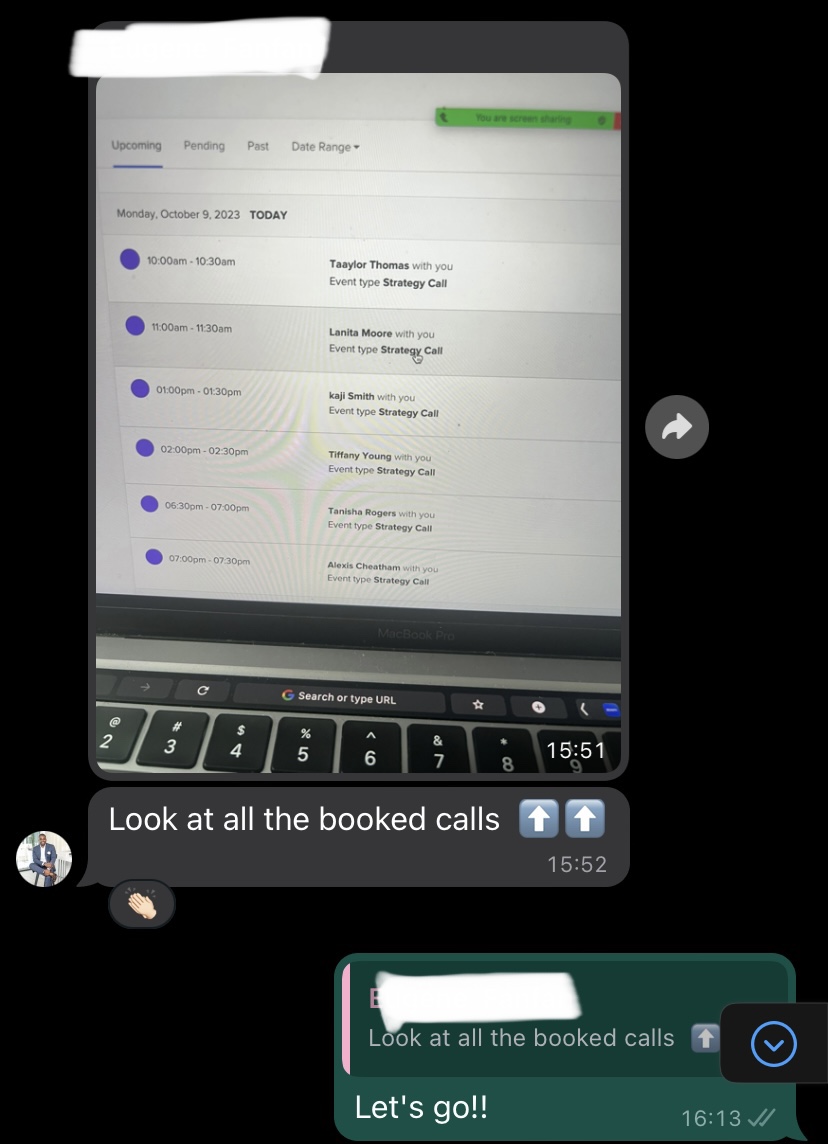
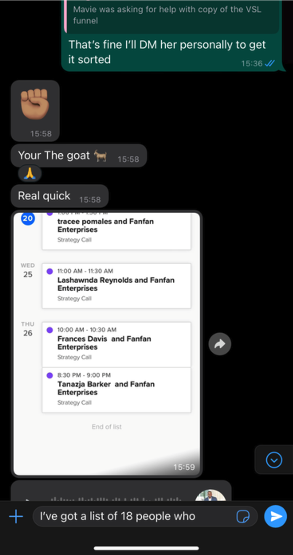
We ended up adding an extra 40k/month to the business with this call funnel. And I believe the client is still running the same funnel to this day.
They’re generating an extra 480k/year in rev to what they’re already doing - without the model being reliant on the creator - since most of the systems automating a lot of the heavy lifting.
This isn’t a lesson on call funnels, it’s a lesson on looking for ways to improve what you’re already doing in the most risk free way you can.
Cause that business can now decide to stop doing webinars and take time off now WITHOUT impacting a ton of revenue.