A few months ago, I wrote my core thesis: overthinking is the subtlest addiction of them all. Most of us are lost in it without noticing, and the machines we built to think for us only make it worse.
To my surprise, it went viral, with hundreds writing to me about migraine relief, OCD softening, and longtime meditators finally breaking through.
You are not the voice in your head, but something much vaster. Learning to live that way is a trainable skill, just a hard one in modern life.
So I wrote a proper guide weaving contemplative practice, somatic psychology, and the most overlooked piece, addiction recovery.
Something that comes up frequently in my work is the feeling of "stuck energy."
It often arises once a person slows down, dropping beneath the surface-level thoughts and stories, into a deeper layer of the soma. There appears to be something waiting there, most typically between the root and the head, in the lower belly, abdomen, chest, or throat. And whatever it is, people report it as stuck. Which is really another way of saying: I don't like this feeling, it's bad, and I want it gone.
And as soon as this happens, the analytical mind is on alert again, insisting that the way your body is – the way that sensations are arising – is wrong. As if the universe makes mistakes.
The moment we frame it as wrong, we're in conflict with ourselves. One part is fighting another. And resistance only makes it grow.
Spiritual practitioners are especially prone to this. If you've felt energy move before – kundalini, say – there can sometimes be a subtle belief that you are the doer, the one moving the energy, rather than the energy moving itself. From there, it's easy to assume any uncomfortable energy now needs to move, that something's blocked. But that very belief is often what keeps it stuck.
The practice is to stop trying to move anything: bring curiosity, even wonder, to what's there. Rest your attention on the sensation, as gently and intimately as possible. The more you investigate the bare experience and stay with it, the more it tends to resolve on its own. With loving attention and no agenda, the body knows how to heal itself.
From another lens, in the deeper dharmic work of unwinding the fetter of aversion, you may discover that the sensations move and shift, never quite able to be pinned down, and yet the energy never fully dissipates. It seems, in some sense, to always be there. And so the most liberating question becomes:
Am I willing to let this be here and live my life fully, even if it's here forever?
Take away the escape hatch – that things could be any other way – and you are no longer in conflict with reality.
First heard this from my dear friend and colleague @CryptoMindcare, who leads a stunning fireside ritual on healing the paternal line at our men's retreats.
Healing can feel like the most self-absorbed thing in the world, almost shameful.
And yet, as family therapist Terry Real says:
“Family pathology rolls from generation to generation like a fire in the woods, taking down everything in its path until one person, in one generation, has the courage to turn and face the flames. That person brings peace to their ancestors and spares the children that follow.”
The tip from @FU_joehudson to say "ouch" each time you catch negative self-talk reminds me of one of my fav zingers:
If a brick landed on your face every time you had a negative thought, you’d start paying attention
A fantastic pod covno with two of the wisest dudes around
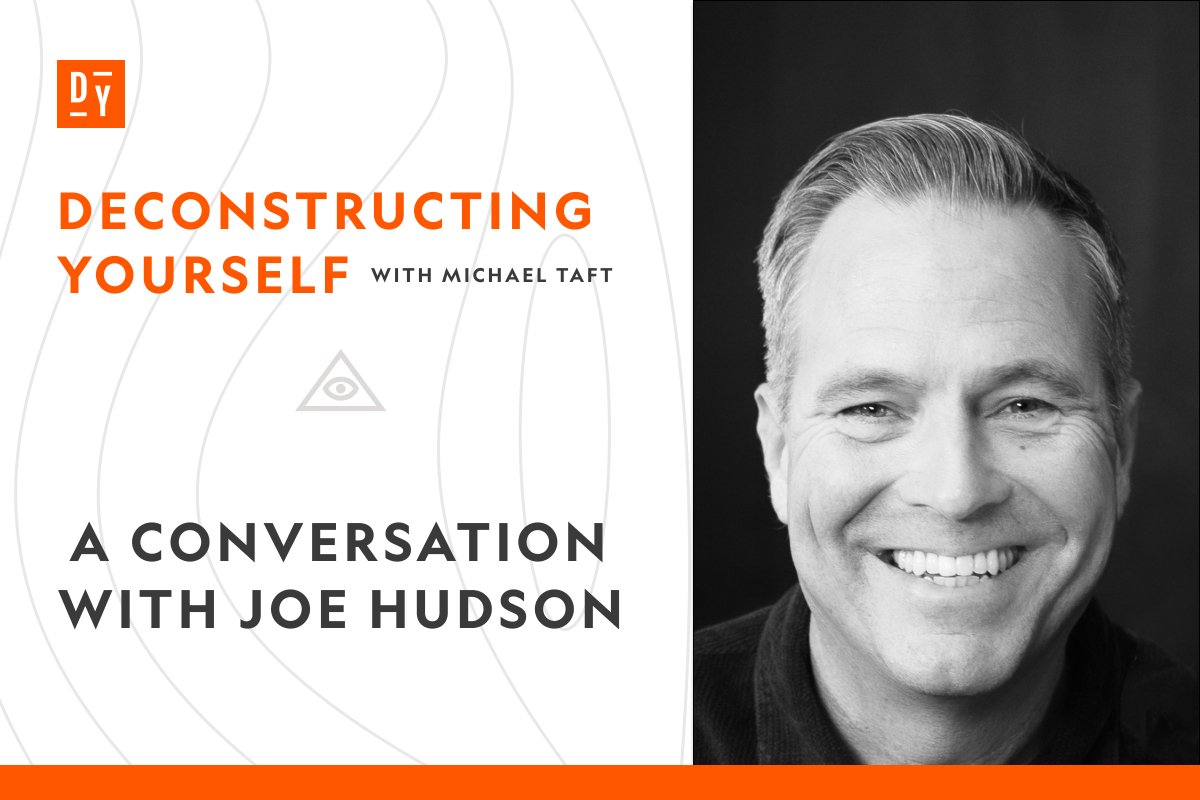
New Deconstructing Yourself podcast is live! In this episode, I speak with @FU_joehudson! We had a great time with this conversation.
Host Michael Taft and guest Joe Hudson explore the crucial difference between awakening and liberation: why insight on the cushion does not automatically free us in relationship, shame, self-talk, or emotional reactivity. Joe reframes emotional practice as a path of awakening, inviting us not merely to accept difficult emotions, but to love them, feel them somatically, and discover the intelligence hidden inside. Together they unpack the “golden algorithm”—the emotions we most avoid are the ones we unconsciously keep recreating—and show how negative self-talk often masks unfelt fear, anger, or shame. Practical conversation about what happens after awakening, when the old wound is triggered and freedom has to show up exactly where we are least willing to feel.
Our brains evolved as threat detection machines, so we carry a strong negativity bias that fixates on what went wrong and what could go wrong, and our media and culture only reinforce it.
But!
At our essence, we are good, better than good, unbelievably so, beings made of literal light.
So you train your attention to catch the negative and turn back toward the light, over and over, until you know you are good. Then it starts spilling out of you without trying.
One of the most liberating teachings I ever received came in my early days of AA.
I'd built my career on being able to speak in public, and when I got sober, without the uppers and downers to numb and "find the flow," I was a raw nerve. It was like my skin had been peeled off. I couldn't get a sentence out without a mild panic attack.
So when I found myself in church basements, trying to share about what I'd been through and the shame I was carrying, I couldn't do it. I was petrified that I had lost my gift of gab for good, and that everyone could see me losing it. I finally confided in my sponsor, and he just said:
"Nobody in here is thinking about you. They're all self-centered assholes, completely lost in their own worlds, just like you."
During a chapter of intensive plant medicine training, I was led on a trek hours into the Amazon. We were heading to an ancient and healing tree. People traveled from all over to be with it, and the local lore was that it could even heal terminal cancer.
I wore an REI mosquito hoodie and pants against the insane bugs, while my Shipibo friends just rocked sandals and tanks. When we finally reached the tree, we hacked off fresh cat's claw and drank rainwater from the branches, and despite the sweat and bugs, your boy was as content as I've ever been. These experiences of learning more earthbound ways of being and relating changed me and the course of my life.
Nothing in recent years has inspired me to revisit the Amazon like this essay on "enlightened trees." I've always loved @TVachaW's practice notes, but now that he's doing long form, instant new fav Substack. Dude is drawing from somewhere deep.
Much of therapy trims the branches; somatic and depth work go down to the trunk; proper spiritual practice goes for the root; and a modern nervous system benefits from all of it, integrated
As a very young child I was obsessed with Middle-earth, wizard spells, jedis, and cultivating "the force." Then, as a teenager, I had spiritual openings, or glimpses, as they're called. But because I carried my own unprocessed insecurities, and because I was so absorbed in a suburban culture that lacked initiation and spiritual nourishment, I started getting high quite young.
And once I was using, I interpreted all those openings as just the aftereffects of the drugs… "I should do more drugs!" I'd have a wave of connection out in nature, even touching oneness, and think, "ohhh, I gotta come back here and get epically high."
It took me a decade of enthusiastic self-destruction, and then another decade of obsessive spiritual practice to figure out that the entire time I was just looking to rest in the freedom that's always here, hiding in this ordinary reality. The drugs just helped me access it.
A few months ago, I wrote my core thesis: overthinking is the subtlest addiction of them all. Most of us are lost in it without noticing, and the machines we built to think for us only make it worse.
To my surprise, it went viral, with hundreds writing to me about migraine relief, OCD softening, and longtime meditators finally breaking through.
You are not the voice in your head, but something much vaster. Learning to live that way is a trainable skill, just a hard one in modern life.
So I wrote a proper guide weaving contemplative practice, somatic psychology, and the most overlooked piece, addiction recovery.
@adelbucetta Machines absolutely exacerbate indecision, love that. Though I would say that we are innately wired for introspection. It's not about turning off the thoughts, but changing your relationship to them, so you are no longer a prisoner to them.