Arrogance. Entitlement. A political class that sees itself as royalty financed by peasants.
If SHA is truly universal, MPs should lead by example.
If it’s not good enough for them, it is NOT good enough for any Kenyan.
Enough with this double life of public modesty and private luxury. They cannot keep eating five-course meals while serving everyone else porridge.
Is SHA too slow for their emergencies? Too basic for their ailments? Too unreliable for their comfort?
Because if SHA is good enough for the people who pay their salaries, it should damn well be good enough for them.
This is the problem with leadership in this country:
They create systems for the masses, then build escape routes for themselves.
They preach equality while budgeting for privilege.
They talk about shared sacrifice while insulating themselves from the consequences of their own decisions.
William Ruto is not a leader who negotiates; he is a politician who manipulates the room, rewrites the script, and crushes anyone who refuses to play along. When his agenda stalls, he doesn’t adjust he breaks the people standing in his way. That is his operating system: compliance or destruction.
And now you have Esther Passaris, suddenly singing hymns of praise as if the presidency were a divine throne. The eagerness to paint Ruto as some “God-sent ruler” is nothing more than an audition to replace the First Lady’s symbolic proximity to power. It’s desperation dressed as devotion.
Then the clearest snapshot of who Ruto really is:
Senator @DrBKhalwale raises a simple, national plea listen to the people. Instead of humility, the president fires back with a ledger of favors. Instead of governance, he gives a bill of debt. Instead of leadership, he delivers a warning:
“Don’t criticize the government. I bought you a car. I gave you money at your wife’s burial. I made you Chief Whip.”_ William Ruto to Boni Khalwale.
That is not mentorship.
That is not guidance.
That is control.
A hustler president weaponizing generosity is not generosity it is a leash. A self-proclaimed born-again leader using personal help as political blackmail is not faith it is moral bankruptcy.
If this is how he talks to his own allies, imagine the contempt he holds for everyone else. This is the reality: @WilliamsRuto does not build loyalty; he purchases silence. And anyone who refuses to kneel becomes a target.
Kenya isn’t dealing with a visionary.
Kenya is dealing with a man who thinks power is a personal empire and every Kenyan is a subject expected to clap.
Citizen TV didn’t host Murkomen to seek clarity they hosted him to run cover. The whole performance was a choreographed clean-up job, a classic state–media alliance where the broadcast isn’t about truth but about rescuing a collapsing narrative. Instead of confronting the hard questions around the coordination between security forces and groups that terrorized citizens the very scenes that drew international condemnation the station handed him a soft landing.
This is how Ruto governs: control the microphone, choke the truth, dominate perception. The regime’s instinct is simple kill the story, not the rot. Every time the country demands accountability, the state runs to a friendly newsroom to repaint the crime scene. And Citizen TV played its part perfectly, acting less like a watchdog and more like an extension of the communications office.
In this system, reality is irrelevant. Power decides what happened, and the media recites it on cue.
HELB has been bombarding unemployed Kenyan youth with threatening messages, demanding that they pay back three to four times the amount they originally borrowed. Ushenzi kabisa. How do you lend someone 80,000 shillings and wake them up years later demanding 320,000? How is that anything other than an extortion scheme disguised as policy?
Why is HELB behaving like a shylock hiding behind government stationery?
Now that the courts have caught them pants down, suddenly they’re shouting “we have complied!”
Complied how?
With what exactly?
Where is the transparency?
Where is the breakdown of these phantom penalties and fictional interests?
Who authorised HELB to turn a loan for poor students into a lifetime financial sentence?
The Grand Falls Multipurpose Dam was a done deal under Uhuru’s administration fully evaluated, approved, and ready to break ground. Then William Ruto walked in and did what he does best: sabotage a national project the moment it doesn’t serve his inner circle’s commercial interests.
Taxpayers now stand to lose Sh337 billion because @WilliamsRuto casually cancelled a mega-dam that would have delivered power, irrigation, flood control, and clean water to three counties. A project already tendered, already vetted, already cleared by every relevant institution. Instead of protecting the country’s investment, he killed it and opened the door to compensation claims that could bleed the public dry.
Former Attorney General Muturi has already pointed out the obvious Ruto wanted the project rerouted to his preferred Chinese-linked allies. @skmusyoka confirmed that Ruto personally tried to force out the British consortium that had legally won the tender. So the cancellation wasn’t about regulations; it was about greed, capture, and primitive accumulation disguised as policy.
This dam was supposed to store 5.6 billion cubic metres of water, power homes, secure food production, and stabilise an entire region. Instead Ruto murdered it for the most predictable reason: if he can’t control the money, he burns the project to the ground.
Kenya loses. Taxpayers lose. Communities lose.
But Ruto? He walks away smiling, pretending it’s “procedure” while stuffing the country into yet another avoidable financial hole.
This is the pattern: if a national project doesn’t enrich his network, he cancels it no matter the cost to the country.
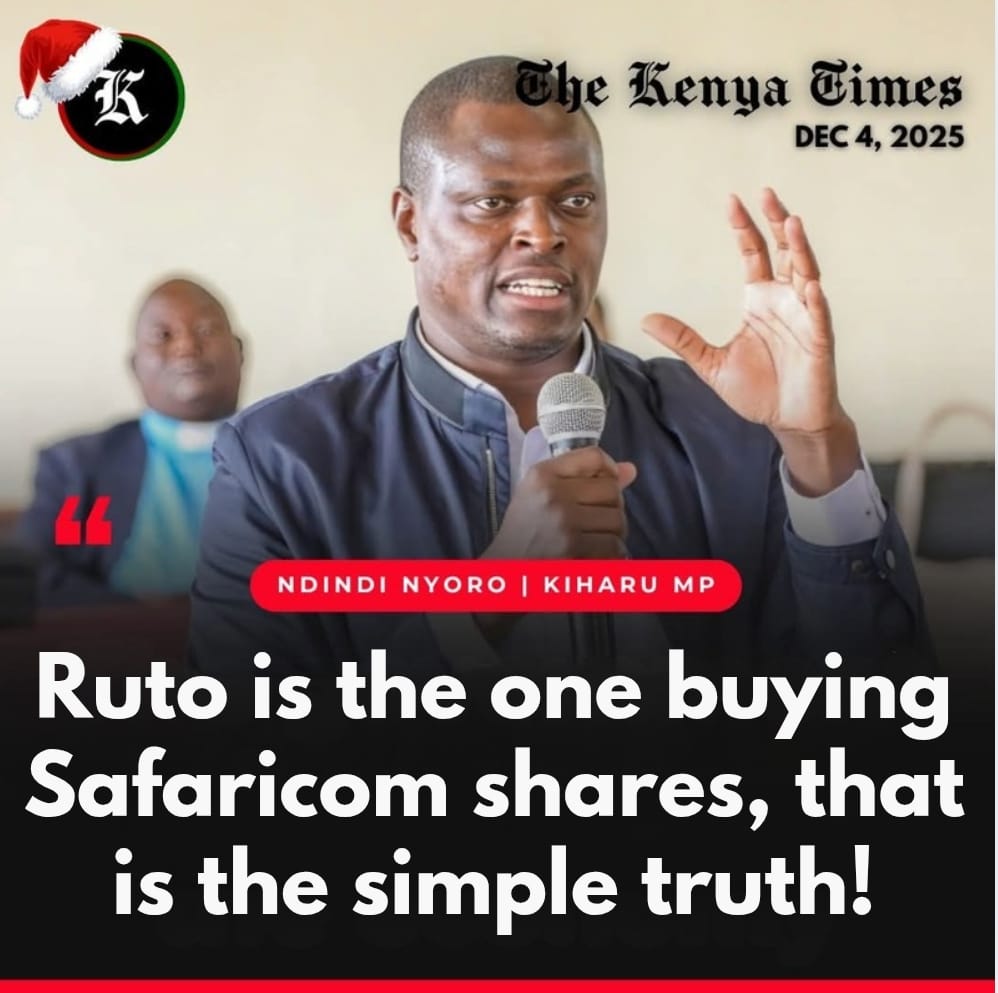
When Ndindi Nyoro blurts out “Ruto is the one buying Safaricom shares”, he is not making a mistake he’s accidentally telling Kenyans exactly why the regime forced the privatization bill through Parliament using obscene payouts and arm-twisting.
Ruto didn’t shower MPs with cash because he believed in “reforms.” He bought their loyalty so he could open the vault. The moment that bill passed, every strategic state asset became a private supermarket for the people in power. Safaricom isn’t just a company it’s the backbone of Kenya’s economy. And the rush to privatize wasn’t about efficiency; it was about positioning insiders to quietly grab slices of the most profitable institutions in the country.
That’s why MPs were suddenly “very cooperative.” That’s why the vote moved at lightning speed. That’s why the public was ignored.
This is the script:
Pass privatization → depress public confidence → acquire shares through proxies → walk away owning what taxpayers built.
The greed is naked. The agenda is obvious. And the cost to Kenyans will be permanent.
Ruto didn’t fight for privatization he fought for a personal marketplace. And now his own allies are confirming it, unintentionally exposing exactly why he needed Parliament on a leash.
@KenyanRegista@otienowill I would rather miss an iphone in a country where I can get other trending cellular than tolerate a country which sells its sovereignty piece by piece.
Mbadi's defence of the Safaricom share sale is the classic problem with technocratic arguments in Kenya: it sounds clever, but collapses the moment you interrogate its assumptions. The entire logic leans heavily on textbook theory and selectively ignores the political, strategic and historical realities that actually govern Safaricom’s position in the country.
First, the idea that Vodacom paying a premium automatically makes the deal rational is misleading. Strategic investors pay premiums when they are strengthening their dominance not ours. A premium is not a gift; it is an investment in deeper control. Safaricom is not a start-up struggling for capital but it is a cash-printing monopoly. Selling more shares to the same foreign behemoth entrenches dependency, reduces leverage, and ensures that long-term strategic decisions will be increasingly influenced by foreign boardrooms. That is not “premium”; that is capture.
Second, relying on Vodacom’s “institutional memory” is precisely the danger. The more embedded a foreign player is, the easier it becomes for the state to lose bargaining power. Institutional memory is not loyalty but leverage.
Safaricom’s infrastructure touches every layer of national life ; money, data, communications, emergency systems, elections. Pretending this is a normal corporate transaction is either naïve or intentionally evasive.
Third, invoking global norms of divestiture conveniently ignores the fact that globally, governments strengthen control over strategic infrastructure, not dilute it. China, India, Singapore, South Korea ; none of these countries surrender majority influence over critical digital infrastructure. They do not treat their communications backbones as cash-out opportunities.
Fourth, the argument collapses at its most important point: there are no enforceable safeguards in Kenya.
None.
Not for data sovereignty, not for revenue repatriation, not for foreign dominance.
The same government that cannot safeguard public hospitals, public land, or public debt suddenly expects Kenyans to believe it will enforce sophisticated regulatory ring-fencing against the continent’s biggest telecoms conglomerate?
President @WilliamsRuto,
Kenyans are watching MAU – RIRONI with a level of clarity your handlers didn’t anticipate.
You cancelled a KSh 155B French-funded project that Uhuru Kenyatta had already negotiated and signed.
Your government paid a KSh 7B penalty for that cancellation.
And today, you are celebrating the same project being revived under China Communications Construction Company (CCCC) at about KSh 200B.
So let me ask you directly, without blinking:
What exactly made 155B “too expensive” but 200B suddenly acceptable?
What is patriotic about paying billions in penalties only to approve a pricier version of the same project?
Why was the French deal “bad” only until a Chinese state firm took it over at a higher cost?
And most importantly:
Why are you forcing @NSSF_ke the pension fund of ordinary workers to bankroll this inflated project?
Retirees already struggle to access their own savings.
Audits repeatedly highlight mismanagement and unexplained losses.
Yet you are pushing NSSF toward financing mega-projects that Parliament never approved and workers never consented to.
President Ruto, this is not leadership.
This is coercion disguised as reform.
NSSF is not your campaign chest.
It is not a state ATM.
It is not a fallback plan for government overspending.
And when you triple NSSF deductions, then divert workers’ money into expensive deals that were once cheaper you cannot pretend this is “for the people.”
Kenyans deserve answers.
Not tweets, not slogans, not media propaganda answers.
The Mau–Rironi saga is no longer about a road.
It is about a pattern a government choosing political ego over economic sense, secrecy over transparency, and pension money over donor agreements.
In 2021, Kenya secured a 155B French donor-funded deal for Mau–Rironi.
In 2022, the new administration cancelled it and triggered a 7B penalty.
In 2025, the same project reappeared under CCCC/CRBC of China, now priced at about 200B nearly 50B more than the original foreign-funded arrangement.
And as if that is not enough, the government now plans to force NSSF to finance the project, turning workers’ retirement savings into a pool for megaproject spending.
This raises urgent national questions:
Why was a cheaper, donor-funded project replaced with a more expensive one?
Why are workers being burdened with higher NSSF deductions only for their savings to be used as government capital?
Why is a pension fund with repeated audit queries being positioned as the financier of billion-shilling infrastructure?
And why does the project timeline conveniently land just before the next general election?
This is not economic policy this is political engineering.
This is not development this is desperation dressed as progress.
And this is not protecting workers this is using workers.
Kenyans have every right to demand clarity.
Every right to demand transparency.
Every right to ask why public finances are being bent around political timelines.
A nation cannot be built by draining the future of its workers.
A government cannot call itself accountable while making its decisions in the shadows.
The truth is simple:
Pension money belongs to the people not the presidency.
And any administration that forgets that truth must be reminded by the citizens themselves.
Kenya is bleeding under a regime that mistakes public suffering for an opportunity to cash out. And this Mau–Rironi tolling scandal is the clearest proof yet that @WilliamsRuto's administration has crossed every line of decency and governance.
Mwai Kibaki built Thika Superhighway and never once tried to turn it into a private cash register. He built a national asset, not a toll trap. He understood that a highway is the bloodstream of an economy not a feeding trough for a regime.
Uhuru Kenyatta gave Kenya the Expressway. Yes, it is tolled but he left Mombasa Road completely free, fully functional, and accessible to every Kenyan who couldn’t afford the toll.
He created choice, not oppression.
He balanced development with public dignity.
He never forced Kenyans into a toll gate they couldn’t escape.
Now enter William Ruto, who wants to toll the Mau–Rironi corridor with no alternative route.
No free lane.
No public bypass.
No mercy.
Just a compulsory toll whether you are a farmer, a trader, a student, a trucker, a matatu operator, or a mother carrying groceries home.
This is not development.
This is economic punishment, designed by leaders who think the country exists to feed their greed.
KSh 8 per km for 176.65 km that’s KSh 1,600 one way.
And they expect Kenyans to pretend that’s normal?
How many towns lie on that road? How many families survive on the trade along that corridor? How many businesses depend on the daily movement of goods? Did Ruto even consider the cost of living in Nakuru, Naivasha, Gilgil, Molo, Mau Summit places where thousands of Kikuyu, Kalenjin, Luo, Luhya, Kisii, and Somali families live?
Because once this toll is slapped:
1. Food prices will shoot
2. Bus fares will spike.
3. Trucking charges will rise.
4. Companies will pass every extra shilling down to consumers.
5. Farmers will earn less because transport cost absorbs their margins.
This is the reality. This is what people are angry about.
Not tribe.
Not politics.
Not bitterness.
It’s GREED.
Pure, naked, unapologetic greed.
And every time Kenyans raise the alarm, the regime starts shouting tribe especially dragging the Kikuyu community into a debate they never started.
Why?
Because they want to turn a national cry into a tribal quarrel.
Because tribal smoke screens have become their full-time defense mechanism.
Because when the theft is too big to sanitize, they look for someone to blame.
But even the ethnic card won’t hide this mess.
This road is a regional business corridor used by Uganda, Rwanda, Congo, and South Sudan. Tolling it recklessly will damage Kenya’s entire economic backbone.
PPP contractors and investors already rejected the model because it makes no sense.
Murkomen already hiked Road Maintenance Levy from 18 to 25 bob.
Kenyans already pay through fuel.
Now they want to toll people on top of what they already pay.
And after borrowing KSh 1.2 trillion this year alone, they still come back to squeeze NSSF dry.
So, let’s say it clearly, with the honesty this country deserves:
Kibaki built.
Uhuru balanced.
William Ruto is squeezing the nation for cash and calling it leadership.
This is not progress.
This is a national ambush.
And Kenya must not be silent.
Because if they can toll a major highway with no alternative, they can toll anything.
And if we keep quiet, they will.
Kenya depends on stopping this.
Senator, of course the meeting looked “groundbreaking” from Washington — because America always measures success by what protects its interests, not by what suffocates the people on the ground. You talk about empowering Kenya, yet you completely skip the reality that ordinary Kenyans are drowning under a government that has turned public suffering into a daily ritual.
You get the polished handshake, the scripted talking points, the promises packaged for foreign ears.
We get the skyrocketing cost of living, the suffocating taxes, the relentless looting of public coffers, and a leadership class so insulated from the pain of the nation that they can jet around the world selling illusions.
America sees opportunity.
Kenyans see a political elite enriching itself while citizens carry the weight of every failed decision.
It’s easy to celebrate deals when you don’t have to live with their consequences.
Selling Safaricom shares for 200B and then turning around to build a 200B toll road that Kenyans must pay for over 28 years is the very definition of economic perversity.
No rational government sells its most profitable national asset only to replace it with a liability that taxes citizens for a generation.
Legally, it offends the Constitution’s requirement for responsible, sustainable financial management. You cannot justify offloading a cash cow to finance infrastructure that will not be owned by the public but instead operated by private concessionaires who’ll milk Kenyans for three decades.
@GadSaad →It’s incitement veiled as philosophy.
→Justification for dehumanization disguised as “civilizational realism”
→And it echoes the rhetoric used before every mass atrocity in modern history — from the “civilizing mission” of colonial Europe to the “cultural purity” talk of Nazi
To have Gen Moses Ali, 86, run for a parliamentary seat in Uganda is an affront to all established morals & decency! We have to accept that Ali is incapacitated & disabled physically & mentally to even run a cattle dip. I look forward to the next Presidency of Gen. Muhoozi Kainerugaba. But to impose candidates like Gen. Ali on the people is disgraceful, disrespectful & beyond the pale! If President Museveni doesn’t have the courage to demand Gen. Ali retires from politics, his family should! There is time for everyone to exit the stage. Gen. Ali must exit or he should be forced to exit the stage!
Muslims should recognize one simple reality: when we approach elections, it is not about perfect candidates. It is about choosing the least harmful option for our community and our values. Muslim candidates can provide representation in a system that is often unwelcoming to us, potentially opening doors and challenging Islamophobia while advancing policies that benefit the ummah.
Politics, by its very nature, is a realm fraught with compromises and moral ambiguities, and no one can enter it unscathed. Supporting a Muslim candidate does not mean blind allegiance to every policy they hold. Nor does it place them on a pedestal as an Islamic role model. We do not (and should not) align with every policy or personal choice, but we must weigh the alternatives, where the opposition often embodies exponentially greater threats to our freedom, dignity, and representation in the country.
The surge of baseless accusations leveled against Muslim figures in public life is nothing short of ludicrous; in a rational society, such rhetoric would be dismissed as satire. This hatred generated towards Muslim figures is a manifestation of pure hatred against all Muslims and Islam itself. In this time especially, it is mandatory on us to teach those who don’t know better (like our next generation) what our religious values are, even while understanding politicans are not being elected to exemplify religion. Ironically, segments within our own ummah sometimes hold Muslim candidates to impossible standards, scrutinizing them more harshly than they would non-Muslims with similar platforms.
We cannot judge politicians based on religion; we judge based on their political values. Based on that, simply being Muslim also does not automatically make someone the best candidate; we must evaluate them based on their overall platform and actions. Hence, this is not a blanket call to rally behind any one person, but a reminder that choosing the lesser harm is a principle rooted in our religion. The goal here is broader: to navigate the tension between faith and governance with wisdom, patience, and tawakkul in Allah ﷻ. May He guide our decisions and protect our community from fitnah.
You appear to have conveniently ‘forgotten’ that the Computer Misuse and Cybercrimes Act was enacted under the Parliament you presided over as Speaker. Passing legislation is not a get-out-of-responsibility card. If the Act is being misused, the first place to look for remedy and moral responsibility is the leadership that shepherded it into law.