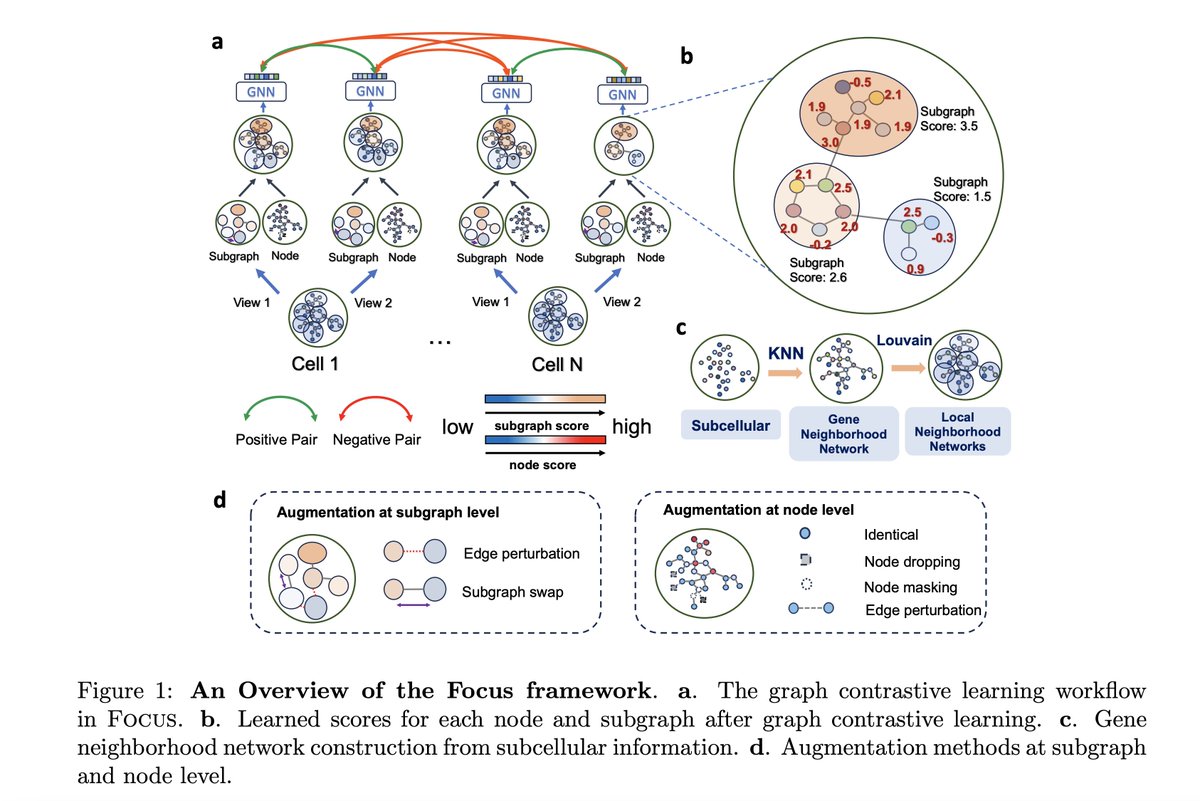
With the imaging-based spatial transcriptomics such as MERFISH, seqFISH, CosMx SMI, Xenium and others, have you ever wondered how we can leverage their subcellular spatial information? Check out our latest preprint on Focus by Qiaolin and Jiayuan @JiayuanDing , two talent students, to find out how we approach this problem: https://t.co/DddCrNZ70m. Focus is a state-of-the-art graph contrastive learning based approach to properly model RNA subcellular spatial distribution that dramatically improves cell type annotation and reveals critical molecular pathways that were not possible before. Specifically, Focus first constructs gene neighborhood networks based on the subcellular colocalization relationship of RNA transcripts. Next the subcellular graph of each cell can be augmented by adding important edges and nodes or removing trivial edges and nodes. Focus then aims to maximize the similarity between positive pairs from two augmented views of the same cell and minimize the similarity between negative pairs from different cells within a common batch. Guided by a limited amount of labeled data, Focus is capable of assigning cell type identities and revealing intricate cell type-specific subcellular spatial gene patterns and providing interpretable subcellular gene analysis, such as defining the gene importance score. Focus is still in its prototype stage but we are excited about this direction and will continue to improve Focus and extend it to many other settings. In the meantime, please let us know if you may have any comments or suggestions! As I just started my lab at Stanford, we are excited about many collaboration opportunities from the Bay area and others as well!
Our latest preprint in single-cell analysis, CellPLM, is now available!
Highlights:
- 🏅️The first of its kind in encoding cell-cell relations.
- 🚀 100x faster inference speed than existing pre-trained models.
- 🏆 SOTA performance in various downstream tasks.
We are excited to announce that our DANCE python package (A Deep Learning Library and Benchmark for Single-Cell Analysis), and survey paper (Deep Learning in Single-Cell Analysis) are both officially released!!!👏👏👏
3/5: In the meanwhile, we conduct a comprehensive survey of “Deep Learning in Single-Cell Analysis”, which covers fundamental concepts of deep learning and reviews seven popular tasks spanning through different stages of the single-cell analysis pipeline.
2/5: Awesome features in the first version of DANCE:
* Unified programming language with Python, PyTorch and programming interface, Sklearn-like API
* One simple command for easy reproduction
* Open source to welcome all contributions, like extra tasks, models and benchmarks
1/5: The first version of DANCE is considered as the benchmark platform to comprehensively evaluate computational models on standard benchmark datasets in single-cell analysis. As many as 32 computational models are evaluated across 21 benchmark datasets under 8 tasks in DANCE.


![WenzhuoTang's tweet photo. Excited to present “scDiff: unifying common single-cell tasks with a diffusion generative model.”
With @WenzhuoTang, @RemyLau3, @bilibiliWehos, Xinnan Dai, @JiayuanDing, Hang Li, @wenqifan03, @Yuyingxie, @tangjiliang
📚https://t.co/6aoKTHKo55
📦https://t.co/oLEelt2B4p
👇 [1/8] https://t.co/rtFM3V0fzz](https://pbs.twimg.com/media/F9SavsfWAAADgwH.png)