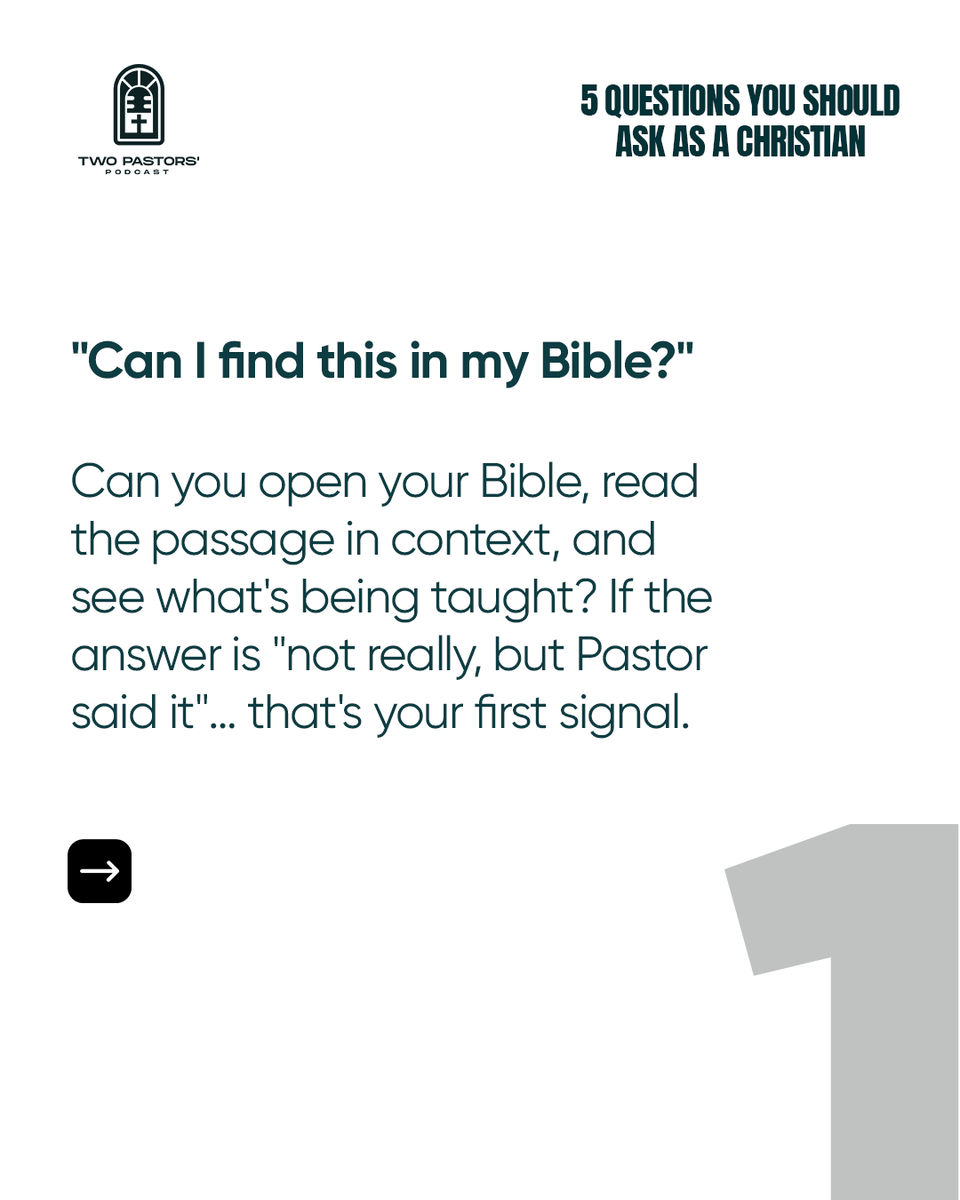
Most churches teach you to trust your pastor. Very few teach you how to lovingly verify him. Both are biblical. Only one gets preached.
Ep. 3 is live. 🎙️ 👇
Someone asked me why as a church we don’t have a theme of the year.
I said we do. And it’s the same theme till Jesus comes “to be conformed to the image of Christ”.
I have no issues with “theme of the year “but this is why our church theme will remain the same…
My mum was just walking down the road when a prophet stopped her and said,
‘Your son will be a pastor.’ 😂
No context. Just like that.
So… what actually makes someone a pastor?
🎧 Episode 1 drops Wednesday.
#TwoPastorsPodcast#FaithTalk
If your assurance that you will make it to heaven and final glory is based on your efforts, you will not make it. You can never make it.
The reason is that you will EITHER soon find that you cannot perform perfectly enough to keep your salvation OR you will drop God's standard for perfection so that you can fulfil it. And This delusion of yours will only be sustained by pride and legalism which themselves are sins.
Your assurance that you will persevere must be based on the fact that Jesus has promised to keep you till the end when He returns and you will enjoy immortality and rest.
Does this mean you can live anyhow and be kept?
The answer is simple and the church has had to remind God's people over and over since St Augustine.
In theology we say God has ordained means. It means that God has a way He does His thing. And the way God will keep you is by washing you and making you conformed more and more to the image of the Son.
You will PERSEVERE WITH SANCTIFICATION and Holiness. You will NOT persevere with sinfulness or lawlessness. If you continue in sin you will go to hell. So, you will grow in righteousness as a pilgrim till the end. God is Holy. No evil doer will inherit heaven.
On the day of His return, like the five wise virgins, God's people will be ready for Him, expecting Him in Holiness. They will not be fornicating or lying or stealing when the Trumpet sounds. The day won't take them like a thief because they're children of light.
You may ask, does this means there is nothing like Apostasy?
My brother, there is. All the Apostles tell us that there are some who have "believed", according to the visible signs of faith like Baptism and joining the church, but will go back to the world. Some of these people had shallow faith like Jesus said (Mark 4). The word barely took root on their stony or weedy hearts. Some were never really saved as John say.
But only God knows who is who. Only God knows those that truly believe in Him and those whose hearts are stony and those who love money and the care of this world but claim to love God. In the end, God will separate the wheat from the tares, false converts from true converts.
So for us, since only God knows, we will warn everyone in this visible church of God of the real danger of apostasy. And we will encourage everyone that if they're God's own, they WILL NOT BE LOST. They don't need to die in the anxiety and fear of lack of assurance of salvation. OR injure their soul with pride and legalism. OR veer off into lawlessness.
Work out your own salvation with fear and trembling. But remember, God is the one working in you to will and to do of His good pleasure. You cannot work it in yourself.
This is what the Lord and Apostles teach us. It is a glorious paradox of God's unfathomable counsel. Glory be to His name.
Grace to all of God's own. Amen.
There is a man in the Bible most people have never heard of. His name is Mattithiah, which in Hebrew means “gift of Yahweh.”
He appears in only one verse, 1 Chronicles 9:31: “Mattithiah, one of the Levites, the firstborn of Shallum the Korahite, was entrusted with making the flat cakes.”
That is his entire biography.
Who was he? Mattithiah was a Levite, part of the tribe God set apart for service in his house. His father, Shallum, helped guard the temple gates, and Mattithiah was given a different but equally important job: baking the flat cakes used in the temple offerings (Leviticus 2:4–5; 7:9).
That might sound small, but it mattered. His work made worship possible. Every offering required care, purity, and faithfulness, and Mattithiah provided that.
This baker in the temple did not have a glamorous job. He was not a prophet or a king or even a priest. He was not someone who spoke to crowds or led armies. He was a man who quietly served.
Yet the Holy Spirit saw fit to record his name in the Bible for all generations.
That tells us something about how God sees service. In the community of faith, there are no trivial people. Paul reminds us in 1 Corinthians 12:14–18 that every member of the body of Christ is vital. Some serve in visible ways, others serve quietly. Both kinds of service matter equally to God.
When you serve in your congregation, whether by cooking meals, sweeping the floors, teaching children, greeting worshipers, or praying, you are doing holy work.
Like Mattithiah, you are a “gift of Yahweh” to the people of God.
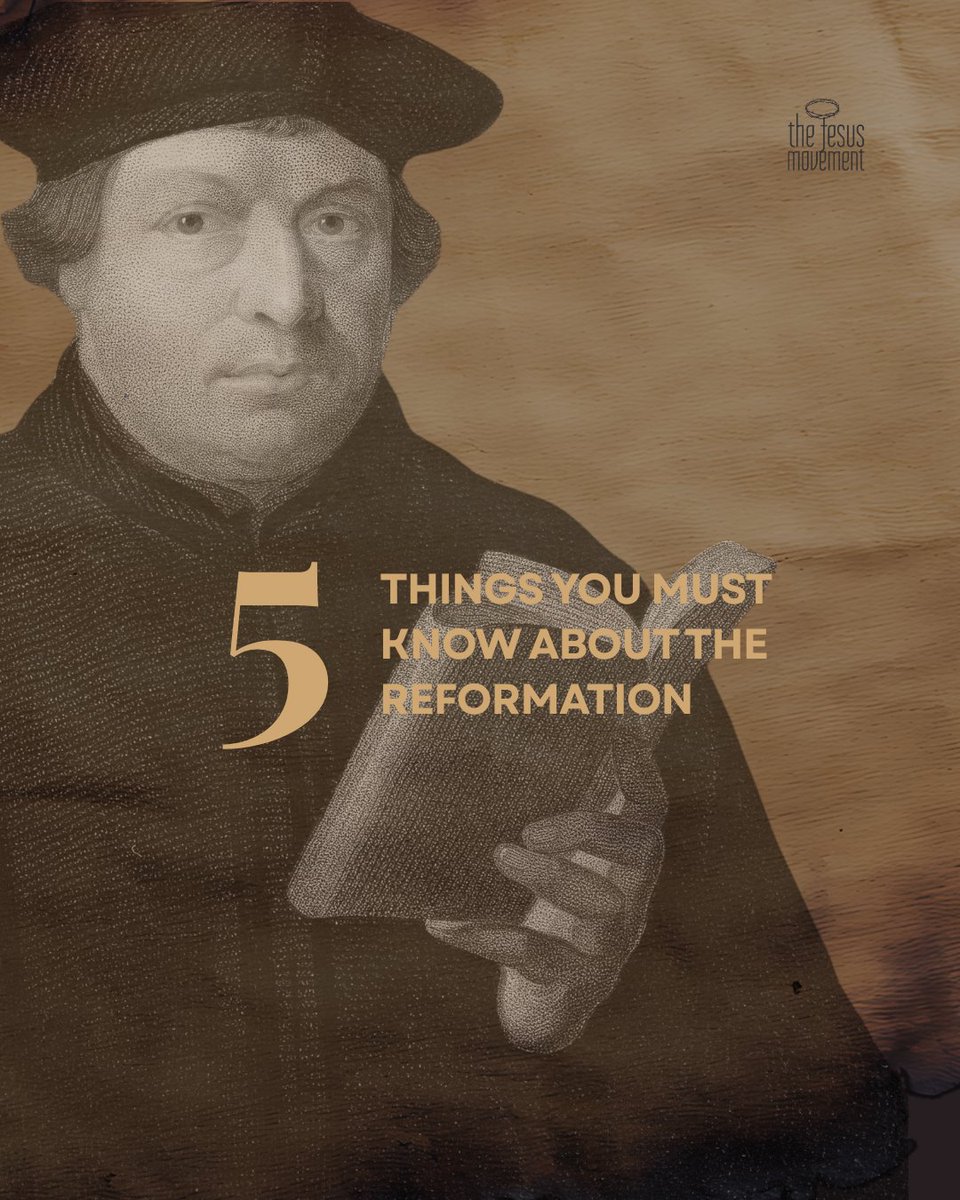
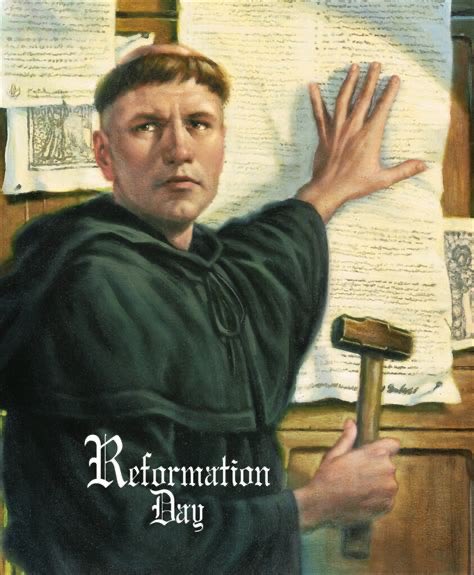
On this day in 1517, Luther famously nailed the 95 theses to the door of the church in Wittenberg, Germany.
In the spirit of reformation month, here are 5 things you should know about the Protestant Reformation.
#OTD October 31, 1517:
Martin Luther posts his Ninety-Five Theses on the door of the Wittenberg Church, challenging the sale of indulgences and calling for debate. The document spreads rapidly, sparking the Protestant Reformation and renewing the church’s commitment to the truth that salvation comes by grace alone through faith alone in Christ alone (Sola Gratia, Sola Fide, Solus Christus), according to Scripture alone (Sola Scriptura), to the glory of God alone (Soli Deo Gloria).
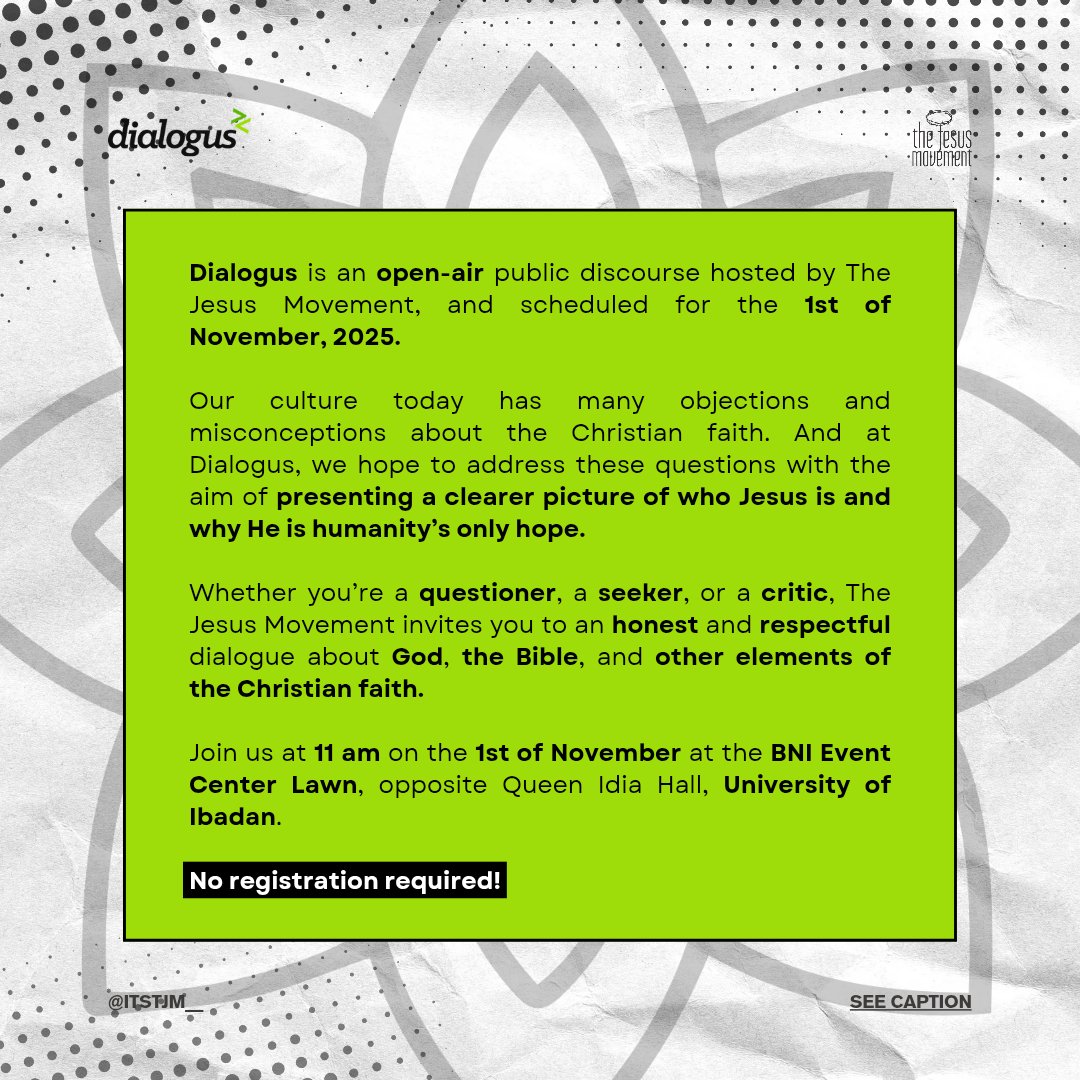
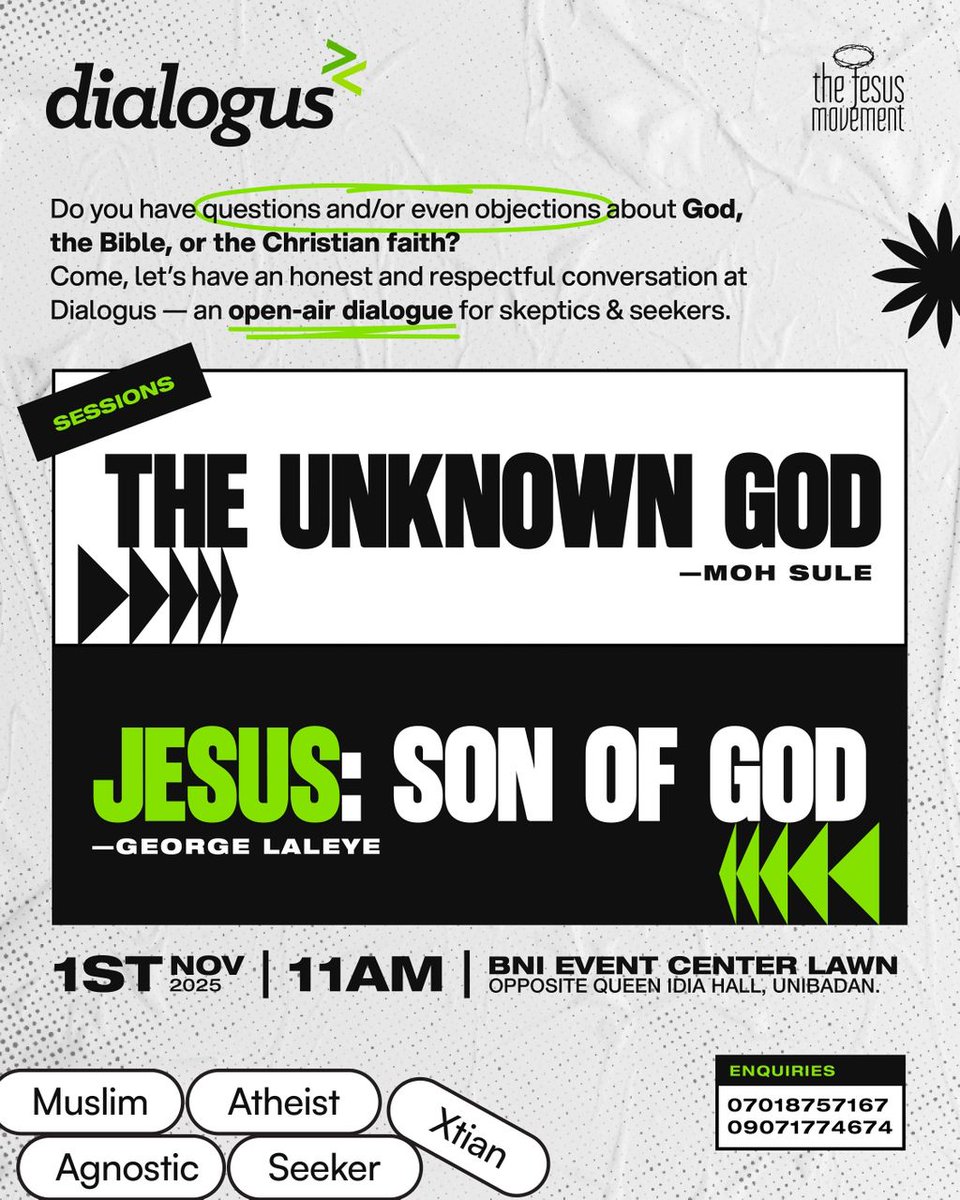
This November, TJM will be hosting an open-air discourse to address the misconceptions about the Christian faith and present a clearer picture of who Jesus is and why he is humanity's only hope. ❤️
Check the flyer for more details.
We can't wait to see you there. ✨
For God to decree or ordain something is not the same thing as Him doing it or directly causing it.
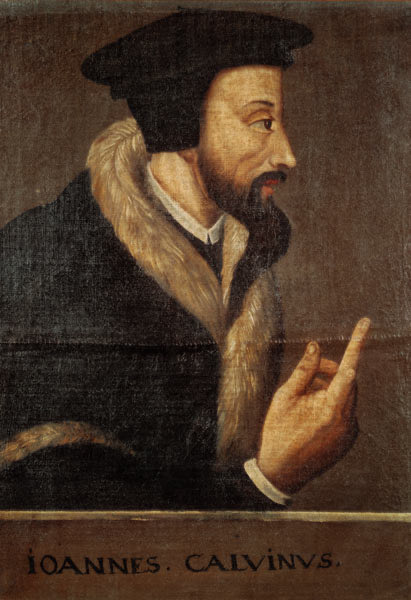
God decreed or ordained absolutely everything that happens (Eph 1:11b), including every evil deed that sinners commit, but without being the author of any sin or in any way complicit with evil (Jas 1:13; 1Jn 1:5).
His nature requires this. Otherwise, He would not be the God of the Bible.
His omniscience means that He knows absolutely every future event, as well as every possible future event.
His omnipotence means that He can prevent anything from happenning that He does not will to happen.
And His immutability means that his decrees were settled in eternity past.
Therefore, whatever He does not prevent, He has willed (i.e., determined) to happen, even when He doesn’t directly do it Himself.
This is not a hard concept. I don’t understand why anti-Calvinists scurrilously twist it.
Are you a skeptic, atheist, or Muslim? Do you have questions about or even objections to the Christian faith? 🤔
Then join our open-air dialogue at Dialogus on Saturday, November 1.
Details of the event are on the flyer. We look forward to having you!
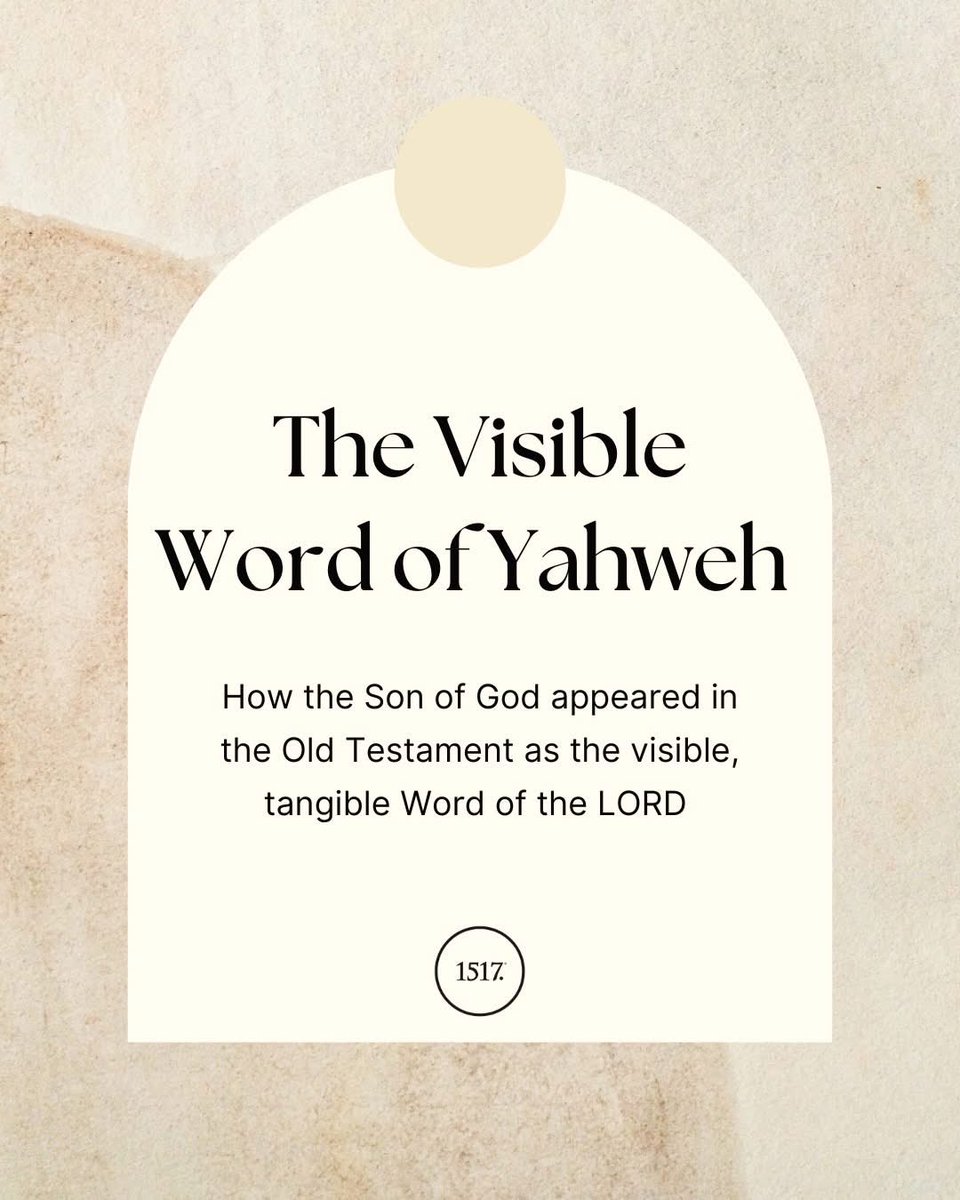
In the call of Samuel, we encounter the Word of Yahweh appearing in human likeness (1 Samuel 3).
Three times Samuel is awakened by someone calling his name. Thinking it is Eli, the boy runs to his master until it dawns on the old priest that God himself must be calling. Eli instructs him to answer, “Speak, Lord, for your servant hears” (v. 9).
Who had been summoning Samuel? The chapter opens, “The Word of the LORD was rare in those days; there was no frequent vision” (v. 1). The Word of God and visions are parallel. Few people had visions in which Yahweh’s Word came to them.
The introduction highlights the rarity and significance of Samuel’s theophany. Each time the boy is called, Yahweh is the one who speaks. In between calls we read, “Now Samuel did not yet know the LORD, and the Word of the LORD had not yet been revealed to him” (v. 7).
Samuel would come to know Yahweh when his Word was manifested to him.
Then we are told, “The LORD came and stood, calling as at other times, ‘Samuel! Samuel!’” (v. 10). The verb “stood” can mean “took his stand” or “presented himself.”
Was it Yahweh or his Word who stood there? In the end, there is no difference. The chapter concludes, “The LORD appeared again at Shiloh, for the LORD revealed himself to Samuel by the Word of the LORD” (v. 21).
The Word was the vehicle of revelation. He came and presented himself. He stood there on two legs. He spoke with a mouth. The Word presented himself to Samuel in some sort of human form in this face-to-face conversation.
By the time we reach the Gospel of John, this Hebrew prelude is fulfilled: “In the beginning was the Word, and the Word was with God, and the Word was God… And the Word became flesh and dwelt among us” (John 1:1, 14).
John chose this language because he knew that the Word temporarily appeared in human form to saints of old. As believers in the Scottish Highlands used to say, Christ enjoyed “trying on the clothes of his incarnation.”
Finally, in the incarnation, the Word of the Father would assume our human nature everlastingly, becoming one with us, even as he has been eternally one with the Father.
_____
-Adapted from my book, The Christ Key: Unlocking the Centrality of Christ in the Old Testament, available at https://t.co/Q16YNBwXk8