First month in @TroupeKZ and I’ve achieved my greatest monthly pnl for 2026.
+220k July
Feeling truly blessed to be surrounded by some of the best onchain traders in the game.
Still so much more to learn and beyond excited for the next few months.
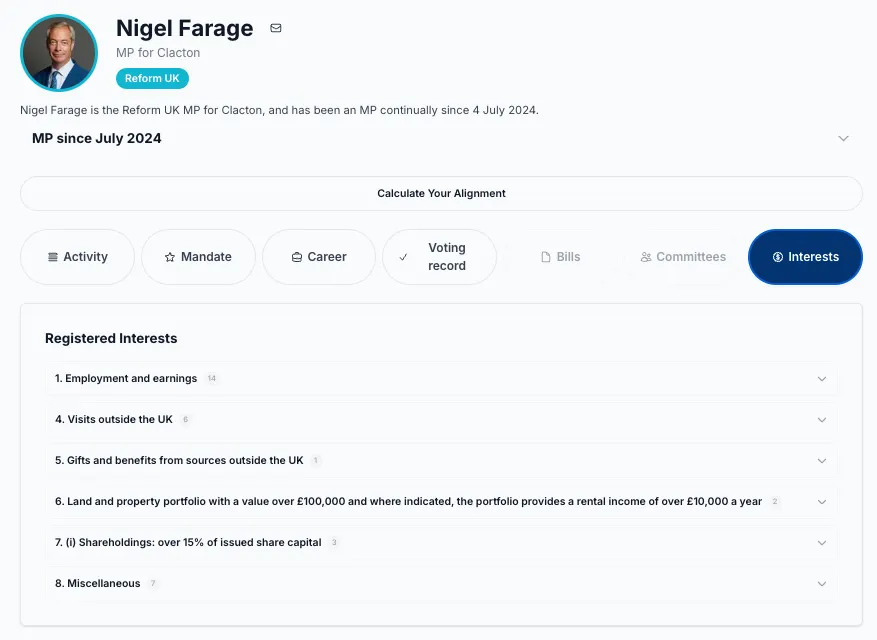
Nigel Farage is under investigation over gifts and donations he did not declare. He says he has done nothing wrong and that the money was "purely personal".
Whether or not that is true, it raises a simple question: how much should the public be able to see about the money flowing around the people who write their laws?
Who funds them, who gives to them, and whether any of it lines up with how they vote should not be something you glimpse only when a scandal forces it into the open.
On House of the People, you can see every MP's declared financial interests and donations alongside their full voting record, and judge for yourself whether the two are connected. Not just when it makes the news.
https://t.co/WVi7iKrI6t
The likely next Prime Minister says Britain needs a "circuit breaker" and wants to put power "in the hands of the people."
We agree completely. The question is what that actually means; handing more power from Westminster to regional mayors is not the same as handing it to the people - it just moves it between politicians.
Putting power in the hands of the people means letting them vote on the decisions themselves.
That is what we built: every bill going through Parliament is available for you to vote on now at https://t.co/WVi7iKrI6t
Andy Burnham, the man most likely to become Britain's next Prime Minister, gave his first major speech this week. His message: "Westminster is broken," and he intends to fix it.
It is worth sitting with that. The person about to inherit the most powerful office in the country is telling you the system itself has failed. On that diagnosis, there is now agreement across the political spectrum.
But a broken system is not fixed by changing who sits at the top of it. It is fixed by changing how decisions are made, and who gets to make them.
Burnham says he wants to put power "in the hands of the people". The most direct way to do that is to give people a say in the laws themselves, not just in who writes them.
That is what we built. Vote on every bill going through Parliament at https://t.co/WVi7iKrI6t
Andy Burnham is on the verge of becoming Prime Minister without a contest. Yesterday his main rival stood aside and backed him. Today, some Labour MPs are pushing a candidate to stand against him for one reason: they believe a Prime Minister should not be crowned without a vote.
They are right to be uneasy about a coronation. But the argument does not go far enough. Even if Labour members do get to vote, that is around 400,000 people choosing who governs 67 million. The rest of the country still has no say at all.
If there is a contest, the next Prime Minister will be chosen by less than one percent of the people they govern. If there is not, he will take office without a single vote being cast, by anyone.
Andy Burnham has won the Makerfield by-election with 54.8% of the vote. He is now an MP, and the door to a Labour leadership contest is open.
The sitting MP resigned his seat specifically so Burnham could stand. An internal party committee cleared him to run. 76,000 people in Wigan voted. The rest of the country watched.
The process that may now produce Britain’s next Prime Minister has involved, at every stage, a smaller and smaller group of people making decisions on behalf of a larger and larger number who had no formal say in any of it.
House of The People was built because the question of who governs this country should never travel this far from the people it is supposed to govern.
https://t.co/WVi7iKrI6t
This week the government announced that children under 16 will be banned from social media platforms including TikTok, Instagram, YouTube, Snapchat, Facebook and X.
The ban will be enforced through mandatory age verification, meaning every adult in the country will be required to prove their identity to a private company in order to access those platforms.
To understand what this means in practice, it helps to look at three pieces of legislation that are now being built simultaneously.
The Online Safety Act, already in force, requires platforms to verify the ages of their users and remove harmful content. It created the legal foundation that makes everything else possible.
The digital ID strategy, announced earlier this year, was the government’s attempt to build a national digital identity infrastructure. A parliamentary committee found it had been announced with no public consultation and described it as doomed to fail before it had even launched. The government partially reversed course and set up a People’s Panel to consider next steps.
The social media ban, announced this week, requires age verification at a scale that experts say is only technically enforceable if every internet user in the country has a verified digital identity. In other words the digital ID infrastructure the government was forced to reconsider three weeks ago has now been revived as a practical necessity through the back door.
Taken together, these three laws represent one of the most significant reconfigurations of how citizens relate to the state and to each other online in the history of the internet in this country. The public was not formally consulted on the Online Safety Act’s age verification measures before they were introduced. The digital ID strategy was announced before consultation concluded. The social media ban was announced before its own public consultation had finished.
Whether these decisions are right or wrong is not a question House of The People takes a position on. What we do is give every citizen a direct vote on the bills underpinning them. Every piece of legislation driving these changes is live on the platform right now.
The Digital Access to Services Bill was announced in the King's Speech. It will introduce digital ID to the UK.
2.98 million people signed a petition opposing the scheme. Public support sits between 27% and 38%.
The government is proceeding anyway.
The public consultation closed in May. A People's Panel of 100 to 120 randomly selected members, costing £630,000, is producing recommendations that conclude this Sunday.
You can see how your MP votes on every bill at https://t.co/WVi7iKrI6t
The former chief executive of the SNP has admitted embezzling over £400,000 of party funds over twelve years. The money was used to buy a £124,000 motorhome, luxury vehicles and personal goods. He is currently in custody awaiting sentencing.
The people who donated to that party, and the voters who trusted it, had no visibility of where their money was going and no mechanism to find out. The finances of every major political party in this country are opaque to the public by design.
The deeper story here is about a political culture in which the people who hold power over public money have never been required to answer to the public it belongs to.
On House of The People you can see every MP's registered financial interests and donations alongside their full voting record, so you can judge for yourself whether the two are connected.
The Prime Minister announced this week that the Cabinet Manual need to be updated. This is a document that sets out the rules governing how the government operates. The announcement came after sustained pressure from a parliamentary committee, not from the public.
The Cabinet Manual governs how ministers behave, how decisions are made and how power is exercised in this country.
Most people have never heard of it. None of them were asked whether it needed changing, what should be in it, or what the rules governing their government should look like.
A document that defines the rules of power in Britain is being rewritten in a room the public has no access to, by a process the public has no part in, following pressure from a committee the public did not elect.
House of The People was built for everyone who just read the above and thought: why do we not get a say in the key decisions that shape our lives?
Today Henry Nowak's case dominated Prime Minister’s Questions. Every party used it to make a political argument. The chamber erupted. Fingers were pointed. Voices were raised.
Nobody in that building asked the public what they think should happen to the policing and justice system that failed Henry.
Nobody consulted the people who will live under whatever policy comes next. The debate about what this case means and what should change is happening entirely among the people whose system produced the outcome in the first place.
House of The People exists because the public deserves to be part of that conversation.
Parliament returns from recess tomorrow. The first major item on the agenda is the second reading of the Health Bill, a piece of legislation that will reshape how your NHS operates for years to come.
It will be debated and voted on by MPs who were elected on a manifesto written before the bill existed, in a chamber where the Prime Minister is fighting for his political survival.
The public will be watching from the outside with no direct input on any of it.
We built House of The People because the technology to give every citizen a direct say in the decisions that shape their life has existed for years, and nobody had built it yet.
On 18 June, a by-election will be held in Makerfield, a constituency in Wigan. The result will determine whether Andy Burnham can enter Parliament and stand in a Labour leadership contest that would determine who leads this country.
The rest of the country will have no vote in it.
It is the first time since 1965 that a by-election has been triggered specifically to provide a seat for a figure not currently in Parliament. The most consequential political decision in Britain right now is being made through a process almost nobody was asked about and almost nobody can participate in.
House of The People was built for everyone who just read that and thought: when did anybody ask us?
The Public Accounts Committee released a report last week that found government departments wrote off around £6.6 billion during the 2024-25 financial year. That figure covers spending that failed to deliver its intended purpose or produced no value for taxpayers whatsoever.
The public can read about it. They can be angry about it. But there is no formal mechanism for them to hold anyone accountable for it, to demand a different outcome, or to have any direct say in how public money gets spent in the first place.
House of The People was built for everyone who just read that and thought: who exactly is accountable to us for losing it?
5,000 council seats across 156 councils being decided today.
Find your ballot, every candidate, and your polling station in 30 seconds. https://t.co/uU1uilxWJ7
Thanks @ReinersProject for a great article that succinctly summarises what https://t.co/QpJCcn3FBH does and what we’re about.
We especially loved the section highlighting the meaning behind the logo!
Trust in politicians is at a record low in Britain.
That is not a coincidence.
It is what happens when the gap between what the public wants and what Parliament does goes unmeasured and unchallenged.
House of the People measures this gap and publishes on every single bill since 2006.
Your voice matters, make it heard at https://t.co/WVi7iKrI6t
MPs are whipped to vote with their party. Lobbyists have direct access to legislation. Donors fund the people making decisions about your life.
None of this is a conspiracy. It is all entirely legal. And none of it involves asking you.
Make your voice heard at: https://t.co/WVi7iKrI6t
Anything you want to know about your MP, you can find on https://t.co/QpJCcn4drf
From how aligned their voting is with yours, to every payment they've received in office.
All in one place: https://t.co/SMkZKXhSZz
Imagine a Prime Minister who could stand up and say: we consulted the public, eight million people voted, this is what we are going to do.
No spin. No guesswork. Just the public will, clearly expressed.
That is the future we are building toward.
https://t.co/QpJCcn3FBH