OnTheBitcoin | Bitcoin is the answer.
Noise or signal? Daily data and news on markets, crypto, AI and tech, with charts I make myself. No calls, no shilling.
Uniswap's fees fell 40% over the last 30 days. Aave's went up.
Aave earned $39.5M in fees over the last 30 days, up 3.6% on the 30 days before. The last week was up 9.4%. Uniswap, for comparison, is down 40.5% over the same 30 days.
Most of it is still on Ethereum: 77.9%. Plasma is a distant second at 7.5%.
What it doesn't show: why. More borrowing demand, higher rates, or a few large positions all look the same in fee data.
I'm watching whether that gap with DEX fees holds.
#Aave #DeFi
A Fed governor just said a half-point hike "should be considered" in December. Not a cut. A hike, twice the usual size.
Christopher Waller said it after October CPI came in at +0.4%, above the 0.3% forecast.
A quarter point is still the main case. A half point was near 15% as of Nov 10, per Reuters. Rates now: 3.75% to 4%.
The timing detail most people miss: the Dec 8-9 meeting comes a day before the next CPI on Dec 10. So they decide without November's inflation number.
What I'm watching: whether other Fed officials repeat Waller's 50 bps line before the meeting.
#Fed #Bitcoin
Solana users paid $7.9M in fees on Nov 11, the lowest daily total since Aug 16, 87 days ago. 3 things worth knowing:
1. Fees for the 7 days to Nov 11 were $60.6M, down 19.2% from the week before.
2. DEX trading volume on Solana fell 24.1% over the same 7 days, to $9.4B.
3. DeFi deposits (TVL) were $5B on Nov 11, down 18.9% from Oct 12.
How to read it: check all three before calling it a slowdown. Fees are what users pay, volume is what they trade, TVL is what they leave parked. This week all three are down.
What the numbers don't say: whether there are fewer users, or the same users doing less.
I'll check the 7-day fee total again on Nov 18.
#Solana #DeFi
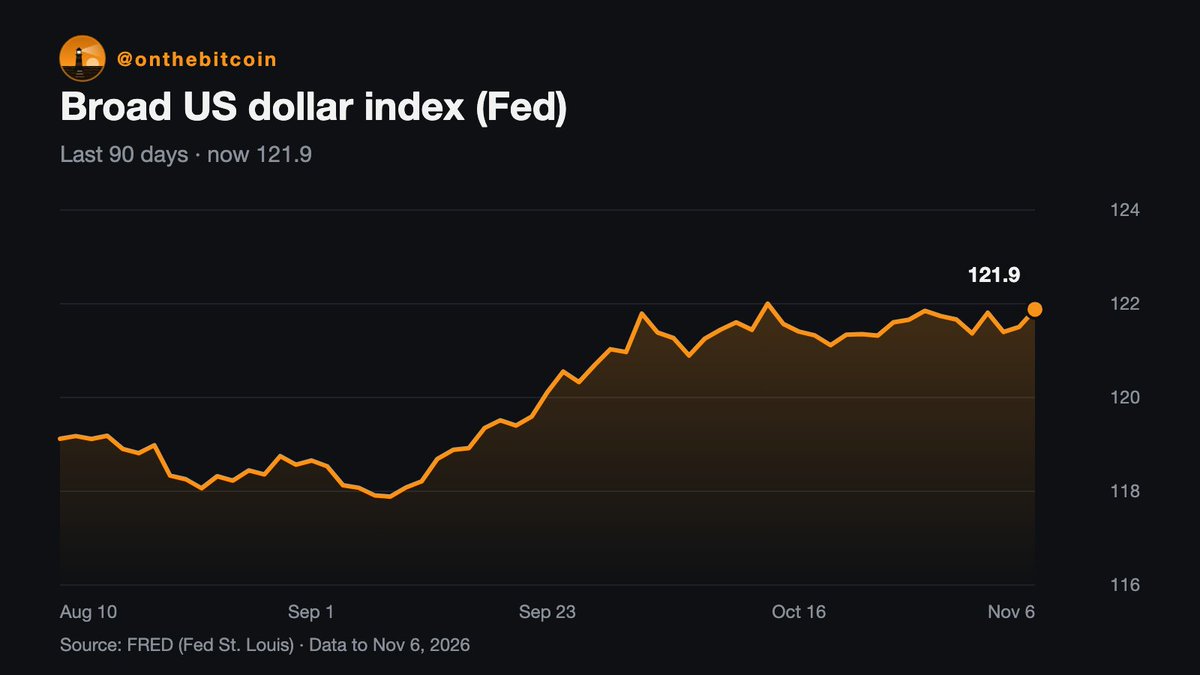
The Fed's broad dollar index was 121.9 on Nov 6, within 0.1% of its 1-year high (122, Oct 14).
It tracks the dollar against America's main trading partners, weighted by trade. The index is up about 3.8% from its low this year (117.4, Jan 29).
This doesn't show why the dollar is strong, and it's Nov 6 data: the Fed publishes this series with a lag, so this week isn't in it yet.
The next release will show whether it clears 122.
#USD #Macro
The Crypto Fear & Greed Index is at 28 today. Seven straight days below 50.
The odd part: it barely moved. -4 points over the last two days. The low this period was 25 on Nov 7.
So the fear isn't spiking. It's just sitting there.
What it doesn't show: what comes next. Back on Sept 22, seven weeks ago, the same index read 78, its high of the past 90 days. Nothing in that number told you 28 was coming.
I'll keep counting the streak. A week under 50 is a mood. A month would be a different story.
#Bitcoin #Crypto
Over the last 30 Nasdaq sessions (Sept 29 to Nov 10), the Nasdaq fell 6.5%. Bitcoin fell 9.8% over the same stretch.
Same direction, different depth: Bitcoin dropped about 1.5 times as much.
This doesn't show one driving the other. Two lines falling together for six weeks is a correlation, not a cause. Both end on Nov 10, so anything after that isn't in these numbers.
I'll check the ratio again at the weekly close.
#Nasdaq #Bitcoin
Bitget Wallet flagged about 37,000 risky signing requests a week in Q3, by its own count. In Q2 it was 5,000.
That's a 7.4x jump. Before you read it as "phishing exploded": the company says it likely reflects both more attacks and better detection, and it can't split the two.
These are flagged signatures, not confirmed losses or unique attacks.
What doesn't change: almost every wallet drain starts with you signing something. A token approval you didn't read is the classic one.
If a site asks you to sign and you don't know why, close it.
#Crypto #Security
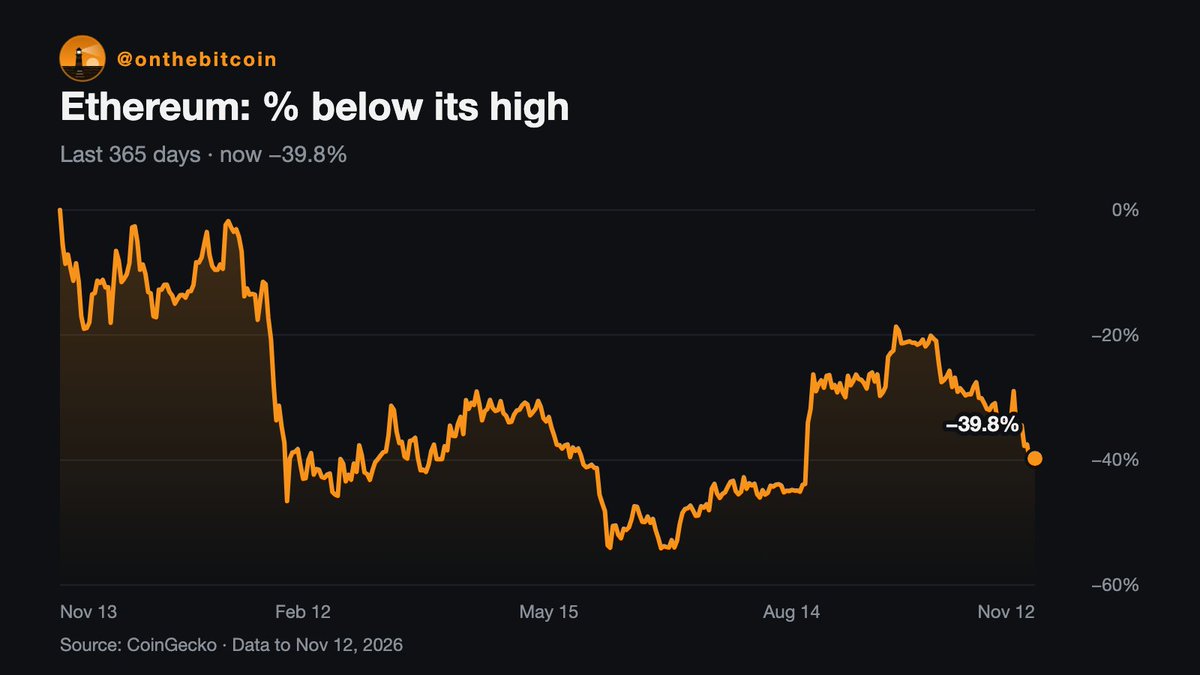
On 123 other days over the past year (out of 366), Ether was at least as far below its 1-year high as it is this morning: 39.8% (Nov 12).
The deepest point: −54.1% on June 26.
That's a gap ETH holders have already sat through in the past year.
It doesn't say where price goes next, or whether the June low gets tested again. It only says −40% is not new territory.
I'll update if the gap from the high passes 45%.
#Ethereum #ETH
Ether fell 15.5% in a week. Bitcoin fell 8.3%. Same market, almost twice the drop.
Solana sat in between at -13.2%. The last 24 hours were flat for all three, under 1%.
The past week hit ETH and SOL harder than Bitcoin. Bitcoin is still 59.9% of the whole market.
Why, the numbers don't say. A bigger drop can mean more selling or just thinner buying. A 7-day window can't tell those apart.
I'll check whether ETH keeps falling faster than BTC next week, or the gap starts to close. Chart shows the last 30 days.
#Bitcoin #Ethereum
Over the last 30 days, more Uniswap fees were paid on Robinhood Chain than on Ethereum.
In the 30 days to Nov 10, Uniswap's fees came 36.5% from Robinhood Chain and 33.8% from Ethereum. Base was third at 15.8%.
The total is shrinking, though: $77.5M in 30 days, down 40.5% on the 30 days before.
What it doesn't show: whether that's real trading on a new chain or a short-lived rush. Robinhood Chain's DEX volume fell 42.6% over the same 30 days.
I'll check whether Ethereum takes the top spot back.
#Uniswap #DeFi
Solana is cooling faster than its biggest memecoin factory.
https://t.co/rtz5uAsypf made $50.2M in fees over the last 30 days, down 14.8%. Solana's total fees fell 36.7% over the same window.
So https://t.co/rtz5uAsypf's slice of Solana fees grew: about 15% in the last 30 days, up from about 11% in the 30 days before.
What it doesn't show: who is paying. A small group of high-volume traders and a crowd of new users look the same in fee totals.
I'm watching whether that share keeps rising.
#Solana #Memecoins
Last week I wrote about the two biggest one-day drops in the Crypto Fear & Greed Index this past year. Here is what came after: six straight days below 50, a 90-day low of 25 on Saturday, Nov 7, and 29 today.
For scale, its 90-day high was 78 on Sep 22.
It measures mood, not money moving, and says nothing about where price goes next. A few points off the low is not the same as a turn.
I'll keep watching whether it stays above 25 or makes a new low.
#Bitcoin #FearAndGreed
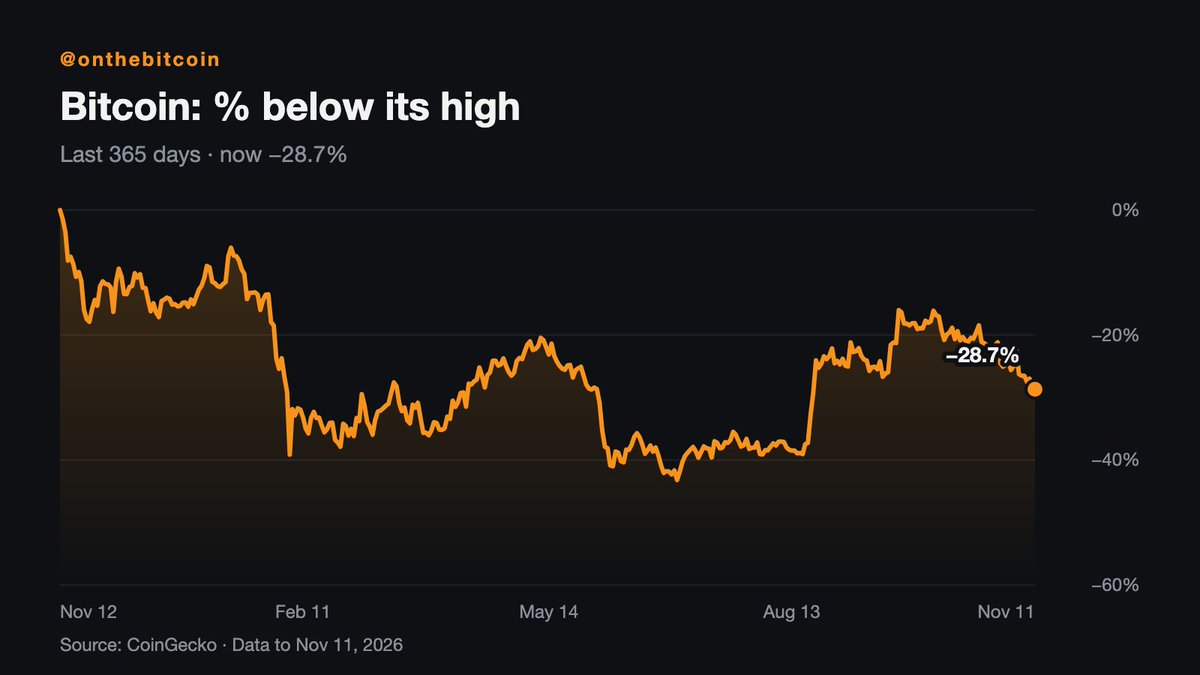
Bitcoin is 28.6% below its high of the past year. This year, that's not unusual.
Over the last 366 days, Bitcoin was at least this far below its high-so-far on 149 other days. The deepest point was July 1: 43.2% down.
If you held through the summer, you've already sat through worse than today.
What it doesn't tell you: whether this ends here or goes back to July's depth. The past year gives context, not a floor.
I'll update if the drawdown crosses 30%.
#Bitcoin #BTC
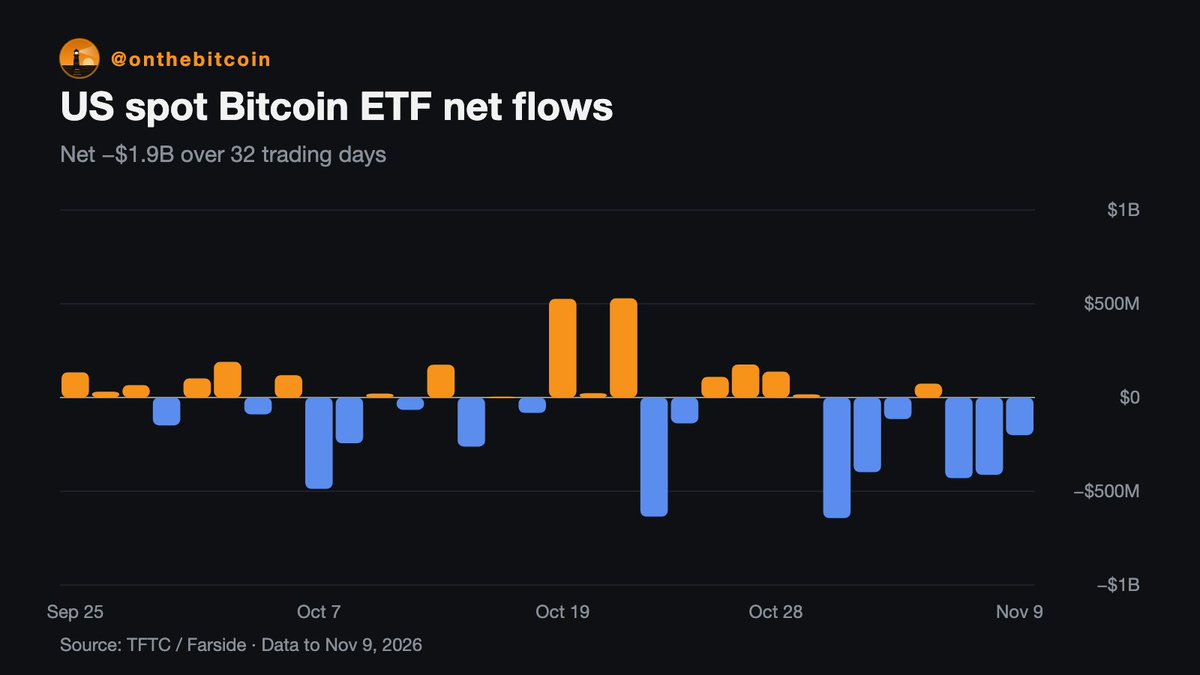
BlackRock's IBIT is almost the whole story of November's ETF outflows.
US spot Bitcoin ETFs lost about $1.48B net over the first six trading days of November (through Nov 9). IBIT alone lost about $1.42B of that, roughly 96%.
On Nov 4, the only green day, the group took in $74.6M while IBIT still lost $201M. The other funds carried it.
What it doesn't show: who is selling. Long-term holders trimming and basis traders unwinding look the same in flow data.
I'll post again when we get three straight days of net inflows.
#Bitcoin #ETF
Bitcoin's next difficulty adjustment, around Nov 14, is tracking about −7% as of Nov 11. That estimate moves with mining speed.
Hashrate (7-day average) was 958 EH/s on Nov 10, down five days in a row and about 11% below its Oct 27 peak of 1,081.
Miners are also earning a bit less from fees: an average 0.020 BTC per block over the last 30 days, down 8.4% on the 30 days before.
What it doesn't show: why hashrate fell. Machines switched off, weather, or plain noise in the estimate. Hashrate is inferred from block times, not measured.
I'll check the real adjustment when it lands.
#Bitcoin #Mining
Poland's lower house voted 240–202 on Friday to let the government freeze crypto under national sanctions.
The bill puts crypto assets, as defined by the EU's MiCA rules, on the list of things authorities can freeze. The interior minister runs the list. A listing takes effect the day after it's published, and stays enforced while any court appeal runs.
It's tied to a sanctions regime Poland built in 2022 against support for Russia's war in Ukraine.
What's unclear: how a freeze works on self-custody wallets. The report doesn't say.
Next: the Senate has 30 days. If it does nothing, the bill passes as is and goes to the president.
#Crypto #Regulation