Gm and Happy Sunday!
0ath Missions is a milestone for the stack: we’re moving from individual liquidity agents to coordination under one owner-defined objective.
Two agents. One Meteora DLMM pool. Separate wallets, Oaths and limits.
A mission defines a fixed bin band and a quote-token depth goal. The goal is soft; spending limits are hard. Each agent operates within its own Oath, position mandate and the mission’s caps.
Repairs use verified, finalized fee receipts earned after arming. Both agents get an unsigned candidate. The lowest actual transaction cost wins, with deterministic tie-breaks—and only the selected agent’s own run can sign.
The execution path matters:
Validate → simulate → recheck fresh state and authority → reserve receipts → sign → persist the original signature → broadcast.
If the outcome is uncertain, capital stays reserved while 0ath reconciles that original transaction. No blind resend. No timer quietly freeing funds that may already have moved.
Implementation and database installation are complete. The build reached 934 passing app tests and 221 isolated PostgreSQL checks; regenerated types and the production build also pass.
Funded Devnet validation is next, before publishing. The demo illustrates the flow; it isn’t a live execution.
From individual autopilot to coordinated liquidity - with every Oath still binding.
Your capital. A promise kept.
Shape it. Stretch it. Give it an Oath.
Our DLMM Pro plan: 0ath Missions coordinating depth, inventory and repairs funded by earned fees, within your limits.
The team designs the curve. The agents get a mandate for managing liquidity as the market evolves.
What is it?
Right now most coins launch on a bonding curve, then ‘graduate’ and get moved to a new pool
With DLMM Pro everything stays in 1 pool and the team designs the curve itself
Shape it, stretch it, send it
So they pick the shape, how wide it goes and how it opens
It's better if we show you.
Meet 0ath Missions - the next layer we're designing for liquidity agents on Meteora.
A shared liquidity objective. Separate wallets. Every agent bound by its own Oath.
An owner defines the approved pool, depth target, fee share and spending cap. A coordinator turns that mandate into bounded proposals, compares eligible plans and holds overlapping repairs before they reserve capital or sign.
This simulation follows a 1,800 USDC depth repair using 30% of the selected agent’s verified fees. Another 4,200 USDC stays protected. The overlapping proposal produces zero sends.
Around that sits the deeper architecture:
• Versioned mandates and explicit arming.
• Inventory accounting that includes positions and order escrow.
• Unsigned simulation and fresh authority checks before signing.
• Receipts linking decisions, costs and outcomes to the original transaction.
• A proposed SDK for token teams to integrate mission controls.
Two agents. One owner. One approved pool to start.
This is a concept demonstration of the proposed upgrade.
Programmable liquidity. Coordinated by agents. Bound by your Oath.
0ath’s latest build is complete. We’ve taken fee automation deeper into Meteora’s stack.
Verified DLMM fee receipts can now fund an owner-linked Dynamic Fee Sharing vault through an explicitly armed mandate. You choose the source pools, funding share and caps. Saving the rules and granting execution authority are separate steps.
Most of this build went into authority, accounting and recovery:
• One receipt ledger across compounding, Fee Waterfall, Inventory and vault funding.
• Exact transaction validation, unsigned simulation and receipt reservation before signing.
• Retained fees protected from other wallet-funded actions.
• Fresh, mint-matched Mainnet pricing for USD checks. Unknown pricing holds funding.
• Recovery that follows the original stored signature after a restart, without automatically creating another send.
Inventory also verifies actual pool accounts, token mints and native limit-order eligibility before arming.
842 tests passed.
397 isolated PostgreSQL checks passed.
Typecheck and production build passed.
A stronger foundation for agents to route earned fees under precise authority, protect reserved capital and recover when execution gets uncertain.
Validated draft complete. Database migrations and publishing are next.
Your capital. A promise kept.
Next on 0ath: fees become strategy.
We’re working on an Inventory Engine designed to turn a capped share of verified claimed fees into passive orders inside eligible Meteora DLMM pools.
You define the pairs, price bands, exposure limits and cancellation rules. The agent works through that mandate.
The technical work goes well beyond placing an order: reserving capital before execution, counting escrowed funds toward exposure, tracking partial fills, reconciling uncertain transactions, and confirming what’s actually available before redeploying it.
Every proposed action still has to pass the Oath, depth, execution-cost and simulation checks.
Alongside the engine, we’re designing:
• Position Mandates - explicit boundaries between position ownership, management permissions and fee destinations.
• Fee-sharing vaults - fixed recipient splits funded from verified claim proceeds.
• A Pro capability adapter - checking program versions, pool features and supported instructions before enabling an execution path.
We’re preparing for DLMM Pro, with Pro execution dependent on verified SDK and permission compatibility.
The goal is an agent that can coordinate liquidity, inventory and earned fees under one reviewable mandate, with a clear account of every decision and movement of capital.
Another substantial layer of the 0ath stack taking shape.
Your capital. A promise kept.
Solana Summit Singapore was just the beginning.
A big thank you to everyone who stopped by our booth, took home some prizes, and showed love for DLMM Pro.
Next stop: London.
The Meteora Supercycle continues.
633/633 tests passed on the core upgrade. This was a huge build for 0ath.
We’ve been working on the layer between an agent deciding to act and your capital actually moving.
Here’s what’s new:
• Cost + Depth hooks - check expected benefit against execution costs and usable bin liquidity. Unsuitable risk-increasing actions can be held before signing.
• Native rebalancing - an atomic path for eligible Meteora DLMM positions, preserving position identity, range width and your saved strategy.
• Fee Waterfall - route verified claimed fees into compounding, reserves and an owner treasury under your configured policy. Exact amounts, with compounding still counted toward portfolio caps.
• Fair, bounded dispatch - durable claims, controlled concurrency and current-network checks, prioritising agents with older actual attempts.
• Clearer execution evidence - explain decisions, preserve pending states, and reconcile uncertain fee allocations against the original transaction signature.
The difficult work was in the edges: stale quotes, thin liquidity, competing workers, expiring claims and uncertain confirmations. Handling those carefully is what makes an execution stack stronger.
Typecheck and production build passed too. Recurring production scheduling remains pending activation.
Your Oath defines the authority. The stack now has deeper checks and clearer evidence around it.
Thank you to everyone building with us and believing in 0ath. We’re here for the long haul.
Your capital. A promise kept.
Before capital moves, your agent should be able to explain why.
We’re working through 0ath’s next upgrades, adding more precision to how liquidity agents operate:
→ Execution Cost Hooks: estimate the complete transaction plan, separate network fees from account rent, and enforce your spending limits before signing.
→ Depth Hooks: inspect token liquidity across the proposed DLMM bins and hold new capital when depth is insufficient or observations are stale.
→ Clear decisions: show exactly which check passed, which failed, and why the agent is waiting.
Next in the pipeline: native Meteora rebalancing, benchmarked against our current execution flow, and taking Fee Waterfall from preview to explicitly authorized routing of verified fees.
Each step needs simulation, fresh policy checks and traceable transaction outcomes. Scheduled runs and funded Devnet validation are part of the release work.
We’re pioneering new possibilities for owner-controlled liquidity agents on @MeteoraAG’s DLMM - and getting 0ath ready for DLMM Pro.
Your capital. Your rules. Every action accountable.
0ath Hooks v1, ready in preview.
• Circuit Breaker: pause new risk on sampled bin moves or stale reads.
• Outcome Receipts: trace decisions and transaction deltas.
• Fee Waterfall: preview wallet-capped splits of verified fees.
Your Oath sets the rules. Your exits stay open.
Sorry for the long delay on this update. It was a big build, and a lot of the hardest work happened underneath the interface.
The 0ath Guard source build is now complete. This takes us further toward liquidity agents whose authority is defined, enforced and traceable at every step.
Here’s what we’ve built.
→ Bounded agent authority
Owner-controlled lanes define which pools and token mints an agent can use, with raw-token limits per action and per window, plus an expiry. Position epochs and lane nonces reject stale or replayed agent requests. The Guard contract checks these boundaries when the agent acts.
→ A stricter execution path
Each action is built from an exact transaction template, simulated, then checked against fresh chain state before the agent’s signing key is loaded. The signed transaction’s signature is saved under the execution lock before broadcast. If confirmation is uncertain, the worker reconciles that same signature instead of blindly creating another transaction.
→ Fees that can go back to work
Guarded compounding uses fee credit measured from claims. That credit is tracked separately from position principal and the funds reserved for a rebalance, with the agent’s permissions and spending caps still applied.
→ Rebalances with the full cost checked
Before closing a position for a rebalance, the worker checks the expected close-and-reopen costs, required bin-array rent and the 0.05 SOL fuel reserve. It checks again using the freshest state before signing. When it proceeds, the reopen keeps the position’s width. The final regression tests catch a move from one required bin array to two at that last check.
→ Owner controls and recovery
The owner can create and fund guarded positions, revoke agent authority, and sign liquidity removal and a vault sweep. Recovery doesn’t depend on the agent running, unused daily limits or an unchanged Oath. We also fixed one-sided deposits when the empty token account needs to be created, and made lane links wait for the actual confirmed transaction slot.
This is why the build took time. We had to work through account permissions, rent, stale reads, signature persistence, concurrent agents and recovery paths together. The latest verification passed 422 app tests and 51 offline deployment checks, plus type checking and the production build.
For clarity: this is a completed source build. Guard is still disabled pending the database migration and a verified Devnet deployment. Independent security review remains ahead. The video demonstrates simulated workflows, not live execution.
For 0ath’s trajectory, this gives us a stronger foundation for connecting our existing monitoring, performance history and shared budgets with future execution upgrades. Inventory and Depth remain review-only today.
We now feel comfortable entering the Meteora hackathon with a stack we can explain and demonstrate in technical detail. There is still work ahead, but the foundation is much deeper.
Thank you to everyone who’s stayed patient and believed in what we’re building. We’re here for the long haul. More updates are coming.
Your capital. A promise kept.
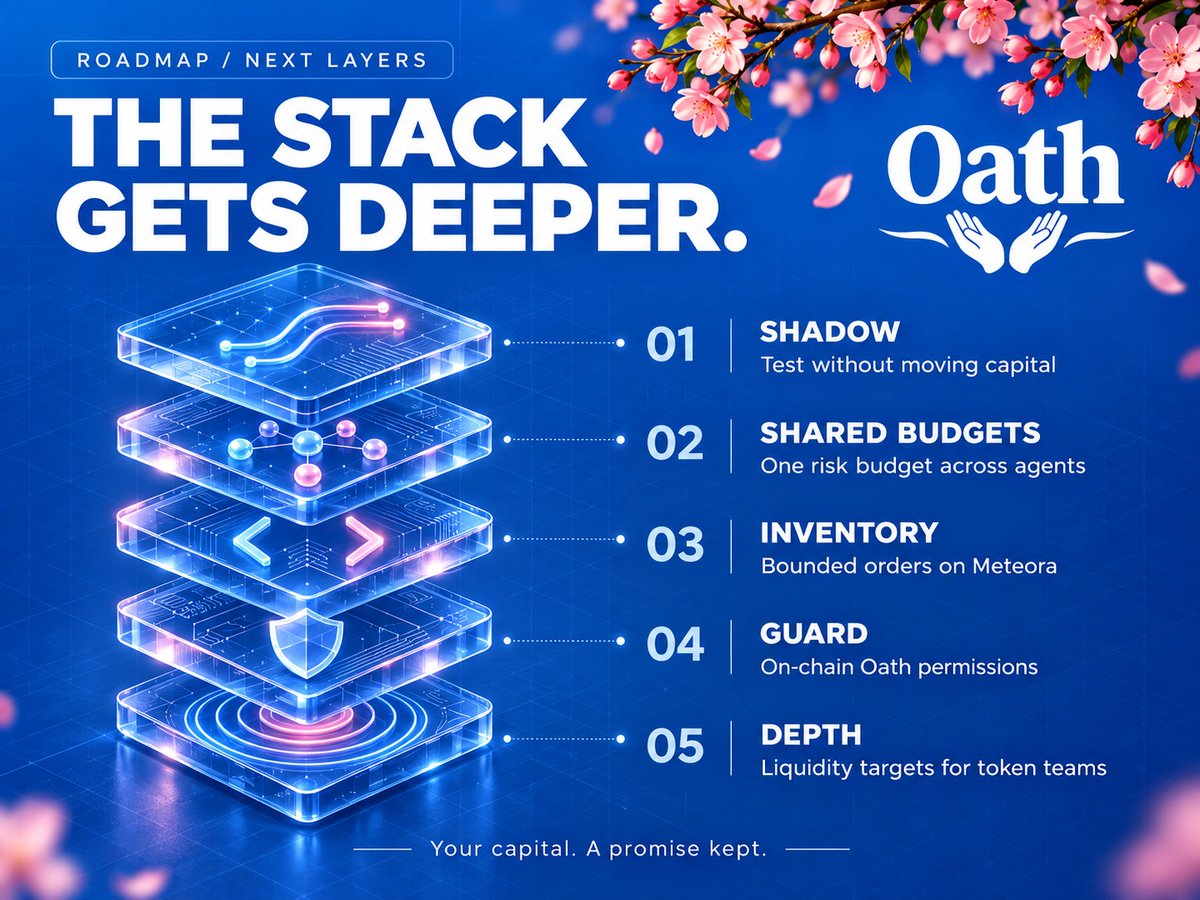
0ath’s stack is getting deeper. ⚙️
The next layers on our roadmap:
👥 Shadow: test and benchmark strategies without moving capital.
🌐 Shared budgets: coordinate portfolio risk across every agent.
🎯 Inventory: bounded native orders on compatible Meteora pools.
🛡️ Guard: enforce critical Oath permissions on-chain.
🌊 Depth: treasury-backed liquidity targets for token teams.
Measurable performance. Coordinated capital. Revocable authority.
We’re building towards agents you can understand, constrain and hold accountable.
A deeper stack, with your Oath governing every layer.
Your capital. A promise kept.
0ath is getting a serious execution upgrade. ⚙️
Your Meteora DLMM range, inventory and earned fees, coordinated through one Oath-governed plan.
Fresh pool reads. Explicit capital budgets. Instruction-level validation. Simulation before signing, with a fresh policy check at the execution boundary.
Rebalances preserve your exact range width. Compounding puts finalized, verified fee claims back to work. Every step leaves a receipt. Uncertain transactions enter reconciliation instead of triggering blind retries.
The latest build brings the planner and execution history into the Agent page. We’re working through the final checks.
More capable agents. Every action accountable to your Oath.
Your capital. A promise kept.