PET-CT bright spot? SUVmax is not the verdict. If the doctor does not call it recurrence or metastasis right away, location, CT shape, old scans, treatment timing and possible pathology still matter. One bright spot is a clue, not the case closed.
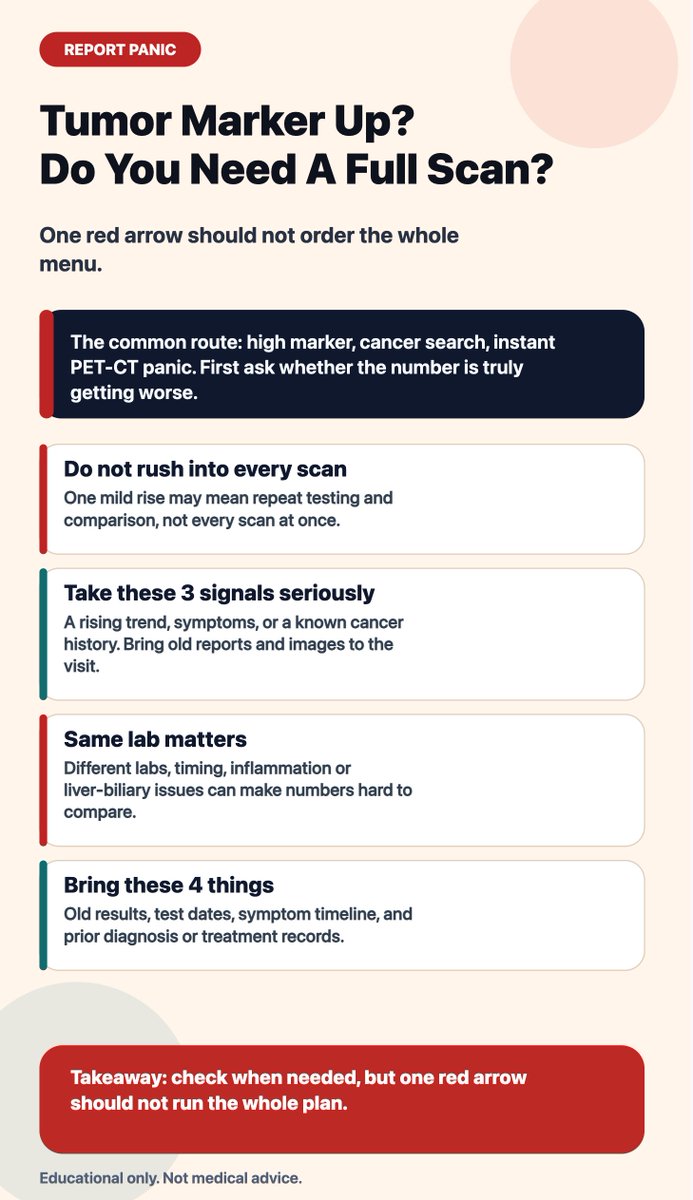
Tumor marker slightly high? Do not let one red arrow push you into every scan at once. Ask first: why was it tested, is the repeat from the same lab, is it rising over time, and do symptoms or imaging match? Escalation depends on context.
Data 05 | A 6 mm lung nodule is not a verdict. Next steps depend on type (solid, ground-glass, part-solid), growth on old scans, risk history, and the CT follow-up plan. Ask what changed, not just whether it is “benign or malignant.”
Data 04 | BI-RADS 3 usually means “probably benign,” not “cancer confirmed” and not “ignore it.” Ask what was seen, whether old images were compared, when to repeat imaging, and whether symptoms or high-risk history change the plan.
Data 03 | A uterine polyp is often benign, but the next step depends on bleeding, menopause status, size/number, fertility goals, and risk factors such as tamoxifen or hormone therapy. Ask whether monitoring, hysteroscopy, or pathology confirmation is needed.
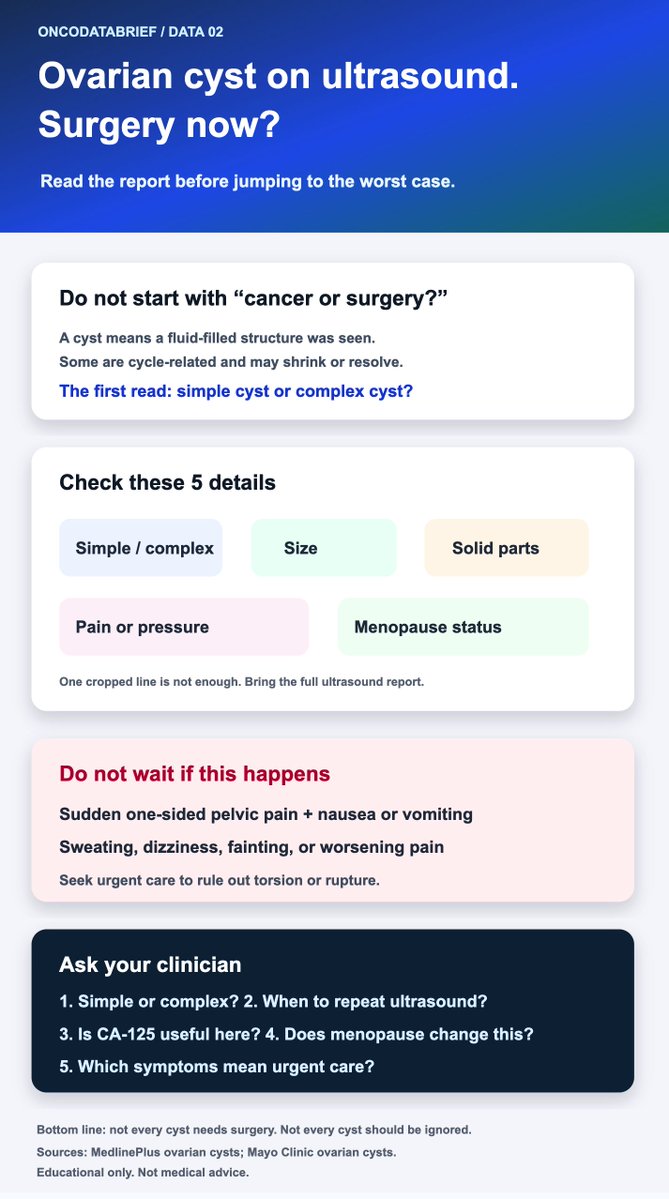
Data 02 | An ovarian cyst on ultrasound does not automatically mean surgery. First read: simple or complex, size, solid parts, symptoms, and menopause status. Sudden severe pelvic pain with nausea/vomiting needs urgent care. Ask for the follow-up plan.
Data 01 | A colposcopy order does not mean cervical cancer. It means an abnormal HPV/Pap result needs a closer look. Ask: why now, where was biopsy taken, what did pathology show, and is the next step follow-up or treatment? Education only.
A strong OS HR is not the whole survival story. Check when the Kaplan-Meier curves separate, how large the absolute gap is, how many patients remain at risk, how much censoring exists and whether follow-up is mature enough for decision-making.
A forest plot is not a winner picker. A lower subgroup HR does not prove larger benefit. Read the overall result, CI width, direction, interaction test and prespecified plan. Significant vs not significant is not automatically a significant difference.
In perioperative trials, EFS improvement is not the same as mature OS benefit. EFS can include progression, recurrence, inability to complete planned surgery or death. It matters, but ask: event definition, absolute gap, OS maturity, safety and surgery completion.
KEYNOTE-942: V940/mRNA-4157 + pembrolizumab improved RFS in resected high-risk melanoma. Risk of recurrence or death was 49% lower; 2.5-year RFS was 74.8% vs 55.6%. Do not read RFS as mature OS. Read absolute gap, DMFS, OS maturity, safety and access.
Non-inferior does not mean better. In DYNAMIC, ctDNA-guided care reduced adjuvant chemo use from 28% to 15%. At 5 years: RFS 88% vs 87%, OS 93.8% vs 93.3%. The read is not “stronger,” but “less treatment without clear loss.” See chart.
HR 0.70 does not mean “70% benefited.” It compares event risk over follow-up. Before trusting a cancer-trial headline, check the 95% CI, whether it crosses 1, how the curves separate, and the absolute difference. Details in the chart.
“60% responded” sounds powerful. But tumor shrinkage is not the same as living longer.
Before trusting a cancer headline, ask: Which patients? Which endpoint? How long did response last? Compared with what? What was the toxicity cost?
Details in the chart.
Colorectal screening is not just a calendar chore. SEER reports 5-year relative survival of 91.3% when localized, 75.2% regional, and 16.9% distant. Stage is the data behind the reminder: know your screening age, and do not postpone warning signs.
The lung cancer average hides the real story. SEER reports 5-year relative survival of 65.5% when localized, 38.2% regional, and 10.5% distant. The uncomfortable part: about 51% are found after distant spread. Ask about screening if you are high risk.
Same cancer, very different data. SEER reports 5-year relative survival for female breast cancer: localized 100.0%, regional 87.5%, distant 33.8%. The point is not panic. It is screening, quick workup, and taking symptoms seriously. Details in the chart.
40% is not blame. ACS linked about 4 in 10 U.S. adult cancer cases and about half of cancer deaths to modifiable risk factors. Read it as a life checklist: tobacco, weight, alcohol, movement, diet, UV exposure, and infections. Details in the chart.