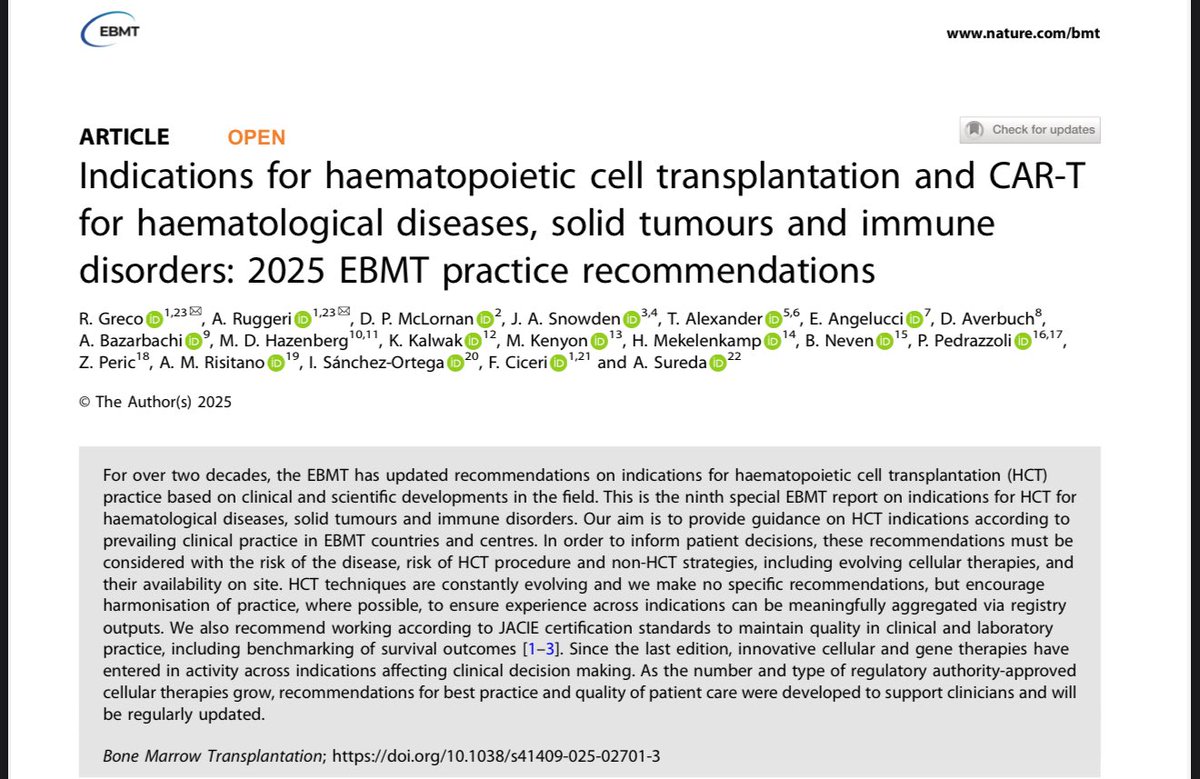
📌 EBMT 2025 Indications for HCT & CAR-T (Practice Recommendations)
🔹 General Principles
•EBMT updates every 4–5 yrs; this is the 9th special report.
•Decisions must balance disease risk, HCT risk, NRM, non-HCT options, and patient QoL.
•Registry harmonization & JACIE standards emphasized.
•Rise in CAR-T & gene therapy reshaping transplant indications.
⸻
🧬 Acute Myeloid Leukemia (AML)
•Allo-HCT in CR1 → indicated for adverse risk & most intermediate risk (per ELN/NCCN).
•Not indicated in favorable risk unless MRD+.
•Mutations mandating HCT: ASXL1, BCOR, EZH2, RUNX1, SRSF2, TP53, etc.
•RIC vs MAC: RIC ↓NRM, MAC ↓relapse (best in MRD+).
⸻
🧪 Acute Lymphoblastic Leukemia (ALL)
•Ph+ ALL: HCT standard in CR1 (imatinib + chemo), but role evolving with 3rd gen TKIs + mAbs.
•Ph− ALL: HCT indicated if MRD >0.01% after 3 blocks or high-risk cytogenetics (e.g., KMT2A, low hypodiploidy).
•CAR-T: ZUMA-3, FELIX → >70% CR in R/R B-ALL; consolidation allo-HCT may be needed post CAR-T relapse.
⸻
🧬 Chronic Myeloid Leukemia (CML)
•TKIs remain SOC; HCT only if failing ≥3rd gen TKI, T315I mutation, or intolerance.
•Indicated in advanced phase or progression.
⸻
🧩 Myeloproliferative Neoplasms (MF focus)
•HCT = only curative option.
•Indicated if Int-2/high DIPSS or high MIPSS70/MYSEC-PM.
•Splenomegaly >5 cm → spleen-directed therapy (JAKi) pre-HCT.
⸻
🧩 MDS & CMML
•MDS: HCT for IPSS-R high/very high or IPSS-M moderate-high/high/very high.
•Lower risk → delayed HCT unless progression or high-risk mutations.
•CMML: HCT in CPSS-Mol high, or Int-2 + extra risk factors (splenomegaly, hyperleukocytosis).
⸻
🧬 CLL
•Novel agents (BTKi + BCL2i) changed landscape.
•HCT only for double-refractory patients (failed BTKi + venetoclax).
•Allo-HCT considered for Richter’s transformation (clonally related).
⸻
🩸 Lymphomas
•LBCL: CAR-T (axi-cel/liso-cel) is 2nd line SOC for primary refractory/early relapse. Auto-HCT still option for late relapse.
•FL: Auto-HCT in POD24 or transformed FL; CAR-T (axi-cel, tisa-cel) approved from 3rd/4th line.
•MCL: Bruton’s TKIs first line; CAR-T after ≥2 lines (esp. BTKi failure).
•PTCL/CTCL: Allo-HCT curative in R/R; auto-HCT for CR1 in selected subtypes.
•HL: Auto-HCT SOC in R/R; allo-HCT after failed BV & CPI; CAR-T investigational.
⸻
🧩 Multiple Myeloma (MM)
•Auto-HCT still SOC frontline in fit patients.
•Allo-HCT reserved for high-risk in trials.
•CAR-T (ide-cel, cilta-cel) → outstanding efficacy in R/R MM (PFS ~55% @27mo).
⸻
🧬 Non-malignant & Solid Tumors
•SAA: MSD-allo-HCT is SOC ≤40 yo; MUD considered in young (<18).
•Hemoglobinopathies:
•Thalassemia: HCT if no severe organ damage.
•SCD: HCT if severe phenotype & no severe organ damage.
•Gene therapy emerging as alternative.
•Solid tumors: HCT rarely indicated; CAR-T under evaluation (gliomas, sarcomas).
⸻
🎯 Exam Pearls for Fellows
•AML: Allo-HCT in CR1 adverse/intermediate (MRD+).
•ALL: MRD >0.01% = HCT indication.
•LBCL: CAR-T now 2nd line SOC (axi-cel/liso-cel).
•CLL: Only “double-refractory” = HCT.
•MDS/CMML: Use IPSS-M / CPSS-Mol for decision.
•SAA: Age >40 → outcomes decline sharply.
⸻
🔗 Full reference: Greco R, Ruggeri A, et al. Indications for haematopoietic cell transplantation and CAR-T for haematological diseases, solid tumours and immune disorders: 2025 EBMT practice recommendations. Bone Marrow Transplant. 2025. DOI: 10.1038/s41409-025-02701-3
⸻
Credits for sharing to Dr. Ahmed Alahmadi
⸻
#HCT #CART #EBMT2025 #HemOnc #Transplant
Review Series on pediatric acute leukemias and myelodysplastic syndromes: a focus on the six key acute toxicities associated with acute lymphoblastic leukemia treatment.
https://t.co/YXArcDUZ90
Read here a new review series of Haematologica on pediatric acute leukemias and myelodysplastic syndromes focusing on the challenges in a field in which much progress has been made during the last decades.
https://t.co/Vn9ltWdda7
New publication📝Data published in @BrJHaem show significantly fewer adult patients with ALL treated with a pediatric-inspired chemotherapy regimen had CNS relapse than those treated with an adult regimen (p = 0.037).
Learn more: https://t.co/SrW8HZAA0B
#ALLsm#leusm#MedEd
Shortage of skilled cytogenetic technologists? Read here about a proposed new workflow integrating multiple FISH panels, genomic microarray, NGS panel-based gene mutation profiling and RNA fusion testing.
https://t.co/zzJkPMmj36
A new retrospective study helps to uncover the impact of obesity on pegaspargase pharmacokinetics, the probability of asparaginase-related toxicities, and treatment efficacy in children with acute lymphoblastic leukemia.
https://t.co/xyoBrrsrPE
🌟 Introducing Prof. François Doz, a keynote speaker at the #SIOPcongress 2025!
His session will dive into two exciting new areas, highlighting crucial breakthroughs for children with retinoblastoma.
📌 Be part of these transformative discussions: https://t.co/pSCIvwSTsh
🔔 Testicular cancer is the most common solid tumor in people with testicles aged 15–44.
A @TheLancet seminar reviews management of seminoma and non-seminoma, follow-up, relapse strategies, and future directions.
DOI 👉🏻 https://t.co/iJjSUsOQXw
#CánCare#oncology #testicularcancer #germcelltumors
🔥 Steroids & PET-CT in Lymphoma 🧪
• Prednisone 💊 – short “pre-phase” use before baseline PET/CT → no significant reduction in SUVmax or scan accuracy 📊 (Blood 2024, NEJM 2017).
• Dexamethasone 💉 – potent, long half-life; small studies show minor ↓SUV uptake, but in lymphoma baseline PET still reliable 🧬.
• Methylprednisolone 💊 – effect similar to prednisone; guideline prep suggests hold ~24h pre-scan ⏱ if clinically safe.
• Hydrocortisone 🩹 – weak glucocorticoid, rarely alters FDG uptake; stopping not essential unless high dose.
⚠️ Longer courses (≥1 week) may blunt metabolic activity → risk of underestimating disease burden.
🚑 Emergencies (SVC syndrome, airway compromise, CNS mass effect): give steroids without delay, proceed PET, and document exposure.
⸻
💡 MCQ:
Q: Which steroid must always be stopped before baseline PET in lymphoma?
A) Prednisone
B) Dexamethasone
C) Methylprednisolone
D) None
✅ Answer: D (None) – short exposure does not significantly affect accuracy.
💡 OSCE:
Scenario: A patient with mediastinal mass on dexamethasone 16 mg/day for airway compromise needs baseline PET.
👉 Proceed with PET, document steroid exposure, and interpret with caution. Stopping steroids is unsafe here.
⸻
📌 Pearls:
•📊 SUVmax largely preserved with short steroid exposure.
•⏱ Best practice = stop ~24h before PET if safe.
•🧪 Interpretation must always consider steroid timing/dose.
#PETCT #Lymphoma #Hematology #ExamPearls #OSCE #Guidelines
Les compartimos esta fundamental jornada de @Nuestros_Hijos, sobre el Plan Nacional de Cáncer Infantil de Chile.
La inscripción es con descuento para amigos de GALOP: https://t.co/8rQyRfWM93