[repost by @wwf]
Take two breaths… did you do it? 👀
Now thank the ocean, because it produces half the oxygen you breathe – all day, every day!
🌏 It also absorbs heat and CO2 from the atmosphere. Really, it’s working round the clock to keep our climate in balance.
But our ocean is in trouble. Since the 1970s, populations of oceanic sharks and rays have plummeted by over 70%.
It’s vital we reduce the pressure from overfishing and climate change, protect habitats and reduce plastic pollution 💙Share this post to give our ocean a voice!
Just a small short on the timeline to build, and capabilities of, the Ocean Mapping vessel I am working on. Current activities are trying to get it "classed" by DNV to ensure quality and safety once built. Paperwork, but very important paperwork.
“Predicting an algae bloom is really the holy grail, right?”
Dr. Jordon Beckler, associate research professor at FAU Harbor Branch, and his research team brought along WPLG Local 10 as they deployed their new water-quality monitoring tool CAROSEL in Lake Okeechobee. #toxicalgae #lakeo #southflorida
https://t.co/D789eWxVMd
Nature figured out distributed systems millions of years before we did.
Meet the giant honeybee (Apis dorsata). No hive box, no protection—just thousands of bees exposed on a cliff face or tree branch. Their defense? A biological Mexican wave that makes predators freeze in confusion.
This is shimmering. And the science behind it is wild.
The Visual
Picture a dark sheet of bees covering an open comb. Suddenly, a ripple of light flashes across the surface—hundreds of bees flipping their abdomens upward in perfect coordination, creating a wave that propagates in under a second. To a wasp or bird approaching for a meal, it's disorienting. The nest surface seems alive, unpredictable, dangerous.
How It Actually Works
Three distinct "agent types" coordinate this defense:
1. Bucket-Bridging Agents (75% of participants)
The foot soldiers. These bees pass the signal neighbor-to-neighbor like a bucket brigade at a fire. They receive the cue from an adjacent bee, flip their abdomen, and pass it on. Velocity: ~0.32 m/s. Linear, reliable, slow.
2. Chain-Tail Agents (9%)
The end of the line. These bees get activated but don't propagate the signal further. They're the wave's trailing edge.
3. Generator Agents (16%)
Here's where it gets interesting. These bees flip their abdomens before the main wave reaches them. They create "daughter waves" that merge with the parental wave, accelerating the whole process by 41.5% to ~0.51 m/s.
Without generators, shimmering would be too slow to matter. With them, the colony responds in real-time to a wasp's flight path.
The "Special Agents" Hypothesis
Early researchers assumed the bees closest to a predator would trigger the wave. Makes sense, right?
Wrong.
Experiments with tethered wasps revealed something stranger: shimmering starts at specific "trigger centers" clustered around the nest's mouth zone—where foragers enter and exit. These aren't random bees. They're specialized.
The position of trigger cohorts doesn't match the predator's location. Instead, bees in these zones are primed to respond faster, possibly through age or experience. Think of them as sentinels—stationed strategically, not reactively.
The Visual Trigger System
Shimmering isn't automatic. Bees are selective about when to deploy it:
• Contrast matters: Dark objects against bright backgrounds (like a hornet silhouetted against sky) trigger strong responses. Reverse the contrast—light object on dark—and nothing happens.
• Size threshold: Objects smaller than ~4cm don't trigger shimmering. Below a certain visual angle (1.6–3.4 degrees), the threat isn't worth the energy.
• Light dependence: Shimmering peaks in bright daylight. At dawn/dusk, the colony switches to other defenses. The visual system needs illumination to work.
Why This Is Brilliant
Shimmering solves multiple problems simultaneously:
1. Predator deterrence: Wasps see the wave and abort approach. The movement is unpredictable, hard to track, signals a coordinated colony.
2. Internal alarm: The wave propagates mechanoreceptive cues and Nasonov pheromone through the nest, alerting bees to prepare for escalation—mass stinging if the predator persists.
3. Energy efficiency: Not every threat triggers full defense. The visual filtering (size, contrast, light) prevents false alarms.
4. Speed through parallelism: Generator agents create saltatory (jumping) propagation that outpaces simple neighbor-to-neighbor transfer. The colony literally shortcuts information flow.
True love lasts a lifetime but plastic lasts even longer!
It can take more than 400 years for your candy-filled heart to break down. Valentine’s Day is coming up! And we challenge you to take a moment to show your love for our planet, as well as to your special someone.
Uma lesminha-do-mar (nudibrânquio), translúcida, bonitinha, singela e delicada, apenas fazendo suas coisinhas de lesminha-do-mar. Ela captura organismos planctônicos com um capuz oral revestido de tentáculos que leva o alimento até sua boca.
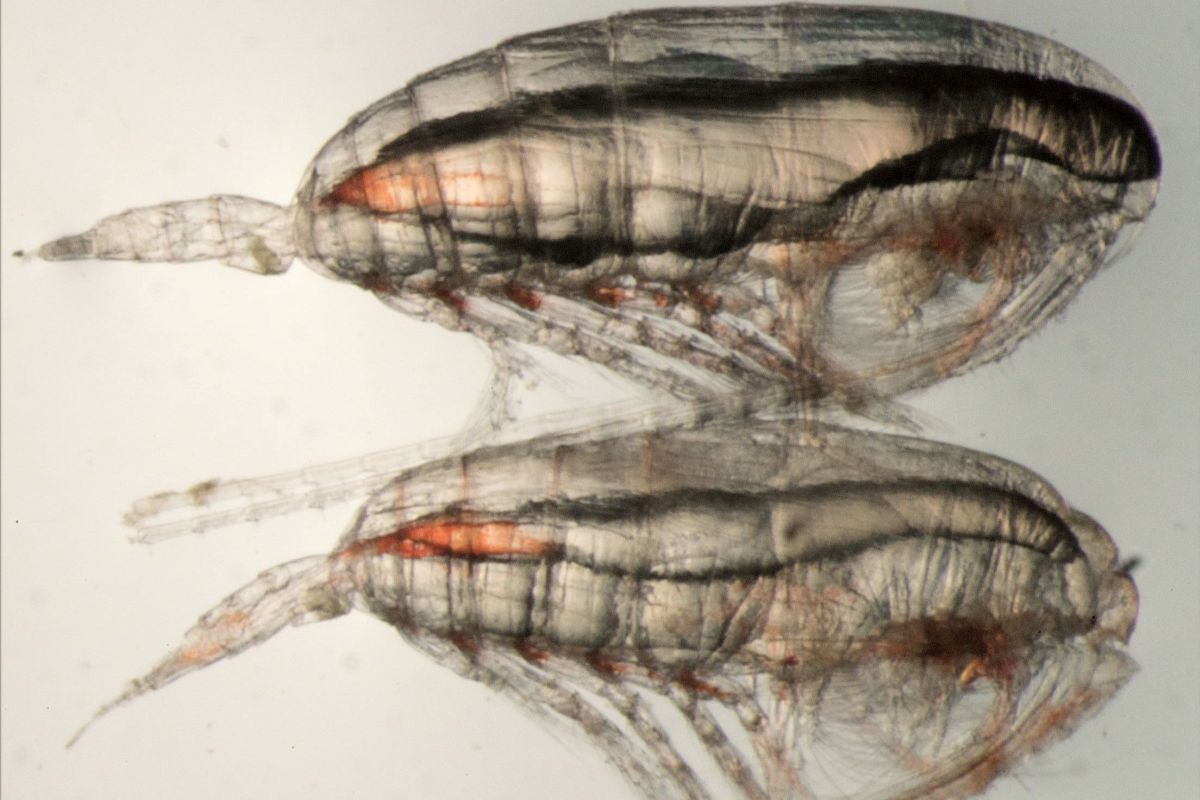
#BigelowLab researchers Nick Record, Rebekah Shunmugapandi, and Karen Stamieszkin were featured in a #MaineMonitor article today about their zooplankton research: https://t.co/s6JV5FPhLF 📸: David Fields.
#maine#ocean#science
Ever wonder how sharks and rays are related? Senior Biologist at Mote Marine Laboratory Kim Bassos-Hull breaks down the subclass Elasmobranchii. https://t.co/sc653y85cT
Here are four #HappyHeadlines for our ocean and our planet, from stronger protections for vulnerable rays and sharks to a major pause on deep-sea mining. Dive into this week’s happiest headlines and celebrate the progress happening right now.
During the NA176 expedition, our team encountered a wealth of biodiversity, including many gorgeous #GlassSponges. In this video, you’ll get up close and personal with some of them.


![WorldOceansDay's tweet photo. [repost by @wwf]
Take two breaths… did you do it? 👀
Now thank the ocean, because it produces half the oxygen you breathe – all day, every day!
🌏 It also absorbs heat and CO2 from the atmosphere. Really, it’s working round the clock to keep our climate in balance.
But our ocean is in trouble. Since the 1970s, populations of oceanic sharks and rays have plummeted by over 70%.
It’s vital we reduce the pressure from overfishing and climate change, protect habitats and reduce plastic pollution 💙Share this post to give our ocean a voice!](https://pbs.twimg.com/media/HG7ICzCXkAAvQwe.jpg)
![WorldOceansDay's tweet photo. [repost by @wwf]
Take two breaths… did you do it? 👀
Now thank the ocean, because it produces half the oxygen you breathe – all day, every day!
🌏 It also absorbs heat and CO2 from the atmosphere. Really, it’s working round the clock to keep our climate in balance.
But our ocean is in trouble. Since the 1970s, populations of oceanic sharks and rays have plummeted by over 70%.
It’s vital we reduce the pressure from overfishing and climate change, protect habitats and reduce plastic pollution 💙Share this post to give our ocean a voice!](https://pbs.twimg.com/media/HG7ICxGWYAAQp6y.jpg)
![WorldOceansDay's tweet photo. [repost by @wwf]
Take two breaths… did you do it? 👀
Now thank the ocean, because it produces half the oxygen you breathe – all day, every day!
🌏 It also absorbs heat and CO2 from the atmosphere. Really, it’s working round the clock to keep our climate in balance.
But our ocean is in trouble. Since the 1970s, populations of oceanic sharks and rays have plummeted by over 70%.
It’s vital we reduce the pressure from overfishing and climate change, protect habitats and reduce plastic pollution 💙Share this post to give our ocean a voice!](https://pbs.twimg.com/media/HG7ICxEWwAEjtPx.jpg)


![WorldOceansDay's tweet photo. [repost by @wwf]
Take two breaths… did you do it? 👀
Now thank the ocean, because it produces half the oxygen you breathe – all day, every day!
🌏 It also absorbs heat and CO2 from the atmosphere. Really, it’s working round the clock to keep our climate in balance.
But our ocean is in trouble. Since the 1970s, populations of oceanic sharks and rays have plummeted by over 70%.
It’s vital we reduce the pressure from overfishing and climate change, protect habitats and reduce plastic pollution 💙Share this post to give our ocean a voice!](https://pbs.twimg.com/media/HG7IDcrXkAIuPhH.jpg)