Emily Xie (@emilyxxie) weaves code into patterns that feel inherited. Her work sits beautifully between textile history, computation, and memory.
As one of our 2025 Digital Artists in Residence, she transformed Gallery 5 into an interactive environment, extending her generative systems into glass and material form. Her work was also featured in our 2025 exhibition Infinite Images: The Art of Algorithms.
Alright I'm not calling the ETH bottom but we're going to do all of this again in 2027 so I just bought all the ETH to fund the https://t.co/wISHDU4gtB initiative for next year too.
It'll look different, maybe more patronage, but the amount ($100k) and idea of supporting more artists is the same. I've loved how all of this has gone, far exceeding my expectations, and I'll do an update soon.
Here's the txn for my haters 🤣🫂: https://t.co/J2dpGXMMS7
I have been in Bitcoin for 10 years.
I have NEVER seen sentiment this bad, on all fronts.
Not 2015, not 2018, not the 2022 collapse.
Something is broken this time, and I think I found out why through 9 charts... 📉
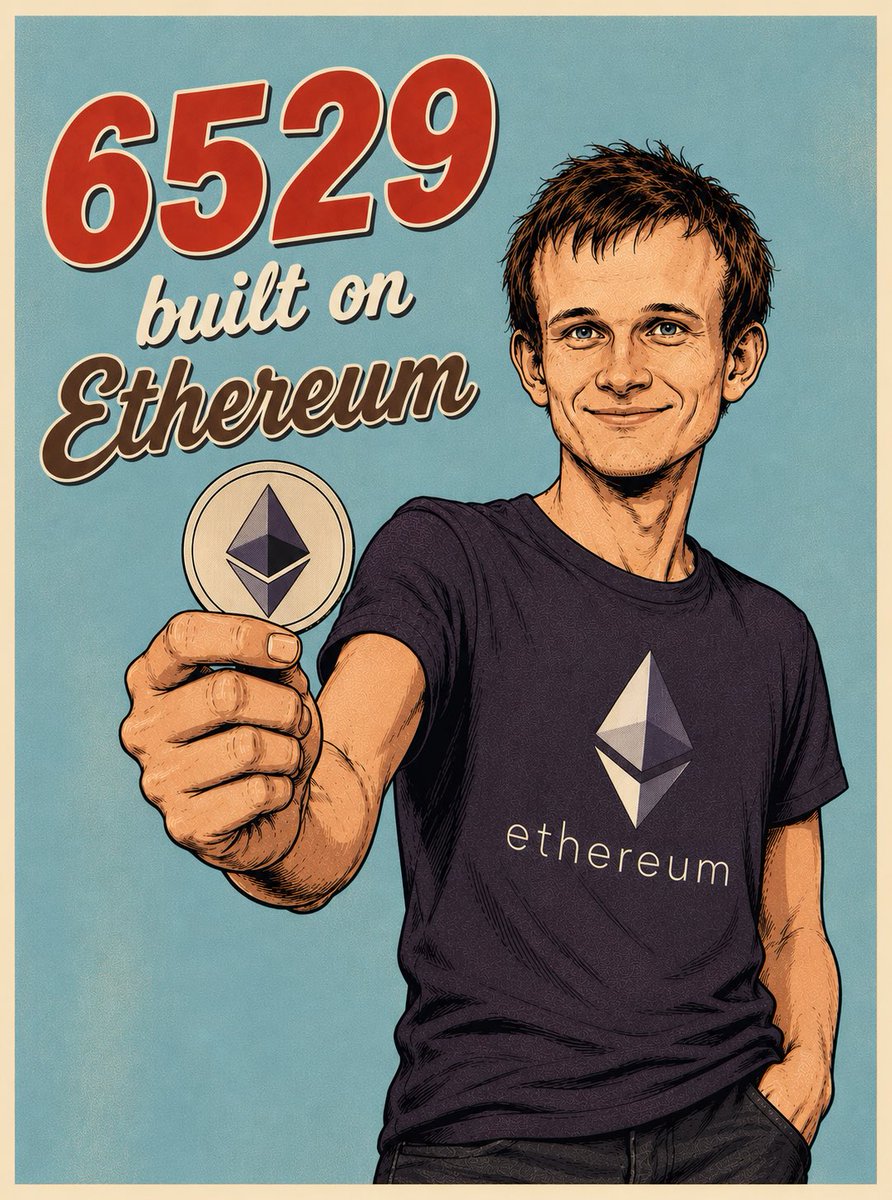
“6529 is a cult.”
“6529 is an NFT project.”
“6529 is a community.”
“6529 is a coordination experiment.”
“6529 is building useful things.”
“6529 is funding public goods.”
“6529 is creating a network economy.”
“6529 might actually work.”
“I wish I paid more attention earlier.”
"ideas having sex" -> open, composable
This is what some NFTs on decentralized permissionless blockchains already are and more can be.
People remix ideas, interact with one another and just do things. Eventually bigger things.
https://t.co/vAMd7T2ZjB
A British biologist looked at 200,000 years of human history and found that the entire reason humans broke out of poverty was not intelligence, not language, not even agriculture, but one mechanism so simple a 6-year-old could explain it.
His name is Matt Ridley.
He is a zoologist by training, an evolutionary biologist by career, and in 2010 he wrote a book called The Rational Optimist that quietly argued the most important fact about human progress had been hiding in plain sight for the entire history of economics.
Naval Ravikant has been telling people to read everything Ridley has ever written for the last 15 years. The reason is the argument inside this one book.
For 200,000 years, anatomically modern humans walked around with the same brain you have right now. Same skull size. Same neural architecture. Same raw capacity for language, planning, and abstract thought.
For roughly 190,000 of those years, almost nothing happened. Generation after generation lived and died inside the same Stone Age toolkit their great-great-grandparents had used. Then somewhere around 50,000 years ago, the line on the chart of human progress started to tick upward. Then it bent. Then it exploded.
The question Ridley spent years on was the only question that mattered. What changed.
It was not the brain. The brain had been the same for 190,000 years. It was not language, which had existed long before the takeoff. It was not even agriculture, which arrived only 10,000 years ago and was actually preceded by the upward bend, not the cause of it.
What changed was that humans started trading with strangers.
This sounds too small to be the answer. Ridley argues that it is the answer to almost everything. The moment one human exchanged a useful object with another human from a different group, something happened that no other species on earth had ever done.
Two ideas that had developed in isolation came into contact. The flint knapper learned what the spear maker had figured out. The fisherman from the coast learned what the hunter from the forest had figured out. The two pieces of knowledge fused into something neither side could have produced alone.
Ridley calls this ideas having sex. The phrase sounds frivolous and it is meant to. The point is that ideas, like genes, get better when they combine with other ideas from different lineages.
An idea sitting inside one head, no matter how brilliant the head, eventually hits a ceiling. The same idea exposed to ten thousand other ideas does something genes do under sexual reproduction. It mixes. It recombines. It produces offspring nobody planned.
The cleanest proof of this argument is the most uncomfortable case study in the book. Tasmania.
Around 10,000 years ago, rising sea levels cut Tasmania off from mainland Australia. A population of roughly 4,000 humans was now isolated on an island, with no possibility of contact with the rest of humanity. They had the same brains. The same language. The same starting toolkit as their cousins 150 kilometers north. The natural experiment was now running.
What happened next is something no economist or geneticist had ever predicted.
The mainland Australians kept inventing. Boomerangs. Spear-throwers. Fishing nets. Bone needles for sewing fitted clothes. Watercraft with paddles. Their technology compounded slowly across the centuries.
The Tasmanians went the other way. They did not just fail to invent the new tools their cousins were developing. They started losing the tools they already had. Fishing was abandoned within a few thousand years. Bone tools disappeared. Fitted clothing disappeared. They forgot how to make fire from scratch and started carrying lit firebrands from camp to camp instead, relighting their fires from a neighbor's whenever their own went out.
By the time European explorers arrived in the 17th century, the Tasmanians had the simplest toolkit of any human society ever recorded. Their material culture had gone backward for 8,000 years.
The archaeologist Rhys Jones called it a slow strangulation of the mind.
Joseph Henrich at Harvard later proved with formal mathematical models that there was nothing wrong with Tasmanian brains. There was something wrong with their network. A toolkit requires a critical mass of people exchanging skills to maintain itself.
The act of teaching a skill is imperfect. Every generation loses a small percentage of what the last generation knew. If your population is large enough and trading widely enough, those losses get caught and corrected by someone else who still remembers.
If your population shrinks below a certain threshold and stops mixing with outsiders, the small losses compound until entire technologies disappear.
This is the part that should haunt anyone reading this in 2026.
Intelligence is not a property of the individual brain. Intelligence is a property of the network the brain is connected to. A genius in isolation will produce less than a mediocre thinker inside a dense exchange of other mediocre thinkers.
The thing your ancestors needed in order to break out of 190,000 years of stagnation was not better brains. It was better connections between brains they already had.
The implication for any individual is direct and uncomfortable. If you are smart and isolated, you will be outproduced by people half as smart who are connected.
The most successful people in any field are almost never the smartest people in it. They are the ones positioned at the intersection of the most idea flows. They are reading more authors than their competitors. They are talking to more people from more disciplines. They are in the rooms where ideas from different lineages bump into each other.
Ridley ends the book on the line that sounds optimistic but is actually a warning its this "The future will be invented by people who connect ideas, not by people who guard them."
What is 6529 (Currently)?
6529 started of with an NFT collection and a vision, that vision is an evolving masterpiece where the destination is somewhat known but the path is ever changing for it is shaped by participants..
So what is 6529 currently, to me it's a funding mechanism for ideas or even a place to claim funding after showing proof of work..
An example is @sertx92 who built a decentralised news protocol for 6529, which was minted as a meme card. Payout for getting a card minted is around 5 Eth currently.
Another example is @HugoFaz, who has worked hard to make an IRL museum for decentralised art in Sao Paulo a success. In recognition the 6529 Network came together and approved funding not once but multiple times after Hugo shared updates regarding the project.
Bottom line is no matter what line of work you are in, if you are one with ideas the best place to discuss them is over at 6529 dot io.. Meme Maxis look forward to hosting you at the bar.
Most people still think NFTs are about pictures.
They're actually about memory.
Every important culture creates artifacts:
Books, paintings, baseball cards, concert posters, historical documents, etc...
The internet created global culture at a scale never seen before, but its artifacts couldn't be owned.
NFTs changed everything. For the first time, internet culture can leave behind permanent, scarce, verifiable artifacts.
And over time, the artifacts of internet culture will become the most valuable of all, because the internet is where humanity overwhelmingly lives, creates, and remembers.
Not everything deserves to be collected. But the things that matter most do. The bet isn't that every NFT succeeds.
The bet is digital culture becomes increasingly significant, and the artifacts people care about most live onchain.
What fascinates me is how small the market still is.
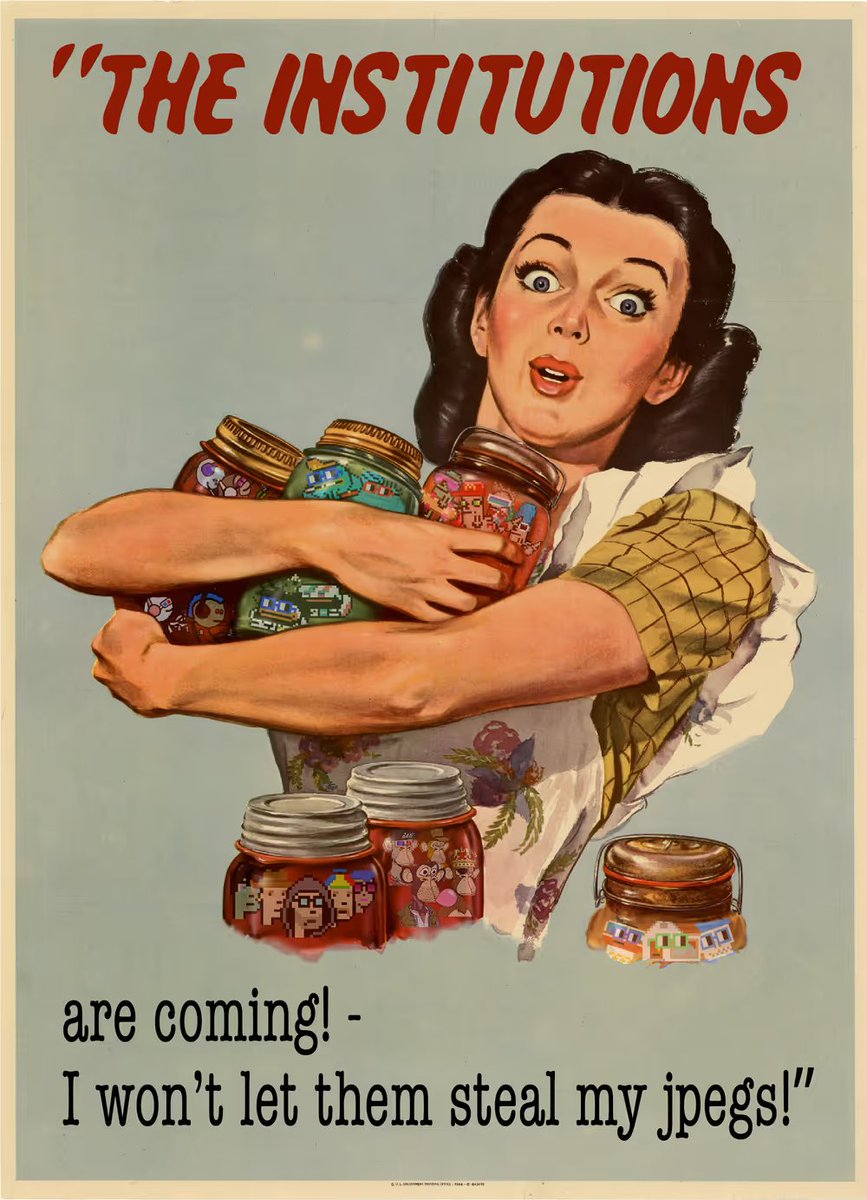
The internet already dominates culture, yet many of the most important onchain artifacts (aka JPEGs) can still be collected by ordinary people.
This opportunity will not exist forever.