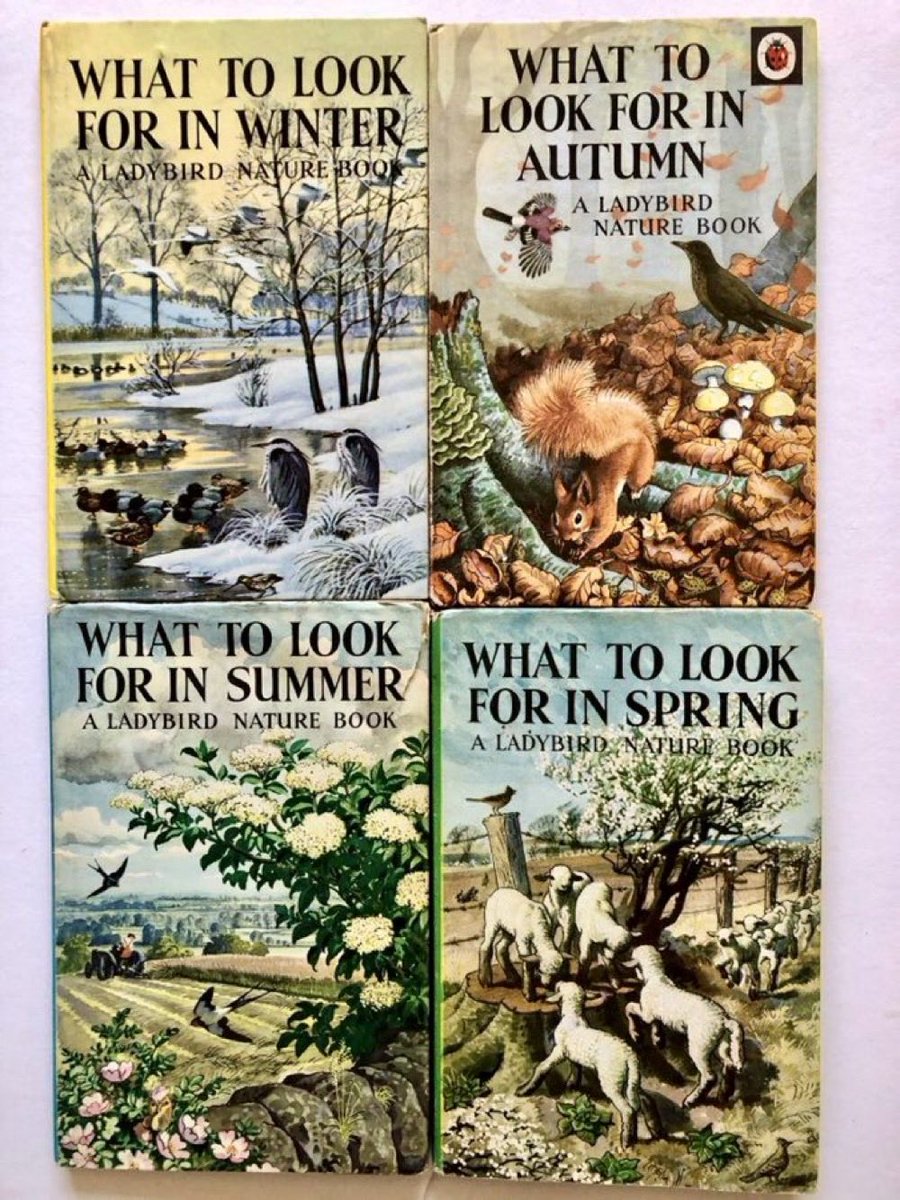
Today, being the first day of Meteorological Summer, I bring you the covers of the 4 seasons books.
But which is your favourite?
My favourite season is Spring (but my favourite of these books is probably Autumn)
Artist: CF Tunnicliffe
With everything we are hearing right now about ticks this seems like good information to share.
“Here’s what I’ve learned after more ticks than I care to count.
First, whatever your uncle told you, forget it. No matches. No nail polish. No Vaseline. No soap on a cotton ball. All of those do the same terrible thing, they stress the tick out, and a stressed tick empties its gut back into the bite before letting go. Which, if you think about what that actually means for a second, is literally how Lyme and the rest get transmitted so you’re not speeding up its exit. You’re making it throw up into you.
Fine-tipped tweezers. Grip right where the mouthparts enter the skin, not the body, the head. Pull straight up, steady, no twisting, no jerking. It’ll feel like it’s resisting because it is, the mouthparts are barbed. Just keep the pressure on and it lets go in a few seconds. If a piece breaks off in the skin, leave it alone. Your body pushes splinters out. Digging around with a needle does more damage then the fragment ever would.
Clean it with alcohol or soap. Wash your hands.
Now here’s the part most people skip: don’t flush the tick.
Tape it to an index card. Clear packing tape right over the body, write the date and where on your body it was, and stick the card in a drawer. If you come down with anything weird in the next 30 days, rash, fever, joint pain, that flu-that-isn’t-flu feeling, that tick goes with you to the doctor. Some labs will test the tick itself, which is faster and often more reliable than waiting for antibodies to show up in your own blood. A dated tick taped to a card is one of the most useful things you can hand a doctor who’s trying to figure out what’s wrong with you.
The other thing worth saying out loud: if the tick was engorged when you pulled it, and you can’t swear it was off your body within 24 hours, call your doctor that same day. Don’t wait for a rash. Fewer than three out of four Lyme cases even produce the classic bullseye. A single preventive dose of doxycycline within 72 hours of a deer tick bite cuts the Lyme odds way down, and most docs in tick country will write that prescription without giving you a hard time, especially if you walk in with the tick taped to a card and a clear timeline.”
@future_ai_focus Yeah I do exactly! It's by the Thames, near tower bridge. I've been to the Watchhouse coffee shop in the picture. There's a great little 'secret' alleyway you can go through to get onto the bank of the Thames at low tide right around where this photo is taken. Like a dirty beach!
@celtic_jaime It's very simple - it depends on density.
If using clotted cream and especially if also a soft jam, the cream goes on first.
If using whipped cream, and especially if also a firm jam, jam goes on first.
And butter FIRST before anything else!
@GoodPoliticGuy This whole thing is so weird 😂
Like it clearly seems to be a mask - that thing on his neck is no shadow, and he looks totally different to other images and videos of him (younger in the Fox appearance for example).
BUT if a mask - WHY have the neck showing like that?!
Doctors warn: Never block a sneeze with your mouth closed.
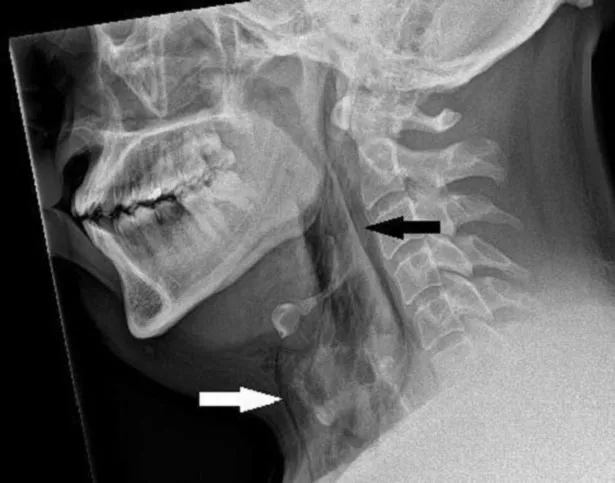
A 34-year-old man in the UK was rushed to the hospital with intense neck pain and difficulty breathing, all because he tried to suppress a sneeze by pinching his nose and closing his mouth.
Doctors later discovered that the pressure had caused his windpipe to rupture, allowing air to leak into his chest and neck. He had developed something called spontaneous pneumomediastinum, a rare but real condition in which air escapes from the respiratory tract and becomes trapped in the central part of the chest.
The man was treated in the emergency department and placed under observation. Fortunately, he recovered without needing surgery, but doctors warned that attempting to hold in sneezes, especially forcefully, can have serious consequences.
So next time you feel a sneeze coming on, resist the urge to clamp down. Let it go, into a tissue, elbow, or sleeve, and keep your airways safe.
Australia is wild.
This Aussie shows how to catch a common house spider and explains why it’s actually good to keep it around—so it can eat other bugs..
Recent advances in neuroscience have revealed a startling truth: what we perceive as “reality” is actually a sophisticated hallucination generated by the brain.
Rather than passively receiving information from the outside world, the brain actively constructs our entire experience. Through a process called predictive processing, neuroscientists like Anil Seth and Karl Friston explain that the brain constantly generates a best-guess simulation of reality based on incomplete sensory input. It then updates this model as new data arrives.
This means everything you see, hear, and feel is a mental creation. Your brain invents the experience of color from raw light wavelengths, fills in your blind spots with fabricated details, and presents you with a version of the present that is delayed by roughly 100 milliseconds. In a very real sense, we are always living slightly in the past.
This internal storytelling goes even deeper. Memories are not faithful recordings but are actively reconstructed each time they are recalled, often incorporating inaccuracies (as shown in the work of Elizabeth Loftus). Even pain is not a direct signal from the body but a protective output generated by the brain itself, according to researchers like Lorimer Moseley.
In the end, our everyday experience of life is a highly evolved, shared hallucination — a brilliant biological illusion that allows us to navigate and survive in a world we can never directly perceive in its raw form.