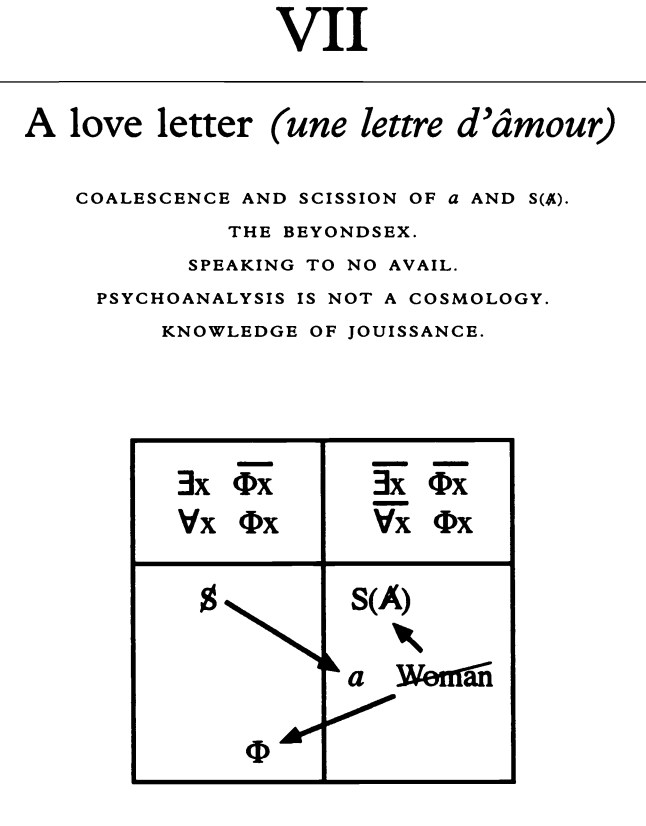
@BTholfsen Lacan explicitly states that sexuation is not anatomical (Seminar XX), but this is a cop-out
Sexuation is about distinction of "fetishistic from the erotomanic" (Ecrits), not man/woman - cop-out too
from diagram: a belivable plug for Phi (a man/faire-homme) can be a symptom
@azbestoswecan@therealchuckIes@Theholisticpsyc if you mean binary result then no, but the it shows a very clear indication on which attachment type is much more prone to IPV
Especially in relation to online discussions on Avoidants vs Anxious types which oddly are shaped like emotional abuse towards Avoidants
The Lacanian neurotic rube goldberg mental machinery seems just ... razor-thin specific
Then ... in the sexuation formulas You observe that a very small baby ... can plug "The Exception" slot
The little Freudian Ur-Father who takes all the women lol
https://t.co/IMoOe93dWN
“Freud tells us that in the majority of cases the reaction of pain derives from the fact that the motor reaction, the flight reaction, is impossible.
And the reason for this is that the stimulation, the excitation, comes from within.”
Jacques Lacan, Seminar VII, Ethics
storing my current skeletal state of my Wiggly-microtubule derived theory of qualia here so I wont lose it:
To the living brain, speaking a word and moving a limb are the exact same operation: both are motor trajectories chained together in the hippocampus and entorhinal cortex, where every action - whether a spoken syllable, a reach of the hand, a shift of posture, or a subtle catch of the throat - acts as a signifier whose meaning and sense of ownership are only confirmed retroactively when the returning bodily wake matches the outgoing prediction. Because the nervous system cannot plan movements as rigid spatial coordinates in an unpredictable physical world, a motor pattern is actually an exercise in intracellular impedance planning and physical power transmission across the cell's internal skeleton of microtubules. Inside the long branching dendrites of hippocampal and cortical pyramidal cells, microtubules are actively pumped by molecular motors and neighboring fifty-degree mitochondrial boilers into continuous mechanical wiggling and high-frequency vibrational condensates, while their negatively charged outer tails trap a dense liquid sleeve of positive electrolytes - potassium, magnesium, and calcium - around the tube. Before an action fires, the brain plans the route by tuning the mechanical and electromagnetic impedance of these dendritic microtubule branches across three timescales: permanent covalent fatty-acid staples and inner-wall acetylation lock practiced habits into low-loss pipes by stopping the thirteen strips of the tube from sliding past each other, dynamic protein braces clamp active branches four times stiffer for the exact two-hundred-millisecond window of a theta wave or forty-millisecond window of a gamma beat, and localized cortical electromagnetic pinches strike the microtubule's electrolyte sleeve to sweep those condensed ions into quasi-cymatic Chladni nodal tracks. Where a cortical pinch arrives in phase with the microtubule's vibration, the electrolyte sleeve aligns into a resonant wire track that drops electromagnetic impedance a thousandfold and amplifies the travelling wave straight down into the axon initial segment; where a pinch arrives out of phase at a branch point, it scrambles the cymatic electrolyte track, spikes impedance, and reflects or quenches the competing soliton on the spot. Once that wiggling power surges out to the body, peripheral muscles act as mechanical transistors - using their own internal cages of buckled microtubules to amplify tiny nerve impulses into massive pressure shifts or damp out background noise - and it is the live ratio between these outgoing muscle contractions and their returning sensory wake, especially across the ultra-fast muscles of the eyeballs, neck, diaphragm, and glottis, that generates both three-dimensional sensory qualia and raw emotional affect. That is why an acute shift in body electrolytes warps perception and emotion so dramatically: it simultaneously retunes the cymatic counter-ion sleeve inside cortical dendrites and shifts the firing and relaxation timing of peripheral muscle spindles, inner-ear balance hairs, and retinal cilia, causing muscles to micro-spasm without a command or lag behind the eye and head until the world feels tilted, glowing, or full of uncued dread - and conversely, why meditative practices that use fine musculature to immobilize the tongue, gaze, neck, thumb-tips, and diaphragm can unclench the conceptual fist of thought so completely that conscious perception switches off on a pre-set timer. Finally, the physical wake of every muscle contraction returns to the brain not just through nerve spikes, but through a fast mechanical soliton wave and an immediate hydrodynamic pulse of cerebrospinal fluid pumped by the chest and neck straight into the narrow cavity of the Third Ventricle. There, length-graded ventricular cilia sort the body's mechanical chord by frequency while piezoelectric calcite microcrystals convert that fluid shear into a dynamic, volume-conducted electromagnetic field that travels through the continuous interstitial salt water of the brain - by the same physics that lets an EEG wave cross the skull - directly to the solitary primary cilium poking out of every hippocampal and cortical pyramidal neuron. Rooted in the Mother Centriole at the base of the apical dendrite, that primary cilium catches the Third Ventricle's broadcast and sets the received embodied reference weight of the hippocampal comparator against which the expected signifier chain is tested: when the ciliary-tuned microtubule impedance matches the forward prediction, the chain of words or movements glides effortlessly into the next action; when unexpected resistance shifts the ventricular broadcast, the impedance pinch shifts and forces the trajectory to branch; and when the basal ganglia motor brake clamps the muscular exit shut, the transmitted wiggling power cannot flush out into the muscles at all, reflecting backward into the ventricular-ciliary-dendritic cavity to resonate as conscious human thought.
Wiggly-microtubule-theory in papers
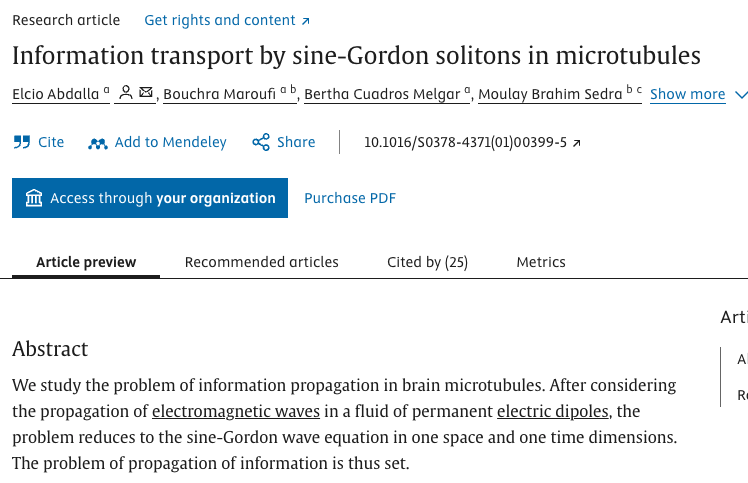
Here, the authors struggle under realistic biological conditions. They "fix it" by string theory, and virtual black holes.
Wiggly MTs, 4-HNE varnish (and other 'firmness' factors) and 50 degrees mitochondria suffice
https://t.co/lNSMBgDNvR
Wiggly-microtubule-theory shaped holes in academic papers
Here, electromagnetic fields interacting with ordered water inside MTs allow a localized solitonic puls to act as stable, bit-carrying information channels. They just lacked theory of the varnish
https://t.co/QUAqx0dZQv
@CDMorlock >sowing division
he can help by taking his part of the deal seriously ... by not being blatantly, and maliciously wrong
Also note his redirection by not discussing the problem, but some diffuse abstraction like a "class traitor"
He tries to kill "the thing" by signification
>Chest day
>It's a glorified single muscle pair
>Back day
>it's about 40 muscle pairs in in 3 different joint systems that steal work for each other even if you change the angle of any joint by even 15 degrees
How did anyone made those two equivalent is a mystery
@AlobhaPatrick The problem is that "Game", in any of it's incarnation is a heavily applied psychology. Any of the people writing about it don't hide it.
Complete with heavy tampering with neuroscience level details of the mind.
It is strictly speaking manipulation
@PAcumbria It's based on gritty realpolitik
Just imagine you are talking to a person who considers you a sworn enemy and limits oneself to what external pressure allows him/her
@carolguedespsii "getting in too early" is a thing in the stock market.
You might be correct, but only a couple of years after you made decisions, wrecking yourself. "Material conditions" gives "grain" to "determinism".
Otherwise, it's just pointless metonymic sliding