@_Boredistan@ninoqazi You are directing your comment to him as if he came out of nowhere. The institution which he represents has a long history. They have ruled the Muslim world during the golden ages of Islam. the so-called cult has great respect around THE world.
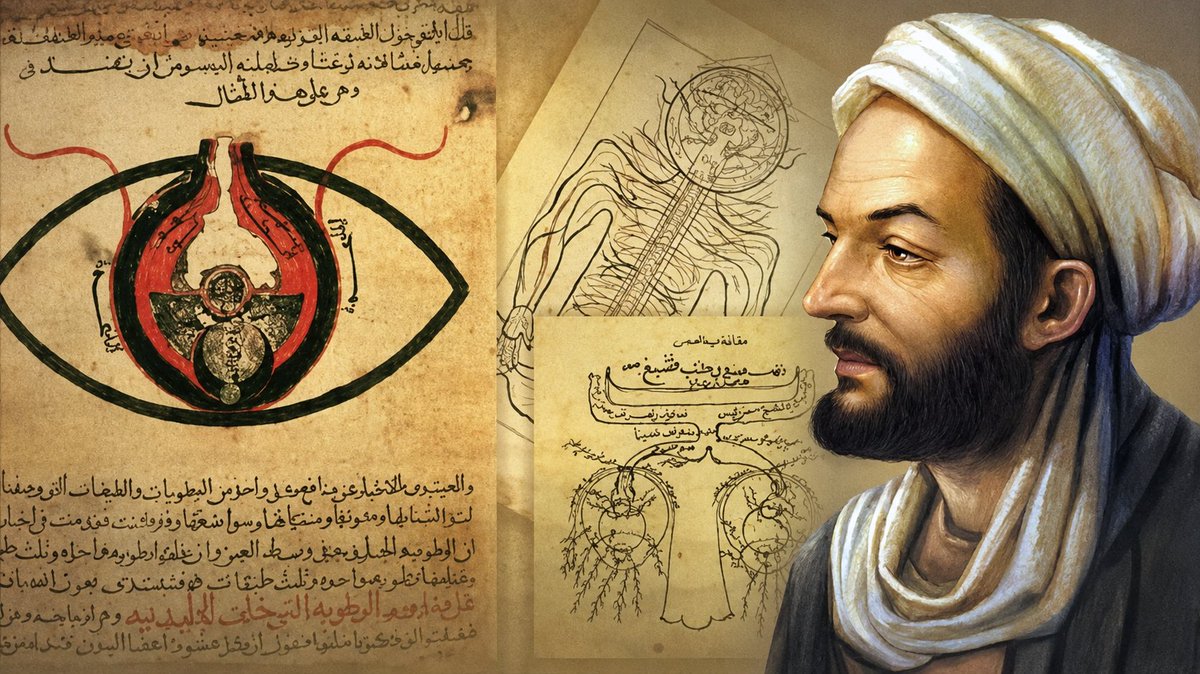
A Persian physician memorized the entire Quran by age 10 and was practicing medicine by age 16. By 18 he had cured a sultan that no other doctor could help. The textbook he wrote in his 30s became the operating manual for every European doctor for the next 600 years.
I started reading about him at midnight and could not believe one teenager had personally built so much of the foundation of modern medicine.
His name was Ibn Sina. The book is called The Canon of Medicine.
Every modern clinical trial. Every evidence-based drug protocol. Every pharmacology textbook. Every medical school curriculum that teaches doctors to observe before they prescribe.
All of it traces back to a Persian teenager who finished his medical education before most modern students finish high school.
Ibn Sina was born in 980 CE near Bukhara, in modern-day Uzbekistan. His father was an Islamic scholar who employed the best tutors money could buy. The tutors started failing to keep up with him almost immediately.
By age 10 he had memorized the entire Quran word for word. By 12 he was correcting his tutors on points of law. By 14 he had outpaced his teacher in mathematics and started learning on his own. By 16 he was treating patients in his neighborhood.
He later wrote, with no false modesty, that medicine was an easy subject and he had mastered it quickly.
He hit a wall around 17. He could not understand Aristotle's Metaphysics. He read the book forty times and still could not grasp it. Then he picked up a commentary on it by Al-Farabi in a Bukhara bookshop for a few coins, read it overnight, and suddenly the entire system of Greek philosophy snapped into place.
He went home and gave alms (money or goods) to the poor in gratitude that he had finally understood.
A year later the news of his medical skill reached the sultan of Bukhara, Nuh ibn Mansur, who was suffering from an illness no doctor in his court could cure. Ibn Sina was called in. He treated the sultan. The sultan recovered. The 18-year-old asked for one thing in payment.
Access to the royal library.
The library of the Samanid sultans in Bukhara was one of the greatest in the Islamic world at that time. Ibn Sina spent the next year inside it reading everything he could find.
He later wrote that by age 21 he had absorbed everything written by every major scholar before him, and that the rest of his career was just refining what he had already understood as a teenager.
He spent the next decade as a wandering physician and political advisor. Empires were collapsing across Persia and Central Asia. He moved from court to court, treating princes, drafting legal documents, escaping invasions, hiding from enemies who wanted to kill him for his association with rival rulers.
He wrote at night while moving between cities by day. He was imprisoned at least once. He kept writing.
In his 30s and 40s he produced The Canon of Medicine. A five volumes book at least a million words. A complete synthesis of every medical tradition he could find. Greek medicine from Galen and Hippocrates. Persian medicine from his own tradition. Indian medicine from Ayurvedic texts. His own clinical observations from thousands of patients.
The Canon was translated into Latin in the 12th century. It was reprinted more than 30 times in the 15th and 16th centuries alone. It was the standard reference text at the University of Paris, the University of Bologna, and Oxford well into the 17th century.
William Osler, one of the founding fathers of modern medicine, called it the most famous medical textbook ever written and said it served as a medical bible for a longer period than any other book in human history.
The part that most people miss is what was actually inside it.
He laid out clear rules for testing whether a drug works rules that still look like modern clinical trials. The drug must be pure, tested on a single condition, and checked against opposite conditions for consistent results. Effects must be seen repeatedly, with timing that matches the treatment. And it has to be tested on humans, since animal results don’t always carry over.
A thousand years before the modern clinical trial existed, he had written its protocol.
He defined medicine itself in a sentence that has never been improved on. Medicine is the science by which we learn the various states of the body in health and when not in health, the means by which health is likely to be lost, and when lost, is likely to be restored.
He insisted that prevention came before treatment. He argued that lifestyle, diet, exercise, and sleep mattered as much as drugs. He was right by a thousand years. He documented hundreds of conditions with such precision that European doctors were still using his diagnostic categories in the 1700s.
He died in 1037 at age 57. He was on a military campaign with one of the rulers he served when he developed colic. He treated himself with what he believed was the correct remedy. The remedy did not work. He died near the city of Hamadan in modern Iran. His tomb is still there.
His own assessment of his life is one of the most honest things any genius has ever written about themselves. He said he had lived a wide life rather than a long one and that he preferred it that way.
The Canon is digitized at the Library of Congress. The original Arabic version is preserved at multiple universities. Free English translations exist online.
The medical textbook that trained every European doctor for half a millennium is sitting one click away from you.
Most modern doctors have never heard the author's full name.
Oh the obsession with the Assasins legends!
WOW what a “fun historical fact”
Bro really went straight for the Bollywood villain arc.
Since you’re so fascinated by that one dramatic chapter, let me give you the director’s cut instead of the trailer.
The modern Nizari Ismailis are indeed the direct continuation of the same community that was once centred at Alamut but that’s just one episode in a 1400-year story. The Ismaili Imams and their followers actually led the Fatimid Caliphate, the largest and most powerful Muslim empire of its time, and the only major caliphate named after Fatima the beloved daughter of the Prophet. While the Umayyads, Abbasids, and then Seljuks were against the followers of Ali, the Fatimids created a golden age of tolerance, learning, and prosperity.
Travellers and scholars from across the Muslim world and even from Christian Europe went to Al-Azhar, the first university ever established in the Muslim world under Fatimid rule.
And if you want to go even further back (which most “Assassin” enthusiasts conveniently skip), this lineage traces directly to Imam Jafar al-Sadiq through his son Ismail, and ultimately to Imam Ali and the Prophet Muhammad himself.
Continuous, unbroken, for centuries. Ismailis have always lived with Imam of the time. Their philosophy of a guide, a manifestation of noor of allah always present living and guiding goes back even before Ali. (There are layers of depth of meanings in this concept if people open their minds)
As for the famous “Assassins” legend that entire spicy story was cooked up by the biggest travel influencer of the medieval period: Marco Polo. He narrated those tales while sitting in a Mongol prison, entertaining his captors with exotic oriental fantasies. Add to that the usual mix of political jealousy, propaganda, and smears from rival rulers who feared the Fatimids’ power and intellectual influence. Classic.
on the etymology: The word “Asāsīyūn” (أساسيون) that Westerners turned into “Assassins” actually means “people of the foundation” those who stand firmly on the Asas (أساس),. That is, the living presence of the Imam as the guide of the time, the inner truth of faith, and the eternal authority in this world.
Next time maybe read beyond the Crusader propaganda and Marco Polo fan-fiction. The real story is far richer.
Fun historical fact:
The modern Nizari Ismailis, led by the Aga Khan, are actually the direct, uninterrupted continuation of the same Nizari Ismaili community once centred at Alamut,
The group Western history remembers as the “Assassins.”
Literally the same religious line continued for 900+ years.
The modern association with education, philanthropy, and development work is just that, a modern association.
@J1618G The Imam is the living Intellect - the perfect mirror reflecting the One to the soul, guiding the gnostic ascent from zahir to batin.
Without him, the seeker wanders in fragmented shadows; through his Walayah, the murid attains true knowledge and union with the eternal.
Ahl-e-Batin knows exactly what level I’m talking about.
A spiritual leader rooted in the East yet living in the West, with a refined accent yet fully a Muslim leader: bearded, but unlike any mullah, suited and booted, modern and graceful. He is accessible in public spaces, makes surprise visits, and shows the warm heart of a single parent with deep affection for the Jamati youth embracing them like his own.
He openly embraces every imperfection in the Jamat, welcomes people of other faiths with open arms, runs marathons, shares flying kisses, and lives as a true bridge between worlds.
While many faiths still picture a religious leader in traditional Shalwar Kameez, with a long beard and Arabic speech, Ismailis have adapted and moved far ahead. They are Ibn ul Waqt - children of the time. They look beyond the outer physical form to find the deeper truth, yet understand that physicality is deeply connected to spirituality. The Imam’s modern presence is not a compromise it is a powerful symbol of living faith in today’s world.
Most importantly, the Deedars and Ismaili updates are now public. Nothing is private anymore. The world sees the services rendered for the Jamat and the Imam all in plain sight.
Of course, this radical openness stirs reasonings and doubts about the Imam’s humanness. But that too carries deep spiritual significance. In this age, the Imam manifests the Universal Soul in a form the contemporary world can recognize and relate to breaking barriers, dissolving secrecy, and guiding humanity through lived example. It is the eternal Light adapting to the times, inviting not just the murids but all seekers to witness the living tariqa of love, service, and intellect.
This is the Imam of the Time, walking with us in the rhythm of today.
The Ismailis, proudly and lovingly call Hasan bin Sabah the great grandfather , the devoted fidayi of the Imam who stood as the fearless guardian of the Manifestation of Noor, protecting its eternal light with unwavering loyalty.
Even today, many noble hearts carry his spirit across the world and they are not nessarily enough ismailis and maybe of other faiths doing the job.
The fanciful tales woven by Marco Polo types simply dissolve in the face of this living truth, while the Seljuqs, Mamluks, Umayyads, and Abbasids among us still fail to grasp the divine reality he so fiercely defended.
Read more on : Hasan bin Sabah is from the Asāsīyūn (أساسيون) “people of the foundation” those who stand firmly upon the Asas (أساس), the sacred bedrock of the Imam’s eternal authority and the inner truth of faith.
@KhanMasab092@hassaninexile Your so called kufr is holding up this country.
Look at the state banquet ceremony where your Army chief, PM and president with all ministers salute and thanks HIM.
Is there any other muslim leader to receive such a graceful welcome everywhere in the world?
Aga Khan V, the 50th Imam, represents the only living direct line from Pakistan’s founding fathers still actively engaged today.
His great-grandfather Aga Khan III (Sir Sultan Muhammad Shah) founded and served as first permanent President of the All-India Muslim League (1906), championing the liberation movement in the British India. He engaged politically with both Gandhi (including meetings in London) and Jinnah, navigating early opposition to later alignment for Muslim self-determination.
His grandfather Prince Aly Salman Khan (Aly Khan) served as Pakistan’s Permanent Representative to the UN (1958–60) and Vice-President of the UN General Assembly; his father Aga Khan IV advanced massive development via AKDN in Pakistan; his uncle Prince Sadruddin was UN High Commissioner for Refugees; and Prince Rahim himself continues this legacy with state visits and national honours.
However, this history of them doesn’t start there only.
Their ancestors have ruled the Muslim world during the golden times of Islam known as Fatimids.
@NisarMajor@iihtishamm Its all perspective.
Maybe there keenness towards him drive through Aga Khans selfless support to Pakistan. They are the only family of the founding fathers of Pakistan.