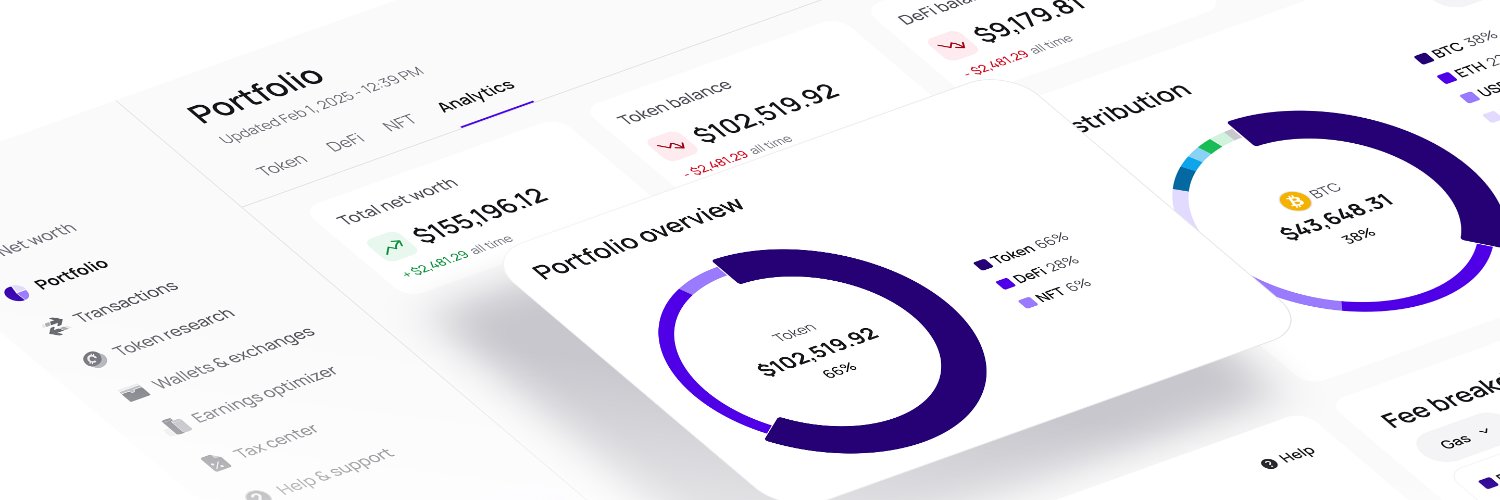
When I first started in crypto, I didn't care about anything more than my balance. That big bold number at the top of my tracker app.
As I spent more time hopping between chains, tokens, and protocols, I started realizing that wasn't enough.
How much did I make from memecoins vs. LP interest vs. binance earn vs. btc gains?
How much had I already made but cashed out? What's the most I'd ever had in crypto?
Big one for me--how much did I actually lose in nfts vs. rugs vs. hacks?
Your tracker app isn't going to tell you that. It'll just show that you have 100k and 70k of that is in USDT and 30k in BTC. Maybe some ETH dust.
That might be good enough when you're starting out. But you graduate out from that soon enough.
Your portfolio app shows $15,000. That’s your balance, not your profit.
It could mean that you invested $10,000 and made $5,000. Or you invested $18,000 and are down $3,000. Same screen. Completely different outcome.
Your app shows the same number for both. 🧵👇
Claude Mythos is live. The cost to build something has never been lower. The risk to DeFiers has never been higher.
Have fun. Be responsible. And if you haven’t already, cancel your open wallet connections with https://t.co/SrgH29tr9C. 2 minutes to protect your wealth.
Introducing Claude Fable 5: a Mythos-class model that we’ve made safe for general use.
Its capabilities exceed those of any model we’ve ever made generally available.
The highs of building your own startup are higher than any job could ever give. The lows are lower too. There's no way to get it until you've jumped into the deep end yourself.
@LefterisJP This is awesome! It’s impossible to understand the infinite edge cases in crypto unless you’ve actually tried building a tracker yourself. Well done!
Crypto can’t build the future of finance while so many builders and investors are focused on extraction. Pump dot fun, prediction markets, the whole pump-and-dump culture, even “democratizing finance” vis-a-vis hyperliquid. All of it pulls against the actual goal.
What moves things forward is experimenters. The Vitaliks, the Stanis, the Michaels. Even Do Kwon, who did real damage but was actually trying to build something novel. People pushing the frontier out of conviction instead of a cash grab.
They built real things first. The money showed up after.
Your portfolio balance and your actual P&L are not the same number, and people only learn that at tax time.
Say you bought 1 $BTC at $40k, sold at $120k last October, then rebought at $62k now. Your balance looks roughly flat, but you actually realized an $80k gain that you owe taxes on.
Watched CoinStats, DeBank, and Koinly all give different answers on a Kamino $SOL LP position.
CoinStats sees the deposit but not the interest, then resets your SOL cost basis to market price on withdrawal.
DeBank doesn’t do Solana at all. Usually better with DeFi tx categorization but huge miss on this.
Koinly catches it but makes you manually enter the cost basis for the principal, the interest, and the withdrawn SOL after redemption. Try doing that a year and hundreds of DeFi transactions later.
Never forget that an audit doesn't mean a protocol is safe. Take it from someone who's gotten dozens of them. Usually it just means a project has 5-6 figs of burnable cash and investors asking "wen launch"
It’s hard to get your first 100 users. It’s even harder if you don’t know where they live.
Crypto users are notoriously divided. Shitcoin gamblers live on CT and telegram. OG DeFiers, farmers, and devs live on CT and discord. All three play around on reddit. Know which group your product speaks to and target the channel they frequent. If you’re on the wrong platform, you’re dead on arrival.
There’s no first 100 without your first 10. These will be your most loyal users. They’ll also be your most critical. They’ve bought into the value of your product and want to shape it to solve their specific problems. Let them. If they have a problem, others do too, and your product will find new pmf. It’ll also convert your loyalists into evangelists who endorse you in their groups.
Early users are sticky. They enjoy being early adopters, but they’ll also be the biggest critics if they feel dismissed.
We learned this on the ground at Cryptofolio. Functions like the ability to see your specific portfolio composition on any historical date, filtered transaction exports, and claim reminders for DeFi rewards all became real selling points and came directly from early followers who pushed us to build them. They told their friends, who then told us what they wanted, and the loop kept going.
User research will make or break your product. It’s your insight into what problems your product needs to solve, but it’s also the path to your first 100 users.
It also looks nothing like what the textbooks describe. There’s no survey panel, no usability lab, no $50k market testing, etc.
User research actually looks like a DM from a Reddit user testing out your app but who couldn’t connect their account. It’s a buddy who wanted to test your product but gave up after getting stuck during onboarding. It’s a shitposter roasting you for leaving something broken for a couple weeks. This is the same person who was one of your first signups and who took the time to write a full paragraph about what they wanted but didn’t get.
Keep your conversations public and other users will stumble across them. They’ll be curious to see if you actually solved others’ problems—likely the same problems they’re having—and they’ll test your product too. If you’re lucky, they’ll take the time to give their feedback. If you come through, they’ll pass the word onto their friends.
It’s a time-consuming process, but it’s a time-tested playbook to early startup growth. You need tough skin, but you get more alpha from any one of these than from a hundred random surveys.
How many wallets and exchanges accounts do you have?
I have 40+. Some for higher risk protocol farming, minting, shitcoin gambling, lending, long term accumulation, and some for fiat on/offramping.
Tracking—not just balance changes but actual profit on each ‘category’ of wallet is top signal but hard af to automate.
Startups are funny. You set out to solve one problem and realize you’re actually solving another.
Cryptofolio was originally designed as a portfolio tracker. We quickly realized most trackers don’t actually calculate P&L, they just show balances. For real performance calculations, you need a tax app. But tax apps are designed to be used once a year, in april, and nobody opens them again until the following march.
So we built something in the middle. A tracker accurate enough to handle taxes, but easy enough to use every day. That’s the message that resonated with people who wanted to know how much they’re up in October, not just during tax season.
And we stumbled into it.
Pre-launch is mostly spent on things that aren’t product.
Building landing pages, debugging analytics so you can tell whether anyone actually cares, fighting bots on signup forms, solving email deliverability, deciding what to cut from v1, writing and rewriting the same hero statement 12 different ways because nobody outside your head knows what you’re building yet, reorganizing project management when the team outgrows the current setup, and worrying about shit that doesn’t matter like logos and pre-launch branding.
The day you start charging money and have proven pmf is the day your life actually gets simpler.
Zero trust products will drive the next wave of adoption.
Cryptoors are tired of getting hacked. Tradfiers are tired of getting scammed. Data leaks, identities stolen, IRL details doxxed, wallets drained, getting rugged, accounts locked, etc are all becoming more and more common with AI and minimal accountability. The bar of what users will connect to is getting higher.
Cryptofolio is being built read-only because of this. No need to provide permissions or IRL identifying info. You can sign up with a wallet and pay with crypto if you want.
The best safeguard against bad actors is to have nothing worth attacking in the first place.
Was discussing crypto marketing with someone from animoca last week. The number one trick for exploding your marketing results? Measure everything.
Every touchpoint with users, community, and investors. Track which produces results and which doesn’t. Map them to your acquisition funnel so you identify problems with reach or conversion in real time. Keep what works, kill what doesn’t, iterate.
Most teams skip this and end up guessing for a year before realizing they’ve been committing their ad spend to the abyss.
Measure everything. Compulsively.
Spent the long weekend looking at AI crypto integrations. Most projects just use ai for the easy parts like chat terminals, data summaries, or sentiment analysis.
The hard parts of building anything serious in this space are on-chain data parsing, transaction classification, cross-chain heuristics, cost basis calculations, etc.
So far, I only know one project that’s been working on these. That’ll become @CryptofolioApp’s moat.
Crypto’s institutionalization is finally giving the industry the maturity it’s needed. The standards are getting tighter, the products are getting more serious, the audience is getting bigger. None of that happens without institutional-grade infrastructure underneath.
The builders best positioned for the next cycle aren’t the pure crypto natives or the tradfi people moving over. It’s the ones who’ve spent years building in crypto but understand how real finance actually works. That intersection is small and it’s about to be a goldmine.