The Fields Every Robotics Engineer Needs (And Where to Actually Learn Them).
You don’t need to know everything to start building. You need three fields: mechanical, electronics, software, and to know which one comes first.
A collaboration between @tnkrdotai Softmatic Academy, and @theaibothub @peterokiokpa
Why Robots Need Bodies
There’s a growing belief in AI that real intelligence can’t be learned from text alone. It needs a body.
The idea is called embodiment. A system that only reads about the world understands it very differently from one that acts in it, bumps into things, and feels consequences.
You can read every book about riding a bike and still fall off. Some knowledge only comes from having a body in the world.
This is why so many researchers think the path to deeper AI runs through robotics. Not just bigger models, but models that live in physical reality.
Intelligence might not be something you can fully download. It might be something you have to earn through experience.
Introducing NEO’s 25 Degrees of Freedom, tendon-driven hands — nearing or surpassing human-level dexterity, strength, speed, and reliability.
For seventy years, robotics worked around the hand problem. The humanoid bet is the reverse: it lives or dies at the fingertips.
Zero-shot capability is an important step for robotics. A robot that can perform new tasks without additional training is more flexible and reduces the time and cost needed for deployment.
The future of robotics is something you have to experience hands-on. 🤲
Join us at #SIGGRAPH2026 for our physical AI labs covering NVIDIA Cosmos, robot learning with Isaac Lab and Newton, and more.
Check the comments for the full lineup. ⬇️
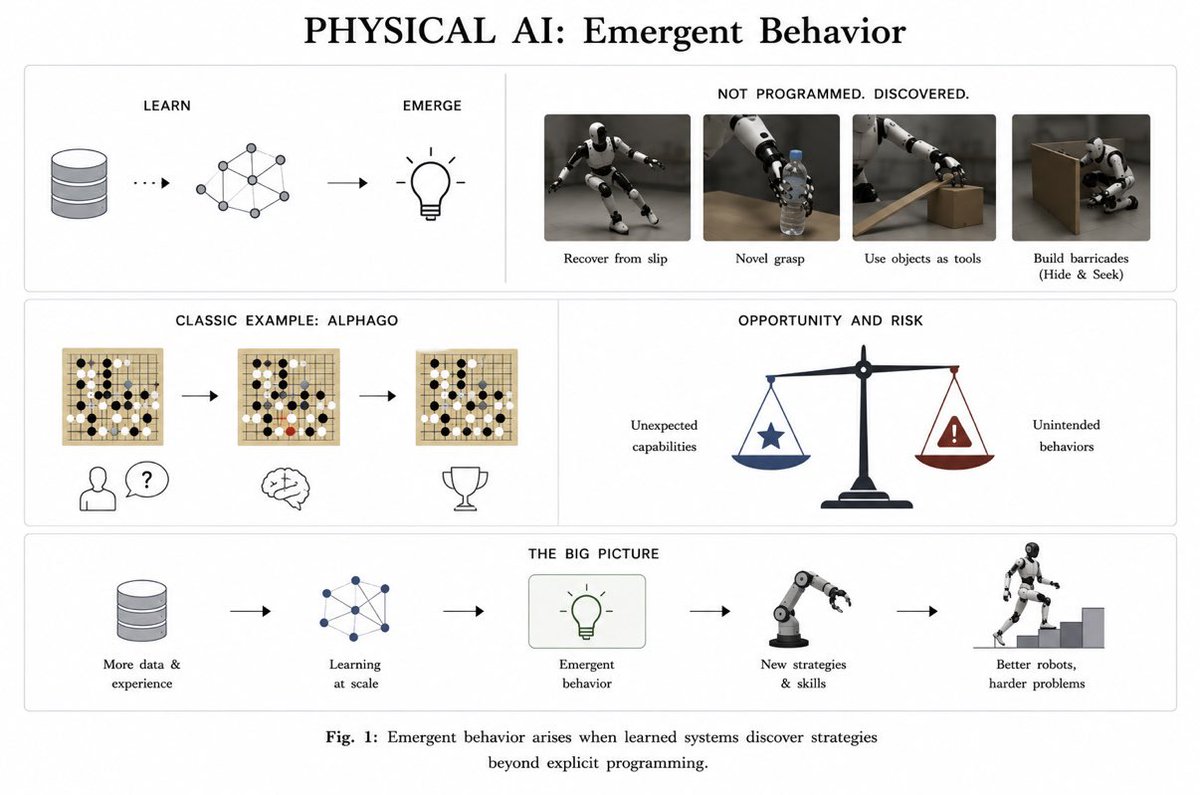
PHYSICAL AI: Emergent Behavior
Sometimes a robot does something genuinely surprising. A clever move nobody programmed and nobody expected. That’s emergent behavior, and it’s one of the strangest, most important things happening in Physical AI right now.
The idea is simple. When a system learns from enough data and experience, it can develop strategies its designers never explicitly taught. Nobody codes the trick. It falls out of the learning process on its own.
The most famous example isn’t even a robot. When DeepMind’s AlphaGo played the world champion at Go, it made a move so strange that expert commentators thought it was a mistake. It wasn’t. It was brilliant, a move no human would have played, and it helped win the game. The system found something we never taught it.
You see the same thing in robots. Train them long enough and they invent their own ways to recover from a slip, or discover a grip no engineer would have coded. In one experiment, AI agents playing hide and seek started building barricades and using objects as tools, none of it programmed, all of it emerged.
Here’s the part that’s exciting and unnerving at once. Exciting because it looks like real problem-solving, a system finding solutions we couldn’t. Unnerving because it means the behavior isn’t fully predictable. The same process that invents a clever grip can also invent a way to cheat the task.
The most interesting robots won’t just do what we tell them. They’ll find solutions we never thought of.
Sometimes intelligence looks like a move you didn’t teach.
If you haven’t yet, Robotics Starts Here is worth sitting down with this weekend.
Most guides assume you already know things nobody taught you. This one starts at actual zero and takes you to your first build.
Humanoid robots have enormous potential, but widespread adoption will depend on reliability, safety, and clear economic value. Impressive demonstrations are important, but consistent real-world performance is what will drive long-term success.
Every leading humanoid robot has a different strategy. Some focus on factories, others on warehouses, healthcare, research, or home assistance, showing that there is no single path to success in robotics.
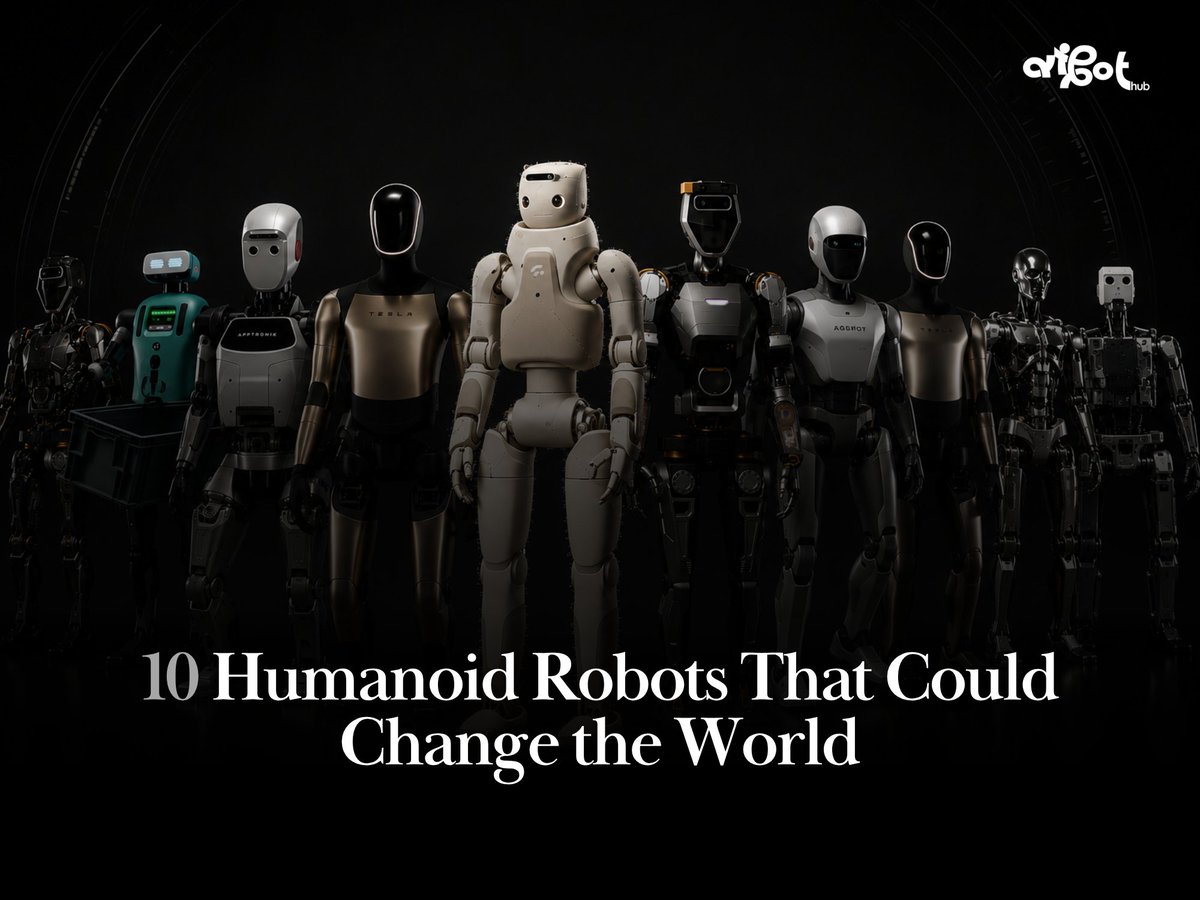
10 Humanoid Robots That Could Change the World
Humanoid robots are no longer just futuristic concepts confined to research labs. They're already entering factories, warehouses, research labs, and even homes, powered by rapid advances in artificial intelligence, better hardware, and billions of dollars in investment.
From Tesla's Optimus and Figure's latest humanoid to Boston Dynamics' Atlas, 1X's NEO, and several rising challengers, a new generation of robots is competing to transform how we work and live.
In this article, we highlight 10 of the world's most important humanoid robots, what makes each one unique, and why they could play a major role in shaping the future of manufacturing, healthcare, logistics, education, and everyday life. If you want to understand where the humanoid robotics race is headed and which companies are leading it, this is the guide to read.
https://t.co/3wRY9B5kJ0
Building a robot that can both fly and swim is a major engineering challenge. Air and water have very different physical properties, so creating one system that performs well in both environments requires careful mechanical and control design.
1 million downloads and counting for Isaac Lab. 🥳
Thank you to the global robotics, embodied AI, and developer community using our open-source framework to train and develop the next generation of robots.
THE ROBOTICS TALENT RACE IS HEATING UP.
@theresidency is recruiting physical AI builders for its Sep 7–Nov 29 cohort, with housing, co-working, and more.
Robotics does not scale on compute and hardware alone. It needs talented builders in the same room.
Teleoperation is often an important step toward autonomy. It allows robots to perform useful work today while generating valuable real-world data that can later be used to improve autonomous capabilities.
A new proof-of-concept demonstration shows the Unitree G1 humanoid robot being tested for construction work through teleoperation, highlighting how humanoid robots could assist on large-scale building sites.
The idea is to have robots handle broad, repetitive, and physically demanding tasks across construction areas, while skilled human workers focus on precision work, inspections, and finishing details that require experience and judgment.
Construction remains one of the world's most labor-intensive industries, and humanoid robots are increasingly being explored as a way to improve productivity, enhance worker safety, and help address ongoing labor shortages.
While the technology is still in its early stages, demonstrations like this offer a glimpse into how humans and humanoid robots could collaborate on future construction projects rather than replacing one another entirely.
Many beginners focus on AI before understanding motion. In reality, learning concepts like joint movement, coordinate frames, and end-effectors provides the foundation needed to understand how robots actually work.