This strategy is undefeated, & ensures your portfolio to outperform the S&P 500 year after year…
Buy Stocks when $VIX is $30.
Buy even more stocks when $VIX is $45+
Sell stocks when $VIX is $14.
& simply repeat the cycle!!
My friend just got RUGGED for 90% of his money when he tried to buy a coin.
Not by the actual token, but by an MEV.
He swapped $10,000 and only got back $1,000 in tokens.
Because his transaction wasn’t private, a bot on chain could see he was about to buy, bought before him, and sold after his buy.
This was because he used a DEX like Uniswap.
I highly recommend using BasedBot.
It protects you from getting Frontrun, it’s faster, cheaper and you get CASHBACK on EVERY TRADE.
Trading on Uniswap is the reason you LOSE.
Imagine you want to buy, and you have to do the SAME, BORING BS every single time:
connect a wallet then paste the token addy, then choose to swap ETH, then type amount, then confirm the signature, then confirm the swap and then wait.
Like bro, it’s not the 1900’s anymore.
BasedBot is simple.
Paste the CA, choose the amount you want to buy, DONE.
Try it out yourself, and thank me later.
https://t.co/pdvK4N1Ce3
If you missed Palantir at $20, Intel at $45 or Seagate at $95, you're not alone.
Each stock ran 500-700% in 12 months and most retail investors had no idea.
I went hunting for the next stock like these, and believe these 3 could go on a similar run:🧵
Every major tech company on Earth is now building a humanoid... pay attention.
$BOT is already up almost 2X from my post 2 days ago.
Follow the right traders on X and start preparing.
Let me explain in more detail...
$TSLA has Optimus.
Figure raised at $40B recently.
Apptronik is shipping Apollo.
1X has Neo.
Unitree is selling them on the internet for $16K.
China has Unitree, Xpeng, Xiaomi, BYD all in the race.
This is no longer a "maybe one day" technology.
It's a "who ships first and at what cost" race.
The math is what makes it nuts though...
Goldman thinks the humanoid market hits $38B by 2035.
Morgan Stanley says 1 billion humanoids by 2050.
Tesla says they could ship a million Optimus units a year by 2030.
Pick whichever number you want and the trade is still massive.
But here is the part that makes this different from every other "next big thing" theme...
Humanoids actually solve a real problem the world is screaming about.
We don't have enough workers.
The US has 8 million open jobs.
Japan is short 6 million workers by 2030.
China's working age population peaked 10 years ago and is falling fast.
Warehouses, factories, elder care, fast food, logistics, all of it needs labor that does not exist.
Humanoids walk straight into that gap.
And the second order trade is where the real money lives...
Just like NVDA created the AI trade and the suppliers compounded faster than NVDA itself...
Tesla and Figure are creating the humanoid trade and the suppliers are about to do the same thing.
Lidar. Vision chips. Precision motors. Actuators. Edge AI silicon. Batteries.
Start looking into these tickers, many of which we've already been talking about for months...
$AEVA
$ALNT
$AMBA
$AMBQ
$ARBE
$ATOM
$AUR
$CGNX
$HG
$INDI
$ISRG
$KITT
$KLIC
$LSCC
$MBLY
$MRAM
$NEO
$NOVT
$OUST
$RR
$SERV
$SYM
$VPG
$XPEV
$ZBRA
Every humanoid is basically a walking shopping list.
Most of these supplier names are small cap, ignored, and trading at AI 2022 valuations. Not AI 2026 valuations.
The repricing window is wide open.
And the people positioned in the suppliers now are going to look like geniuses 18 months from now IMO.
Will of course keep updating...
Stay tuned.
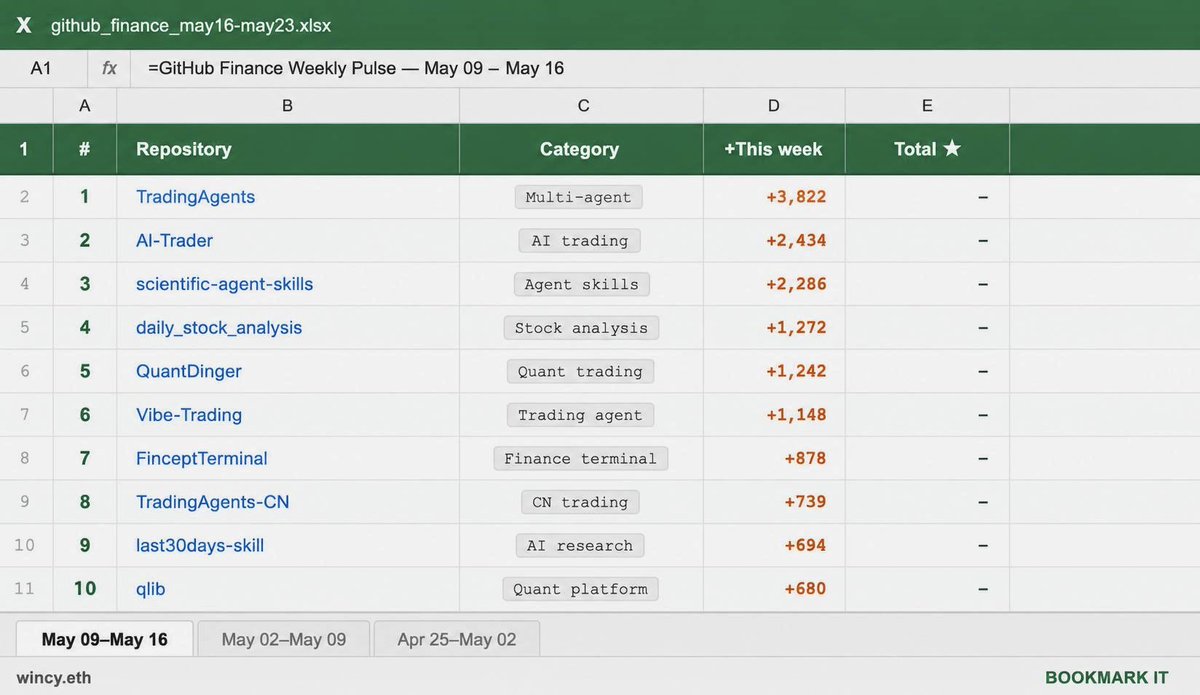
the fastest growing GitHub repos in finance this week:
1. TradingAgents (+3,822 ★)
multi-agent LLM trading framework built for financial research and execution. combines analyst agents, sentiment models, portfolio reasoning, and provider integrations into a single trading stack.
2. AI-Trader (+2,434 ★)
fully automated agent-native trading system. built around autonomous decision-making, price fetching, execution, and monitoring workflows. focused on end-to-end AI-driven trading infrastructure.
3. scientific-agent-skills (+2,286 ★)
plug-and-play agent skills for finance, research, science, engineering, and writing. integrates with multiple agent frameworks and supports web research, bioinformatics, cheminformatics, and analysis pipelines.
4. daily_stock_analysis (+1,272 ★)
LLM-powered stock analysis platform covering US, Hong Kong, and Chinese equities. combines market data, real-time news, AI dashboards, automated reporting, and multi-channel notifications with near-zero operating cost.
5. QuantDinger (+1,242 ★)
AI quantitative trading platform for crypto, stocks, and forex. includes live trading, strategy backtesting, market analytics, and broker integrations. built for traders experimenting with AI-assisted quant workflows.
6. Vibe-Trading (+1,148 ★)
personal AI trading agent focused on algorithmic trading and backtesting. combines lightweight automation with agent-style portfolio management and strategy experimentation.
7. FinceptTerminal (+878 ★)
modern open-source finance terminal inspired by Bloomberg-style workflows. provides market analytics, investment research, trading tools, and AI-powered financial infrastructure in one interface.
8. TradingAgents-CN (+739 ★)
Chinese-enhanced version of TradingAgents. adapts the multi-agent LLM trading framework for Chinese financial markets, datasets, and workflows. rapidly growing among Chinese quant and AI communities.
9. last30days-skill (+694 ★)
AI agent skill for researching trends across Reddit, X, YouTube, Hacker News, Polymarket, and the broader web. designed for signal discovery, narrative tracking, and internet-wide monitoring.
10. qlib (+680 ★)
Microsoft’s AI-oriented quant investment platform. covers the entire quant pipeline from data collection to alpha generation, portfolio construction, and execution. still one of the strongest open-source quant ecosystems available.
bookmark this and start today.
Karpathy just described what hiring looks like in 2026:
"Build a large project with Claude Code — like a Twitter clone. Make it secure. Have real agents using the platform doing stuff. The interviewer uses parallel agents trying to break in to verify security."
One person. Multiple agents. Shipping and defending production code simultaneously.
This is not a future job description.
This is happening right now.
The founders who get there first are not the smartest ones in the room. They are the ones who stopped doing everything themselves and built agents to do it for them.
Here is the complete playbook — 13 agents, exact prompts, 90-day build plan ↓
Read this before your competition does.
A regular American developer bought $1,400 worth and stacked seven Mac Minis on top of each other and connected them with metal cables.
Neighbors thought he was building a mining server. His wife thought he'd lost his mind. He just didn't want to pay $15,000 a month for a dev team.
On the screen - a diagram. Seven Mac Minis connected via Ethernet working as one machine. EXO framework distributes tasks between them automatically. 11.44 TFLOPS each. Together - more than most cloud servers that companies pay thousands for every month.
He paid $1,400 for the hardware once.
38 agents from GitHub, 156 skills. A system that learns from session to session and in two weeks writes code just like he does - but seven times faster because it runs on seven machines in parallel.
A task that took a junior dev 10-12 hours - the tower closes in 20 minutes.
One founder with this setup ships a product like a team of eight people.
For $20 a month instead of $120,000 a year.
This 7 Mac Mini setup helped him win the Anthropic hackathon and make $26,000 without a team.
HOW TO BUILD MOBILE APPS WITH AI IN 2026
1. Use Claude Code, Rork, Vibecode app etc to get the first mobile MVP live the same day the idea forms
2. Use Claude Code to tighten logic, handle edge cases, and make behavior predictable
3. Design the core interaction so it fits inside a 10-second screen recording from day one (this is key and is the new "lean startup")
4. Study top short-form videos in your category and write down the first 3 seconds of each
5. Build demos around the hook rather than the feature list (mindset shift)
6. Record simple demos straight from the simulator or device and post them as is
7. Treat short-form video as a live feedback channel (v important)
8. Test multiple hooks for the same app before touching the code
9. Watch where people pause, replay, or comment “wait what” to see what matters (in analytics)
10. Screenshot comments that explain the product clearly and reuse that language
11. Paste comments into Claude Code and ask it to cluster feedback into concrete product changes
12. Ship the smallest change that makes the demo clearer
13. Use Claude Code to push those changes fast and re-record the demo the same day (can be founder led or find someone or ai avatar)
14. Repeat this loop daily until the app explains itself without narration
15. Let the demo become the distribution engine. This is your north star.
16. Add a paywall once curiosity appears to test willingness to pay
17. Add a one-question or short quiz in onboarding to create investment early
18. Use quiz answers to personalize the first output so it feels made for the user
19. Show the result immediately after onboarding to reinforce that the input mattered
20. Surface one clear “this is why this matters” insight right after first use
21. Save the first output so users feel ownership and return to it
22. Ask for one small follow-up action after value appears to deepen commitment
23. Turn common onboarding answers into new demo angles for content
24. Highlight progress or change over time with a simple before-and-after view
25. Trigger reengagement when the output meaningfully changes
26. Let users export or share their result in a way that preserves context (and that helps drive virality)
27. Continuously improve onboarding copy with Claude Code based on what converts
28. Lock in the hook when people start explaining the app to each other
29. Increase posting volume after the format proves consistent. Keep experimenting
30. Shape the product around what performs on video
31. TLDR: Ship → demo → observe reactions → tighten the loop → charge → repeat until momentum compounds
32. PMF incoming (hopefully). Take dividends, reinvest in new apps (buy or build) or raise VC if you fancy that.
33. You just built a mobile app with AI.
Optics will likely follow memory in the AI supercycle
Here are some of the top optics stocks to consider for your portfolio:
— $COHR | Coherent – Makes the high-speed lasers and fiber-optic parts that move data between servers in cloud and AI data centers.
— $LITE | Lumentum – Supplies optical modules and lasers that big cloud providers use to upgrade their data-center and AI networks to higher-speed connections.
— $AAOI | Applied Optoelectronics – Builds fiber-optic modules that plug into servers and switches so hyperscalers can move data quickly inside modern data centers.
— $FN | Fabrinet – Contract manufacturer that assembles a large share of the industry’s advanced optical modules for major networking and AI customers.
— $CIEN | Ciena – Sells optical networking systems that carry huge amounts of traffic between data centers and across long-distance fiber networks.
— $MRVL | Marvell – Designs the chips that sit inside high-speed optical modules and switches, letting AI clusters communicate efficiently at massive scale.
— $GLW | Corning – Provides the fiber-optic cable and connectivity hardware that data centers and telecom operators use to build out high-bandwidth networks.
— $VIAV | Viavi Solutions – Makes optical components and test tools that network operators use to build, check, and maintain fast fiber-optic networks.
— $NOK | Nokia – Through its optical networking business, provides coherent optical systems and transport gear that boost capacity on fiber links between large data centers and across regions.
— $POET | POET Technologies – Microcap photonics company developing compact optical engines for high-speed links in AI and cloud data centers.
— $LWLG | Lightwave Logic – Early-stage company working on new electro-optic materials that could make future data-center optical links faster and more efficient.